 Casewell

Say your baby fed at six in the evening and has had several wet diapers since. The other parent is packing the car, the next feed may fall during the journey, and neither of you can remember whether the last bottle was finished. A tense exchange can start with an ordinary information gap.
Co parenting a newborn works better when you treat the handover as a transfer of care, not just a change of address. The receiving parent needs usable facts, the baby needs continuity, and neither parent needs an argument at the car door.
The Handover Record Every Newborn Needs
A clinical-style handover record is a short account of care, not a diagnosis or a case against the other parent. It should let the receiving parent answer what happened at the last feed, what's expected next, how the baby has slept, and what has changed.
Use a shared care summary for information both parents need. Keep your own dated account separately if you also need to document attendance, disagreements or departures from the plan.
Use the same fields at every exchange
The newborn-care guidance summarized by Missouri's Safe Sleep program supports responsive feeding, commonly around 8–12 feeds per 24 hours, alongside a consistent safe-sleep routine. A running count helps parents spot a change, but it doesn't replace feeding cues or the baby's individual medical instructions.
Newborn handover record fields
| Record field | What to write | Why it matters |
|---|---|---|
| Feeding method and last feed | Breast, expressed milk or formula; time and amount when measurable. | Shows whether the next feed may be due. |
| Feeds in the last 24 hours | Running count since the previous day's handover. | Helps both parents review feeding frequency alongside hunger cues. |
| Wet and dirty diapers | Count and time of each since the last handover. | Helps identify changes that may need assessment of intake. |
| Sleep | Start time, position, surface and location. | Records whether the agreed safe-sleep setup was used. |
| Medication and symptoms | Name, dose and time given; fever, breathing, feeding or lethargy changes. | Supports escalation decisions and helps prevent duplicate doses. |
| Next expected feed and instructions | Expected feeding time or cues and any pediatric instructions. | Prevents gaps between households. |
| Deviation from the agreed plan | What differed, when and the reason given. | Keeps the record factual and dated. |
Cradlo's guide to feeding logs for nannies offers a useful reference for organizing feeding details when another caregiver takes over. For the exchange itself, an exchange log template can help separate the planned handover from what occurred.
Write observations, not conclusions
Record that the baby turned away from the bottle and how much remained, rather than deciding that the other parent fed incorrectly. If an amount wasn't measurable, say so; don't estimate a breastfeed volume to fill an empty field.
Practical rule: Log the exchange immediately, while the details are fresh. Add a dated correction rather than overwriting the original entry.
How to Set Up the Shared Care Protocol
One written protocol, agreed before handovers begin, replaces memory and assumptions. It needs to be usable by a tired parent holding a crying baby, so keep instructions direct and put contact details where neither parent has to search.
The process starts with agreeing how care information will travel.
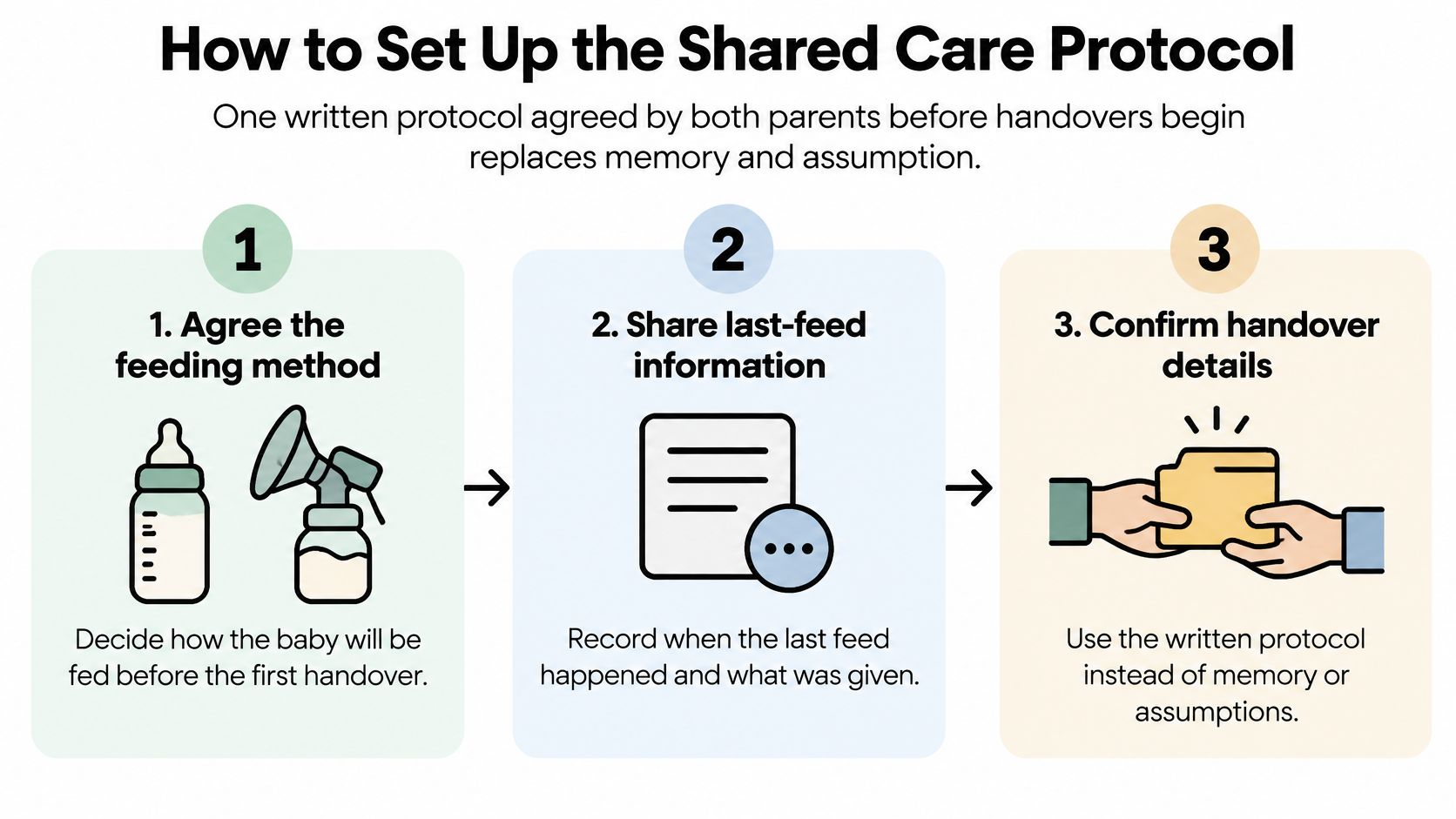
Agree the care tasks before the exchange
Agree the feeding method and information transfer. Specify direct breastfeeding, expressed milk, formula or the agreed combination, including who supplies feeds and how bottles are labeled with contents and preparation or expression details. State how the last-feed information reaches the receiving parent; the common slip is sending bottles without explaining which should be used next.
Write the safe-sleep rule. Specify a firm, flat, separate sleep space, back placement for every sleep and no bed-sharing in either home so fatigue doesn't lead to improvised arrangements. The common slip is treating an adult bed or sofa as acceptable because the nap will supposedly be short.
Get written escalation instructions. Ask the pediatric team to specify what requires urgent help, what requires a call and whom to contact for fever, breathing difficulty, poor feeding, unusual lethargy or clearly reduced wet diapers. Include the after-hours route and don't delay emergency care while seeking the other parent's agreement; the common slip is writing only “call if worried.”
Have both parents demonstrate hands-on care. Practice diapering, safe lifting, soothing, burping, temperature checks and bassinet setup, ideally with a pediatric nurse or clinic, so confidence is backed by practical ability. The common slip is accepting “I know how” without checking the technique or equipment.
Confirm the receiving home is ready. Check that the actual sleep space, supplies and feeding equipment reproduce the agreed standard before the baby arrives. The common slip is assuming that owning a bassinet means it's assembled, empty and ready for use.
Start the log and arrange a review. Use the agreed fields from the first exchange and bring unresolved care questions to the next pediatric visit, so the protocol changes with the baby rather than parental frustration. The common slip is creating a document that neither parent updates.
Separate care instructions from legal arrangements
A parenting plan template can hold the broader arrangements, while the newborn protocol carries the practical care instructions. Keep them consistent, but don't bury urgent feeding or medical information inside a long custody document.
Miles Hansford Law Firm's discussion of infant visitation schedules after divorce is useful context when parents need to consider visitation alongside newborn care. Legal arrangements and clinical care decisions serve different purposes: a schedule doesn't establish that equipment is ready or that a feeding plan is workable.
If you disagree about a care instruction, identify the exact question for the pediatric team. Asking whether the baby needs a particular feeding adjustment is more productive than asking a clinician to decide which parent is right.
Feeding and Milestones That Reshape the Schedule
At the first handover, the practical question is who will provide the next feed and what they'll need. Direct breastfeeding, expressed milk and formula create different preparation tasks, so name the method rather than writing only that the baby has been fed.
Use the feeding arrangement to plan the exchange, not the exchange to force a feeding change.
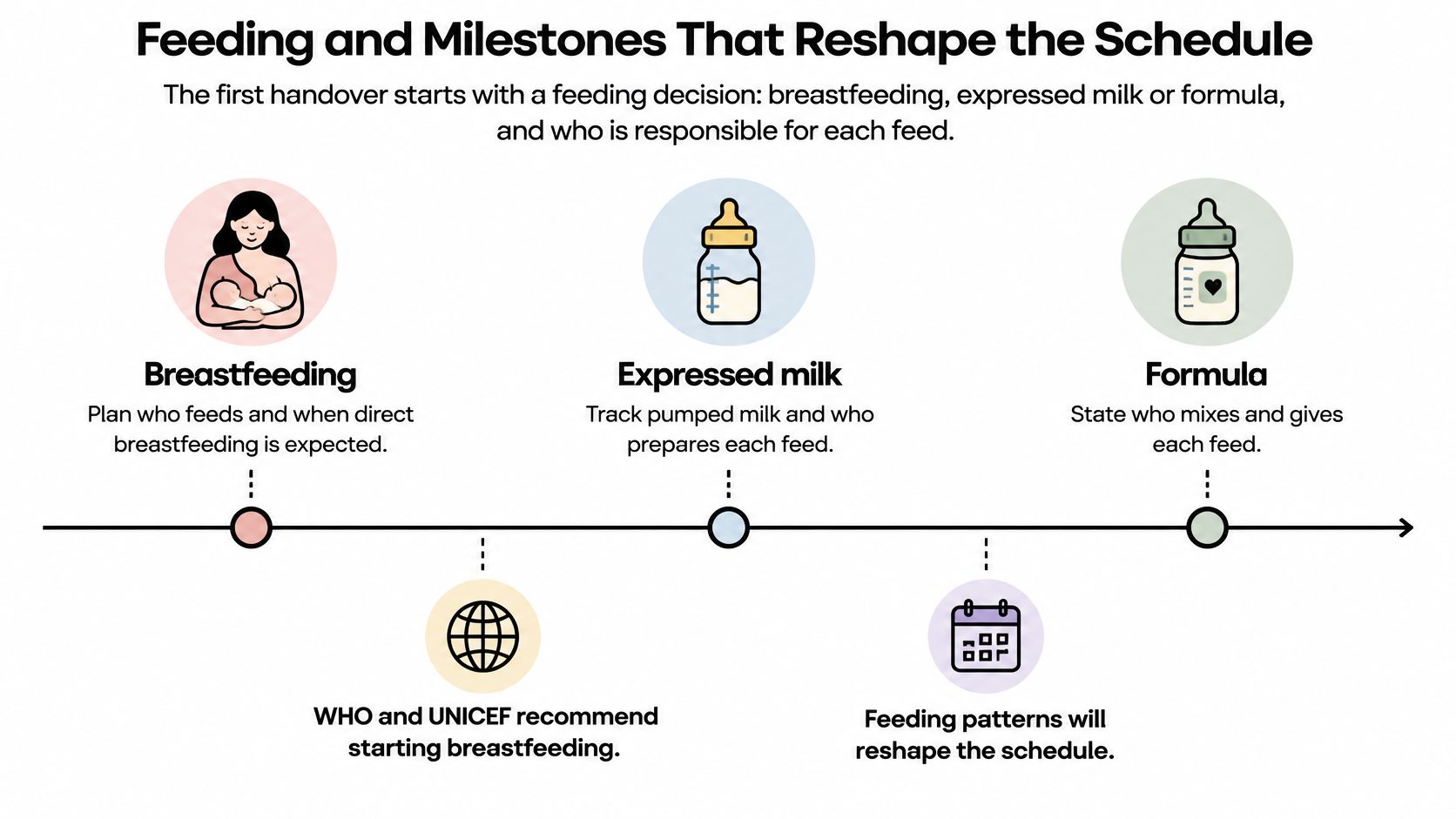
Treat milestones as review points
WHO's infant and young child feeding guidance sets out WHO and UNICEF recommendations to initiate breastfeeding within the first hour, provide only breast milk for the first six months, introduce safe complementary foods at six months, and continue breastfeeding to age two or beyond.
Newborn feeding milestones and what they change at handover
| Milestone | Guidance | What changes at handover |
|---|---|---|
| First hour after birth | Start breastfeeding. | Record whether feeding started and when. |
| 0 to 6 months | Breast milk only is the global recommendation. | Label expressed milk and any formula used under the baby's actual care plan, and log measurable volumes and times. |
| 6 months | Introduce safe, nutritionally adequate complementary foods. | Agree who prepares foods and which foods are used. |
| 6 months onward | Continue breastfeeding alongside complementary foods. | Keep feeding arrangements and handover timing aligned with breastfeeding needs. |
| Age 2 or beyond | Breastfeeding can continue. | Review the protocol again as feeding changes. |
These are feeding recommendations, not a custody timetable. A baby receiving formula or mixed feeds still needs an individualized, clearly documented plan without blame or pressure.
Make bottles traceable
For expressed milk and formula, record the date, time and volume, identify who prepared the feed, and label containers clearly. Follow the relevant storage and preparation instructions, and pass on enough information for the receiving parent to establish whether a feed can still be used safely.
Don't assume a bottle changes hands safely just because it feels cool. The receiving parent needs to know its handling history, including whether feeding has already started.
Feeding records should explain what the baby received, not grade either parent's commitment.
The video below can support discussion, but your pediatric team's instructions should resolve questions specific to your baby.
Record difficulties plainly: trouble latching, milk leaking during bottle-feeding, refusal or vomiting. Send feeding-method questions to the pediatric team rather than interpreting a difficult feed as proof that contact should expand or stop.
Safe Sleep Settings Both Homes Must Match
A CDC analysis of Illinois Pregnancy Risk Assessment Monitoring System data from 2016–2020 found that 19.3% of new mothers reported following all six assessed practices, including feeding and smoking measures, while 8.1% followed all four sleep-environment practices. Those are Illinois findings, not a prediction about either parent, but they show why a general promise to follow safe sleep isn't enough.
Both homes need an actual, usable setup. Buying similar equipment helps only if each parent uses it correctly when tired, interrupted or trying to settle the baby.
Compare the setup, not the parents
Geisinger's guidance on co-sleeping with infants describes the American Academy of Pediatrics recommendation for room-sharing without bed-sharing. Sharing a room and sharing a sleep surface aren't interchangeable arrangements.
Sleep settings and their safety status for newborns
| Sleep setting | Status under guidance | What to agree |
|---|---|---|
| Separate bassinet or crib in the parent's room | Recommended room-sharing arrangement. | Equivalent safe equipment, clear sleep space and back placement in both homes. |
| Parent's adult bed with the baby | Bed-sharing isn't recommended. | No bed-sharing, including after night feeds. |
| Couch, recliner or armchair | Unsafe for routine infant sleep. | Avoid these sleep locations; if a parent accidentally falls asleep holding the baby, transfer the baby when the parent wakes. |
| Inclined surface or loose bedding | Unsafe. | Use a flat, firm surface without pillows, soft objects or loose blankets. |
| Sleep position | Back sleeping for every sleep. | Apply the same rule to naps and nighttime sleep. |
| Smoke exposure | Avoid around the baby. | Agree smoking restrictions before care begins. |
The parents don't need identical brands of crib. They need to meet the same safety standard, with equipment used according to its instructions.
Respect family practices without negotiating away safety
A family may associate sleeping close with comfort, responsiveness or tradition. Acknowledge that meaning without treating an adult sleep surface as an equivalent alternative to the agreed infant sleep space.
A preferred lullaby, settling phrase or order of bedtime tasks is different from a hazardous sleep location. Parents can accommodate preferences when they don't undermine safety or medical instructions.
- Record the setting. Note the sleep surface, position, location and bedding you observed.
- Describe nighttime care. Record feeding-related waking and who handled settling, without inventing details about periods you didn't witness.
- Identify exposure. Document observed smoking or relevant substance concerns specifically, rather than using broad labels.
- Capture the exception. If exhaustion disrupted the plan, record what happened and the action taken to restore the safe setup.
A useful safety entry describes a condition and a response. An accusation describes a person.
Private documentation isn't a substitute for getting help when a baby faces immediate danger. Follow the clinical escalation instructions, and use the appropriate emergency route when urgent intervention is needed.
If a court order or parenting plan requires a communication platform, keep using it; private documentation can sit alongside that required channel. The final readiness test is concrete: can the receiving parent show the prepared sleep space, clear bedding area and intended position before the exchange?
Equal Time Versus Equitable Newborn Care
Treating an equal split as automatically fair from birth confuses adult symmetry with newborn care. Equal parenting time measures time; equitable newborn care asks whether parents are sharing responsibility in a way that meets the baby's needs and supports recovery.
A 2025 systematic review published in Marriage & Family Review identified only 13 relevant studies among 7,152 publications and found none examining infant sleep, co-parenting, parental relationship satisfaction and sleep arrangements together. That limited evidence doesn't justify presenting a universal newborn schedule as scientifically settled.
Count care, not just possession of time
Postpartum recovery, feeding frequency, medical complexity and the baby's ability to settle affect what's workable. The non-birthing parent can still take meaningful responsibility through feeding where appropriate, diapering, soothing, preparing supplies and supporting rest.
The American Academy of Pediatrics' message to fathers describes observations that newborns held skin-to-skin on a father's chest cried less, settled sooner and showed less agitation than babies placed in bassinets immediately after birth. Participation can begin with attentive care rather than waiting for longer separations.
Consider a hypothetical ninety-minute visit that starts around an expected feed. Under the agreed feeding plan, the visiting parent gives the feed, burps and settles the baby, then places the baby in the prepared sleep space before leaving.
That visit includes real caregiving, but it isn't a rule that every newborn should complete a feed-and-settle cycle within that time. If the baby needs something different, the adults adapt rather than rushing to finish a task before the visit ends.
Expand responsibility with demonstrated readiness
Use practical criteria when revising a co-parent schedule, rather than treating expansion as a reward or restriction as punishment.
- Begin predictably. Arrange manageable contact around the baby's current care needs.
- Check competence. Confirm both parents can carry out the feeding, settling and escalation instructions.
- Review actual care. Record start and end times, tasks completed and infant-focused reasons for changes.
- Adjust deliberately. Lengthen periods when care is consistent and the arrangement remains appropriate.
Temporary arrangements should remain reviewable. Neither a difficult visit nor a smooth visit should become a permanent conclusion about a parent's ability.
Keeping Conflict Out of Every Handover
A common handover conflict starts when a parent challenges a rule the other has already been following. Messages shift from what the baby needs to who is controlling, careless or unreasonable, while the immediate care question goes unanswered.
Agree on a written channel and a realistic response window before that happens. Keep routine messages focused on the baby, and make clear that urgent medical action won't wait for a reply.
Send each disagreement down the right path
| Type of disagreement | Appropriate route | What to record |
|---|---|---|
| Safety or symptoms | Follow the escalation instructions and seek pediatric or emergency help as appropriate. | Observations, advice received and action taken. |
| Care preferences | Use the agreed protocol while discussing a proposed change. | The request, response and any agreed revision. |
| Schedule or plan disputes | Seek mediation or legal guidance; use the court process where necessary. | The disputed arrangement and what actually occurred. |
Don't ask a pediatrician to settle a custody argument or a mediator to diagnose a feeding problem. Describe the issue accurately so the right professional can address it.
Keep the doorway conversation narrow
The handover should cover the baby's present condition, immediate needs and essential supplies. Save disagreements about earlier events for the written channel or an arranged discussion.
- Use observable wording. Write that a bottle was missing, not that the other parent wanted the visit to fail.
- Preserve corrections. Leave the original entry visible and add the corrected detail with its date.
- Attribute explanations. Distinguish the reason a parent gave from something you independently know.
- End circular exchanges. State the unresolved question and proposed next step rather than repeating accusations.
Strategies for high-conflict co-parenting are most useful when they reduce contact friction without withholding necessary care information. A private journal doesn't replace information the receiving parent needs to care safely for the baby.
Confirm One Protocol Before the Next Handover
The decision this week isn't whether you can settle every parenting disagreement. It's whether the next receiving parent will have the information, supplies and instructions needed to care for the baby without guessing.
Use a short readiness check before the exchange:
- Write the protocol. Keep the care fields, feeding method, sleep setup, escalation instructions and handover arrangements together.
- Agree changes in writing. Send the working version through your established channel and identify anything still unresolved.
- Record the exchange. Capture what happened, including missing information or a departure from the agreement.
Keep the record useful as care changes
Bring unresolved clinical questions to pediatric visits and revisit arrangements when feeding or sleep needs change. A protocol should support care, not become a document parents defend after it stops fitting the baby.
Casewell is a private custody journal for separated parents, available for iPhone and Android. Its parenting time log records scheduled care, changes, overnights and the time that took place; the journal remains your own record, and the other parent doesn't need to install, approve or join it.
A private account supports your documentation, while the shared care information still needs to reach the receiving parent. Before the next handover, confirm one workable protocol that both homes can follow.
Keep newborn handover notes, schedule changes, and relevant attachments together in a dated private record. Visit Casewell to document the care that took place while continuing to use your agreed communication channel.