

You've downloaded a parenting plan template, opened it, and found yourself staring at a long list of blank fields. The calendar looks manageable until you reach questions about holidays, transportation, medical decisions, missed exchanges, school events, and what happens when one parent stops following the agreed routine.
Two questions usually sit underneath the hesitation: Does every line really need an answer? And will a judge or mediator accept a fill-in-the-blanks document? The practical answer is that a template is a structured draft, not a one-size-fits-all contract or a legal verdict. Courts and mediators care far more about whether the plan explains how parenting will work than whether the document uses polished legal language.
Opening a Parenting Plan Template Without Overwhelm
At mediation, one parent may arrive with a parenting plan template filled with dates, times, and proposed procedures. The other may bring the same form with blank sections and margin notes such as, “We'll work this out later.” That difference matters because the unresolved items are usually the ones that create conflict after filing.
A mediator will not automatically reject an incomplete draft. The completed version, however, gives everyone something concrete to test against school schedules, work demands, transportation, and the child's routine. A blank field leaves the hardest practical question unanswered: what happens when the parents do not follow the expected plan?
Court forms increasingly treat parenting plans as working family-court documents rather than optional guidance. Florida's approved form states that a parenting plan is required in every case involving time-sharing with minor children and must address daily responsibilities, the time-sharing schedule, health care, school matters, and communication methods. The Florida's Supreme Court-approved parenting plan form shows the practical detail courts may require.
A template does not decide whether legal custody should be shared, whether one parent should have primary residential responsibility, or how the child's needs should shape the schedule. It gives parents a structure for recording those decisions so a judge, mediator, school, or caregiver can understand and follow them.
Practical rule: If a reasonable person could read a clause and still ask, “What happens next?”, the clause needs more detail.
Use Casewell's parenting plan templates as working documents, not forms to complete mechanically. Set up a workable schedule first, then record decision-making rules, exchanges, communication methods, expenses, conflict procedures, and review triggers. Add an operational layer that many templates omit: dated exchange records, a log of deviations from the schedule, and clear points for reviewing what no longer works.
Legal wording cannot fix a plan that fails to say who picks up the child, where the exchange occurs, how lateness is handled, or how a missed exchange is recorded. Put the school calendar, work schedules, travel details, and major expenses beside the template. Complete one decision at a time, and write each procedure so another person can apply it without asking the parents to negotiate the same issue again.
Core Sections Every Parenting Plan Template Must Cover
A court-ready parenting plan answers eight different questions. Don't treat them as interchangeable. A residential schedule tells you where the child stays, while a decision-making clause tells you who has authority to make important choices. A communication clause governs how parents exchange information, not how much parenting time either parent receives.
The overview of what a parenting plan covers can help you understand the distinction between these functions. When you complete the template, use the labels that appear in court forms and mediation materials so everyone is discussing the same issue.
The eight essential building blocks
Identifying information
List each parent, each child, relevant addresses, and the child's date of birth as the form requests. A red flag is a plan that uses informal labels such as “Mom's house” without identifying the people, residences, or children covered by the order.Legal custody and decision-making
State whether legal custody is joint or sole, then address education, medical care, religion, and extracurricular activities. “We'll decide together” is incomplete unless the plan explains how parents make a decision when discussion doesn't produce agreement.Physical custody and the residential schedule
Set out regular weeks, weekends, holidays, school breaks, vacations, birthdays, and special occasions. “Reasonable visitation” signals that the parents haven't settled the schedule and leaves the most important daily question open.Exchange logistics
Name the location, time, transportation responsibility, and waiting procedure for every routine transfer. A clause that says “the parents will exchange the child” is underspecified if it doesn't say who drives or where the handoff occurs.Communication protocols
Define communication between the parents, communication between each parent and the child during the other parent's time, and appropriate third-party contact. “Communicate as needed” gives no channel, response expectation, or boundary.Financial allocations beyond child support
Assign uncovered medical care, childcare, school costs, activities, clothing, travel, and reimbursement duties. “Share expenses fairly” creates a later argument unless the plan identifies categories, approval rules, documentation, and payment timing.Conflict resolution and dispute pathways
Establish the sequence for raising a concern, exchanging information, using mediation, and seeking court intervention. A plan without a dispute pathway forces parents to improvise when cooperation is already failing.Modification and review triggers
Explain when the parents will review the plan and how an agreed change becomes part of the written record. Without this section, informal changes accumulate until neither parent can reliably identify the current arrangement.
Washington's court materials illustrate why the schedule needs this level of precision. The residential schedule is designed to identify where the child resides each day, including holidays, birthdays, vacations, and special occasions. Washington's parenting plan form treats the calendar as a complete framework, not a broad statement of intent.
| Section | What It Covers | Common Mistake |
|---|---|---|
| Identifying information | Parents, children, addresses, and case details | Leaving names or residence information inconsistent |
| Legal decision-making | Education, health, religion, and activities | Confusing joint custody with automatic agreement |
| Residential schedule | Regular time, holidays, vacations, and breaks | Using “reasonable” or “flexible” without default dates |
| Exchange logistics | Location, transportation, timing, and delays | Failing to assign responsibility for driving |
| Communication | Parent-to-parent and parent-to-child contact | Relying on an undefined “as needed” standard |
| Financial allocations | Shared costs, approval, records, and reimbursement | Saying “split fairly” without mechanics |
| Conflict resolution | Discussion, mediation, and court procedures | Filing immediately without an agreed first step |
| Review and modification | Triggers, addenda, and version control | Changing the plan informally and losing the record |
The last three blocks are where many home-drafted plans fail under pressure. A calendar can look complete and still provide no answer when an exchange is missed, a reimbursement is disputed, or a work schedule changes.
Filling Out the Template Step by Step
Start with decision-making, then build the residential schedule around the child's school, activities, and realistic travel time. Don't begin by choosing the most equal-looking calendar. Begin with the routine both households can maintain.
Write decision rules that produce an outcome
A useful joint decision clause identifies the subject, the required consultation, the response period, and the next step if the parents disagree. For example:
“Parents shall share legal custody and make non-emergency decisions jointly after good-faith discussion. If unresolved after 48 hours, the matter proceeds to the dispute resolution clause.”
That is a proposed drafting example, not a universal legal requirement. Adapt it to the court's form and your circumstances. The important feature is that it doesn't stop at “joint decisions.” It tells both parents what happens after discussion fails.
For emergencies, separate immediate authority from later notification. A practical clause might say that the parent caring for the child may authorize emergency treatment, then must notify the other parent through the designated channel as soon as reasonably possible. Non-emergency proposals should be written, specific, and tied to a response window.
Turn the residential schedule into a calendar
A 2-2-3 schedule can be written as follows:
- Parent A has the child from Monday at school dismissal until Wednesday morning school drop-off.
- Parent B has the child from Wednesday morning until Friday morning school drop-off.
- The parents alternate the Friday-to-Monday weekend, with the weekend beginning at school dismissal and ending at school drop-off.
A week-on, week-off schedule needs the same precision:
- Parent A's week begins Monday at 18:00 and ends the following Monday at 18:00.
- Parent B's week follows immediately, using the same start and end time.
- If school is in session, the exchange occurs through school when possible. Otherwise, the named exchange location applies.
The exact arrangement must fit your child, distance between homes, school obligations, age, and parental availability. Oregon legislative materials emphasize that parenting-time decisions are highly case-specific and that no preset allocation fits all or even most families, while shared parenting may be appropriate when both parents agree or child-specific circumstances support it. The Oregon evidence review supports a customized approach rather than an automatic formula.
Draft holidays as exceptions to the regular schedule
Write holidays by name, start time, end time, and calendar-year rule. For example:
- Thanksgiving is with Parent A in even-numbered years and Parent B in odd-numbered years, from Wednesday at 18:00 until Sunday at 18:00.
- Winter break is divided into two defined blocks, with the first block assigned to Parent A in even-numbered years and Parent B in odd-numbered years.
- Mother's Day is with the mother from Saturday at 18:00 until Sunday at 18:00, regardless of the regular rotation.
- Father's Day follows the same rule for the father.
If a holiday conflicts with a school break, say which provision controls. Don't assume the answer is obvious.
Make communication measurable
Name the channel. Email or a designated co-parenting app is easier to organize than scattered texts and calls. A proposed clause could require responses within 24 hours for non-urgent matters and the same day for issues affecting the child's immediate care, while limiting messages to child-focused topics.
Specificity signals that the parents have negotiated the details. “Use email, respond within 24 hours, and include the child's name in the subject line” is operational. “Keep each other informed” is an aspiration.
For more drafting guidance, use this guide to writing a co-parenting agreement alongside the official form for your jurisdiction. A template becomes useful when another adult can follow it without asking either parent to interpret the missing parts.
Adding the Operational Layer Most Templates Miss
Most parenting plan templates are strongest on broad categories and weakest on implementation. They identify parenting time but don't always document the handoff. They mention shared expenses but don't explain how a parent requests reimbursement. They require cooperation but don't preserve a reliable record when cooperation breaks down.
The operational layer fixes that gap.
Specify each exchange
Write the exchange section as if a third party had to supervise it. Include the location, the person responsible for transportation, the precise time, and the procedure for delay.
A workable clause could identify the child's school parking area for weekday exchanges and a named public location for weekends. It could set a 15-minute grace window, require the delayed parent to notify the other through the agreed channel, and state whether the waiting parent leaves after that window or remains available for a defined period.
Use 24-hour time if that prevents confusion. “18:00 on Friday” is clearer than “Friday evening.” Also address school closures, sick days, public holidays, and a parent's inability to complete transportation.
Keep a deviation log
A deviation log isn't a weapon. It's a way to separate the written schedule from what happened. Record the facts promptly, without speculation or insults.
| Field | What to Record |
|---|---|
| Date | The calendar date of the exchange |
| Child | The child involved |
| Scheduled time | The time stated in the parenting plan |
| Actual time | The time the exchange occurred or was cancelled |
| Reason | The stated reason for the deviation, using neutral wording |
| Counter-signature | Confirmation by the other parent when available |
The log should also capture cancellations, replacement time, changes agreed in writing, and whether notice was provided. The Washington study of parenting plans found that 45% used a primary residential parent with an every-other-weekend schedule and one midweek evening, while nearly 1 in 5 had no specified residential schedule. The Washington parenting-plan study illustrates why leaving the schedule open for later negotiation creates avoidable uncertainty.
Add expense mechanics
Separate ordinary shared costs from extraordinary costs. Your plan can identify routine categories such as clothing, school fees, childcare, and agreed activities. For an extraordinary expense, require prior written consent above a stated threshold unless there is an emergency.
Then define the paperwork:
- The requesting parent sends the receipt and a short explanation through the designated written channel.
- The other parent responds within the agreed response window.
- Reimbursement occurs within 7 days of receiving the required documentation.
- The plan identifies the payment method and how disputed amounts are preserved for later resolution.
Tie decisions to a conflict ladder
A practical sequence is:
- The parent raising the issue sends a factual written proposal.
- The other parent responds within the stated period.
- The parents hold a focused discussion limited to the child-related issue.
- An unresolved matter proceeds to mediation or another agreed professional process.
- Court intervention remains the final step when earlier procedures fail or urgent protection is required.
This structure won't eliminate disagreement. It prevents every disagreement from becoming an unstructured emergency.
What Courts and Mediators Actually Expect
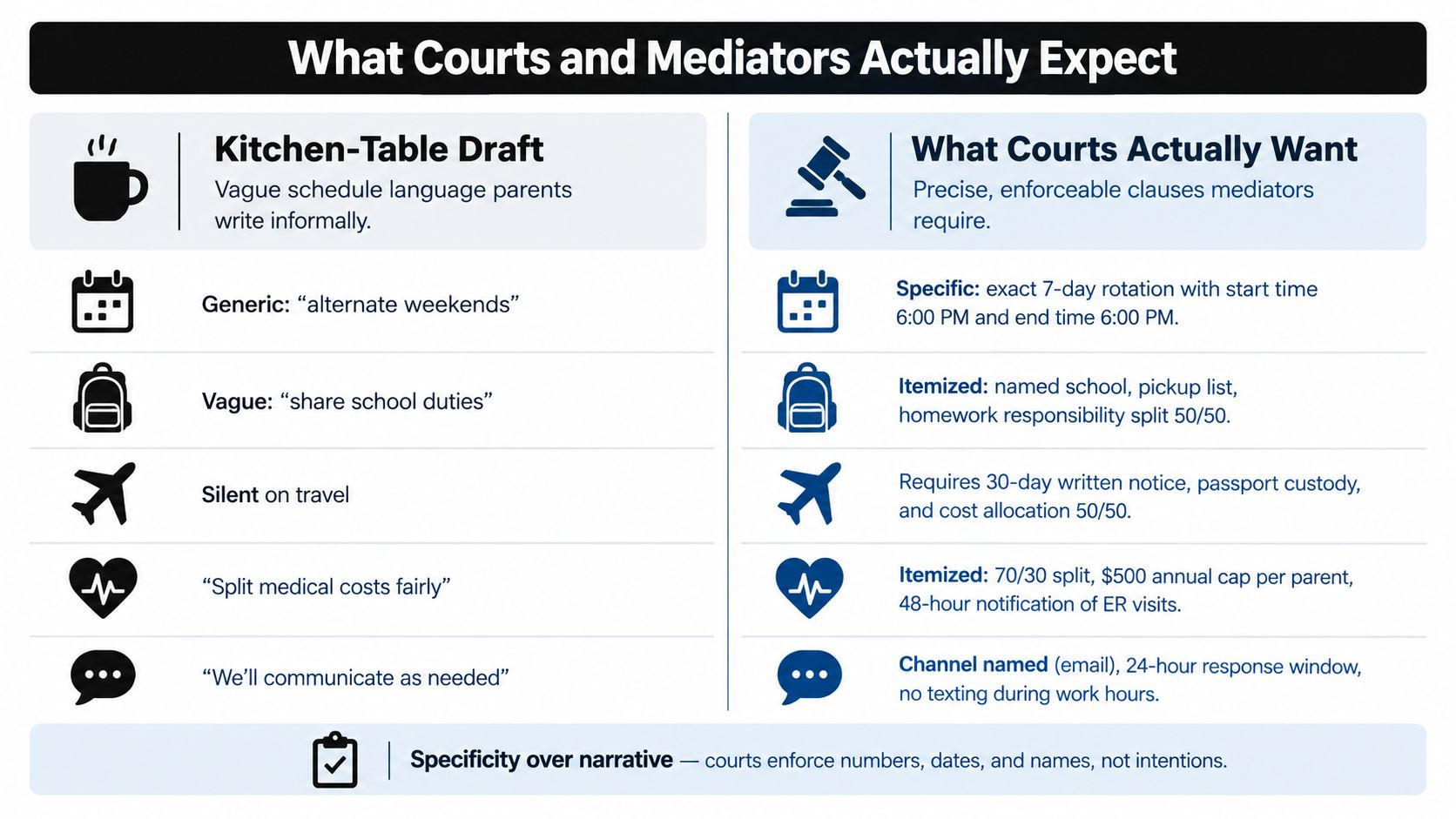
Parents drafting at the kitchen table often write what they mean. Courts and mediators need language that shows what will happen. Those are different standards.
| Kitchen-table draft | Professional version |
|---|---|
| “Alternate weekends” | A defined seven-day rotation with start and end times |
| “Share school duties” | Named school responsibilities, pickup authority, and homework procedures |
| “Travel will be discussed” | Written notice through a named channel, with required travel details |
| “Split medical costs fairly” | Defined categories, approval rules, records, and payment timing |
| “Communicate as needed” | A designated channel, response window, and subject boundaries |
Courts tend to value specificity over narrative. A long explanation about why both parents love the child doesn't replace a holiday schedule, a travel-notice procedure, or an exchange location. Mediators also look for emotional guardrails because parents must use the plan when they're frustrated, not only when they're cooperating.
Avoid clauses that sound reasonable but have no tied behavior. “Each parent shall act in the child's best interests” is a principle, not a procedure. “Each parent shall notify the other in writing about a non-emergency medical appointment and provide the appointment details through the agreed channel” gives the principle a concrete action.
Be cautious with unilateral authority. A parent may need authority during an emergency or during that parent's scheduled care, but major decisions often require a consultation process. Also avoid broad indemnity language that shifts ordinary costs or responsibility without explaining what the clause covers.
Professional wording usually contains four things: a person, an action, a deadline, and a record.
Four phrases often improve a draft when they accurately reflect the agreement:
- “Within 24 hours”
- “Written notice via email”
- “Return receipt”
- “Subject to review every 12 months”
These phrases don't make a clause enforceable by themselves. They make the obligation easier to identify and administer. A sentence that signals professionalism is: “The parents will follow the schedule as written, record any agreed deviation in the designated written channel, and review the arrangement when a stated trigger occurs.”
Review, Modification, and Keeping Records That Hold Up
The weakest part of many downloadable parenting plan templates is the absence of a real modification mechanism. Parents sign a schedule built for one school year, then work hours change, a child joins an activity, or exchanges become difficult. They make informal adjustments until the written plan no longer matches ordinary life.
The California Family Court Services Snapshot Study found that 57% of families made informal changes to the legal plan within the first year, while 76% of children primarily lived with one parent and only 4% maintained a strict 50/50 split. The California study is a strong reason to build review and documentation into the original plan instead of pretending the first version will remain unchanged.
Write review triggers into the plan
Use clear triggers such as:
- Every 12 months.
- At a significant school transition.
- After a move beyond the agreed geographic area.
- After a material change in either parent's work schedule.
- When the child's documented needs make the existing routine impractical.
An agreed change should become a dated addendum signed by both parents, with version numbering that begins at v1.0. Record what changed, when it takes effect, which provision it replaces, and whether the remaining provisions stay in force. If a court order controls the arrangement, confirm the local process before relying on an informal change as an enforceable modification.
Preserve a private, factual record
Keep medical and school documents in a shared folder or another agreed storage location. Use a dedicated email thread for parenting communications, reconcile reimbursed expenses on a regular quarterly schedule, and preserve receipts beside the transaction they support.
Neither parent should rely on text messages as the sole record. Export screenshots or relevant messages from the agreed channel monthly, retain the original files, and avoid editing the underlying evidence. The guide to custody modification records provides a useful framework for organizing dated events, agreements, and deviations without turning ordinary notes into emotional narratives.
A parenting plan that documents its own evolution is a living plan. It tells a mediator or court what the parents agreed to, what changed, when it changed, and whether the change was temporary or permanent. That record is far more useful than a perfect calendar that stopped matching reality.
Casewell offers a private custody journal for dated co-parenting records, including exchange check-ins, agreement-linked deviations, expense entries, attachments, and focused PDF reports for professional review. Use it to preserve the operational history behind your parenting plan, then visit Casewell to organize records before the next mediation, review, or modification discussion.