

You're sitting in a custody hearing with a signed parenting plan in your file. The other parent says you violated the new exchange schedule. You look at the signature page, then at the calendar, and notice the plan was signed on 15 March but says it becomes effective on 1 April. The disputed exchange happened in between.
That single distinction can change the question before the court. Was the new schedule already controlling, or were the parties still operating under the prior arrangement? The answer won't come from the fact that a PDF was signed. It will come from the agreement's wording, governing law, and the records showing what happened in sequence.
The practical rule is simple: identify every relevant date, preserve the language that gives each date its meaning, and keep evidence showing when each obligation began. This guide explains how to do that for custody arrangements, parenting plans, mediated settlements, and later amendments.
When the Calendar Becomes a Custody Question
A parent often discovers the problem when reviewing an old text message, exchange note, or expense receipt before mediation. The signed agreement is easy to find, but the timeline is not. One file shows the date the parents signed. A court filing shows a later approval date. A private calendar reflects the date the new parenting schedule was first followed. Each record may be accurate, yet each answers a different question.
Suppose the parenting plan says it is “effective as of 1 March,” but the second parent signs on 15 March. Or reverse the dates: both parents sign on 15 March, while the plan says the new exchange schedule begins on 1 April. A disagreement about a mid-March handover isn't resolved by choosing whichever date appears most prominently. The controlling clause matters.
Practical rule: Never record only “agreement signed.” Record when it was signed, when it says it becomes effective, what condition could delay it, and when the parties first acted under it.
This distinction matters because custody terms are operational. Parenting time, exchange locations, notice periods, expense-sharing duties, and communication requirements may all begin on different dates if the agreement says so. A later amendment can also change one part of the arrangement without replacing the entire history.
The question to keep asking is not merely, “What date is on the agreement?” It's “Which date governs this obligation, and what evidence proves that interpretation?” A clear chronology gives your lawyer, mediator, or judge something more useful than a stack of undated screenshots.
Defining the Effective Date of Agreement
The effective date of agreement is the contractual trigger for when the rights and duties described in the document begin. It may start parenting-time provisions, expense duties, notice requirements, confidentiality terms, deadlines, or other operative obligations. It isn't necessarily the date when the parties signed.
The execution date generally records when the required parties signed. The effective date may be the same day, a later calendar date, an earlier expressly agreed date, or a conditional event such as court approval. If the agreement doesn't specify an effective date, a commonly applied default is the date of the last required signature, but governing law and document type can change that result, as explained by Thomson Reuters' overview of executed contracts.
Think of a child enrolling in school before the first day of attendance. Enrollment shows that the arrangement has been accepted. The first day of attendance tells you when the daily schedule begins. In the same way, signing can show assent while the effective date determines when the custody schedule and related duties start running.
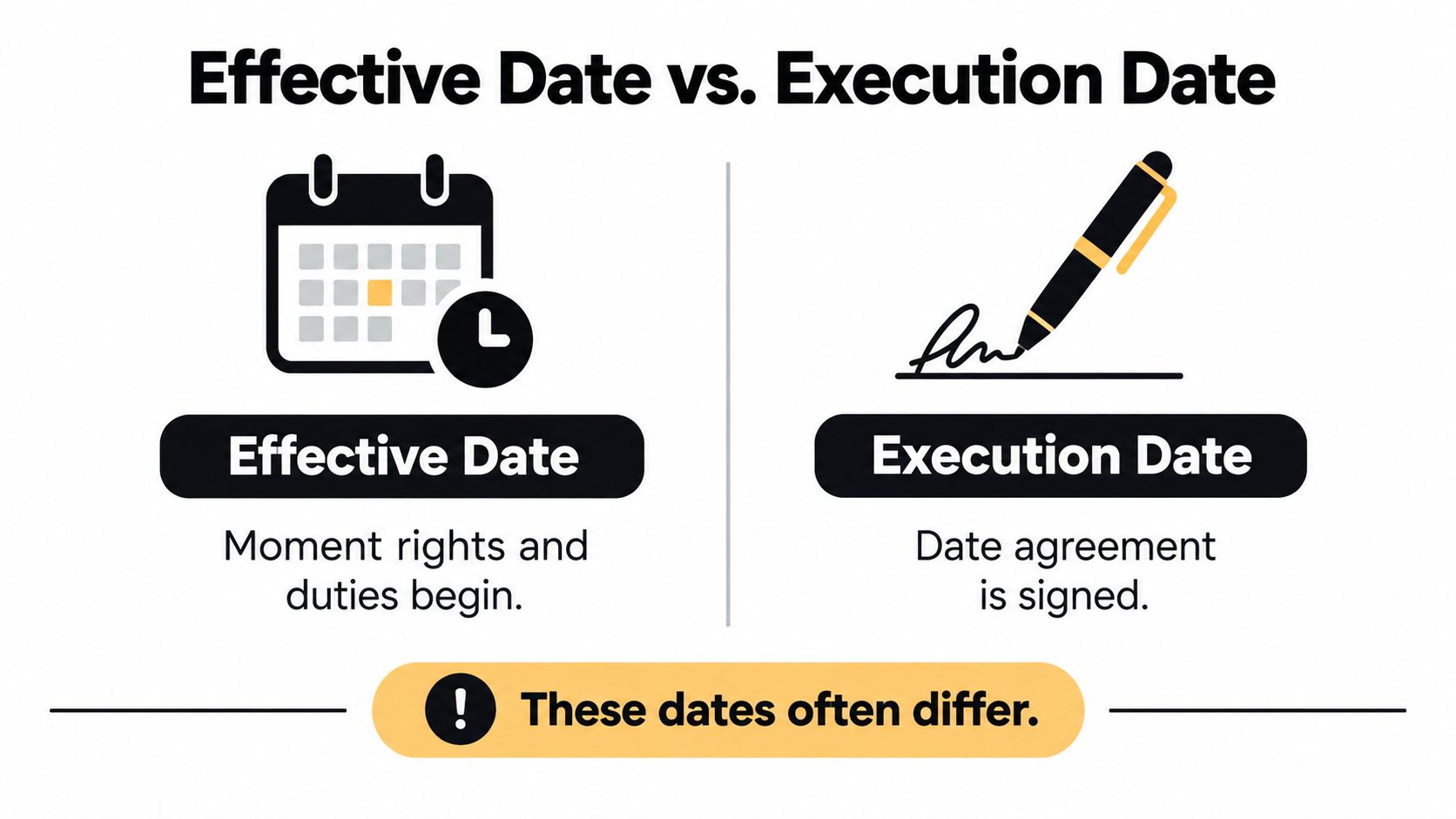
The two dates side by side
| Dimension | Execution Date | Effective Date |
|---|---|---|
| What it records | When the required parties signed | When the agreement's operative terms begin |
| Typical evidence | Signature block, signing certificate, audit trail | Effective-date clause, approval record, or stated commencement event |
| Custody relevance | Shows when assent was completed | Shows when parenting time, expenses, notices, or other duties begin |
| Can it differ from the other date? | Yes | Yes |
A signed parenting plan can therefore exist before its duties start. Conversely, an agreement can expressly apply to an earlier period, provided the wording and applicable law support that result. Read the clause that identifies the effective date, not just the signature page. For background on how a signed arrangement may interact with a formal family-law stipulation, see this explanation of stipulation and agreement.
Common Drafting Approaches in Custody Agreements
Custody agreements usually answer the effective-date question in one of several ways. The wording may be clear, indirect, or silent. Your first task is to locate the sentence that connects the agreement to a date or event.
Last required signature
Some agreements become effective when the last required person signs. This approach fits a document that is intended to operate immediately after both parents accept it. The signature sequence matters if the parents sign on different days, so preserve each timestamp rather than entering only the date that appears on the final PDF.
This approach is not automatically universal. Default rules vary by jurisdiction and document type. The LegalZoom explanation of effective-date rules notes that the U.S. Federal Acquisition Regulation uses the specified date or, if none is stated, the last signature date, but that rule shouldn't be treated as a global default for private custody or parenting agreements.
A stated future calendar date
A parenting plan may say that the new schedule begins on a named date, such as the first day of a new month or the first Sunday after a school break. Parties may choose this structure so children, schools, childcare providers, and both households have time to prepare.
The document might be signed earlier, but the new exchange rules don't begin until the stated date. A custody journal should therefore show both the signing event and the first day on which the new schedule governs. Don't compress those events into one “start date” field.
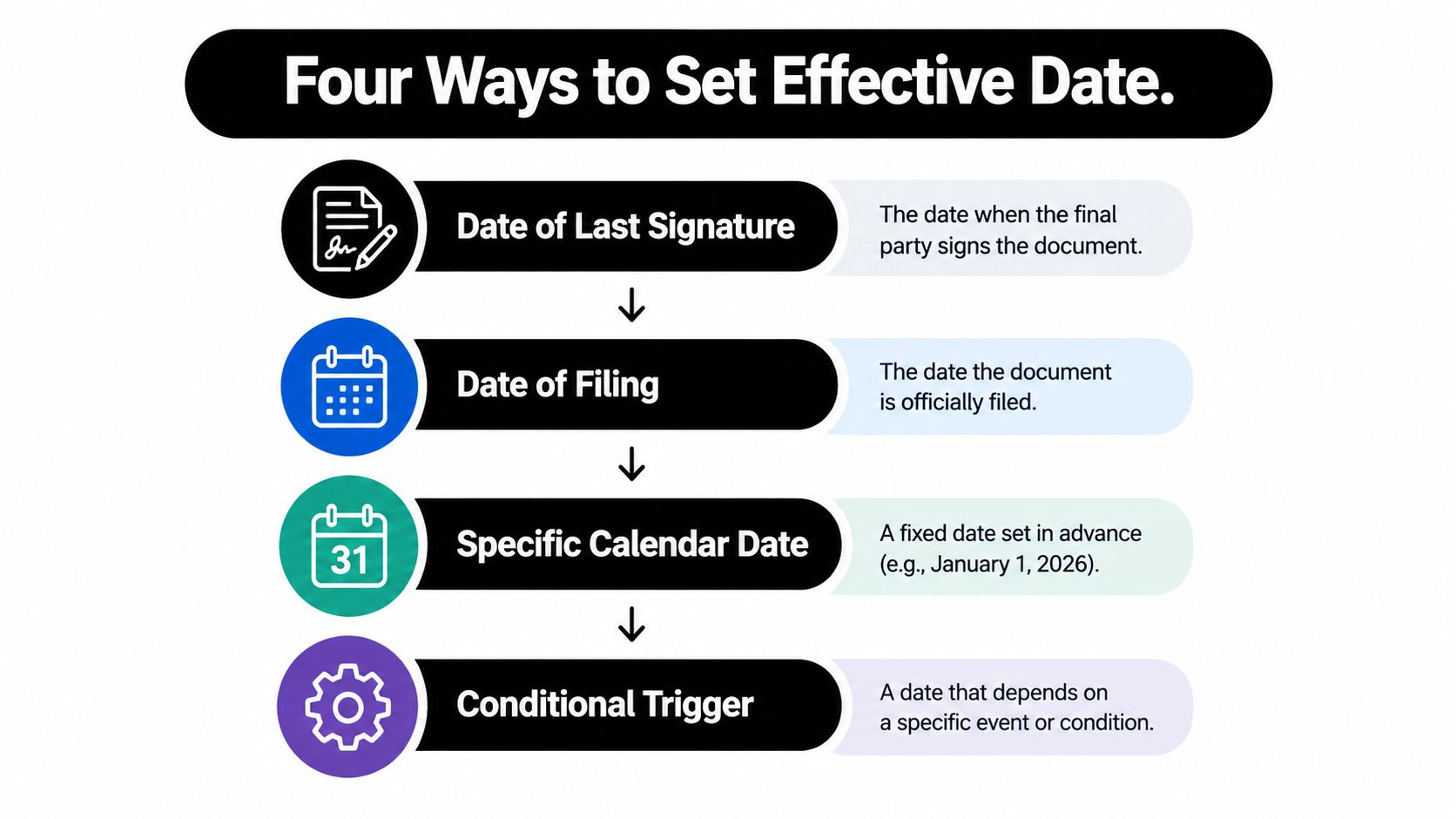
An earlier expressly agreed date
Parties sometimes write that an agreement is effective “as of” an earlier date. This can formalize an arrangement they had already been following informally, or set expense terms from an identified earlier period. The phrase must be read carefully. It may apply to the whole agreement, or only to a specific provision.
A retroactive clause doesn't erase the execution history. Keep the date the agreement was signed, the date it says it applies from, and evidence of what each parent did during the intervening period.
A conditional commencement
Some agreements don't become operative until a condition occurs. The condition might be court approval, an agency decision, completion of a required class, or another event named in the document. In that situation, signing alone doesn't establish the operative date.
Record the condition, the evidence showing when it was satisfied, and any separate order or approval. If the language is silent or ambiguous, ask counsel which event controls before assuming the schedule has changed.
Jurisdictional and Document-Type Variations
The effective date of a private parenting agreement depends on more than the date printed beside a signature. State law, the type of document, the agreement's governing-law clause, and any required court or agency action can all affect the analysis.
A private parenting plan, a mediated settlement, a filed stipulation, and a court-entered order may not follow identical timing rules. A document can be signed by both parents but still require judicial approval before a particular term becomes enforceable. Another agreement may state that it operates immediately upon the last signature.
Electronic records prove events, not every legal conclusion
In the United States, the federal E-SIGN Act became effective on October 1, 2000, and generally provides that a record or signature can't be denied legal effect, validity, or enforceability solely because it is electronic. It also allows an electronic record to satisfy a legal writing requirement, as described in the Illinois statutory text discussing electronic transactions.
That rule supports the legal relevance of electronic execution. It doesn't mean the timestamp beside a digital signature automatically becomes the agreement's effective date. The timestamp can prove when a person signed. The agreement must still identify when its obligations begin.
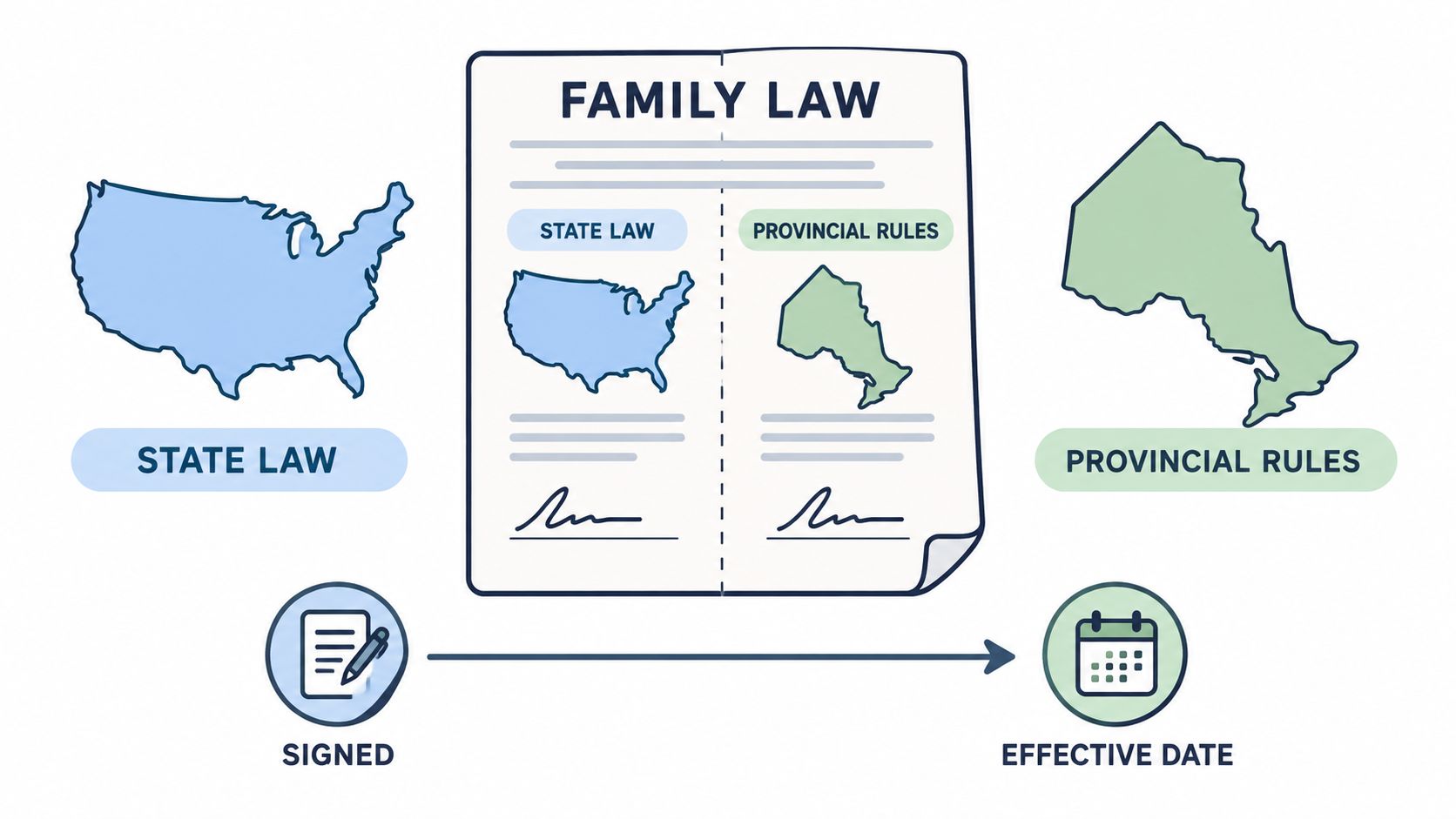
UNCITRAL's Model Law on Electronic Commerce also distinguishes between dispatch and receipt of electronic messages, while deliberately leaving the exact time of contract formation to applicable national law. That is why an electronic-signature workflow should preserve the event history without assuming that one timestamp answers every legal question.
For practical guidance on maintaining a dated, private record of co-parenting events, see this guide to recording co-parenting information.
Worked Examples in Custody and Parenting Plans
Examples make the distinction easier to apply. In each situation, separate the date the parties signed from the date the relevant duty began.
A parenting plan signed before its schedule starts
The parents sign a parenting plan on 15 March. The document says the revised exchange schedule is effective on 1 April. On 20 March, one parent misses an exchange required by the old schedule, and the other parent calls it a breach of the new plan.
The likely analysis begins with the clause, not the signature page. If the new plan becomes effective on 1 April and contains no earlier operative provision, the missed mid-March exchange should be assessed under the arrangement that governed before 1 April. The useful records would include the signed version, the effective-date language, the old schedule, the exchange note, and any evidence showing which arrangement the parents followed.
A signature proves that the parties accepted the document. It doesn't, by itself, move a future effective date backward.
A settlement that applies to an earlier period
The parents sign a mediated settlement after discussing unpaid child-related expenses. The settlement says its expense-sharing provision applies “as of” the date the matter was filed. The parties then dispute reimbursement requests for the prior month.
Here, the express retroactive language may make the earlier date the operative anchor for that provision. The analysis still requires precision. Did the “as of” language apply to all terms, or only expenses? Did the agreement require approval before that clause operated? Preserve the filing record, the final settlement, the signature sequence, the reimbursement requests, and any approval evidence.
For examples of how different parenting schedules can create different factual timelines, consult these custody schedule examples.
A stipulation awaiting judicial approval
The parents sign a stipulation in February. The document says it becomes effective only after judicial approval. The court enters the corresponding order in May. One parent argues that the February signature date controls a dispute about a spring exchange.
The conditional clause changes the analysis. If approval was a stated condition to effectiveness, May may be the operative date for the terms covered by that condition. The court order, docket history, signed stipulation, and records of exchanges before and after approval become central evidence.
These examples also show why “the agreement date” is too vague. A factfinder may need to identify the date for a particular obligation, not just select one date for the entire file.
Recording the Effective Date in Your Custody Journal and PDF Exports
A custody dispute may turn on two dates that look similar in a file. A parent signed a revised parenting plan on Monday, but the plan says the new schedule begins after court approval on Friday. Your journal should make that difference visible rather than compressing both events into one “agreement date.”
A useful custody journal, such as the Casewell custody journal, preserves chronology across each parenting plan, stipulation, order, and amendment. Create a separate agreement record, paste the exact effective-date clause into the notes, link the signed document, and record the execution date in its own field.
Add the events that test the timeline: each signature timestamp and time zone, delivery, approval, first performance under the agreement, and later amendments. If a parent first followed the new schedule during a particular exchange, record that as performance evidence. It does not replace the stated effective date.
A repeatable record-keeping workflow
- Name the document clearly. Label it as a parenting plan, mediated settlement, stipulation, order, or amendment.
- Copy the controlling language. Preserve the exact sentence that states the effective date or condition.
- Separate execution events. Record each signer, signing time, sequence, and delivery of the final version.
- Capture approvals. Attach the court or agency approval and record when its condition was satisfied.
- Link later conduct. Connect the first exchange, expense, notice, or other performance event to the agreement record.
- Preserve versions. Keep the original clause when an amendment changes a schedule or date. Show the replacement language beside it.
An electronic agreement record needs more than a rendered PDF. Retain the original electronic record, signer identity or authentication evidence, signing sequence, timestamps and time zone, the version presented for signature, the completion certificate or audit trail, and the text identifying the effective date, as described in federal electronic-signature recordkeeping guidance.
Fields to capture for an effective date
| Field | Why It Matters | Where It Appears |
|---|---|---|
| Effective-date clause | Identifies when covered duties begin | Agreement text |
| Execution date | Shows when signing was completed | Signature block or audit trail |
| Signature timestamps | Establishes signing sequence | Electronic certificate |
| Approval date | Shows when a condition was satisfied | Court or agency record |
| First performance date | Connects the document to actual conduct | Journal entry, exchange note, or receipt |
| Amendment relationship | Shows which version changed which term | Agreement register and attached file |
Casewell's focused PDF exports show the effective date, execution date, approval event, amendments, first performance, and source files supporting each entry. A professional can read the chronology without opening every attachment. Original notes and later edits remain visible, so the record distinguishes what was entered at the time from what was clarified later.
Common Misconceptions About Effective Dates
A signed PDF is automatically effective. Not always. A plan signed on 15 March may state that the new schedule begins on 1 April, so a dispute about a 20 March exchange requires the earlier arrangement and the agreement's clause to be examined.
An electronic-signature timestamp is the operative date. A timestamp shows when a signer completed an electronic action. It doesn't override a clause saying that the plan begins after approval or on a later calendar date.
Editing a journal entry changes when the agreement started. It doesn't. A later correction can improve the record, but it should preserve the original entry, the edit history, and the reason for the correction.
An amendment takes effect when it is signed. The amendment may state a different date or condition. An expense change signed on one day may apply from an earlier date, while a schedule change may wait for approval or a named start date.
The date on the signature page answers every custody question. It answers one question, when a person signed. It doesn't necessarily answer when parenting time changed, when reimbursements became due, or when notice duties began.
The safest habit is to label dates by function. Write execution date, effective date, approval date, first performance date, and amendment effective date rather than using one broad label such as “agreement date.”
Custody Date Checklist and Quick Answers
For every custody agreement, preserve this chronology:
- Effective-date clause: Copy the exact wording, including any “as of” language or condition.
- Execution record: Save every signature date, time, time zone, signer, and signing sequence.
- Approval evidence: Attach the order, filing, or other record showing when a required condition occurred.
- First performance: Record the first exchange, payment, notice, or other event carried out under the agreement.
- Amendment links: Connect each amendment to the version it changes and preserve both dates.
- Focused export: Show the execution date, effective date, approval date, first performance, edits, and attachments in chronological order.
Quick answers
How can I tell signing from effectiveness? Read the agreement's effective-date clause and compare it with the signature and approval records. The signature date proves execution; the clause or required condition identifies when the covered obligations begin.
Can an agreement have a retroactive effective date? It may, if the agreement expressly says so and applicable law permits it. Preserve the earlier date, the execution date, the reason for the retroactive language, and the records showing what happened during that period.
How do I prove an electronic-signature date later? Keep the original electronic record, audit trail, signer authentication, version presented, timestamps, time zone, delivery evidence, and effective-date text. A screenshot of a completed PDF alone may not show the full sequence.
Today, open your current parenting plan and create separate entries for its execution date, effective date, approval date if applicable, and first performance. If any date is missing or unclear, preserve the original file and ask your family-law attorney or mediator to interpret the wording before you rewrite your timeline.
Casewell helps you keep agreements, exchange notes, receipts, amendments, and supporting files in a dated private custody journal, then organize the chronology into focused PDF reports for professional review. Visit Casewell to create a clearer record of when each custody agreement was signed, became effective, and changed.