

Friday at pickup can look simple from the outside. One parent has the backpack, the other has the weekend bag, and the child is trying to remember whether the soccer cleats are in the trunk or still by the front door. Everyone thinks they understand the plan until the first holiday lands on “the wrong” weekend, a school event pops up on Sunday night, or one missed visit turns into an argument about make-up time.
That's why an alternating weekend custody schedule often feels easier on paper than in daily life. The repeating rhythm is straightforward. Real family calendars aren't. They include teacher conferences, birthday parties, travel delays, illness, and ordinary questions like who does pickup if Friday school ends early.

A lot of confusion starts with language. Parents may say “visitation,” “weekend time,” or “parenting time” and mean slightly different things. If you want a quick plain-English explanation of the term itself, this guide to what parenting time means helps ground the conversation before you start working through calendar details.
The schedule usually fits families who want one home to serve as the school-week base while the other parent has regular, predictable weekend time. That can work well when parents live farther apart, when one parent has a work schedule that makes weekday overnights hard, or when a child does better with one weekday routine.
Still, the weekend pattern is only the skeleton. parenting plan needs muscles and joints. It needs holiday rules, exchange times, transportation terms, and a clear answer to one common question: what happens if a weekend is missed?
Introduction to Alternating Weekend Custody in Real Life
The most familiar version starts on Friday evening and ends on Sunday evening. In some families, the return happens Monday morning at school instead. That small difference changes how the schedule feels in practice. A Sunday evening return can mean homework, baths, and school prep all happen in one rushed handoff. A Monday school drop-off can reduce direct contact between parents and give the child a calmer transition.
Why the simple version gets messy fast
A weekend rotation feels neat when you say it out loud: “every other weekend.” But a child doesn't live in a phrase. A child lives in a calendar.
Consider a common month:
- First weekend: everything goes as planned
- Second weekend: a holiday overrides the regular turn
- Third weekend: the child has a team event on Saturday morning
- Fourth weekend: one parent asks to swap because of work travel
None of those problems means the schedule is bad. They mean the schedule needs rules around it.
Practical rule: If a plan uses a repeating weekend pattern, write the exceptions with the same level of detail as the normal weekends.
Parents often get stuck on whether the arrangement is “fair” in the abstract. A better question is whether it's clear, workable, and steady for the child. A clear plan usually causes fewer conflicts than a vague plan that looked balanced at first.
What to picture as you read
It helps to think of this schedule as a reusable calendar frame, not a fixed script. The frame tells you which weekends belong to which parent. The rest of the plan answers questions the frame can't answer by itself:
- When does the weekend begin
- Where does the exchange happen
- Do holidays replace the normal pattern
- Is missed time made up automatically or only by agreement
- How do you keep the child connected during the long gap between weekends
Those are the questions that decide whether alternating weekends feel calm or constantly negotiable.
How an Alternating Weekend Custody Schedule Works
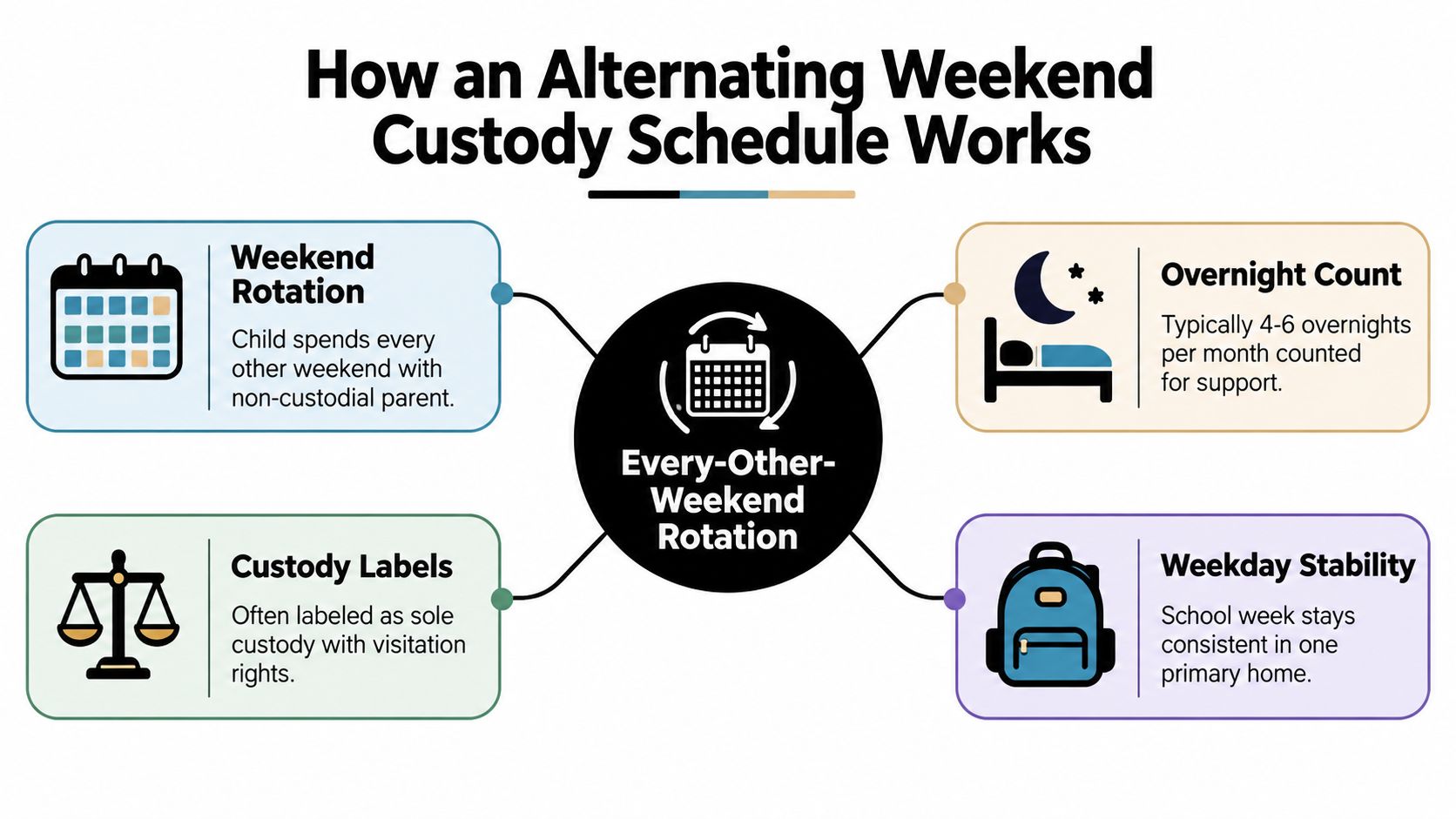
An alternating weekend custody schedule runs on a two-week loop. One parent has the child during one weekend, then the child stays with the other parent the next weekend, and the pattern keeps repeating.
The basic two-week rhythm
A train that stops at the same station every other Friday. If the pickup happens this Friday, it won't happen again next Friday. It will happen the Friday after that.
A standard version often looks like this:
- Week 1
- Monday through Friday with the primary weekday parent
- Friday evening through Sunday evening with the other parent
- Week 2
- Full week and weekend with the primary weekday parent
- Then the pattern repeats
That “off weekend” is what creates the long stretch between contacts. In many families, that's the hardest part emotionally, even when the overall pattern is easy to remember.
An alternating weekend schedule usually means one parent provides the school-week home base while the other parent has every other weekend.
How overnights are counted
Courts and calculators often look at overnights, not just daytime hours. In a common alternating-weekend arrangement, the child spends about 2 nights out of every 14 with the non-primary parent, which is roughly 14.3% of overnights. In practical terms, that works out to about 52 overnights per year for the visiting parent and about 313 overnights for the other parent, making it a classic “primary residence plus weekend contact” model, as explained in this 80/20 custody schedule overview.
That's one reason parents may hear different labels for what feels like the same schedule. Some people describe the pattern as 80/20. Others describe a common Friday-to-Sunday setup as 86/14, depending on how the counting method treats the Friday night and exchange day. The schedule itself may not change. The counting label does.
Why courts often treat it as a baseline pattern
This schedule is still widely used. In a 2026 study of 357 separated families who chose a named custody schedule, 36% selected a weekend-based pattern, and in a 2026 refresh of 619 cases, weekend-based schedules still led at 31.7%, ahead of alternating weeks and split-week patterns, according to schedule data collected by Split Day. That same source also cites a Florida judicial example showing 84 overnights, or 23%, for the parent with weekend time compared with 281 overnights, or 77%, for the other parent.
Because of that history, many forms and custody calculators still treat alternating weekends as a standard non-equal parenting arrangement rather than shared physical custody.
For a side-by-side look at where this pattern sits next to other common arrangements, this custody schedule comparison tool can help make the trade-offs easier to see.
Common Variants and Calendar Examples You Can Copy
A weekend schedule is rarely just one thing. Small changes in start time, end time, and weekday contact can completely change how the plan feels for the child and for both parents.
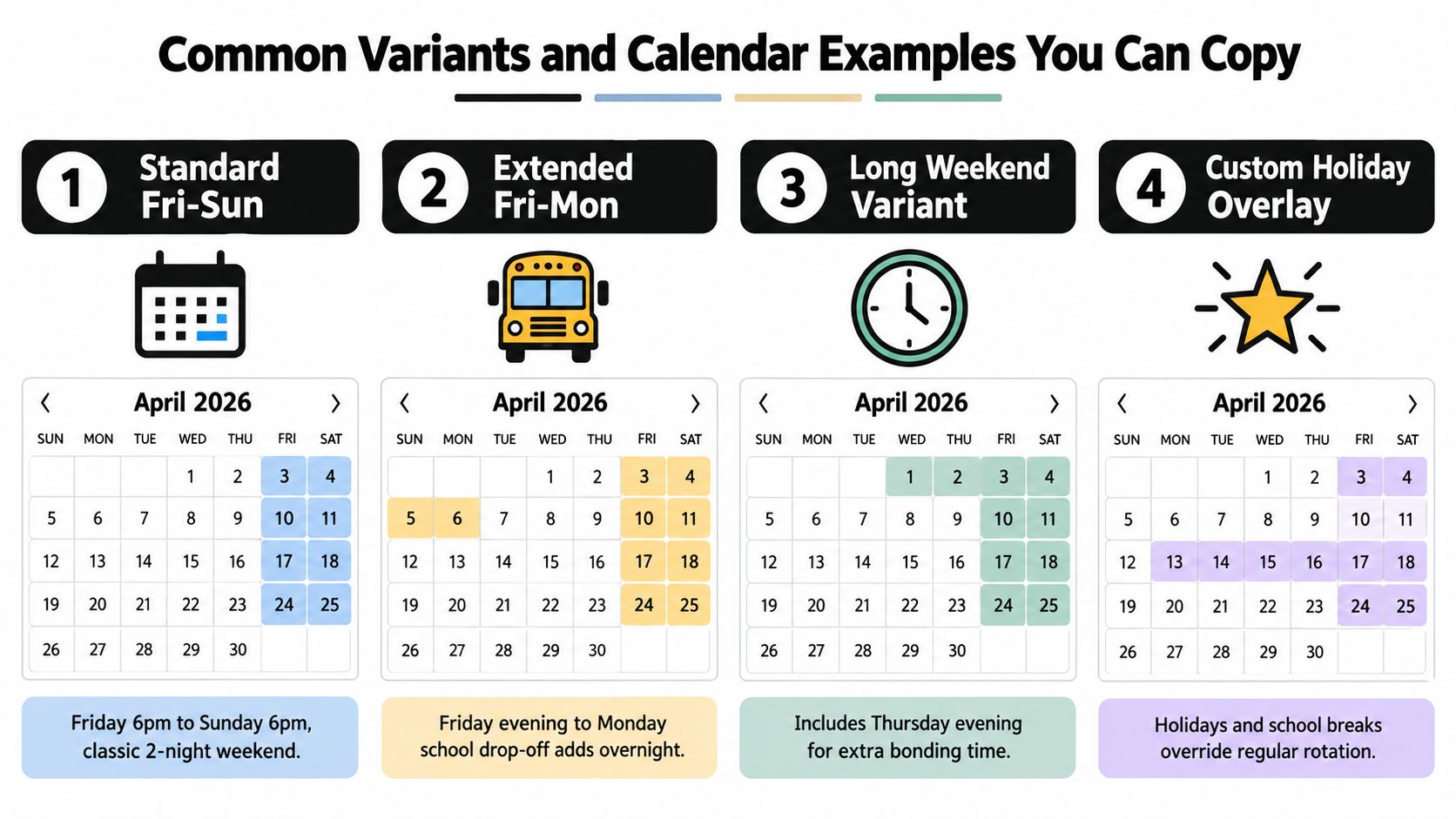
Four common versions
Here are four versions families often use as working models.
1. Standard Friday evening to Sunday evening
This is the cleanest version to explain and the easiest for many children to remember.
Week 1
- Mon: Parent A
- Tue: Parent A
- Wed: Parent A
- Thu: Parent A
- Fri day, Parent A. Fri night, Parent B
- Sat: Parent B
- Sun until evening: Parent B, then return to Parent A
Week 2
- Full week and weekend: Parent A
This version works well when parents want one school-week base and minimal exchanges.
2. Friday evening to Monday school drop-off
This version adds a school-night feel to the weekend. The child wakes up Monday in the weekend parent's home and goes directly to school from there.
Week 1
- Mon through Fri day: Parent A
- Fri night through Mon school drop-off: Parent B
Week 2
- Full week and weekend: Parent A
That Monday transition often lowers friction because the exchange happens through school, not face to face.
A broader set of custody schedule examples can help if you want to compare this with patterns that add more weekday time.
Variants that reduce the long gap
One of the biggest weaknesses of alternating weekends isn't only the overnight share. It's the interruption between contacts. A guide from Custody X Change on alternating weekends highlights how holidays, canceled weekends, make-up time, and the long break between visits often create more strain than the basic rotation itself.
That's why many families modify the frame instead of abandoning it.
3. Extended weekend plus midweek evening
Week 1
- Thu evening through Sun evening: Parent B
- Or Fri evening through Sun evening with a dinner visit in the off week
Week 2
- Midweek dinner or activity visit with Parent B
- Remaining time: Parent A
A midweek touchpoint can help the child stay connected in ordinary life, not just “weekend life.”
This walkthrough may help if you want to hear the timing discussed out loud:
4. First, third, and fifth weekend plan
Some parents don't use a strict every-other-weekend loop. They define weekends by position in the month.
Example:
- 1st weekend: Parent B
- 3rd weekend: Parent B
- 5th weekend: Parent B when it exists
- All other time: Parent A
This can be easier for some work schedules, but monthly calendars vary. A “fifth weekend” month can create uneven spacing, so the order needs to be written carefully.
Alternating Weekend Variants Compared
| Variant | Typical Time Window | Best For | Watch Out For |
|---|---|---|---|
| Standard Fri to Sun | Friday evening to Sunday evening | Families wanting a simple repeating pattern | Sunday return can feel rushed before school |
| Extended Fri to Mon | Friday evening to Monday school drop-off | Parents who want more settled time and less direct handoff | Monday logistics must be very specific |
| Weekend plus midweek contact | Standard weekend plus dinner, activity, or short visit in the off week | Children who struggle with long gaps | Vague midweek plans often turn into disputes |
| 1st 3rd 5th weekends | Assigned weekends by calendar position | Parents with rotating work calendars | Monthly spacing isn't always intuitive |
The decision matrix most parents need
If you're choosing among these versions, use a few plain questions:
- Distance matters: If parents live far apart, a school-night extension may be harder.
- School routine matters: If the child gets dysregulated by transitions, fewer exchanges may help.
- Work schedule matters: If one parent works weekends sometimes, a fixed position schedule may fit better.
- Connection matters: If the child struggles with long breaks, some midweek contact may matter more than the exact weekend model.
The key is simple. The weekend pattern gives you the bones. Your holiday and exception rules give it a working body.
Pros and Cons for Parents and Children
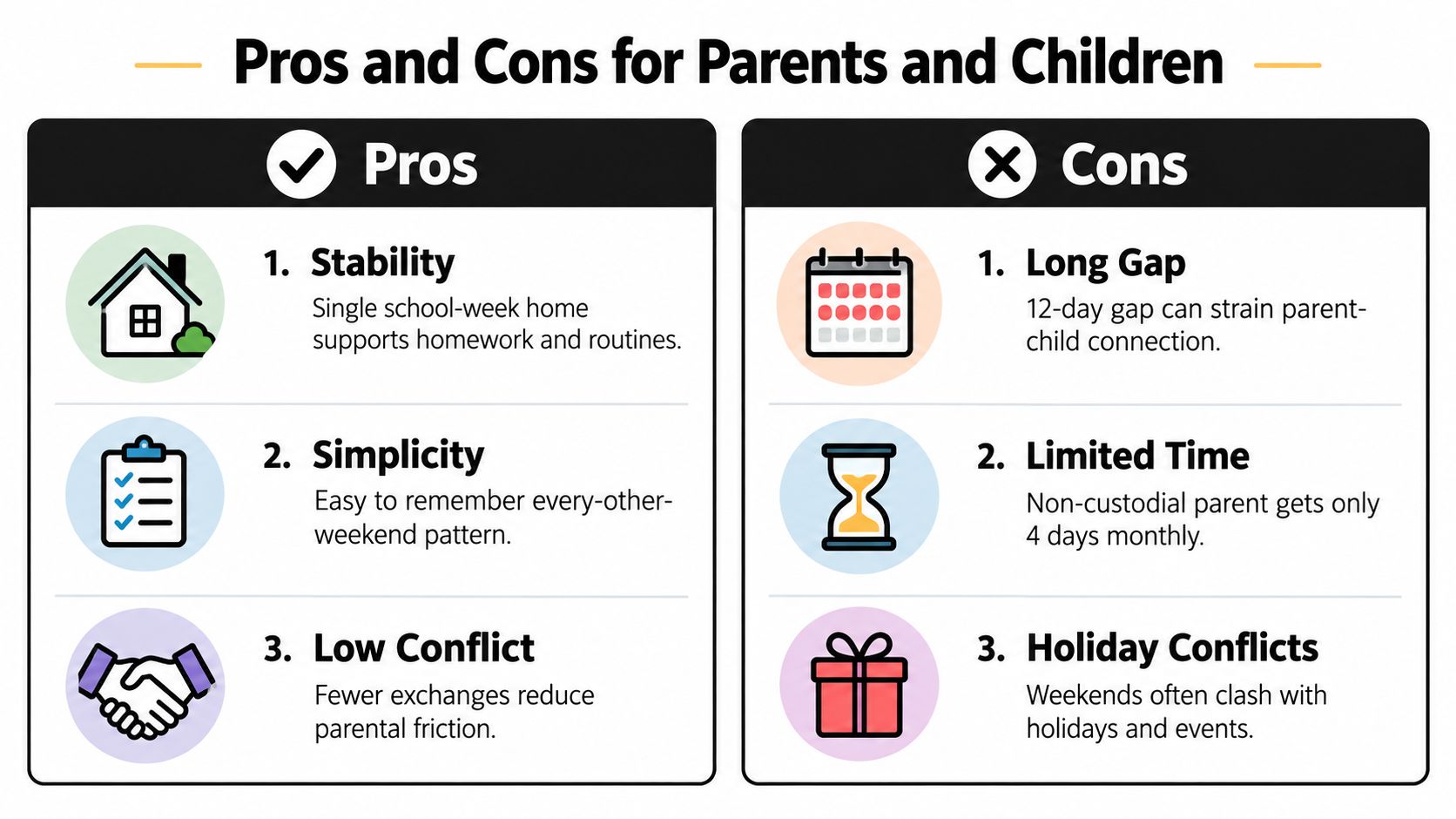
The main appeal of an alternating weekend custody schedule is stability. The main risk is distance in everyday life. Both can be true at the same time.
Where the schedule often works well
When one home serves as the weekday base, school mornings, homework, and bedtime routines usually stay in one place. Many children find that easier than switching homes frequently.
This schedule can also reduce handoffs. Fewer exchanges can mean fewer chances for parents to argue in front of the child. If conflict tends to flare during transitions, that matters.
Here's the short version of the upside:
- Routine stays anchored: One school-week home keeps books, clothes, and assignments in one place.
- The pattern is memorable: Most children can understand “this weekend yes, next weekend no.”
- Planning gets easier: Parents can often schedule work, childcare, and activities around a known rhythm.
Where the schedule can start to feel thin
The hardest part for many families is the long break between contacts. Guidance on alternating weekends notes that the structure commonly functions as an 80/20 or 70/30 parenting-time split and can leave a 12-day gap between weekends unless the plan includes midweek contact, which can weaken the child's day-to-day connection over time, as discussed in this alternating weekends explanation from Kidtime.
That gap affects more than feelings. It can make it harder for the weekend parent to stay involved in school events, sports practices, ordinary doctor visits, and the small weekday routines that help a parent feel present.
The question isn't only “How many weekends are there?” It's also “How does the child stay connected between them?”
Conflict changes the picture
No single custody timetable is automatically best for every child. A research synthesis on joint physical custody found that no one schedule is uniformly superior for child adjustment, but when parental conflict is high, shared-custody arrangements are more strongly associated with worse outcomes, and adolescents who feel caught between parents show higher risk of lower life satisfaction and depression, according to this Springer research chapter on child adjustment and custody.
That doesn't mean alternating weekends solve conflict by themselves. It means the quality of handoffs and communication can matter as much as the calendar.
A balanced way to assess the schedule is to ask:
- Does the child need one strong weekday base right now
- Can the non-primary parent stay involved without relying only on weekends
- Are exchanges calm enough that the plan won't keep reopening old fights
If the answer to the second or third question is no, the schedule may need added contact or tighter exchange rules.
Negotiating Holidays Exchanges and Conflict Scenarios
Most fights about alternating weekends don't start with the repeating weekend itself. They start where the plan is silent.
Holiday overrides
Holidays need an explicit rule that answers one basic question: does the holiday override the regular weekend rotation? If the plan doesn't say, each parent will usually assume a different answer.
A clean approach is to write the holiday schedule as its own layer above the regular calendar.
Sample language:
- Holiday priority: Listed holidays override the regular alternating weekend schedule.
- Return point: After the holiday ends, the child returns according to the normal rotation unless the plan says otherwise.
- Exchange detail: The holiday exchange time and location are stated separately from normal weekend pickup.
Example scenario: Parent B is scheduled for the weekend, but Thanksgiving is assigned to Parent A this year. If the order says holidays override weekends, there's no debate. If it doesn't, the same conflict can repeat every year.
Drafting note: If a holiday replaces a parent's only weekend that month, say whether make-up time is automatic, optional, or unavailable.
Missed weekends and make-up time
Many “simple” plans fail. Parents often agree on the weekend pattern but never write what happens when a visit is canceled because of illness, travel, weather, or a child's event.
Three common choices work better than vague promises:
- Automatic replacement: A missed weekend is replaced by the next available comparable weekend.
- Mutual written agreement only: Make-up time happens only if both parents agree in writing.
- No automatic make-up: Missed time is not replaced unless the order specifically provides for it.
Example scenario: A child gets sick Friday afternoon and the weekend is canceled. If your plan already defines whether that time is replaced, the discussion stays practical. If not, the disagreement often shifts from logistics to blame.
Exchange logistics that lower tension
Parents tend to write “Friday evening” when they should write the actual process.
Clear exchange language should identify:
- Time: exact pickup and return time
- Place: school, curbside, a public lot, or one parent's home
- Transportation: who drives which leg
- Delay rule: what counts as late, and how notice is given
- Child belongings: how medications, school items, and sports gear travel
Example scenario: One parent is late to pickup and sends no message. A useful plan doesn't just say “be on time.” It says what happens next. For example, a late parent must send notice as soon as practical, and if pickup can't happen, the fallback location or time is already defined.
Simple wording often works better than legal-sounding wording
Try short, operational phrases:
- The weekend begins Friday at school dismissal.
- If school is not in session, pickup is at 6:00 p.m.
- Holiday time overrides the regular weekend rotation.
- Canceled parenting time is made up only by written agreement.
- Each parent sends needed school and medical items with the child at exchange.
Parents don't need a poetic plan. They need one that answers ordinary calendar questions before those questions turn into repeated arguments.
Tracking and Documenting Exchanges With Casewell
Once the plan is written, daily life begins. That's when documentation matters. Not because every exchange will become a dispute, but because memory gets unreliable fast when weeks are busy and emotions are high.
What to record after each handoff
A simple log works best when it stays factual. Record what happened, not your full theory about why it happened.
Useful details include:
- Date and time
- Which child the exchange involved
- Where the exchange happened
- Whether it occurred as scheduled
- Any deviation from the plan
- Items exchanged, such as medication, homework, or sports gear
If something unusual happened, attach proof beside the note. That might be a screenshot of a schedule change, a photo of a returned item, or a receipt tied to transportation or child expenses.
How to keep the wording neutral
Neutral writing is more useful than emotional writing. “Pickup occurred at 6:24 p.m.; order states 6:00 p.m.” is more useful than “He was disrespectfully late again.”
That doesn't mean your frustration isn't real. It means the record is stronger when it separates fact from reaction.
A private documentation tool can make that easier. Casewell is a single-user custody journal that lets parents create structured entries with date, time, child, notes, attachments, agreement links, exchange check-ins, expense records, and focused PDF exports for professional review. If you want examples of how parents map repeating schedules and keep records tied to them, this guide to parenting time calendars is a practical next step.
Keep one habit: log the exchange the same day, while the details are still plain and specific.
A basic documentation routine
This routine is usually enough:
- Check the planned exchange the night before.
- Log what happened shortly after pickup or return.
- Attach support only if something differed from the agreement.
- Link the event back to the plan if the issue involved a holiday override, cancellation, or late exchange.
- Review patterns occasionally instead of trying to reconstruct months of events later.
That kind of record helps attorneys, mediators, and parents themselves stay grounded in sequence and detail.
Choosing and Making Your Alternating Weekend Plan Work
An alternating weekend custody schedule can work well when a child needs one steady school-week base and both parents want a pattern that's easy to remember. It tends to work less well when the long break between visits starts weakening ordinary parent-child connection or when the order leaves too much unsaid.
A practical final check looks like this:
- Choose the right variant: Standard weekend, extended weekend, or weekend plus some midweek contact.
- Write holiday rules clearly: Say whether holidays override the normal rotation.
- Decide missed-time policy now: Don't wait for the first canceled weekend.
- Define exchanges precisely: Time, place, transportation, and late-arrival notice.
- Create a record-keeping habit: Keep facts, attachments, and deviations organized.
The strongest plans usually aren't the ones with the most complicated math. They're the ones both parents can follow on a real calendar in a real month, including school breaks, sports, and the occasional disruption.
If you're weighing this schedule, focus less on labels and more on function. Ask whether your version supports routine, preserves connection, and reduces the need for repeated renegotiation.
If you're trying to make an alternating weekend plan workable in real life, Casewell gives you a private place to log exchanges, store screenshots and receipts, link events back to agreements, and export focused records when a lawyer or mediator needs the facts. It's built for personal documentation, which can be especially useful when weekend schedules start changing around holidays, missed time, or disputed handoffs.