 Casewell
guides to recordingspecific events
How to record missed handovers, late payments, denied parenting time and other events so each one is dated, factual and easy to find.

every guidepractical, step by step and free to read
how to document a missed handover factually
Document a missed handover with factual wording, evidence labels, a realistic annotated entry, and a chronology that preserves context.
Read guide 02Specific situationshow to document parenting time exchanges
Record parenting time exchanges with scheduled time, actual time, place, messages and issues so patterns are clear without emotional wording.
Read guide 03Specific situationswhat to look for in a custody exchange tracking app
How to choose a custody exchange tracking app that records scheduled time, actual time, messages, evidence and clean exports.
Read guide 04Specific situationshow to log denied or withheld visitation
Log denied or withheld visitation with the schedule source, proof made at the time, cancelled visits, make-up time and neutral wording for withholding.
Read guide 05Specific situationswhat happens when a parent misses visitation
What to do when the other parent doesn't show up for their parenting time: how to record no-shows, track the pattern, and keep the effect on your child factual.
Read guide 06Specific situationshow to document custody order violations
Document custody order violations by linking the order term, actual event, evidence, response, impact and professional-review question.
Read guide 07How courts decidehow to prove parenting time
How to prove parenting time actually exercised: the scheduled-vs-actual log, third-party corroboration from schools and activities, and how overnights get counted.
Read guide 08Specific situationshow to document late or missed child support payments
How to document late, missed or partial child support payments with due dates, amounts, proof and a running payment history.
Read guide 09Specific situationshow to track shared child expenses after divorce
A simple way to track shared child expenses after divorce with receipts, reimbursement status, messages and a clear running record.
Read guide 10Keeping a recordhow to keep useful records in high-conflict co-parenting
A selective high-conflict co-parenting record system focused on child impact, patterns, boundaries, safety and an organised chronology.
Read guide 11Keeping a recordhow to write a factual co-parenting incident report
Write a useful co-parenting incident report with a copyable template, event-versus-interpretation test and annotated factual rewrite.
Read guidequestions parents ask
Do I need a lawyer to use these?
No. Lots of Australian parents work through parenting arrangements without a lawyer. Good records let you describe what happened in your own words, whether or not someone represents you.
What does a family dispute resolution practitioner ask about?
FDR practitioners focus on your children's routines, changeovers and what's working or not. Bring a handful of dated, factual entries rather than a full diary, so the session stays on the issues.
Do I have to try family dispute resolution first?
Mostly, yes. Before applying for parenting orders you generally need a section 60I certificate. There are exceptions, such as family violence or urgency. Your records are useful on either path.
Where can I get free help?
Each state and territory has a Legal Aid commission, and Family Relationship Centres offer low-cost support. Take your records along so the appointment goes on your questions, not on piecing dates together.
keep the whole recordin one place
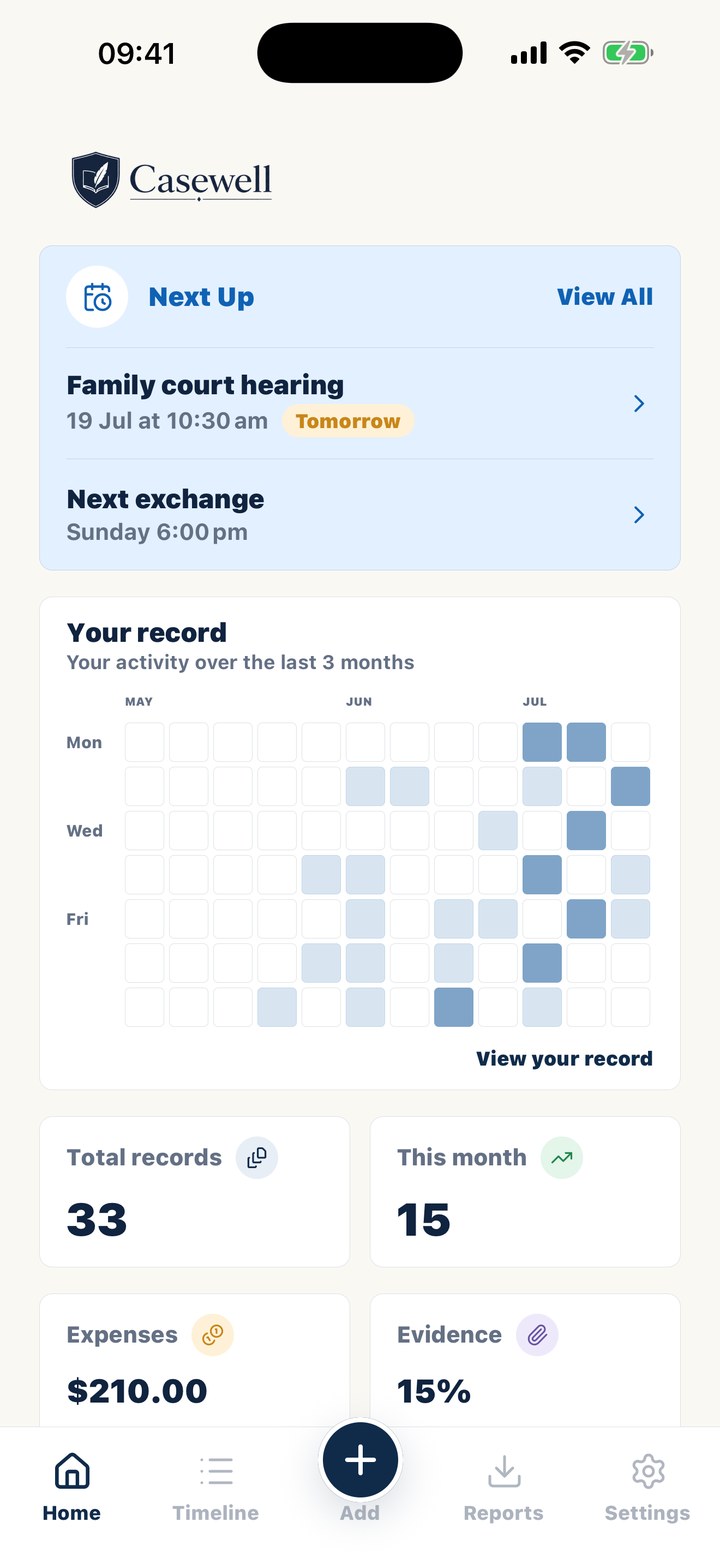
Casewell does it on your phone: dated notes, evidence attached, your court dates in view, and one clear PDF for your family lawyer.
Start free trial14 days free · Private by design