
A Tuesday in March, one parent pays $240 for spring soccer fees using the shared card. The registration confirmation arrives, so the parent takes a screenshot and texts the other parent, expecting repayment by Friday. The request seems straightforward, until three weeks pass and the other parent says the reimbursement never happened.
The bank statement shows a charge to the youth sports league, but it doesn't answer the questions that matter. Who paid the expense? Which parent owed the money? Was a reimbursement sent? If it was sent, did it reach the intended account? A payment tracking ID can provide the missing connection. It gives both parents, and potentially a mediator or court reviewer, a reference tied to one specific movement of money. That reference can sit beside the receipt, the expense entry, and the parenting-agreement provision that made the expense shareable. For background on how reimbursement records fit into a broader custody record, see this guide to what expense reimbursement means.
The Reimbursement You Can Neither Prove Nor Disprove
The conversation stalls because each parent has one part of the story. The paying parent has the soccer receipt and a bank charge. The other parent remembers discussing the fees but says no repayment appeared. Neither record identifies the exact transfer that would settle the disagreement.
A bank statement is useful, but it usually describes a transaction in broad terms. It may show a date, amount, merchant, and account activity. Those details can establish that money left an account, yet they may not show whether the payment addressed a particular custody expense or whether a later reimbursement was completed.
Practical rule: A receipt proves what the expense was. A payment tracking ID helps prove which transfer addressed it.
The missing detail is a unique identifier connected to the exact transfer. It isn't the amount, because many payments can have the same amount. It isn't the date, because several transactions may occur on the same day. It also isn't necessarily the name displayed in a payment app, because the visible name may identify an account or profile rather than the underlying bank record.
What the identifier adds
Suppose the parent sends the reimbursement and saves the confirmation screen. The custody record can then connect four separate facts:
- Expense: The soccer league charged the registration fee.
- Responsibility: The parenting agreement or expense arrangement required, or permitted, reimbursement.
- Payment: Money was sent through a particular payment rail.
- Reference: The transfer received a unique tracking ID that can be searched or requested later.
That chain changes the character of the discussion. Instead of asking, “Did you ever pay me?”, the parent can identify the transfer, the date it was initiated, the account involved, and the evidence attached to the expense. The tracking ID doesn't decide whether the expense was properly allocated, and it doesn't replace the receipt or agreement. It gives the payment event a stable label.
The same approach works when a parent requests reimbursement rather than sends it. The request should identify the expense, amount, supporting receipt, due context, and later payment status. If money moves, the tracking ID belongs in the record immediately, while the confirmation is still available.
What a Payment Tracking ID Actually Is
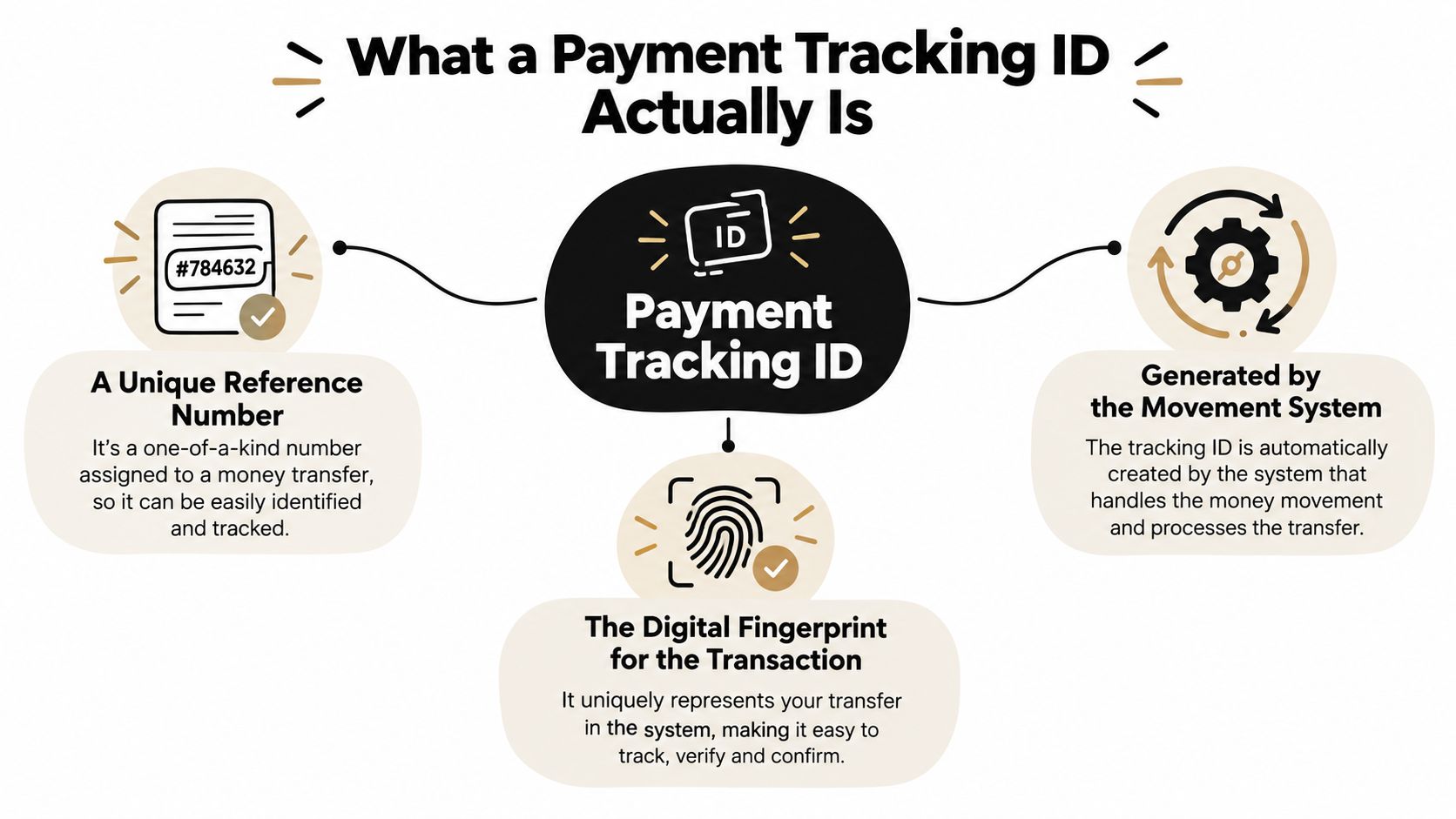
A payment tracking ID is a unique reference assigned to a particular transfer of money. The system handling the payment generates it, and the reference helps that system, the bank, or the payment provider locate the transaction later. In plain language, it's the receipt number on a payment's passport.
The amount and date describe the payment. The tracking ID distinguishes it from other payments. In a custody journal, that distinction matters because a parent may need to connect one transfer to one receipt, one reimbursement request, and one agreement entry long after the payment screen has disappeared.
The names you may encounter
Different systems use different labels. They aren't necessarily competing numbers. They can be different windows into the same movement of money.
- Transaction ID: The reference a banking app or payment platform displays to the user. It may be the easiest value to copy from a confirmation screen.
- Bank trace number: A bank's reference for locating a payment in its own records or within a payment network.
- ACH trace number: A 15-digit reference used for an automated clearing house entry. Its first eight digits map to the originating bank's routing number, and its final seven digits identify the originator's sequence, as described in this explanation of ACH transaction numbers.
- UETR: The Unique End-to-End Transaction Reference used for cross-border payment tracking. It is based on a 36-character UUID format and follows the payment instruction through the chain, according to the BIS report on harmonised ISO 20022 data requirements.
The modern standards work behind payment identifiers also matters. The W3C Payment Method Identifiers specification defines identifiers as URL-based or standardized values and explains how they can be validated and registered. That formal structure shows why a tracking ID is more than a casual receipt label. It belongs to a system designed to route, validate, and reference payments across connected services.
Why Different Payment Methods Produce Different Identifiers
The number shown on your screen may not be the number a bank representative searches first. That difference causes confusion during reimbursement disputes, especially when a parent saves only a screenshot of an app confirmation and assumes it contains every reference needed to investigate the transfer.
A payment moves through a particular rail. Each rail can create or expose its own identifiers at different stages. A consumer-facing app may show a short transaction reference, while the bank or network retains a deeper trace. For card payments, the visible transaction reference may not be the same as the card-network trace used during an investigation. Guidance on transaction IDs and card references, including the role of an ARN in some card workflows, appears in Stripe's explanation of transaction IDs.
The important distinction
For an ACH reimbursement, the app may show a confirmation or transaction ID, while the underlying entry has a 15-digit trace number. The trace number can help the banks locate the exact clearing record, rather than relying on a payer name, amount, or date that may appear in multiple records.
For an international payment, the UETR is the end-to-end reference that can remain associated with the instruction as it passes through correspondent banks. A domestic bank reference may still matter, but a parent handling a cross-border reimbursement should preserve both values when both are available. The practical reason is simple: different institutions may search different systems.
Instant-payment systems also use structured payment-identification elements. The identifier may be created and displayed differently from an ACH or wire reference, so the parent should save the confirmation supplied by the sending service and ask the bank which reference it needs if the transfer becomes disputed.
| Payment rail | Identifier shown to user | Identifier banks search on |
|---|---|---|
| ACH transfer | App confirmation, transaction ID, or bank receipt reference | The ACH trace number and related payment details |
| Bank-based person-to-person transfer | Provider confirmation or transaction reference | The provider record and underlying bank or network reference |
| Card payment | App receipt, authorization detail, or transaction ID | Card-network or processor references, which may include a separate trace |
| Instant payment | Confirmation reference supplied by the sending service | The end-to-end payment record and rail-specific reference |
| SWIFT cross-border payment | Bank confirmation and customer-facing reference | The UETR, plus relevant bank references |
The table's main lesson is not to guess which number matters. Save every reference the payment service provides, then identify the one the bank or provider needs for a status inquiry.
Recording the Tracking ID in Your Custody Journal
The best time to record a payment tracking ID is immediately after selecting Send, Transfer, or Submit. Waiting until a reimbursement becomes disputed creates avoidable work because confirmation screens can refresh, email receipts can be buried, and some apps show fewer details after the transaction leaves the active screen.
Start with the expense entry, not a blank note. Identify the child, expense category, amount, payment date, and parent responsible for the reimbursement. Then attach the receipt or registration confirmation so the payment reference won't float separately from the event it is meant to document.
A repeatable capture process
- Complete the payment: Use the intended account or payment method and wait for the confirmation screen.
- Preserve the confirmation: Take a screenshot before closing or refreshing the app. Keep the date, amount, recipient, and visible reference in the image.
- Copy the identifier: If the screen offers a copy button, paste the transaction ID into the journal field labeled Bank Reference or an equivalent field.
- Connect the evidence: Attach the receipt, link the entry to the relevant agreement clause, and note the receiving account details that are appropriate for your private record.
A screenshot alone isn't enough if the reference is too small to read or the recipient is unclear. Review the image while the payment is still open. If the app displays more than one identifier, record each one with its label instead of combining them into a single unexplained string.
Details that prevent later confusion
Don't rely only on a statement line item. It may omit the underlying trace number. Don't record only a Zelle handle, email address, or phone number, because that identifies the recipient profile, not necessarily the bank's payment reference. A parent should also record the last four digits of the receiving account when the service makes that information available and when storing it is appropriate.
For a practical system for organizing supporting documents, use a consistent method for keeping track of receipts. Keep the payment date and time in one consistent timezone, especially when the sender and recipient use accounts in different locations. That small choice prevents one record from showing the transfer on one day while a later reconciliation places it on another.
Comparing Identifiers Across the Payment Methods Parents Use Most
Parents often use the fastest available method, not the method with the clearest evidence trail. A Venmo receipt, Zelle confirmation, bank ACH detail, card charge, instant-payment record, and international wire confirmation can all look different even when they serve the same purpose, which is to show that money moved.
The key is to separate three values: what the user sees, what the institution logs, and what belongs in the custody journal. The first may be immediately available. The second may require a bank inquiry. The third should preserve enough information for the record to connect the payment to the expense without relying on memory.
| Payment method | What the user sees | What the bank logs | What to record in the journal |
|---|---|---|---|
| Venmo | Payment confirmation and platform transaction reference | The platform record and linked funding transaction | Visible transaction reference, recipient, amount, date, screenshot, and related receipt |
| Zelle | Confirmation number, recipient details, and status shown by the participating bank or app | Bank or provider transaction record, including any underlying trace available on request | Confirmation number, recipient details, status, screenshot, and bank reference if supplied |
| Bank ACH | Online banking confirmation or transfer receipt | ACH entry and its trace number | Confirmation, ACH trace number when available, amount, date, account details, and expense link |
| Card charge | Card receipt, authorization detail, or wallet transaction record | Processor and card-network records with their own references | Receipt, visible transaction ID, card details permitted by the record system, and any later refund or dispute reference |
| Instant payment | Immediate confirmation and status from the sending service | End-to-end payment record and rail-specific identifier | Confirmation, payment status, recipient, date, and any bank-provided reference |
| International wire | Bank confirmation and customer reference | Correspondent-bank records and the UETR | UETR, domestic bank reference, confirmation, recipient, date, and expense link |
Don't assume that a platform label such as “completed” answers every later question. A transaction ID can identify the payment while the status of settlement, refund routing, or a dispute requires additional lifecycle information. Payment tracking guidance from Stripe describes this distinction, including situations where one payment can have multiple dispute events associated with the same payment ID.
When a parent can't find the bank-level reference, the journal should say that clearly. “Platform confirmation saved, bank trace not displayed” is more useful than silently substituting a username or receipt number and presenting it as the bank's identifier.
Turning a Tracking ID Into Proof in a Court-Ready Report
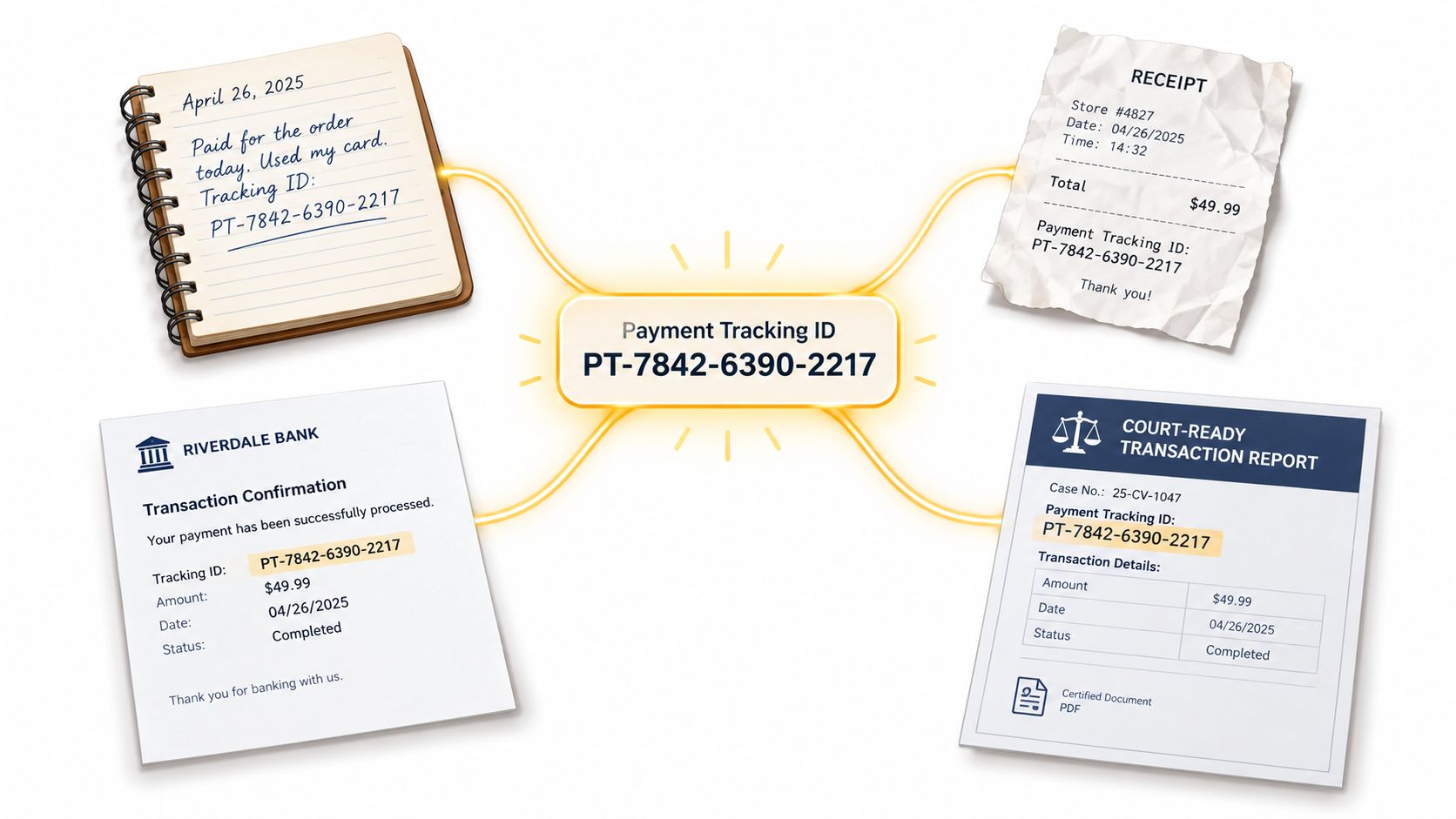
A payment tracking ID becomes useful evidence when it links separate records into one understandable chain. The finished report shouldn't present a number by itself. It should show what the payment was for, who made it, which agreement or expense rule relates to it, and what confirmation supports the entry.
A focused PDF for one reimbursement can contain four connected artifacts:
- The custody-journal entry, with the child, expense category, date, amount, and reimbursement status.
- The underlying receipt, such as the soccer registration confirmation.
- The payment confirmation, showing the transaction reference, recipient, amount, and status.
- The relevant agreement record, identifying why the expense was shared or reimbursable.
Why the linking field matters
Without the tracking ID, a reviewer may have to infer that a bank confirmation relates to a particular receipt. The amount may match, but matching amounts aren't unique proof. With the reference included, the reviewer can move from the journal line to the payment record and then compare the recipient, date, status, and amount.
The report should distinguish facts from conclusions. “Transfer confirmation lists reference ABC and recipient account ending in the recorded digits” is a factual description. “The other parent refused to reimburse” is a conclusion that may require separate messages or acknowledgments.
A mediator, family-law professional, or court reviewer may not need every transaction in a family's history. A focused court-ready report can present the relevant expense and its supporting documents in sequence. The tracking ID serves as the linking field, but the receipt, agreement, and receiving-side information give that field meaning.
Two Common Misconceptions That Weaken Reimbursement Claims
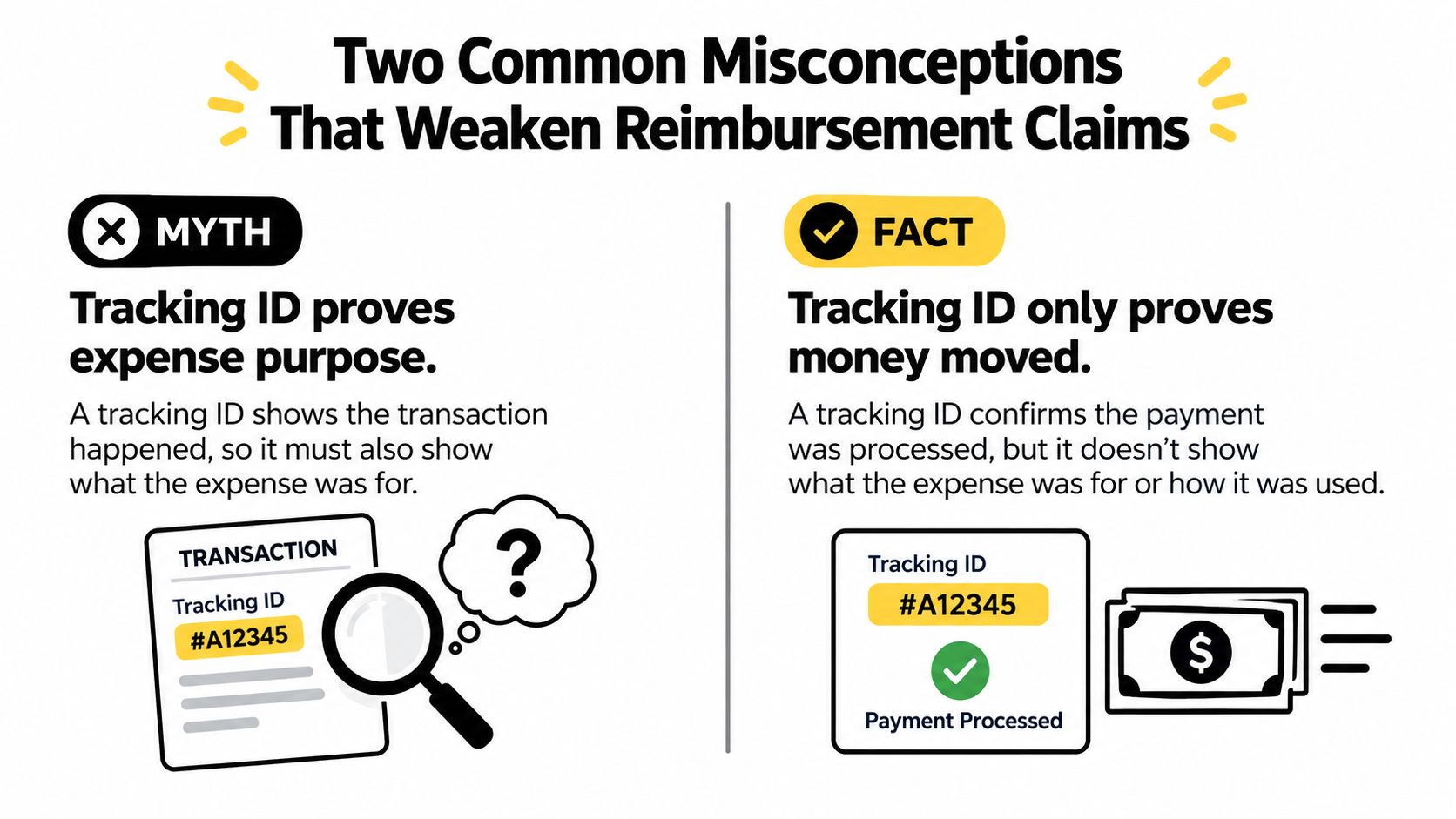
The first misconception is that a tracking ID proves the expense itself. It doesn't. The identifier shows that a payment moved through a particular rail or created a record in a payment system. It doesn't establish why the payment was made, whether the underlying expense was covered by the parenting agreement, or whether the intended recipient accepted it for that purpose.
A reimbursement entry still needs the receipt and the agreement connection. If the payment was sent to the other parent, preserve any receiving-side acknowledgment or message that identifies what the money was meant to cover. If the payment went directly to a provider, keep the provider receipt and the transfer confirmation together.
One payment may have several relevant references
The second misconception is that one identifier follows every stage from initiation to final outcome. Payment systems can expose separate references for authorization, processing, settlement, refund, or dispute activity. Card guidance commonly distinguishes a transaction ID from another trace used to locate a card transaction, while cross-border payments may use the UETR alongside a domestic bank reference.
That lifecycle gap matters when a parent says, “The transfer was sent,” but the other parent says, “I never received it.” The initial confirmation may show submission. A later bank record may show settlement or rejection. A refund or dispute may create another event that needs its own supporting reference.
A tracking ID identifies a payment record. It doesn't, by itself, prove the purpose, acceptance, or final resolution of the payment.
Record each stage that matters to the reimbursement. Save the original submission, any status change, the receiving-side acknowledgment, and the later refund or dispute information. If a bank asks for a particular reference, add that reference to the same expense entry instead of replacing the original value.
A Short Checklist for the Next Reimbursement You Send or Request
Use this checklist before the next reimbursement conversation becomes a disagreement. Each action creates a specific piece of evidence, so you won't have to reconstruct the payment from memory.
- Start with the expense: Open or create the journal entry for the child-related cost. Record the amount, date, payer, recipient, and balance owed.
- Attach the receipt: Save the invoice, registration confirmation, medical bill, or other document that shows what the payment covered.
- Identify the agreement connection: Note the relevant parenting-plan provision or expense arrangement. Don't assume a transaction record explains why the expense was reimbursable.
- Send or request the payment: Use the agreed method and keep the recipient details visible in the confirmation.
- Copy the tracking ID immediately: Paste the transaction reference into the journal's bank-reference field. If the system shows more than one reference, label each one.
- Screenshot the confirmation: Preserve the amount, status, date, recipient, and reference before the app refreshes.
- Record the receiving details: Add the available account-ending information or provider details, while avoiding unnecessary sensitive data.
- Ask for acknowledgment: Request a simple written confirmation from the receiving parent when the payment is intended for that parent. Keep the acknowledgment with the expense record.
- Use a consistent file name: Include the expense date, child or category, payment method, and reference label so the attachment can be found later.
- Update the balance: Mark the amount requested, amount received, and any remaining balance separately.
A parent who needs help making a clear reimbursement request can use this guide to request a reimbursement. The final report should pull the receipt, agreement link, confirmation, tracking ID, and payment status into one sequence, rather than leaving each item in a different message thread.
Casewell provides a private custody journal for dated records, expense details, receipts, screenshots, agreement links, and focused PDF reports. To keep payment references connected to the reimbursement they support, visit Casewell and create a record for the next expense when the payment is made.