
You paid the bill because the bill had to get paid. Maybe it was a copay after urgent care, soccer registration before the deadline, daycare tuition, or the class trip fee your child would have missed if you waited for a reply. Now you're stuck doing the second job nobody talks about. Chasing the other parent for their share.
Most parents start with a text. “Can you send me your half?” That feels easy in the moment. It's also how reimbursement fights turn into circular arguments, selective memory, and a pile of screenshots that don't clearly show what was owed, when it was requested, or what proof supported it.
If you need to request a reimbursement from a co-parent, treat it like a financial record from day one. That means one clean request, attached proof, a deadline, and a matching entry in your custody journal on the same date. That's the difference between “I asked a bunch of times” and “Here is the expense, here is the agreement, here is when I requested payment, and here is the unpaid balance.”
Why a Reimbursement Request Needs More Than a Quick Text
A casual text is easy to send and even easier to ignore.
You fronted money for your child, sent a quick message, got a thumbs-up, and then nothing happened. A month later, you're scrolling through old messages trying to find the amount, the date, and whether you ever sent the receipt. That's exactly how a simple reimbursement turns into a dispute.
A reimbursement request is a claim, not a favor
If money is owed under your parenting plan, court order, or written agreement, you are not asking for a personal favor. You are making a financial claim. Claims need structure.
At minimum, every reimbursement request should include:
- Date of the expense so nobody can pretend the timing is unclear
- Exact amount paid by you and the exact share owed by the other parent
- What the expense covered with enough detail to identify it later
- Attached proof such as a receipt, invoice, statement, or EOB
- A payment deadline so silence isn't treated like an open-ended option
That's invoice logic. Use it.
Text messages create weak records
Texts are fine for logistics. They are weak for money disputes because they get buried, screenshotted out of order, and answered with vague reactions instead of actual payment. They also invite side arguments. Instead of focusing on whether the expense is owed, the conversation drifts into who approved what, what was “necessary,” or why the other parent is “busy right now.”
Practical rule: If you'd want a mediator or judge to understand it in thirty seconds, don't leave it as a loose text chain.
A proper request also protects you later. The same issue tends to repeat. If one season's activity fee wasn't documented well, next season's request will be challenged the same way. Sloppy records multiply conflict.
Use one clean request and one matching journal entry
My advice is blunt. Stop re-asking in fragments. Send one complete request. Log it once in your custody journal with the same date. Attach the same proof there too.
That gives you a paper trail that holds up if the other parent later says they never got enough information, never agreed, or already paid. You won't be reconstructing the story from memory. You'll already have the file.
Which Expenses Are Reimbursable and What Counts as Proof
Not every child-related purchase is automatically reimbursable. The controlling rule is whatever your court order, parenting plan, or written agreement says. If the document says medical, school, childcare, and agreed extracurricular costs are shared, that's your lane. Stay in it.
The mistake I see all the time is parents assuming an expense feels fair, so it must be reimbursable. That's not how these disputes get resolved. What matters is whether the expense was covered by the agreement and whether you can prove the charge with clean documentation. If you need background on reimbursement basics, this overview of expense reimbursement is a useful starting point.
The categories that come up constantly
Here's the short version. The most common reimbursable expenses fall into a few predictable buckets.
| Expense Category | Best Proof to Attach |
|---|---|
| Medical copays and prescriptions | EOB plus the dated payment receipt |
| School fees and supplies | School invoice or order confirmation |
| Childcare and daycare | Monthly statement showing the child's name and service period |
| Extracurricular activities | Registration receipt plus season or lesson schedule |
That table matters because different expenses need different proof. Don't attach random screenshots and hope the other parent figures it out.
What to attach for each type of expense
- Medical expenses usually need two things. The EOB shows what the charge was for, and the receipt shows what you paid.
- School costs are strongest when tied to the school itself. Use the invoice, fee notice, or online confirmation.
- Daycare and childcare should show the child's name and the period covered. A monthly statement beats a casual message from a provider.
- Extracurriculars need the registration receipt. If the other parent tends to argue the activity wasn't real or wasn't for that season, attach the schedule too.
The best proof is the document that answers the argument before it starts.
The gray zone that causes fights
Some expenses sit in a gray area. Birthday party upgrades, nicer clothing than necessary, gifts, elective purchases, or services not required by the parenting plan often trigger conflict. Those may still be reimbursable if the other parent agreed in writing first.
That written approval matters. Save it.
If the expense wasn't clearly required and wasn't clearly approved, don't act shocked when payment stalls. In those cases, the prior written agreement becomes part of your proof packet. Without it, you're asking the other parent to accept your judgment after the fact. That rarely goes smoothly.
Building a Complete Reimbursement Packet Before You Hit Send
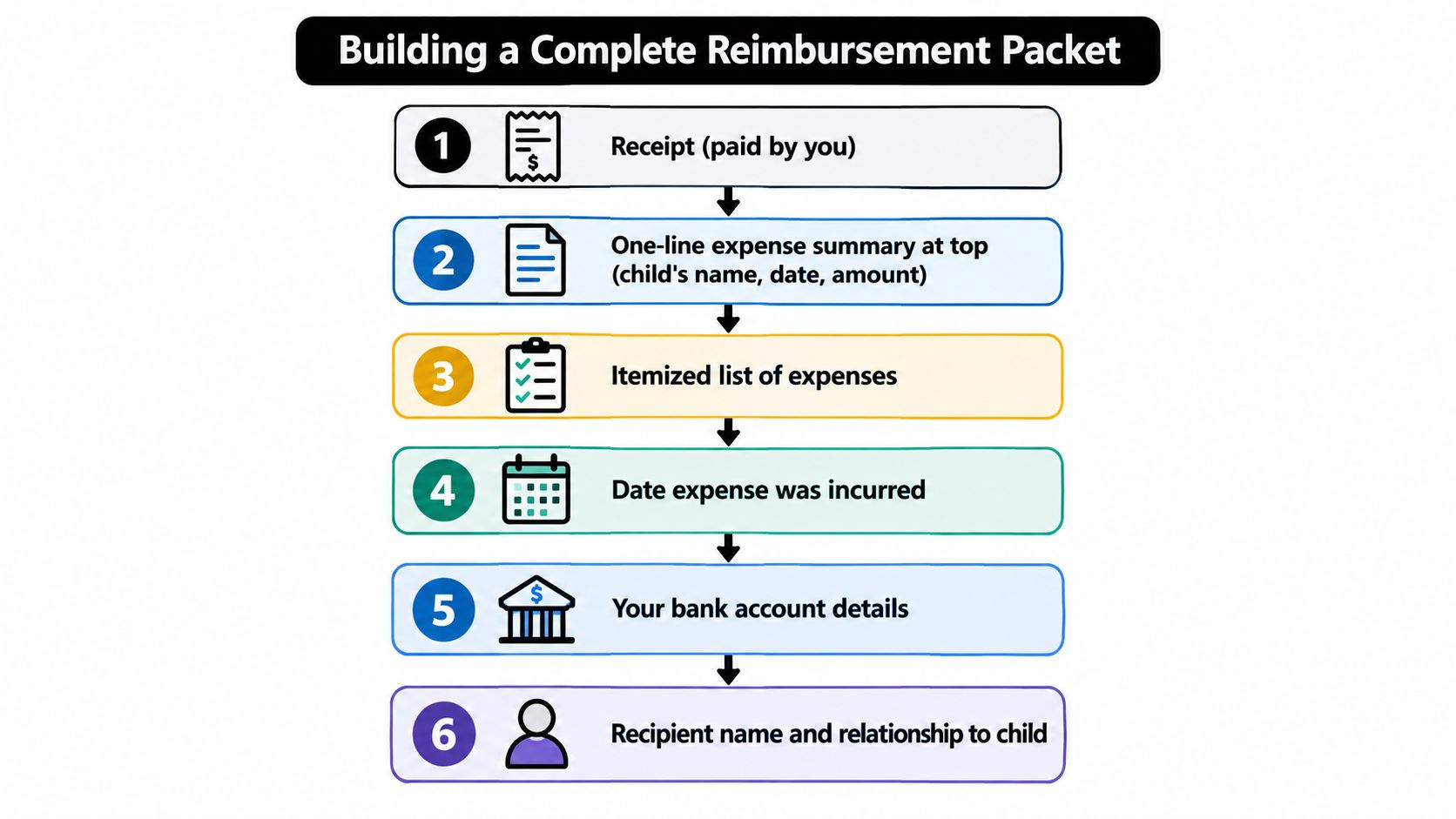
If you want to request a reimbursement without chasing it for weeks, build the packet first and send the message second. Most delay happens because the request goes out half-finished.
The packet should be boring, complete, and easy to verify. That's the standard.
What goes in the packet
Use this order every time:
One-line summary
Child's name, date of expense, total paid, and amount owed.Short justification
Cite the parenting plan section or prior written agreement.Proof attachment
Receipt, invoice, EOB, provider statement, or relevant screenshot.Payment method
State how the other parent can pay you.Clear due date
Give a specific date, not “when you can.”
A strong request might read like this:
Per section 4(b) of our parenting agreement, your share of this expense is $[amount], payable by [date]. I've attached the receipt and related documentation.
Or this:
On [date], I paid [total amount] for [child]’s [expense]. Your share under our agreement is $[amount]. Please send payment by [date] via [payment method].
Two habits that save you later
Don't bundle unrelated expenses into one messy request. If you combine a prescription, soccer fee, and school supply order into a single vague total, you're inviting selective objections. Keep each request tight or, if you send several together, list each item clearly and attach proof for each one.
Also, re-attach the proof even if the other parent saw it earlier in chat. Never assume they'll scroll back and find it.
If your receipts are scattered, fix that first. This guide to keeping track of receipts covers the basic organization problem that usually causes reimbursement requests to fall apart.
Your sent message should stand alone
The message itself should make sense without extra explanation. Someone reading it months later should understand the entire issue from the email and attachments alone.
That matters because the packet isn't just for the other parent. It becomes your exhibit if payment stalls. A complete reimbursement packet today is a court-ready file tomorrow.
Tracking Requests, Payments, and Balances in a Custody Journal
Sending the request isn't the hard part. Remembering what happened after you sent it is where parents lose control of the record.
If you don't log the request the same day, details start slipping fast. Was it sent by email or text? Was the due date two weeks out or end of month? Did the other parent pay part of it? Did they dispute one line item or ignore everything? By the time mediation or court comes around, you're rebuilding the story from fragments.
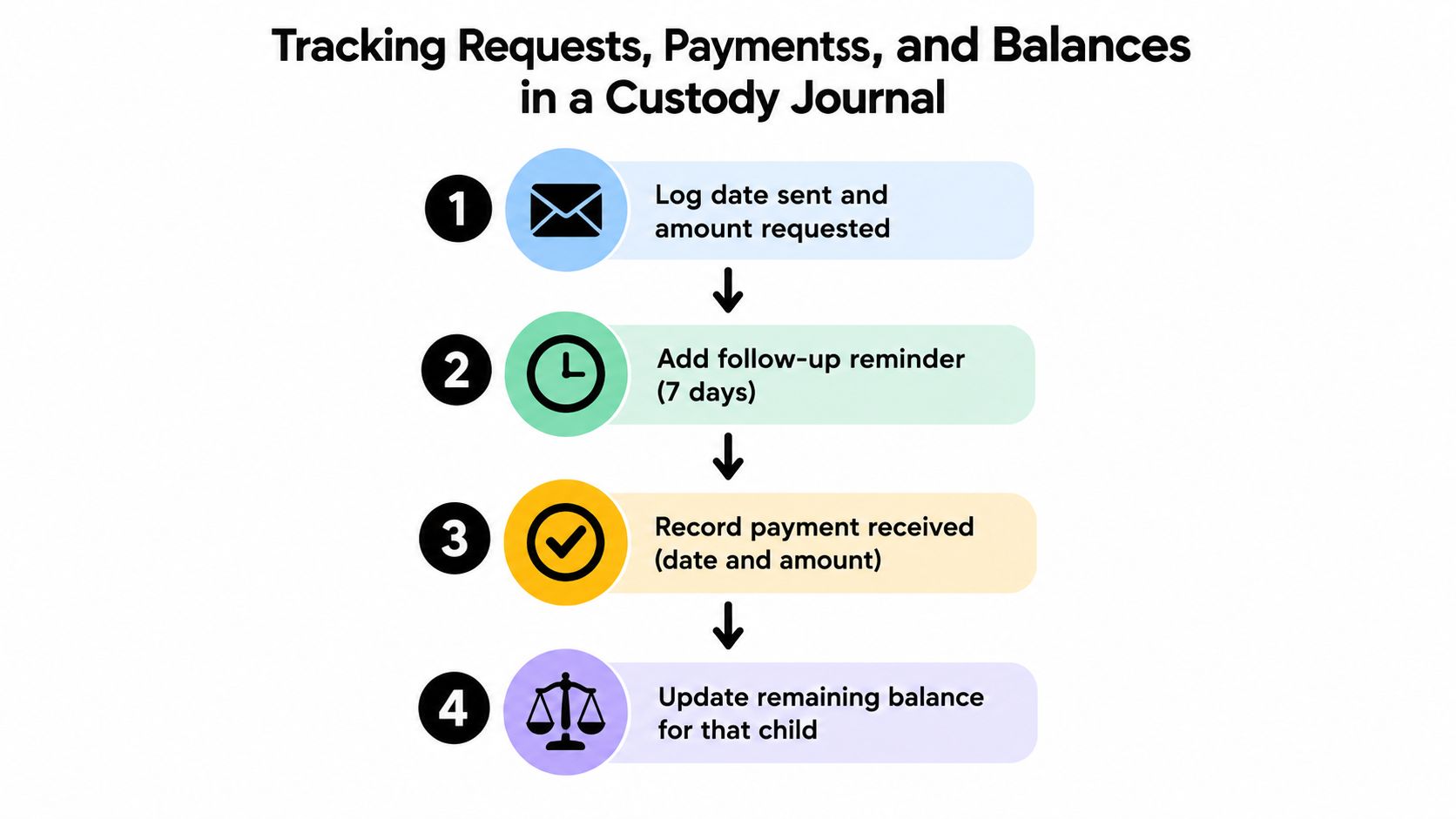
What to log every single time
Your custody journal entry should track the reimbursement like a ledger, not like a diary.
Include:
- Date sent with the channel used, such as email or parent portal
- Amount requested and the category, such as medical, school, or activity
- Due date so nonpayment becomes visible, not vague
- Proof location including the receipt, EOB, invoice, or screenshot
- Response status such as paid, partially paid, disputed, or no response
How to record partial payments and disputes
Good journals separate serious records from messy notes.
If the other parent pays part of the expense, log the payment date and amount, then update the remaining balance. If they object, summarize the objection factually and attach the message. If they say nothing, note that too. Silence is still part of the timeline.
Record what happened, not what you think it means. “No response by due date” is better than “ignored me again.”
A journal system also works best when each entry is tagged by child and tied to the parenting period involved. That matters in families with multiple children or recurring expenses.
For parents who want a private record system rather than a shared messaging tool, Casewell's co-parenting journal shows the kind of structure that helps here. The useful part is the format: dated entries, linked attachments, reimbursement status, and exportable records.
Don't delete closed entries
Even after a reimbursement is paid, keep the entry intact. Closed entries prove the pattern. They also help if the same issue resurfaces and the other parent claims you never sent proper requests before.
A monthly export or running ledger is often the cleanest document to bring to mediation. Instead of waving around separate receipts and angry message threads, you can show one organized sequence: expense incurred, request sent, proof attached, payment due, payment received or still outstanding.
That's what people mean when they talk about a court-ready reimbursement file. It's not fancy. It's just complete.
What Successful Reimbursement Systems Teach About Submission
Here's the useful lesson from large reimbursement systems. Submission quality matters more than follow-up volume.
The strongest example comes from EU VAT reimbursement workflows. The European Commission's quantitative study reported that administrations approved 2.5 million claims in 2016, equal to a 99.5% approval rate among claims processed, but only about 91.7% of submitted reimbursement claims were processed. The same study points to invoice discrepancies, lack of documentary evidence, and missed deadlines as common reasons reimbursements were reduced or rejected, which is why a complete claim package matters most at the time of submission, not after the fact (European Commission VAT refund study).
That's the pattern separated parents should pay attention to. The weak point usually isn't final merit. The weak point is incomplete submission.
What this means in co-parenting practice
If you request a reimbursement with the amount, receipt, date, and agreement reference all in one place, you cut off the usual excuses before they start. If you send “Can you reimburse me for this?” and promise to send proof later, you create room for delay.
Use this standard:
| Packet Quality at Submission | Approval Rate | First-Review Processing Rate | Average Time to Payment |
|---|---|---|---|
| Complete packet with matching proof and deadline | High once reviewed, as seen in large reimbursement systems | Higher likelihood of smooth processing | Usually faster |
| Incomplete packet with missing records or unclear support | More likely to stall or require back-and-forth | Lower likelihood of smooth processing | Usually slower |
That table is qualitative on purpose. Family reimbursement disputes don't run through one universal system. But the operational lesson is still obvious. Front-load the evidence.
The wrong instinct is repeated nudging
Parents often think persistence solves this. It doesn't. Five reminders won't fix a bad first request. One clean packet usually does more than a week of “just checking in” messages.
Build the file first. Send it once. Then track enforcement if needed.
What to Do When Payment Is Refused or Delayed
Even a strong reimbursement packet can be ignored. That doesn't mean you start over. It means you escalate in a controlled way.
The mistake is getting louder before your record gets better. Don't do that. Each step should rest on documentation you already have.
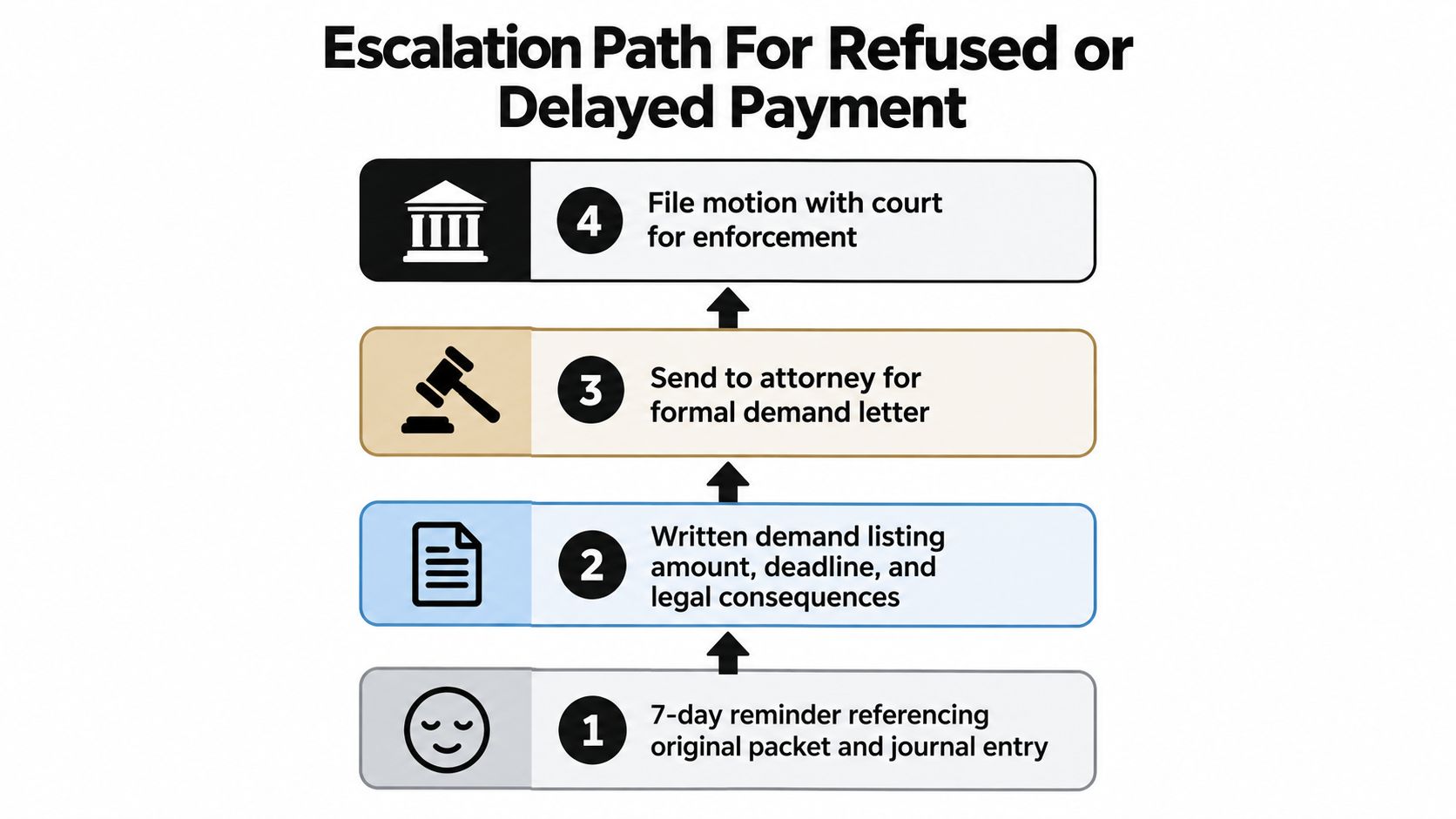
Tier one and tier two
Start with a short reminder after the due date passes.
Tier one, calm reminder
Refer to the original request, amount owed, and journal entry. Keep it brief and give a short window to pay.Tier two, written demand
If there's still no payment, send a firmer written demand through a trackable channel. State the amount, date of expense, agreement clause, documents attached, and a cure deadline.
Before you send either one, make sure your custody journal includes the original packet, the sent date, and proof of delivery if available.
“Attached again for convenience” is one of the most useful lines in reimbursement follow-ups. It removes the excuse that the other parent didn't have the paperwork.
Tier three and tier four
If direct requests aren't working, move the dispute into a setting where records matter more than personality.
Tier three, mediation or parenting coordinator review
Bring the ledger, not a pile of emotional messages. You want a neutral third party to see the timeline in order.Tier four, legal enforcement
If your order requires sharing these expenses and the other parent still won't pay, your documentation may support a motion to enforce. At that point, timestamps, attachments, reminders, and delivery records matter.
A useful benchmark from another reimbursement-heavy system makes the cost of poor documentation obvious. In U.S. private-payer medical reimbursement, roughly 15% of claims are initially denied, and 54.3% of those denials are ultimately overturned and paid after multiple appeals. Becker's also cites Change Healthcare data estimating denial rework at roughly $118 per claim. The practical lesson is simple: requests can succeed later, but the rework is expensive and slow, so build an audit-ready packet from the start (Becker's review of claims denial costs).
That same logic applies here. You can fight your way to payment later. It's better not to need the fight.
A Repeatable Reimbursement Workflow You Can Use This Week
The cleanest system is the one you'll repeat. You don't need a complicated process. You need one that starts the moment you pay the expense and ends only when the balance is cleared.
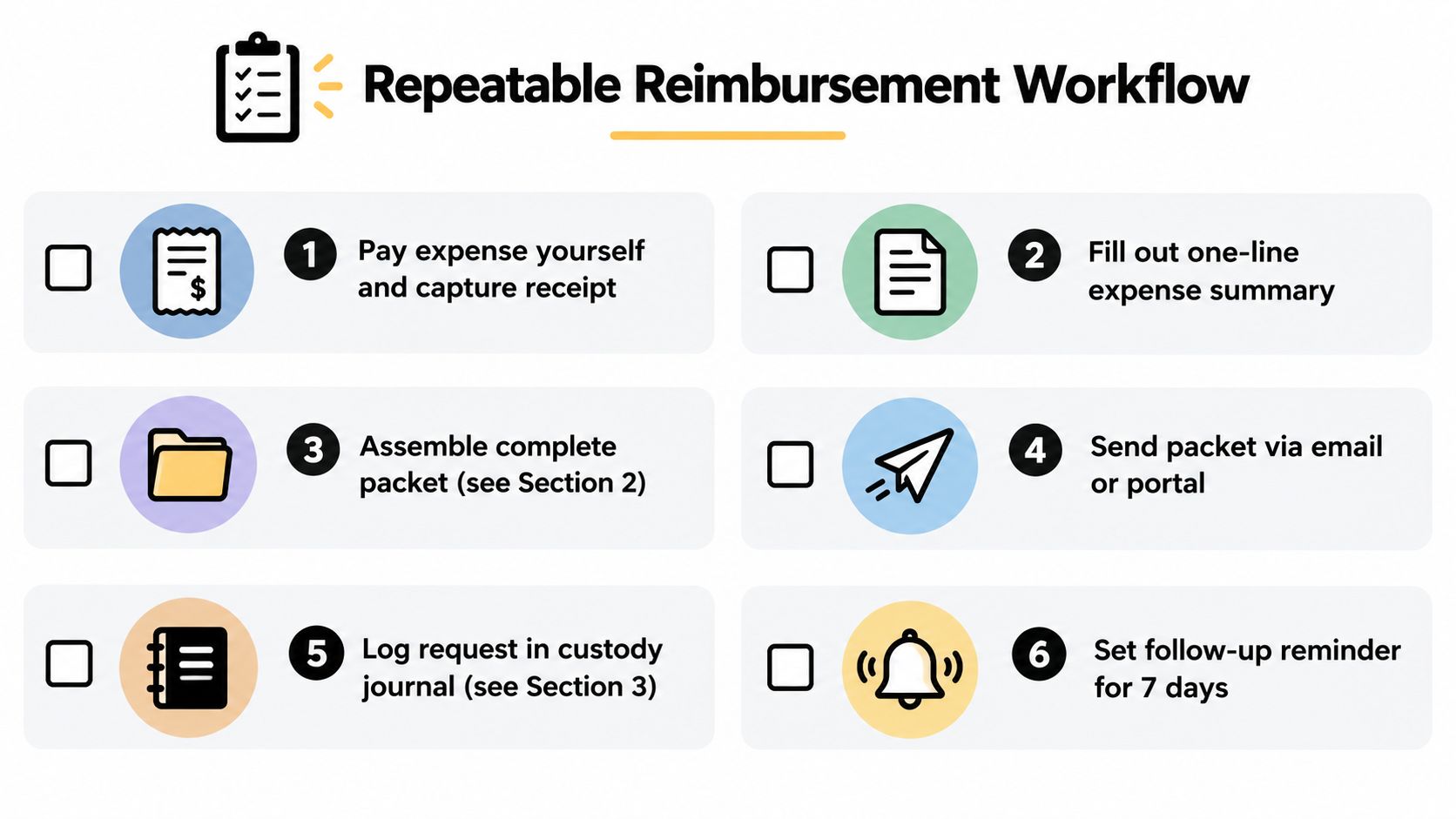
The weekly workflow
Run this sequence every time:
Pay and capture
Save the receipt immediately. If there's an EOB, invoice, provider statement, or approval message, save that too.Open a dated journal entry
Log the child, category, date, total paid, and the other parent's share.Attach support
Add the receipt and the agreement clause or written approval that supports reimbursement.Send a structured request
Use the packet format from above. Include amount owed, proof, payment method, and deadline.Log the sent date and deadline
Many parents get sloppy. Don't rely on memory.Update the outcome
Mark it paid, partially paid, disputed, or unpaid. If unpaid, escalate based on the record.
The phone-note version
If you want the shortest possible checklist, save this:
- Capture receipt now
- Log expense same day
- Attach proof
- Send one clean request
- Set reminder
- Update balance
- Escalate only from the record
That's it.
For a practical template you can keep handy, this co-parenting expense checklist gives you a simple structure to follow each time you request a reimbursement.
What actually gets co-parents to pay
Direct opinion here. Co-parents are more likely to pay when the request is easy to verify and annoying to dispute. Not hostile. Not dramatic. Just documented.
A vague message invites delay. A complete packet plus a dated custody-journal entry creates pressure in a different way. It signals that the expense is tracked, the agreement is known, and the unpaid balance won't disappear because the other parent stayed silent.
That's the goal. Not better wording alone. Better records from the first dollar.
Casewell gives separated parents a private place to keep dated custody-journal entries, attach receipts and screenshots, track reimbursement requests and balances, and export focused PDF records when a dispute needs to be shown clearly. If you're tired of rebuilding the same reimbursement story from texts and camera roll clutter, visit Casewell and set up a record system that starts before the next expense fight.