 Casewell
Makeup parenting time is extra time with your child that replaces a visit you lost. Whether you get it depends on your custody order, your state’s law and how well you can show what happened. Missed visits are not automatically repaid. The parent who has the dates, the written requests and the replies is the one a judge can act for. A custody journal that logs each exchange and exports a clean PDF, like Casewell, keeps that record in one place from the first missed visit.
TL;DR
- Makeup time is not automatic. It comes from an agreement between parents, your order’s own terms, or a court order in an enforcement case.
- State rules differ on timing: Michigan requires makeup time within one year, Illinois generally within six months, Utah within two years in qualifying cases.
- Put every request, date, start and end time and transportation detail in writing.
- If the other parent refuses, your records of the order, the missed date and the facts decide how strong an enforcement petition is.
- This article is general information, not legal advice. For your case, talk to a family law attorney in your state.
Table of Contents
- Is makeup parenting time automatic?
- What state rules say
- How to request makeup parenting time, step by step
- When the other parent says no
- What to put in your record
- Where Casewell fits
- Our perspective
- FAQ
- Sources
Is makeup parenting time automatic?
No. Texas guidance on makeup visitation describes it as something parents may agree to, or a court may order in an enforcement suit, rather than an entitlement for every missed visit. Your order comes first. Some orders have a makeup clause. Many say nothing, and then you rely on agreement or on asking the court.
The reason for the missed visit matters. Indiana’s parenting time guidelines say makeup time should happen as soon as possible after an adjustment outside the normal routine or a parent’s control. They also say it should not be used routinely to cover poor planning without a true emergency. If the other parent withheld the child, the question changes from “can we swap” to “was the denial justified.”
Two situations to keep apart:
- You cancelled or could not attend. Makeup time is usually a favor or a negotiated swap, and the other parent can say no.
- The other parent denied your court-ordered time. Many states let a court order makeup time as a remedy.
What state rules say
There is no single national rule. Examples show how much the details vary:
| State | What the law says | Source |
|---|---|---|
| Michigan | Each circuit must have a chief-judge-approved makeup policy. Makeup time must match the type and duration of the denied time and happen within one year. | MCL 552.642 |
| Illinois | A court in an enforcement proceeding can order same-type, same-duration makeup time, generally within six months, or one year if a holiday or period cannot be made up sooner. | 750 ILCS 5/607.5 |
| Arizona | After notice and a hearing, a court that finds refusal without good cause must impose at least one listed remedy, including makeup time. | A.R.S. 25-414 |
| Maryland | Makeup visitation is allowed when a court finds unjustified denial or interference with ordered visitation. | Maryland appellate opinion |
| Utah | Makeup parent-time is mandatory on motion for specified denials tied to certain child-protection or protective-order situations, within two years of the makeup order. | Utah Code 81-9-208 |
Courts also look at both parents’ conduct. An Indiana appeals court held that a trial judge could award makeup time without finding contempt, and upheld a limited award where both parents had contributed to the lost time. A 2026 New Jersey appeal shows the other side: a disputed holiday schedule and doubt about whether an order had been modified weighed against sanctions for a missed Father’s Day visit. The controlling order and the facts around it decide the outcome.
Safety is also part of the picture. The Michigan Supreme Court’s 2025 guidance cautions that makeup time may be inappropriate in domestic violence situations where earlier orders have not addressed safety. If that is your situation, speak with an attorney or a domestic violence advocate before arranging any swap.
How to request makeup parenting time, step by step
1. Read your order
Find the visit schedule, any notice rule for missed visits and any makeup clause. Many Texas schedules, for example, require 24 hours’ written notice of a missed visit, though your own order controls. Our guide to parenting time orders and how to enforce them explains how to read the terms.
2. Notify the other parent in writing
Ask promptly and in the format your order requires. Keep the tone neutral and factual: the date missed, why, and what you propose. Casewell’s AI-assisted rewriting, which you approve before anything is saved, is designed to help you turn a frustrated draft into neutral language for your journal entry.
3. Propose specific makeup dates
Vague offers like “we’ll make it up sometime” cause fights later. Put in writing:
- the exact dates
- start and end times
- who handles transportation
- the type and length of time being replaced
In Indiana, if parents cannot agree, the guidelines let the parent who lost time choose the makeup time within one month. In Michigan, the wrongfully denied parent picks the dates and must give written notice at least one week ahead for weekday or weekend time and 28 days for holiday or summer time.
4. Get the agreement in writing, and formalize it if it matters
TexasLawHelp warns that if an informal agreement falls apart, you should follow the schedule in the court order, because courts often do not enforce a different schedule that was never formalized. If you are swapping a major holiday or a long stretch, ask an attorney whether to put it in a court-approved agreement.
5. Log what actually happens
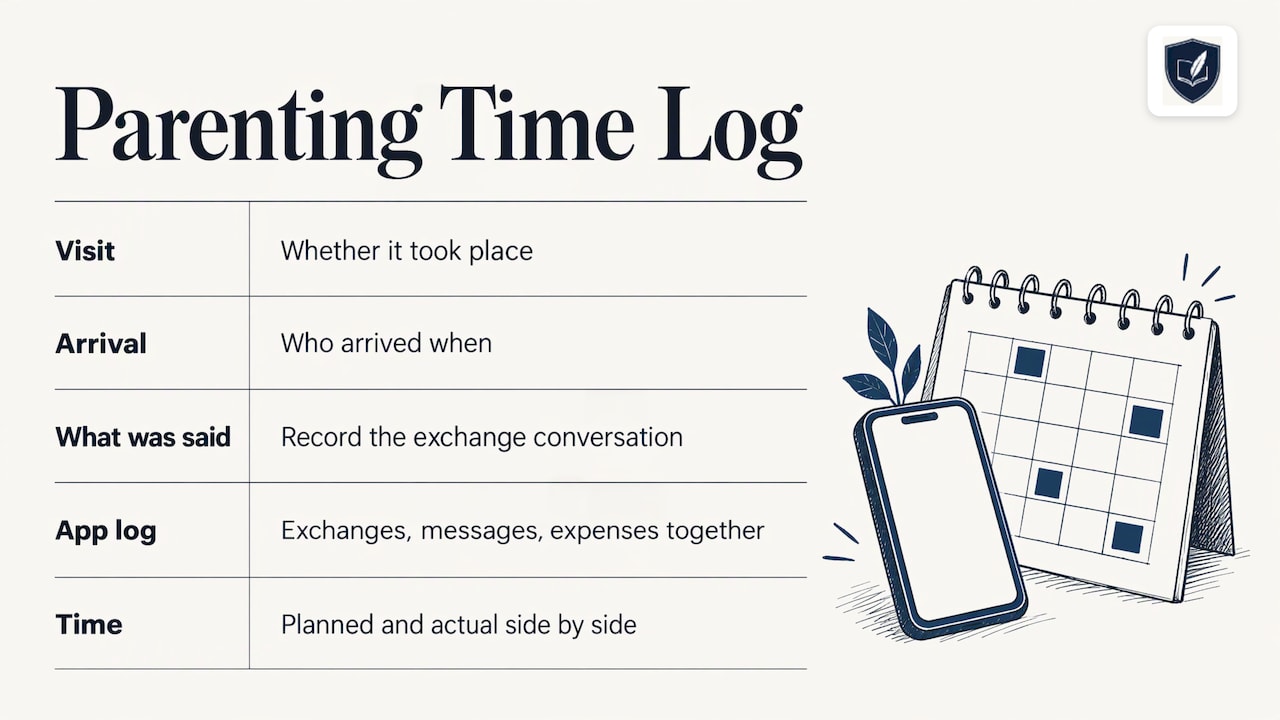
Record whether the makeup visit took place, who arrived when and what was said. In Casewell, you log exchanges, messages and expenses in one place, and the app prompts you after each exchange or handover so the entry is made while it is fresh. Our parenting time log shows how planned and actual time sit side by side.
When the other parent says no
If an agreed makeup visit is refused, follow the order’s regular schedule and keep a record. If the other parent denies your ordered time, most states let you file an enforcement action.
- Texas: a refused written agreement can lead to an enforcement lawsuit.
- Arizona: the statute provides for a hearing or conference within 25 days after service of a verified petition.
- Idaho: the court’s self-help instructions say you may petition to enforce parenting time and ask for temporary changes that let missed time be made up, with a hearing set within 28 days of filing and a required set of forms and a filing fee.
- Illinois: remedies include makeup time, contempt and civil fines per incident.
Michigan’s guidance adds that makeup time suits isolated violations unlikely to recur, while repeated or severe denial may call for a different response. That is why a pattern, documented date by date, matters more than one angry message.
In some states, repeated interference can carry criminal exposure. California’s custody deprivation statute, for instance, is explained in this overview of PC 278.5 child custody deprivation. If you are accused of interfering, or think you may be, speak to a local attorney.
What to put in your record
The Michigan Supreme Court’s 2025 memorandum says a written complaint should identify the date of the alleged violation, the most recent order and the relevant parenting-time provisions, and the facts supporting the allegation. A verified statement may be used if contempt follows. Build your journal around that list:
- The order and the exact schedule clause
- The scheduled time and the time that actually happened
- Your request for makeup time, and the reply or silence
- Messages about the missed visit
- Costs, such as travel you paid for a visit that did not happen
- Proposed and agreed makeup dates
The Maryland opinion above treated reimbursement of travel expenses as a remedy, which is one reason expenses belong in the same log. For more on what holds up, see how to prove parenting time, and for a high-conflict situation, our guide to high-conflict co-parenting documentation.
Where Casewell fits
Casewell is a custody journal for co-parents. You log exchanges, messages, expenses and agreements, watch a real-time timeline of planned and actual time, and export court-ready PDFs that are filterable and indexed. Records are stored encrypted on your device, with no copies kept on company servers. Plans are $2.99 per week or $49.99 per year after a free trial, on Casewell Premium. If you already have a pile of records and a hearing coming, the Court timeline service starts from £29 one-off. You can also see how a court-ready report is built.

Our perspective
Makeup time is won or lost on small facts: the date a visit was missed, what was offered, what was answered. Parents rarely lose because they were wrong. They lose because they cannot show it calmly and in order.
We built Casewell so that a parent can log each exchange right after it happens, keep messages and expenses beside it, and see the whole timeline at once. Entries stay encrypted on your device, and the optional AI rewriting only changes your wording into a neutral tone after you approve it.
When the time comes to ask for makeup time or to bring an enforcement petition, a focused PDF of the relevant dates is far easier for everyone to read than a phone full of screenshots.
Mielad
FAQ
Can a judge order makeup time without holding the other parent in contempt?
In some states, yes. An Indiana appeals court decided that a trial court could award makeup parenting time without a contempt finding. Maryland’s appellate opinion likewise described makeup visitation as a remedy even though contempt was not recommended.
How long do I have to use makeup time?
It depends on the state. Michigan sets one year, Illinois generally six months (or one year in some cases), and Utah two years for qualifying makeup orders. Your own order or agreement may set a shorter window.
Can the other parent skip a visit and take it back whenever they like?
Not unless your order says so. Open-ended arrangements with no notice period are a common source of conflict. Put any swap in writing with dates and times, and follow the order if the other parent changes course.
What should I do first if my time was denied?
Write down the date, the order provision and what happened, and send a calm written request for makeup time. Then log the reply. If it is refused, a family law attorney in your state can tell you whether to file an enforcement petition.
Sources
- Makeup Visitation, Texas Law Help
- MCL 552.642, Michigan Legislature
- Order Amending Indiana Parenting Time Guidelines
- Michigan Supreme Court memorandum 2025-02
- New Jersey opinion A-3824-24
- Murray v. Murray, Indiana Court of Appeals
- Maryland appellate opinion, Anne Arundel County
- A.R.S. 25-414, Arizona Legislature
- Idaho instructions: Petition to Enforce Parenting Time
- 750 ILCS 5/607.5, Illinois
- Utah Code 81-9-208
- PC 278.5 child custody deprivation