 Casewell

A father can request sole legal custody, primary physical custody, or both. The court applies a gender-neutral best-interests test: being a father neither wins nor blocks the request. Fathers are a recognized share of custodial parents, but that alone does not show what arrangement serves a particular child.
Focus on the remedy the evidence supports. A request should explain how the proposed arrangement meets the child's safety, stability, and needs. Keep it specific and support it with reliable records. Broad demands driven by frustration can weaken a case; a focused request gives the court a clearer basis to assess what is best for the child.
What Full Custody Means for a Father
The U.S. Census Bureau's 2022 custodial-parent tables identify approximately 13.9 million custodial parents as parents living with children whose other parent lived outside the household. About 21.8% were fathers, compared with 78.2% who were mothers. Those figures describe household residence and custodial-parent status. They don't show how often fathers win contested trials or receive sole custody, and they don't establish a legal preference for mothers.
“Full custody” isn't one precise legal term. People use it to mean sole decision-making authority, a child living primarily with one parent, or both. Courts and forms use different terminology, so first decide which specific outcome you're asking the court to order.
| Custody remedies a father may actually request | What the order covers | Proof that fits this ask |
|---|---|---|
| Sole legal custody | Major decisions on school, health, and religion | A history of sound decisions and evidence the other parent refuses or can't participate in decisions |
| Primary physical custody | The child lives mostly with the father; the other parent has parenting time | Consistent overnights, a steady school routine, and a workable schedule for the other parent |
| Sole legal and sole physical custody | Both decision-making and primary residence | Safety concerns or serious instability, supported by a complete caregiving record |
| Joint legal custody with father as primary residence | Shared major decisions and the father's home as the child's base | Cooperation on decisions and a stronger day-to-day care history |

A father who already handles school mornings, bedtime, and pediatric visits might have a strong basis to seek primary physical custody. But that record doesn't automatically support sole legal custody too. Ask for each remedy separately, and connect each request to the child's needs. A fit, loving father can still lose primary residence if the complete record supports a different home as the better base for the child.
For a practical overview of how people use “full custody” and prepare a request, the Law Office of Bryan Fagan custody guide offers additional context. Before you start gathering paperwork, write down the single remedy your current facts can support.
Prepare the Sole Custody Request
Build the request around what serves your child, not around gender, entitlement, or a desire to punish the other parent. By 2013, all 50 states used some form of best-interests analysis, and some expressly barred custody decisions based on a parent's gender, according to a history of custody standards. The old “tender years” presumption that mothers were better suited to care for young children isn't the modern test. Courts look at the child's actual relationships, caregiving history, stability, safety, and each parent's ability to meet the child's needs.
Use this factor table to decide which evidence matters. The strongest filing makes it easy to see how each record supports a factor and the particular order you're asking for.
| Best-interests factors and useful proof | What the court is asking | Records that usually help |
|---|---|---|
| Safety | Is the child protected from abuse, neglect, or substance-related harm? | Police, medical, school, or protection-order records tied to dated incidents |
| Stability | Will housing, school, and routine stay steady? | Lease or mortgage, school enrollment, childcare plan, and work schedule |
| Caregiving history | Who has actually provided daily care? | School pickup log, medical appointments, and records of meals and bedtime routines over time |
| Relationship with the other parent | Will this parent support safe contact? | On-time exchanges and messages that facilitate, rather than block, parenting time |
| Capacity to meet needs | Can this parent handle health, school, and supervision? | Insurance details, provider contacts, backup caregivers, and a realistic calendar |
Abuse, neglect, substance misuse, abandonment, or serious instability can materially affect the outcome. But making an allegation isn't proof. Keep the focus on documented incidents and their effect on the child, and verify the applicable legal test with a local lawyer or court self-help office because custody terms and requirements vary by jurisdiction.
Six steps to prepare a focused request
Get the rules and paperwork. Find the custody statute, required forms, filing instructions, and deadlines for your jurisdiction. If you already have a custody order, ask whether your filing is a request to modify it and what you must show to change it. A court self-help office can point you to local forms; a family lawyer can assess how the rules apply to your facts.
Write out the child's actual routine. Record school attendance, medical care, transportation, housing, your work hours, and who supervises the child before and after school. Be specific about who does each task and how the arrangement will work on an ordinary weekday, not just during a holiday or court hearing.
Draft a complete parenting plan. Set out the decision-making arrangement, weekly schedule, holidays, exchange times and places, communication rules, and what happens if the child is sick or a parent is late. A plan should explain how the child's routine continues, not merely describe what you want from the other parent.
Organize evidence by date and issue. File records under relevant factors such as safety, school, healthcare, and caregiving. A teacher's attendance record, a clinician's appointment information, childcare records, a police report, or financial documents can be more useful than a stack of accusations. Keep original documents and connect each item to a clear point.
Choose witnesses who observed the parenting. List people who can speak to what they directly saw, such as a teacher who observed school involvement or a childcare provider familiar with pickups. A relative who dislikes your co-parent may not add much if they can't give relevant firsthand information.
Request temporary orders narrowly. If a present problem needs a court decision while the case proceeds, ask for a specific temporary arrangement that addresses it, such as a stable school-week home or a safe exchange plan. Don't claim you need every form of sole custody if your evidence supports primary residence but not sole decision-making.
A Stanford review of access to justice reports that studies found legal representation influenced custody arrangements, particularly in contested cases. Get a lawyer's advice before a hearing if you can. A custody process overview from the Law Office of Bryan Fagan, PLLC can also help you understand the general sequence of a custody case, but local court rules and your specific facts should guide your filing. If you need help assembling the paperwork, review this guide to filing custody papers.
Records That Help Instead of Hurt
A useful custody log is factual, dated, and tied to the child. Write each entry on the day the event happens. Note the scheduled plan, what occurred, and any practical effect on the child. A log that reads like a running argument with your co-parent can undermine the point you're trying to prove.
Compare these examples:
Useful: “Tuesday, 3:15 p.m., school parking lot. Pickup was scheduled for 2:30 p.m. The child arrived 46 minutes late and missed the 3:00 p.m. dental appointment. The clinic text confirming the appointment is attached.”
Weak: “She was late again because she wants to punish me. She never cares about the child.”
The first entry gives a date, time, place, plan, event, and child-related consequence. The second mixes accusation with speculation. Leave conclusions about motive out unless you have direct evidence that makes them relevant.
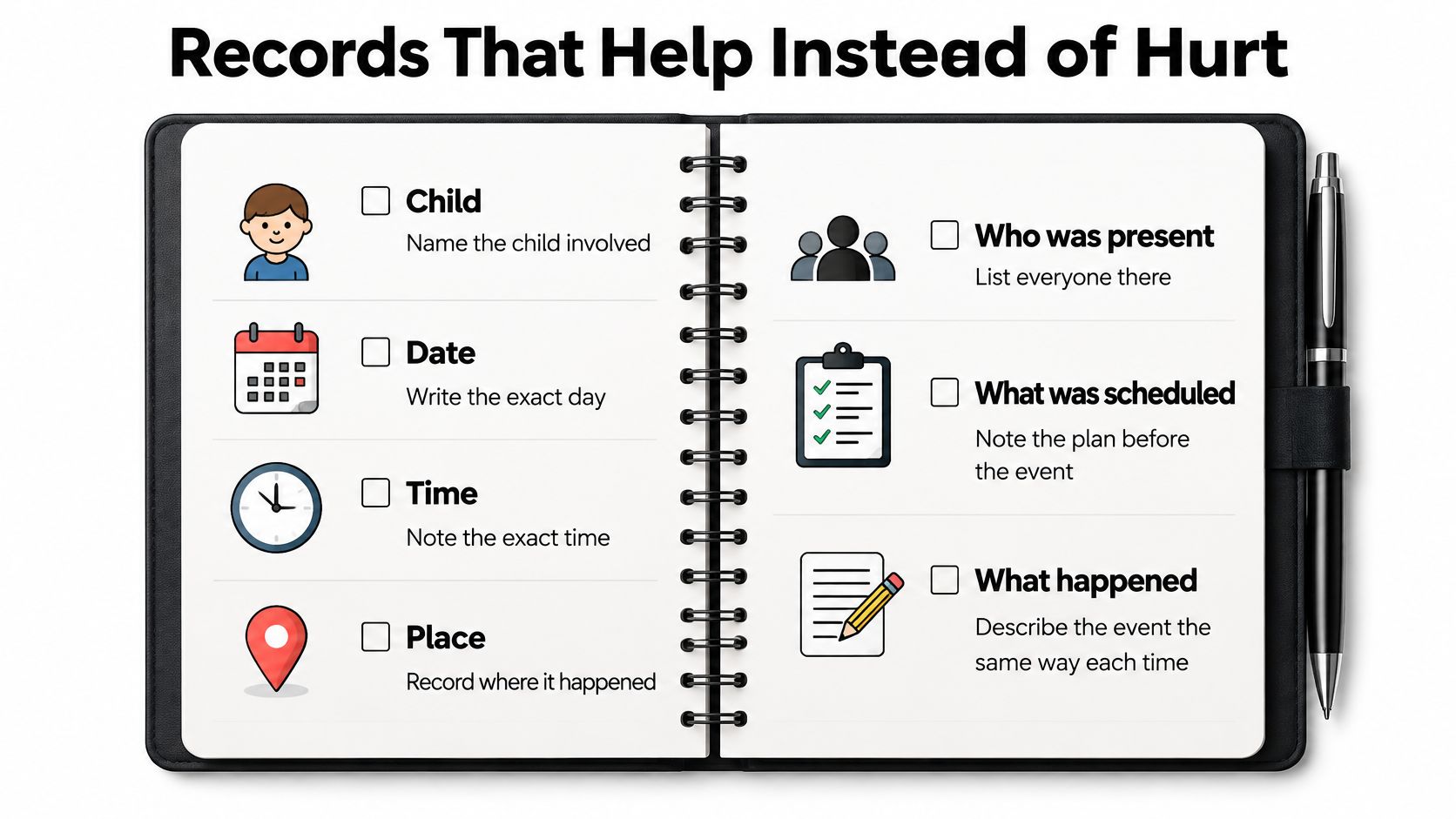
What to include in an entry
- Child: Name the child involved.
- Date and time: Record the exact day and, when relevant, the time.
- Place and people present: Note where the event happened and who witnessed it.
- Scheduled plan: State what was agreed or ordered before the event.
- What happened: Describe observable actions without guessing at motives.
- Supporting material: Attach the original message, photo, receipt, or other record connected to the event.
Keep track of exchanges, missed or shortened parenting time, your involvement with school and healthcare, agreed schedules, and child-related expenses. Store receipts beside the expense they support and keep original messages and photos attached to the event they help explain. If your parenting plan or court order requires a particular messaging app, keep using it. Your private log should supplement that channel, not replace it.
A journal isn't self-proving evidence. The court may need testimony, authentication, context, and relevance before it considers a record, and the judge decides what comes in. Keep the first version of each entry; if you correct or clarify it later, make the change transparent rather than rewriting the record without a note. Skip trivial disagreements, insults, and speculation. They can bury important events and make your file look retaliatory.
When you prepare for a lawyer meeting, select the dates that relate to the remedy you're seeking instead of handing over an undifferentiated archive. An evidence checklist for custody preparation can help you check that your notes and attachments are organized. No app can make a record admissible or substitute for legal advice.
Safety Claims That Can Backfire
Don't use custody litigation to relitigate adult conflict. If the child may be unsafe, treat the matter as a safety issue, not an ordinary disagreement to collect in a co-parenting log. If the dispute is about poor communication rather than danger, don't dress it up as an abuse allegation.
The U.S. National Institute of Justice's summary of custody and visitation orders examined 393 orders across six states involving fathers who had perpetrated domestic violence. Most orders awarded legal and physical custody to mothers and imposed structured or restrictive visitation, yet 40% of fathers still received joint custody despite a statutory presumption against custody. Those results are a benchmark from particular cases, not a prediction of what a judge will do in your case.
If you believe your child is at risk, take these steps:
- Tell the right people about immediate risk. Contact your lawyer, the court, or an appropriate protection agency. If there's an emergency, use the relevant emergency services rather than waiting for a routine court date.
- Preserve records. Keep original police, medical, school, shelter, and digital records. Don't alter messages or discard material that could give important context.
- Avoid confrontation. Follow current court orders. Use court-approved communication or supervised exchanges where ordered; don't create a private confrontation to try to capture a reaction.
- Describe specific events. State dates, witnesses, injuries, threats, and any effect on the child. Separate what you personally observed from what someone else told you.
- Ask for a proportionate protection. Depending on the risk and local law, a request might address supervised contact, a neutral exchange location, or a custody evaluation.
Don't turn a safety concern into a counterattack
Unsupported claims that the other parent is alienating the child can backfire. A Georgetown Law Journal study summarized in the National Institute of Justice's account reports that fathers' parental-alienation crossclaims nearly doubled the rate at which courts denied mothers' abuse allegations and removed custody. Raising a label without solid, relevant evidence can shift attention away from the child's safety and onto your credibility.
Harassment, coercion, intimidation, and deliberate interference with a child's safe relationship with the other parent can also count against the parent seeking custody. Don't secretly record conversations or confront the other parent to manufacture evidence; ask a local lawyer first because privacy and evidence rules vary. Relocation, international travel, and which court has authority can also matter, so get legal advice promptly if a parent plans to move or cross-border contact is involved.
If you're sorting out an allegation, review practical guidance on documenting co-parenting and false accusations. Keep the record neutral and preserve relevant material, but leave legal strategy to a qualified lawyer.
Book the Lawyer Review Before You File
Before you file a broad sole-custody request, take the facts to a family lawyer who practices in the relevant state. Bring three things: the specific remedy you believe the evidence supports, a one-page outline of your child's week, and a short packet of dated records that relate to that remedy. A focused packet gives the lawyer something concrete to assess without burying the key facts in every disagreement you've recorded.
Ask direct questions. Which statute and legal test apply? Is this a request for an original order or a modification? What temporary order is realistic on the current facts? Which forms, exhibits, or other papers won't the local court accept? A family lawyer can assess whether the records you've selected are useful under local rules and advise you about evidence, procedure, and the relief to request.
Use a preparation list to organize the meeting, such as this custody lawyer preparation guide. If your record is scattered across messages, receipts, and notes, gather only the material that supports the remedy you're considering. Don't ask for sole legal and physical custody because you're angry or worried; ask for the orders your evidence can carry.
Casewell is a private custody journal for separated parents that creates PDF exports for a lawyer or mediator. It can help organize dated records for professional review, but it doesn't give legal advice, determine whether a record is admissible, or prove a disputed claim. The court decides whether a record can be used. If an existing parenting plan or court order requires a communication app, keep using that channel and use your personal journal only as a separate record.
Schedule a lawyer consultation before filing a sweeping sole-custody request your current facts may not support. Bring the remedy, the weekly routine, and the focused records, then let a local family-law professional help you decide what to file.
Casewell is a private custody journal that helps separated parents organize dated, factual records and create PDF exports for a lawyer or mediator. Use it to prepare a focused packet for your custody consultation, then visit Casewell to learn more.