

You're reading a proposed parenting plan at the kitchen table when a relative sends you a guardianship form. Both documents concern your child, but they seem to answer different questions. Before you sign anything, you need to understand which document addresses your situation, what authority you're asking someone to exercise, and which records a lawyer might need.
Why These Legal Terms Often Get Confused
A parenting plan might describe school pickups, holiday arrangements, and consultation about medical care. A guardianship form might ask about parental availability or someone else's proposed authority over the child. To a worried parent, both can sound like paperwork about who's in charge.
The confusion is understandable. Custody and guardianship aren't interchangeable labels, but their meanings also aren't identical across jurisdictions. A familiar term from a friend's divorce may mean something different in your court, and the heading on a document won't tell you everything about its legal effect.
Start with the practical question
Before choosing a label, map your family's arrangements: who handles everyday care, who participates in major decisions, and what happens when someone cannot exercise the necessary authority. That description does two jobs. It helps a local professional identify the legal route, and it shapes which records will matter if a court reviews the situation later.
A disagreement about collection after school raises a different question from a relative needing authority to arrange care when parents are unavailable. Neither situation should be classified solely by what an adult calls it.
- Identify the unresolved task. Is someone disputing the schedule, refusing consultation, or unable to provide care?
- Read the actual wording. Look for the requested powers, existing obligations, and any conditions attached.
- Avoid assuming the outcome. A proposed document describes what someone wants, not necessarily what the court will grant.
Why the distinction matters
Choosing a label too early can send you toward the wrong paperwork or create unnecessary conflict. It can also lead you to collect material that doesn't answer the legal question a court will ask.
A useful starting point is modest: describe what needs to happen for your child and what currently prevents it. Your records can help explain that problem; they don't decide who should hold legal authority. What you write down now becomes the raw material a lawyer or judge reviews later, so clarity about the problem beats a thick file that proves the wrong thing.
Building a Clear Legal Foundation
A parent may say, “I take my daughter to every appointment,” while a relative says, “She stays with me during the week.” Both statements describe care, yet neither establishes who holds legal authority. Start with parental responsibility, the broad set of responsibilities for a child's upbringing and development. The United Nations Convention on the Rights of the Child, Article 18 recognizes the principle that both parents share common responsibilities, while domestic law determines how that principle operates.
Responsibility works less like one master key and more like a set of separate keys: providing daily care, authorizing treatment, and spending scheduled time with a child each raise distinct questions. A person may exercise one power without holding another.
The concept map separates those questions visually.
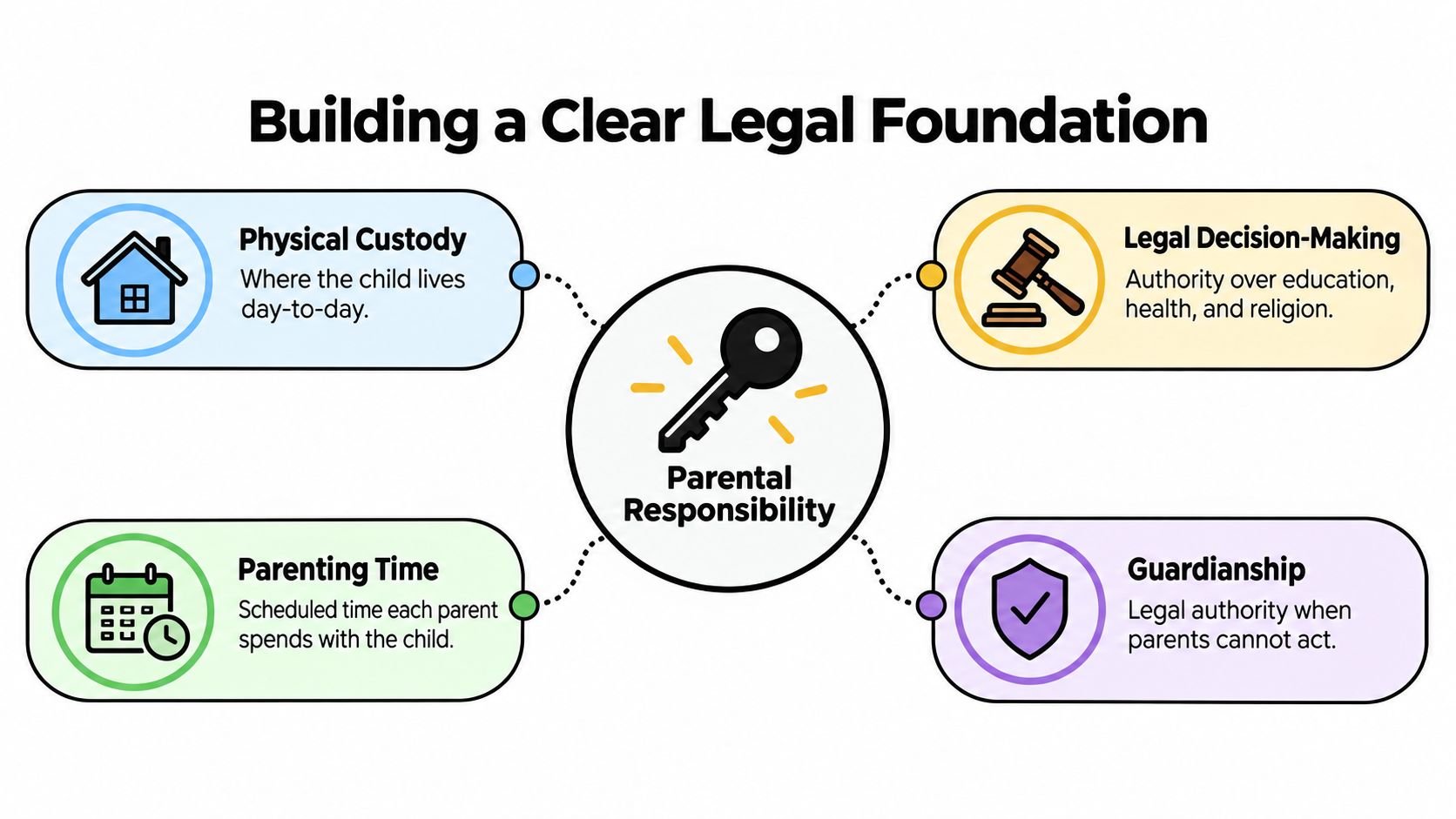
Separate care, decisions, and time
Use these working descriptions to prepare questions for counsel, since legal definitions vary by jurisdiction:
- Physical custody commonly concerns where a child lives and receives everyday care. Ask how your jurisdiction distinguishes residence from decision-making authority.
- Legal decision-making concerns authority over significant matters, potentially including education, health, or religious upbringing. The applicable law and order determine its scope.
- Parenting time describes arrangements for time with a parent. A schedule alone may leave unanswered who can authorize a major decision.
- Guardianship concerns a legally recognized role whose powers and conditions require careful local interpretation. In the child-care context discussed here, it may involve an intervention when parents cannot exercise necessary responsibilities.
Terms such as joint custody and sole custody need the same care. Ask what the relevant document permits each person to do rather than assuming that “joint” means identical time or unrestricted authority.
Read for authority, not just labels
Suppose a child stays with one parent during the school week. That arrangement does not, by itself, establish whether that parent can change schools without consultation. A relative who regularly provides care also cannot assume that practical involvement includes every necessary legal permission.
Practical rule: Ask who may make the specific decision, under which document, and subject to what conditions.
Records enter this analysis as evidence, not as substitutes for legal authority. An appointment history may show chronology and participation. Its usefulness still depends on provenance, accuracy, privacy, and how clearly it connects to the legal question. A court considering whether to create, transfer, or limit authority will apply requirements that a journal or collection of records cannot replace.
Comparing Custody and Guardianship
The central distinction is between allocating caregiving and decision-making responsibilities and seeking a particular legal intervention concerning authority over a child. Custody discussions commonly address arrangements between parents. Guardianship requires a separate inquiry into the proposed role, why it's needed, and what the governing law permits.
That distinction isn't a universal filing rule. A jurisdiction may use different terminology, allow overlapping arrangements, or require a different procedure altogether. Treat this comparison as a way to prepare questions, not choose a petition without advice.
Custody and guardianship compared
| Issue | Custody | Guardianship | Parent takeaway |
|---|---|---|---|
| Main question | How should caregiving, decisions, and parenting arrangements be allocated? | Is a legally recognized guardian needed, and with what powers? | Describe the practical problem before naming the remedy. |
| Decision-making authority | The relevant law and agreement or order define participation. | The appointment and governing law define the guardian's authority. | Ask about the specific decision, such as school enrollment. |
| Disagreement | May concern schedules, consultation, or exercise of parental responsibilities. | May concern whether appointment is justified, including over objection. | Opposition doesn't establish which proceeding is appropriate. |
| Evidence | Relevant material should address the disputed parenting issue. | Required material must address the applicable appointment criteria. | Match documentation to the legal question. |
| Duration and review | Check the order and rules for changing the arrangement. | Check appointment terms and rules for review or ending the role. | Don't assume either label guarantees permanence. |
| Practical effect | May specify residence, exchanges, and decision processes. | May authorize particular caregiving or decision-making functions. | Obtain clear advice about what changes and what remains. |
The evidence question changes with the request
For a schedule disagreement, a proposed calendar and records of actual exchanges may help a professional understand the issue. They don't necessarily address the findings required for contested guardianship.
For example, Massachusetts legal-services guidance on minor guardianship explains that, over parental objection, the petitioner generally bears a clear and convincing evidence burden concerning each parent's unavailability or unfitness, the necessity and appropriateness of guardianship, and the child's best interests. That's a jurisdiction-specific standard, not a rule to transplant elsewhere.
A missed handover and an allegation of parental incapacity are therefore different kinds of assertions. Counsel must determine what facts matter to the requested remedy.
If your uncertainty concerns major decisions rather than residence, this explanation of legal custody and decision-making can help you prepare more precise questions. Ask separately about education, healthcare, residence, and consultation rather than requesting “full control” without defining it.
Who Can Seek Custody or Guardianship
Having concerns about a child and having standing to file a particular petition are different questions. Standing means whether the law permits you to bring that request before the court. A close relationship, substantial caregiving, or a strong disagreement doesn't answer that question by itself.
Parents considering custody or parenting-time proceedings should establish their recognized legal status and identify any existing orders. Someone considering guardianship needs advice about eligibility for that specific petition, including how parental rights, consent, objection, and the child's circumstances affect the proposed route.
A caregiving role isn't a filing entitlement
Consider a grandparent who regularly collects a child from school and provides overnight care. Those activities help describe the family's practical arrangements, but the grandparent still needs jurisdiction-specific advice before assuming they can seek or exercise legal authority.
Likewise, a parent's objection shouldn't be treated as either an automatic veto or something the applicant can ignore. The applicable procedure determines what notice, evidence, and findings are required. The contested Massachusetts example illustrates why checking the actual legal threshold matters.
Professionals may have different roles:
- An attorney can advise on eligibility, requested relief, and procedural obligations.
- A mediator may help participants discuss disputed arrangements where appropriate, but their involvement shouldn't be mistaken for a court appointment.
- A guardian ad litem or other appointed professional may have a defined role under a local rule or order. Ask what that assignment authorizes rather than assuming the person becomes the child's guardian.
Questions to take to counsel
Bring the documents you already have, including existing orders and any proposed agreement. Explain your relationship to the child without presenting your preferred outcome as a legal entitlement.
Ask counsel:
- Standing: Am I eligible to bring this particular request?
- Notice: Who must receive documents or participate?
- Scope: What authority would the proposed order grant or restrict?
- Review: What reporting, review, or later application might be required?
These questions help separate the desire to help a child from the legal process required to act.
How Different Family Situations Unfold
The following situations are hypothetical illustrations, not case studies or predictions. Each calls for different preparation because the practical problem changes.
The visual provides broad examples of family arrangements, not predetermined outcomes.
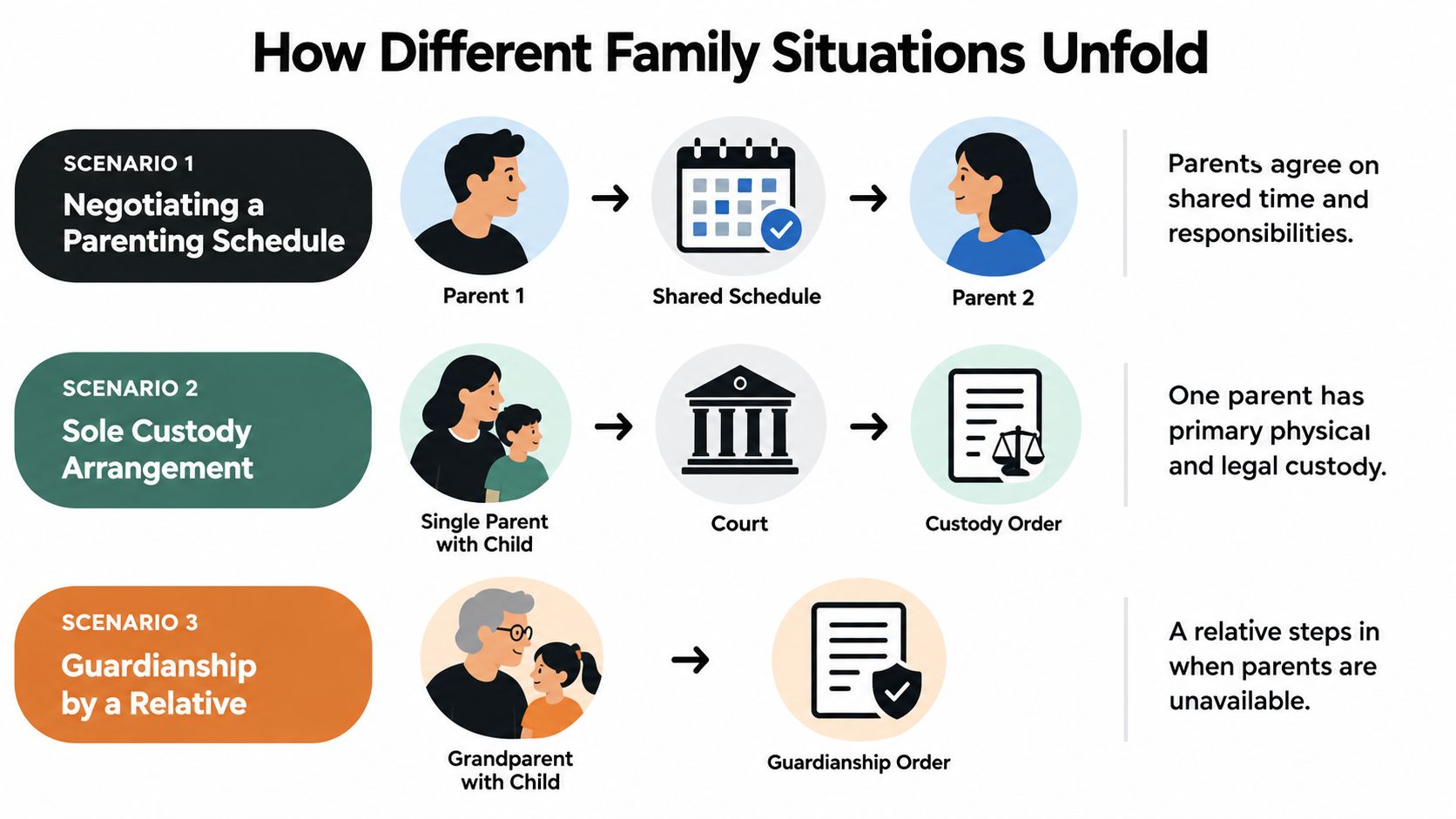
Parents negotiating a workable schedule
Separated parents agree about most care but disagree about collections after extracurricular activities. Their useful preparation includes the proposed schedule, relevant messages, transport constraints, and notes about what occurred.
An entry explaining that an activity finished later than expected provides more context than describing the other parent as unreliable. Here, the parent's role is primarily participant and organizer, identifying a workable arrangement.
A disagreement about shared expenses
Another family's dispute concerns reimbursement for child-related costs. The useful packet contains receipts, the agreement being relied on, payment requests, repayments, and any disputed items.
The financial context is substantial: custodial parents were expected to receive $29.9 billion in annual child-support payments in the Census Bureau's report on custodial parents and child support for 2022. Those national figures describe support patterns, not whether a particular expense is legally reimbursable.
For the hypothetical family, the immediate task is accounting rather than character assessment. A lawyer can then assess the obligation against the applicable agreement and law.
Serious concerns about care or authority
A relative becomes concerned that parents cannot arrange necessary care and asks whether guardianship might help. The relative should prepare dates, relevant documents, direct observations, and a clear description of the unresolved need.
If the caregiver is a stepparent, a guide to step-parent legal guardianship can help frame the consultation. It shouldn't be treated as confirmation of eligibility.
The adult's role has shifted to careful observer and professional-review client. A concerning event deserves accurate description, but neither the infographic nor the adult's account establishes which legal remedy a court should use.
Build a Record That Professionals Can Review
A useful record lets another person understand an event without relying on your memory or adopting your interpretation. Start with a consistent entry format, whether you use a notebook, a spreadsheet with secure files, or a dedicated application.
The screenshot shows a structured journal approach.
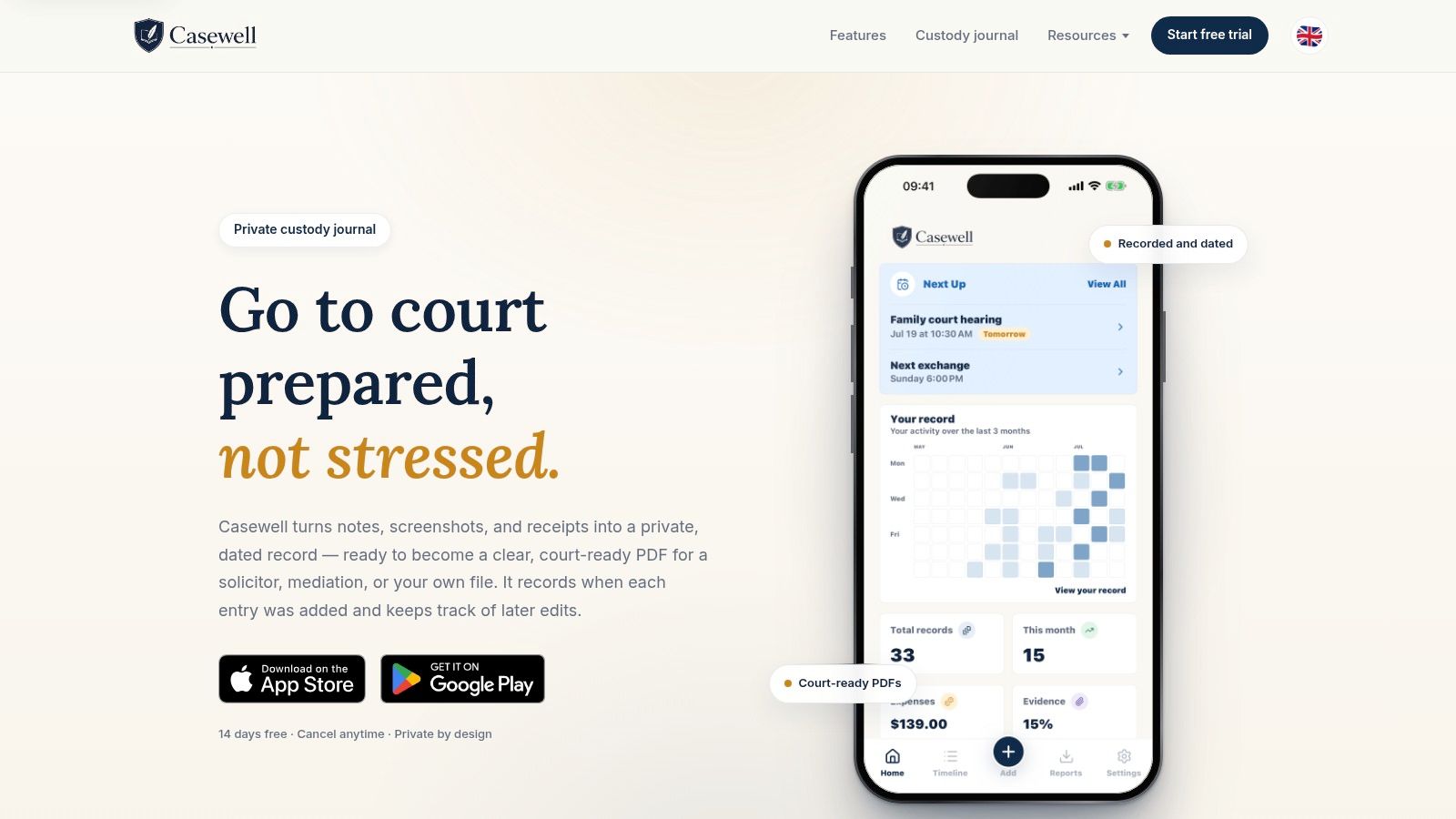
Capture the event and its origin
Record event type, title, date, time, child, people present, and observable details. Distinguish the event date from when you wrote the entry, especially if you're reconstructing something later.
Separate these categories explicitly:
- Direct observation: What you personally saw, heard, paid, sent, or received.
- Reported information: What another person told you, identifying that person and when they told you.
- Interpretation: What you think the event might mean, clearly marked as your view.
- Supporting material: The relevant agreement, receipt, message thread, photograph, or file.
Provenance means where a record came from and how it reached its present form. Keep originals where possible, identify later edits, and note gaps or contradictory information rather than covering them up.
Make the record balanced and reviewable
Include ordinary successful exchanges and routine care, not only disputes. For expenses, connect the receipt to who paid, what repayment was requested, what was repaid, and the remaining balance, without assuming the balance is legally owed.
Casewell is one option for this work: a private, single-user journal with structured fields, search and calendar filters, exchange prompts, agreement links, expense tracking, attachments, and selected PDF exports. Its entry history preserves earlier versions and edit timestamps; it's designed for personal documentation, not co-parent messaging.
Before sharing: Check whether every attachment is relevant and whether unrelated information about your child or another person can be excluded appropriately.
The video offers an additional product walkthrough.
For a meeting, use a short issue summary and selected entries rather than an undifferentiated archive. This evidence-preparation guide can help you organize the handoff.
A readable export is still a private record. Its format doesn't establish authenticity, admissibility, or the truth of every statement, and professional review remains necessary.
Separate Useful Evidence From Assumptions
A large screenshot collection can feel persuasive because it contains so much material. Yet a cropped reply may omit the request it answered, and a detailed calendar may show attendance without explaining the quality of care.
The task is to examine the timeline without filling its gaps with assumptions.
Time and volume aren't conclusions
Parenting-time percentages aren't reliable substitutes for assessing child welfare. Canada's Department of Justice synthesis on parenting arrangements concludes that no fixed amount or percentage works for every family and emphasizes interaction quality, daily activities, parental characteristics, and environment.
Document concrete context instead of assigning meaning to time alone. School participation, routine care, and the circumstances surrounding a difficult exchange may help a professional understand what a schedule total leaves out.
A credible record preserves what happened, when it was written, where the evidence came from, and what remains unknown.
Preserve the child's voice without recruiting it
Being heard isn't the same as controlling the outcome. Irish research on children's views in guardianship, custody, and access proceedings found that views were obtained in only a minority of cases, with variation between court locations.
If a child spontaneously describes an experience, distinguish their words from your observation and interpretation. Don't repeatedly question them, rehearse an account, or ask them to gather information about the other household; seek professional guidance about appropriate participation.
- Preserve context: Note what prompted the conversation and who was present.
- Respect privacy: Avoid collecting intimate material merely because it might become useful.
- Mark uncertainty: Don't turn distress after an exchange into a conclusion about its cause.
Research addressing children's participation and family-justice processes also highlights the importance of scrutinizing adult-generated accounts. Your documentation can support legal or mediation review, but it cannot independently settle credibility, authority, or the child's best interests.
Make an Informed Next Step
Start by naming the unresolved issue in ordinary language: daily caregiving, parenting time, a major decision, or someone needing legal authority to act. Then ask a qualified local attorney which legal process addresses it, rather than selecting a form because its title sounds familiar.
Separate agreements, events, expenses, child-related observations, and interpretations before your consultation. Choose the records that answer the professional's questions, retain their supporting material, and check what private information you're proposing to share.
Prepare a focused consultation
- Bring the operative documents: Include existing orders, current agreements, and any proposed application.
- State the practical need: Explain what cannot happen under the present arrangement and why it matters to the child.
- Ask before changing course: Obtain advice before filing, changing an arrangement, or treating a journal export as a court document.
If you're unfamiliar with the setting, an explanation of what family court does can help you prepare questions about procedure. Your local court and attorney must still define the applicable requirements.
The documentation application described above is not a law firm, legal service, or substitute for an attorney or mediator. Better records can support clearer conversations and more focused review, but legal outcomes depend on the applicable law and evidence, not the amount of material you collect.
Casewell offers a private place to organize parenting events, agreements, expenses, and supporting files into selected PDF reports for professional review. Visit Casewell to start a factual record of the custody and guardianship questions you need to discuss with qualified local counsel.