 Casewell
A hearing date is approaching, your messages and notes are scattered across apps, and nobody is checking every page before you file. In that situation, a custody affidavit example can help you organize your account, but copying a sample word for word can create problems if it doesn't match your court's rules.
The useful model is modular: it helps you write down what you personally know, connect important statements to records, and check the filing requirements that apply where your case is heard. Local rules decide whether you need an affidavit, declaration, or another form of written evidence, and how it must be signed, filed, and served.
What a Custody Affidavit Must Accomplish
A custody affidavit is a first-person account intended to help the court evaluate the child's welfare under the custody standard that applies in your case. In the United States, that standard is generally described as the best interests of the child, though the specific factors vary by state. The principle took shape in the nineteenth century: Massachusetts statutes passed in 1855 and 1857 authorized courts to decide custody according to children's “happiness and welfare,” and best-interests analysis was firmly established by the beginning of the twentieth century (historical overview of the best-interests standard).
That history has a practical consequence for your writing. A useful affidavit focuses on the child's daily life and care: parenting conduct, stability, safety, school involvement, medical needs, and the child's relationship with each parent. It doesn't ask the judge to accept broad claims such as “the other parent is selfish” or “they never care about our child.” It gives the court concrete, dated events that can be assessed against the child's welfare.
Practical rule: Describe what happened, how you know, and what effect it had on the child. Leave character judgments out.
For each important incident, identify the date, approximate time, location, people involved, what you personally observed, and the child-related impact. A school notice, medical document, receipt, photograph, or contemporaneous message may help support the account, but it doesn't replace a clear explanation of your own knowledge.
Many family-court litigants prepare filings without full legal representation. The U.S. Department of Health and Human Services reports that self-represented litigants participate in approximately 70% to 90% of family-court cases (HHS information for people without a lawyer). A disciplined affidavit can help make scattered records easier to review. Use the sections below to assemble the facts, then check the local filing rules before submitting anything.
Required Sections of a Custody Affidavit
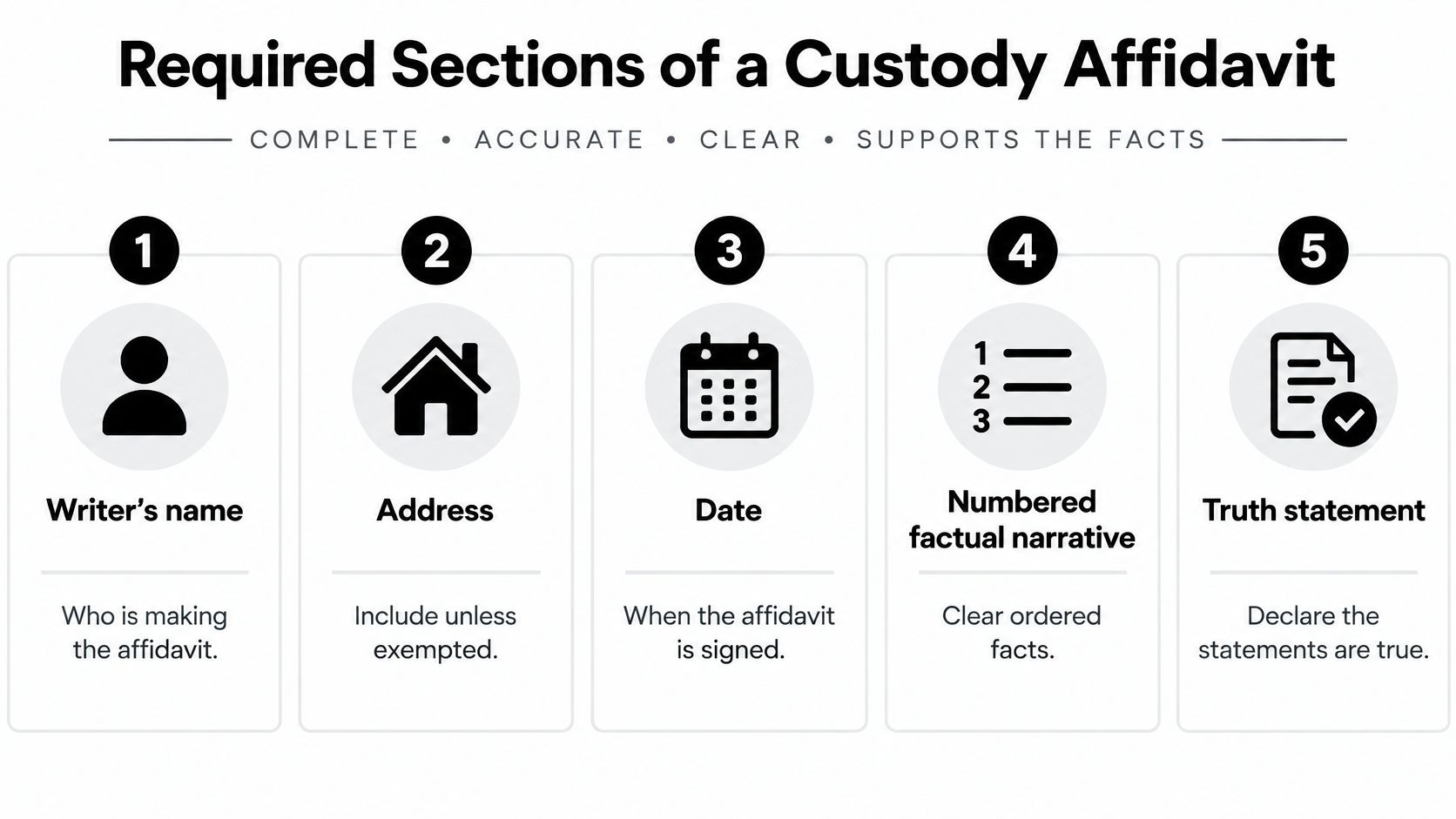
Start with the identifying and signing information required by your court. UK family-court guidance, for example, calls for a witness's name, address unless exempted, and date, followed by a truth declaration and signature. The exact language and whether you must swear or affirm the document depend on the court where you're filing (UK guidance on written statements and child-arrangements applications).
Assemble the affidavit in filing order
Caption and writer's name. Use the court's case caption, if one is required, and identify who is making the statement. For example: “I, [full name], am the [parent/guardian] of [child's name].”
Address and date. Include your address unless the court allows or requires you to omit it. Date the document when you sign it, not when the events in the narrative occurred.
Numbered factual narrative. Use numbered paragraphs, each containing one material fact or a closely connected sequence. “I attended the school meeting on [date]” is clearer than combining unrelated incidents in a long paragraph.
Truth statement and signature. Use the declaration or oath wording required by the local form. Sign only as directed, and don't assume that an ordinary signature is enough if notarization or another formal step is required.
Exhibits and references. Attach records where permitted, label them consistently, and refer to each exhibit in the paragraph it supports.
Organize the narrative chronologically when the sequence of events matters, such as a series of exchanges. Organize it by issue when the court needs to compare distinct subjects, such as school attendance and medical care. Headings such as Background, Current Parenting Schedule, Specific Incidents, Child-Related Expenses, and Requested Arrangement can help the reader find relevant information.
The UK child-arrangements template also prompts practical details such as separation timing, contact frequency, the child's weekday and weekend routine, each parent's role, transport to school, and the proposed schedule. Treat those prompts as a way to check for missing context, not as a substitute for your court's own form.
Annotated Custody Affidavit Example
The sample below is fictional and illustrates drafting, not a claim about an actual family. Replace its details with events you can truthfully describe, and don't use a paragraph if it doesn't match your own knowledge.
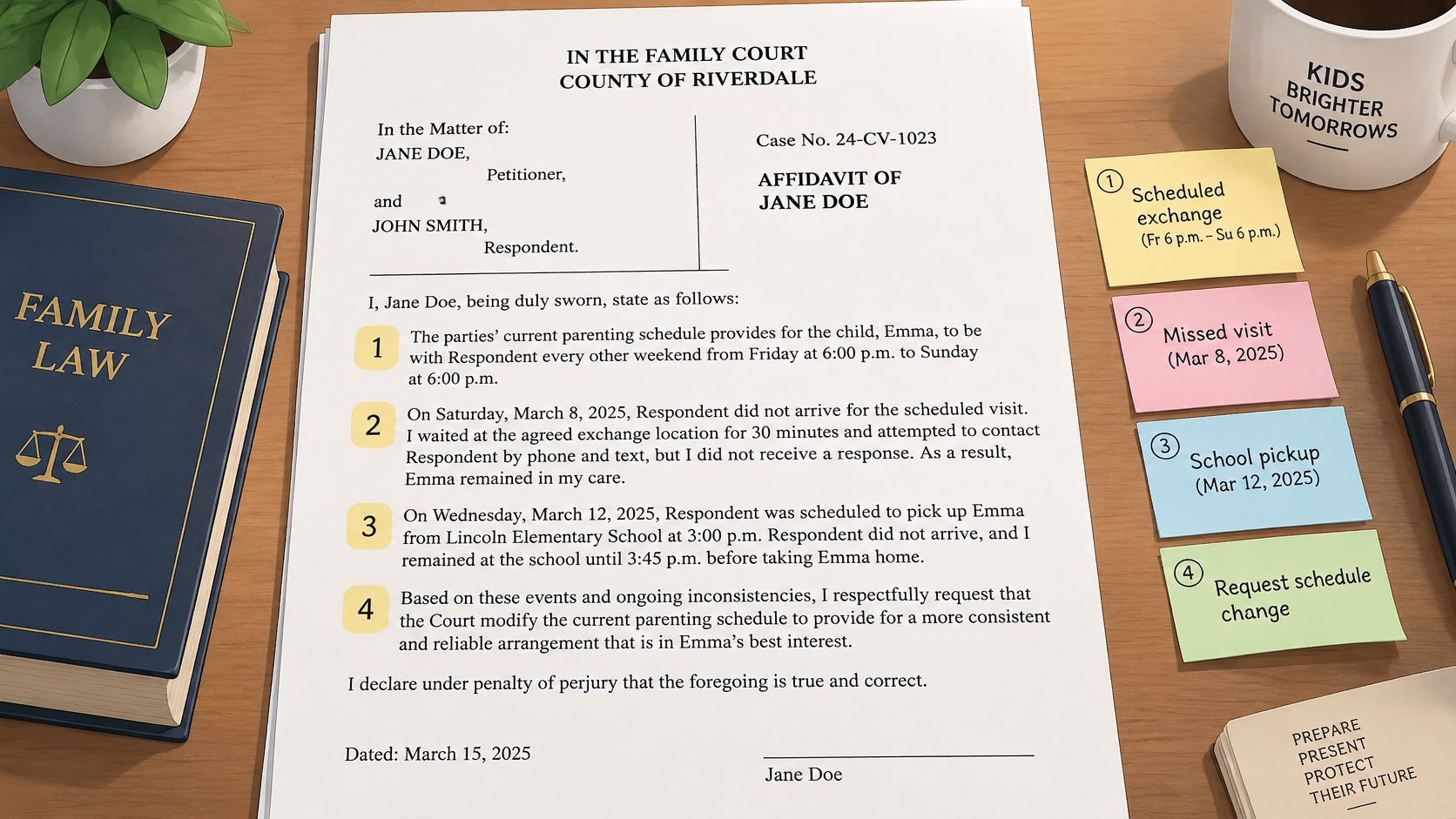
1. Scheduled exchange. “On [date], the parenting schedule required the child's exchange at approximately 5:00 p.m. at [location]. I arrived at approximately 4:55 p.m. The other parent arrived at approximately 6:10 p.m. No message about a delay reached me before the arrival. The child waited with me at the exchange location. A copy of the relevant messages is attached as Exhibit A.”
Annotation: The paragraph gives the scheduled time, approximate arrival time, location, and what the writer personally observed. It replaces a conclusion such as “the other parent was irresponsible” with details a court can assess. Keep the times approximate if you can't verify them precisely.
2. Missed visit. “On [date], the child was scheduled to spend parenting time with the other parent from [start time] to [end time]. I was at [location] with the child at the scheduled start time. The other parent did not arrive while we waited there. I received a message at approximately [time] stating, ‘[brief accurate excerpt],’ which is included in Exhibit B. The child remained with me that day.”
Annotation: Distinguish the observed event from the message. The writer saw that the other parent didn't arrive; the message is a separate record with its own source. Don't state a reason for the missed visit unless you have a reliable basis for it.
3. School pickup. “On [date], I collected the child from [school] at approximately [time]. [Name or role of staff member, if known] told me that the child had not been collected by the person expected to pick them up. I did not witness the earlier pickup arrangements. The school notice I received is attached as Exhibit C.”
Annotation: This wording doesn't present the staff member's statement as something the writer personally witnessed. Identify the source, and attach the notice if it's available.
4. Requested schedule adjustment. “I ask the court to order [specific proposed arrangement]. I believe this schedule would address [child-related practical concern, such as school transportation or a recurring exchange difficulty]. The records referenced above are attached as Exhibits A through C.”
Annotation: A request should be concrete and connected to the child's routine. Don't use it to add fresh accusations that aren't explained in the factual paragraphs.
The affidavit itself must be based on personal knowledge and explain how the writer acquired that knowledge. California's court rules also require statements to be admissible as evidence (California rule on declarations supporting family-law motions). A polished example can't fix a statement that relies on speculation or presents someone else's account as firsthand observation.
A short video can help illustrate how to think about custody documentation. Treat it as general information, not a substitute for the form and rules used by your court.
Fillable Custody Affidavit Template
Use this as a working draft, not a universal court form. Your court may require different language, a prescribed declaration, or an oath or notarization block. Confirm the form before you sign or file.
[COURT NAME]
[CASE CAPTION AND CASE NUMBER, IF REQUIRED]

AFFIDAVIT OR DECLARATION OF [FULL NAME]

I, [full name], state:

Background
1. I am [relationship to child]. The child or children involved are [names or initials, as allowed by local rules].
2. [Brief relevant background, such as the current order or parenting arrangement.]
3. [Relevant information about the child’s routine, school, care, or medical needs.]

Current Parenting Schedule
4. The current schedule provides [briefly state the relevant arrangement].
5. [Describe the usual exchange location and transportation arrangement, if relevant.]

Specific Incident
6. On [date], at approximately [approximate time], at [location], [people present].
   I personally observed [observable conduct].
   The immediate effect on the child was [specific effect, if observed].
   [Exhibit letter] contains [identify the supporting record].

[Repeat paragraph 6 for each material incident. Include the date, approximate time, location, people present, observed conduct, and child-related impact when relevant. Identify the source when a statement was made by someone else.]

Child-Related Expenses
7. On [date], I paid [expense description]. [Receipt or other record] is attached as [Exhibit letter].
[Include this heading only if the expense issue matters to the request.]

Requested Arrangement
8. I ask the court to order [specific schedule or other requested relief].
9. The facts supporting that request are [briefly connect the requested arrangement to the child’s needs].

TRUTH DECLARATION
[Insert the exact declaration or oath required by the court.]

Date: [date signed]
Signature: ____________________
Printed name: [full name]
[Notary or court-required signing block, if applicable]
For an incident paragraph, the date, approximate time, location, people present, observable conduct, and any relevant child impact help make the event understandable. Use “approximately” when you're estimating. For a background paragraph, focus on context rather than forcing every incident field into it. A request paragraph should state what you want the court to order and why it relates to the child's needs.
The court's form may already supply the caption, truth declaration, or signature block. Don't paste in a different version without checking. A declaration and an affidavit may have different formal requirements, so confirm whether you must sign before a notary or follow another procedure.
Dating and Labeling Supporting Evidence
An event date and a record date aren't always the same. A message may be sent on the day of an exchange, while a journal entry about that exchange may be created later. Keeping those dates distinct lets a reviewer see when the event occurred and when you documented it.
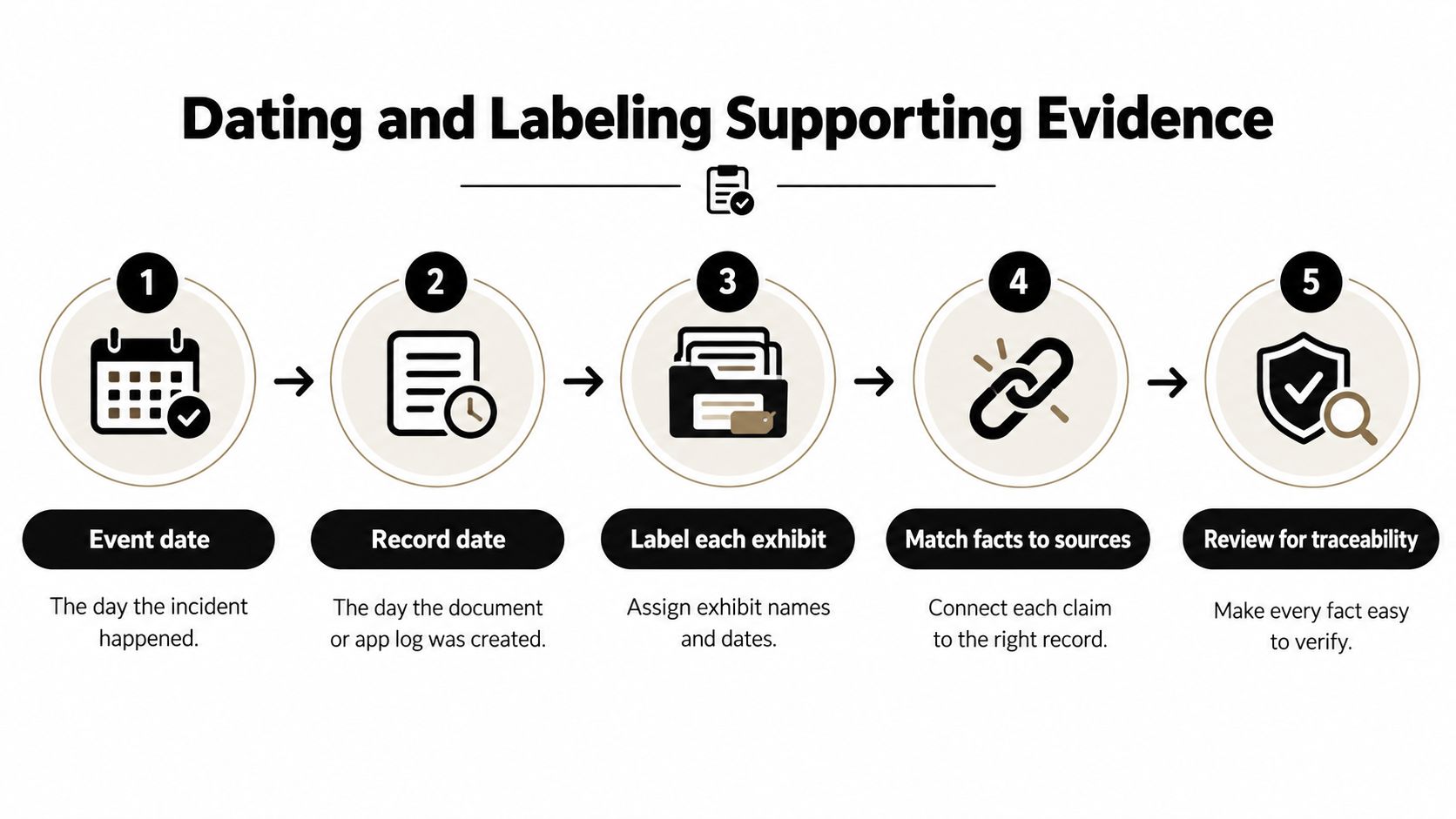
Use the same routine for each item you may rely on:
- Record the event date. Note when the exchange, school issue, purchase, or other event happened.
- Preserve the record date. Keep the message timestamp, receipt date, or journal creation date visible when possible.
- Assign an exhibit label. Give each item a unique label, such as “Exhibit A,” and write down its original filename and capture or export date.
- Match the claim to the record. Refer to the exhibit in the paragraph it supports. A receipt for a child-related expense belongs with the paragraph about that expense, not as a general attachment with no explanation.
- Review for traceability. Check that the date, label, and text reference agree, and that the attachment is readable.
A photograph can support a description of what it shows, but label when it was taken if you know. A receipt can document a purchase; a school attendance notice can support a statement about attendance; a medical document may relate to care; and a dated message may show what someone communicated. Don't claim that an item proves more than it shows.
An exhibit should make a specific paragraph easier to verify, not make the judge guess why it's included.
A practical evidence checklist for organizing supporting records can help you review what you have before assembling an exhibit package. Follow your court's rules for exhibit format, privacy redactions, and filing.
Documenting Sensitive Events Without Speculation
A serious allegation doesn't become stronger because it uses more forceful language. A parent may be tempted to write “the other parent is abusive” or “the child was traumatized,” but those are conclusions. A useful account identifies what the writer saw or heard, who supplied any other information, and what happened next.
If you witnessed an event, describe the observable conduct. If another person told you about it, identify that person and make clear that you didn't witness it yourself. If the child made a statement, don't turn it into a diagnosis or embellish it. State when the child spoke, what you personally heard, and any immediate action you took. Whether the statement can be included as evidence is a question for local rules and legal advice.
For example, replace “the other parent threatened the child” with a precise description: “On [date], I heard [person] say [accurate words, if remembered] during a call at approximately [time]. The child was present. After the call, I observed [specific behavior].” If you didn't hear the words yourself, name who reported them and when they did so. Don't present a secondhand account as firsthand knowledge.
Protect both accuracy and privacy: Keep sensitive records relevant, minimize children's identifying details where permitted, and avoid changing screenshots in ways that could raise questions about their integrity.
The affidavit should contain the factual narrative and identify the supporting records. A police or medical record, screenshot, or message may belong in an exhibit if local rules allow it and it's relevant. Don't attach private details that have no bearing on the request. For careful wording and source separation, use a factual incident-reporting approach as a drafting aid, then check admissibility and redaction requirements with local counsel or the court.
Converting App Exports into Affidavit Exhibits
An app export or private custody journal is a record to review, not a ready-made affidavit. Keep the original entry and its creation date intact. Use a neutral summary in the sworn narrative, and disclose later edits where the export or court process calls for them. Never rewrite an old note and present the altered wording as though it were the original.
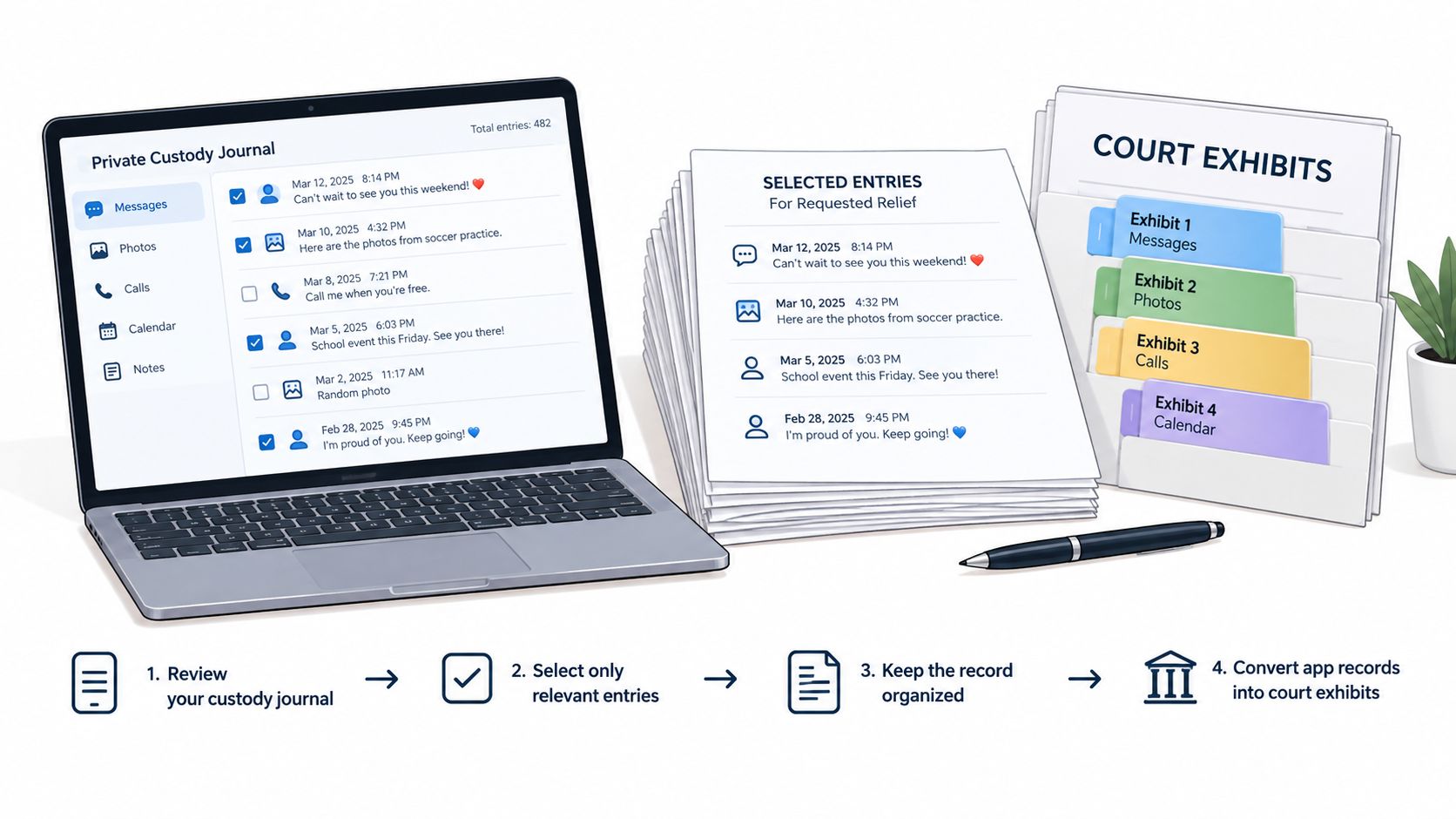
Move from raw entries to a focused attachment
Start by selecting entries that relate directly to the order you're asking for. A complete export may contain useful context, but an attachment filled with unrelated diary notes can make the relevant facts harder to find.
Suppose your original note says: “I can't believe they did it again. They don't care about anyone but themselves. The pickup was a disaster.” Keep that note as the original record. In the affidavit, a neutral summary might say: “On [date], the scheduled pickup was at approximately [time] at [location]. The other parent arrived at approximately [time]. I received no advance message about a delay. The child waited with me at the location. See Exhibit D.”
The summary should match what the original entry and any supporting record show. If you edited the entry later to correct or add information, preserve the earlier version and the edit history rather than hiding the change.
A useful PDF export can show the event date, when the entry was written, later edits, and any attached proof. These details help a reviewer distinguish a contemporaneous note from a later recollection. Check that names and dates are consistent across the export, the affidavit paragraph, and the exhibit label.
For messages, preserve the relevant conversation and its visible timestamps where possible. Avoid submitting isolated fragments that remove context, and follow court rules for redacting sensitive identifiers. A practical guide to printing text messages for court review can help with preparation, but the court decides what format it will accept.
Jurisdictional Rules That Change the Filing Package
A sample can be well written and still be unusable if it doesn't satisfy local filing rules. Courts may differ on the required form, whether a sworn affidavit is necessary, how it must be signed, and what supporting documents belong in the filing. Treat a custody affidavit example as a modular starting point, not a form to copy unchanged.
Florida's official form, for example, requires an affidavit in cases involving parental responsibility, custody, or time-sharing, even when custody is undisputed. It also requires notarization, filing with the clerk, and delivery of a copy to the other party (Florida's official family-law affidavit form). That requirement illustrates why a signature block from an online sample may not be enough.
Before filing, check each item that could change what you submit:
- Form and evidence type: Does the court require its own form, an affidavit, a declaration, or a witness statement?
- Signing requirements: Must you swear or affirm the statement, use a notary, or complete a court-specific block?
- Length and format: Are there page limits, typing requirements, or rules for exhibits?
- Redaction and privacy: Which personal details must be removed or protected?
- Filing and service: Do you file electronically or on paper, and how must you deliver a copy to the other party?
- Related documents: Are financial forms, parenting-plan documents, proof of service, education records, or local cover sheets also required?
The affidavit may be only one part of the filing package. A judge or clerk may also need exhibits, proof of service, and other court forms. Procedural compliance can matter as much as clear prose because an incomplete or improperly signed submission may fail to meet filing requirements.
Check the court's current instructions or ask local counsel before relying on an online example. A guide to filing custody papers can help you organize the process, but only the court's applicable rules determine what must be filed in your case.
Comparing Record-Keeping Options for Custody Documentation
The record-keeping method you choose affects how easily you can find dates, preserve attachments, and prepare a focused export. A shared messaging thread is useful for communication, but it can mix practical arrangements with disputes. A general notes app offers flexibility, yet freeform entries may omit dates or leave evidence stored elsewhere.
A purpose-built private custody journal is another option for keeping personal documentation separate from co-parent communication. Casewell, for example, organizes entries by child and category, uses fields for event type, date, time, and details, keeps attachments beside an event, and produces selected PDF exports that show event dates, entry timing, later edits, and attached proof. It's designed for personal record-keeping rather than communication, and its data stays under the user's control.
| Option | Structure and Fields | Evidence and Export |
|---|---|---|
| Shared messaging thread | Messages appear in conversation order, but discussions and logistics may be mixed together. | Messages can retain timestamps, but relevant exchanges may need to be located and saved separately. |
| General notes app | Flexible for quick entries, but the writer must maintain a consistent format and search or sort the notes. | Photos or files may sit apart from the note; export options depend on the app. |
| Private custody journal | Structured entries can capture event type, date, time, child, and practical details. | Attachments stay with the event, and selected records can be exported for review. |
Choose based on how you document events. If you already keep clear, dated notes and preserve supporting records, a general-purpose app may be enough. If you need structured fields, linked attachments, and focused exports, a dedicated journal may offer a more organized workflow. Whichever option you use, keep original records and avoid relying on a tool's wording as a substitute for your own review.
Starting Your Custody Affidavit Record Today
Begin with the rules for the court that will hear your case. Confirm the correct form, signing requirements, page limits, exhibit rules, and method of filing and service. Don't assume that a sample affidavit's caption or truth declaration will be accepted in your jurisdiction.
Next, write dated entries for recent events using the template fields: date, approximate time, location, people present, observable conduct, and immediate effect on the child. Label each supporting item with an exhibit letter, preserve its original filename and date information, and cite it in the paragraph it supports. Before a hearing or mediation, select only the records relevant to the request and prepare a focused export for review.
If you're unsure whether a statement belongs in your affidavit or whether a record can be filed, ask local counsel or the court before submitting it. A factual, well-organized account is more useful when the form and attachments also meet local requirements.
Casewell provides a private custody journal for organizing dated parenting records, messages, expenses, agreements, and supporting attachments into focused PDF exports for professional review. If you want a structured place to keep the records behind your custody affidavit, visit Casewell and start building a clear, private record.