 Casewell
You're looking at a child support order, a daycare bill, and a calendar that no longer matches the parenting plan. Your income may have changed, or your child may be spending more nights at your home. Before you can tell whether the monthly payment should change, you need to know which facts go into the calculation and how to prove them.
Child support in Colorado starts with a formula, but the result depends on documented inputs. Pay records establish income. A dated calendar supports the overnight count. Receipts, agreements, and repayment records help distinguish an expense someone paid from an expense the other parent must share.
Colorado Child Support Rules at a Glance
Colorado generally calculates monthly support using both parents' incomes, the children covered, parenting time, and qualifying expenses. The statewide schedule supplies the starting obligation, rather than a fixed percentage of one parent's paycheck.
| Rule | Current figure | Why it matters |
|---|---|---|
| Schedule income range | $1,100 to $40,000 combined monthly adjusted gross income, with the upper limit raised March 1, 2026 | Sets the starting basic obligation for most families |
| Children covered by the schedule | One to six children | The number of children directly affects the basic obligation |
| Overnight adjustment | Graduated credit from the first overnight, effective March 1, 2026 | Replaces the former all-or-nothing 93-overnight threshold |
| Modification benchmark | Substantial and continuing change, including a 10% increase or decrease in the order | An older order doesn't update automatically |
| Reimbursement threshold | Former $250 deductible eliminated effective May 31, 2025, under HB 25-1159 | Either party can request reimbursement without meeting the former threshold |
| Age-19 endpoint | Support generally ends when the youngest or only child reaches 19 for orders entered on or after July 1, 1997 | Statutory exceptions can extend support |
| Guideline review | Formal review at least every four years by the Child Support Commission under C.R.S. 14-10-115 | The calculation framework is periodically reviewed |
| Presumption | The guideline amount is rebuttable | A court may depart from it with findings explaining why |
The Colorado Judicial Branch's child support guidance describes the four-year review requirement, the rebuttable presumption, and the general age-19 endpoint for orders entered on or after July 1, 1997. “Presumptive” means the court starts with the guideline result, not that every case must end there.
Parenting arrangements and support are related, but they aren't interchangeable. The guide to Colorado custody laws can help you distinguish the parenting order from the financial order. Find the table row that matches your concern, then use the relevant explanation below to identify the records you need.
What Colorado Child Support Pays For
What is this money supposed to cover? Think of child support as a contribution toward a household budget that keeps running after the parents separate. Your child still needs housing, food, clothing, supervision, and medical care, even though those needs now span separate homes.
The basic obligation addresses ordinary living costs. Other qualifying expenses can affect the calculation or create separate sharing responsibilities. The Colorado Supreme Court's explanation of the guidelines describes a framework based on both parents' economic circumstances, with adjustments for work-related childcare, extraordinary medical expenses, and physical-care arrangements.
Match the Expense to Its Treatment
A cost's category matters because it determines what you're trying to establish. Ordinary groceries support your child, but they aren't treated like an unreimbursed medical bill or a childcare charge entered into the worksheet.
| Category | Typical items | How it is treated | Proof to keep |
|---|---|---|---|
| Basic needs | Housing share, food, clothing, everyday necessities | Covered by the basic obligation in the schedule | Income records and parenting-time log |
| Childcare | Daycare and after-school care needed for work | Qualifying recurring expense in the formula; work-related childcare can be adjusted | Provider invoices, payment records, work schedule |
| Healthcare premiums | The child's share of health insurance | Qualifying recurring expense in the formula | Insurance statements and payroll deduction records |
| Extraordinary medical | Surgery, orthodontics, qualifying therapy beyond routine care | Added to support and divided proportionally by adjusted income | Itemized bills, insurance explanations of benefits, proof of payment |
| Education and activities | School fees, tutoring, sports, lessons | Governed by the order or written agreement; not automatically recoverable | Order or agreement, invoices, repayment request |
Childcare and insurance are formula inputs, not reasons to add the same charge again to a reimbursement demand. Extraordinary medical expenses require a clear account of insurance coverage, the remaining cost, and who paid it.
Separate Spending From Reimbursement
Say you enroll your child in an activity and pay the registration charge. The receipt establishes the purchase, but it doesn't establish that the other parent agreed to contribute or that the order requires contribution.
Read the relevant expense provision before requesting repayment. Check approval requirements, allocation rules, and any instructions about providing bills or making requests.
Practical rule: A receipt alone doesn't make an expense recoverable. The order, any applicable written agreement, and the request history help establish whether repayment is owed.
How to Calculate Child Support in Colorado
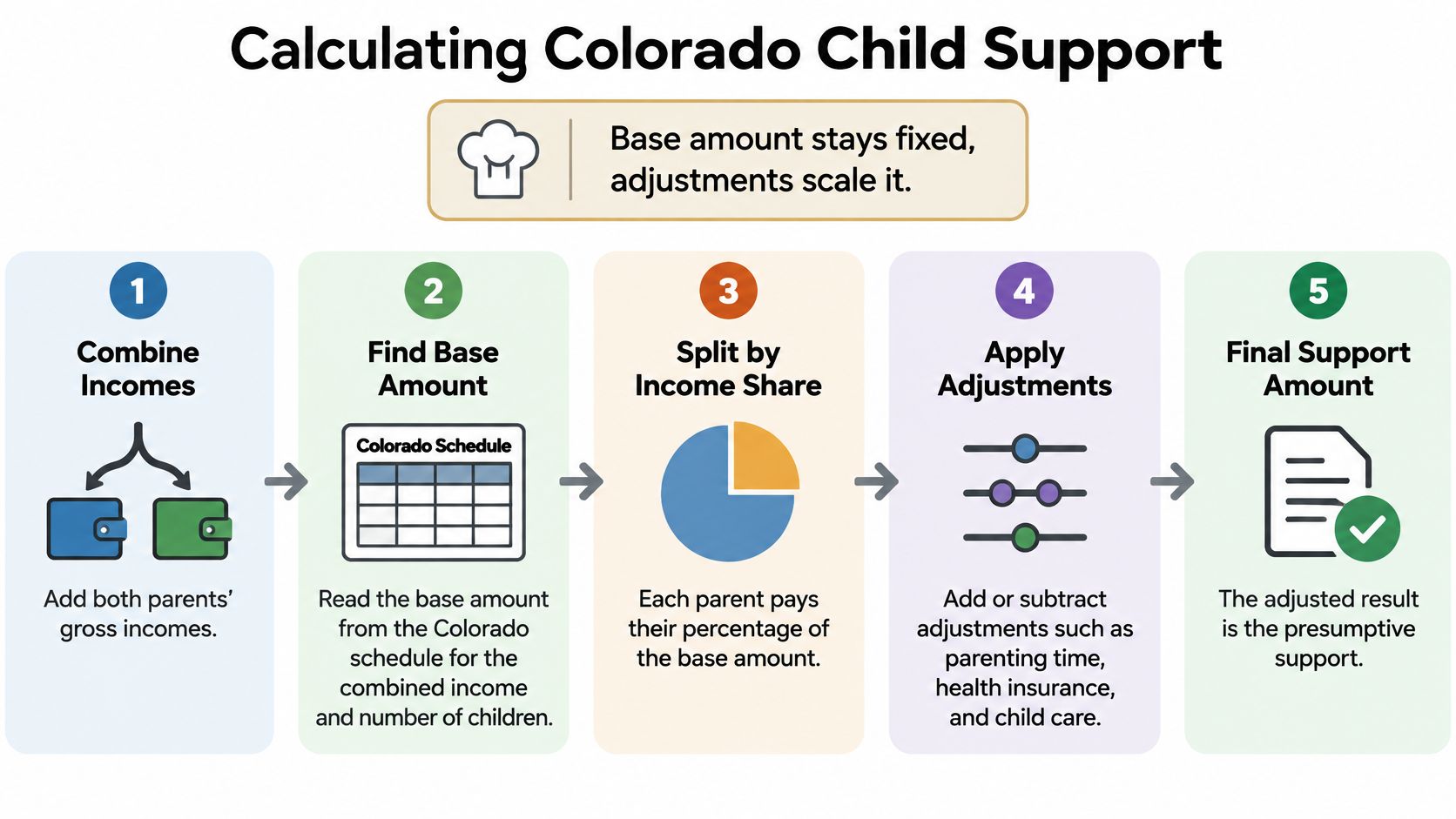
The calculation works like a recipe: the schedule supplies the base, and the worksheet applies the adjustments that fit the household. You can't reliably predict the final payment by changing a single ingredient while leaving everything else unchecked.
This overview shows the relationship between income, the base obligation, and adjustments.
Build the Worksheet From Supporting Records
Gather verified income for both parents. Start with pay statements, tax returns, and records of other income or benefits. Monthly adjusted gross income is a worksheet input, not simply the amount deposited after payroll deductions, so flag questions about income treatment for legal review.
Identify the children covered by the calculation. Use the current order and case documents rather than assuming every child living in either household belongs in this calculation. Bring any other support orders to the person preparing the worksheet.
Find the scheduled basic obligation. Combine the verified adjusted incomes and use the schedule entry for the applicable number of children. The worksheet then allocates responsibility according to each parent's income share.
Document parenting time. Bring the parenting plan alongside a dated record of actual overnights, exchanges, cancellations, and swaps. If the plan and actual care differ, show both instead of silently substituting your preferred count.
Check the low-income provisions. Supply current pay records and benefit information so the preparer can determine whether a reduced calculation applies. Don't assume the ordinary calculation controls just because it appeared on an earlier worksheet.
Enter qualifying expenses and who pays them. Use childcare invoices, insurance statements showing the child-related premium, and medical records showing the uncovered amount. Identify expenses paid directly by each parent so the worksheet doesn't treat the same payment inconsistently.
Distinguish the guideline result from a requested deviation. The completed worksheet produces the presumptive amount after the applicable adjustments. If someone requests a different amount, organize the supporting facts separately so the court can evaluate and explain any departure.
Check the Inputs Before Relying on the Output
A calculator result is only as reliable as the entries. A total insurance deduction may include adults as well as children; a childcare invoice may show charges that were later credited; a calendar may record planned visits rather than completed care.
Keep the supporting document beside each disputed input. Before a hearing or modification request, have counsel or the court's official calculation software generate the controlling worksheet. Don't replace an ordered payment with your own estimate.
When Low Incomes Change the Amount Owed
A paying parent's very low income can change which child-support calculation applies. The current Colorado judicial worksheet recommends $10 per month when monthly adjusted gross income is $650 or less, regardless of the number of children. If income is above that floor but within the applicable self-support reserve, the worksheet lists reduced basic obligations of $50, $70, and $90 for families with one, two, and three children.
| Adjusted gross income | Children | Recommended basic obligation |
|---|---|---|
| $650 or less per month | Any number | $10 per month |
| Above $650, at or below the applicable self-support reserve | One | $50 per month |
| Above $650, at or below the applicable self-support reserve | Two | $70 per month |
| Above $650, at or below the applicable self-support reserve | Three | $90 per month |
These are worksheet recommendations, not permission to reduce an existing payment without review. The self-support reserve protects a portion of the paying parent's resources when the presumptive obligation is calculated.
Why the Income Evidence Matters
Suppose a parent's verified monthly adjusted gross income falls below the worksheet floor. The key question is whether the evidence supports using the low-income rule, rather than what a standard calculation would show at a higher income. Pay records and other documents establish the income figures that go into the worksheet.
If income is above the floor, the preparer must check whether it falls within the applicable reserve before using the reduced amount for the family size. The current worksheet sets the reserve and explains how to handle families with more than three children, so the listed amounts should not be extended on assumption.
Overnights can also affect which calculation applies to a low-income paying parent. The current worksheet sets out how to treat them, and a Colorado family lawyer can confirm the result for a particular case. A few accurately recorded overnights may matter because they help determine which calculation rules apply.
Keep the full income picture: Pay statements, benefit letters, qualifying-expense records, and a timeline of parenting exchanges help show which worksheet inputs apply. A deposit screenshot alone may leave important questions unanswered.
A change in verified income or parenting time can shift a case into a different calculation rule. Keep the documents behind each figure, so the calculation can be checked against the income, expenses, and care that occurred.
How Overnights and Modifications Change Support
More overnights don't automatically mean a lower support payment. Both parents' incomes, the children covered, and qualifying expenses still affect the result.
Record the care that took place, including changes between homes.

The Colorado Bar Association's explanation of the reforms describes how changes effective March 1, 2026 replaced the former 93-overnight threshold with a graduated credit beginning at the first overnight, consolidated the worksheets, and expanded the schedule to $40,000 in combined monthly adjusted gross income. It also explains that modification generally requires a substantial and continuing change, including a 10% increase or decrease in the current order.
Compare a Recalculation With the Existing Order
Under the former structure, crossing the shared-parenting threshold could cause an abrupt calculation change. A graduated credit changes that structure, but it doesn't rewrite an older order automatically.
As a hypothetical arithmetic example, an $800 order recalculated at $700 falls by 12.5%, while a recalculation at $750 falls by 6.25%. The first crosses the percentage benchmark; the second doesn't, and neither calculation alone establishes every requirement for modification.
Use a neutral calendar to support the proposed overnight input. The guide to proving parenting time explains how to organize dated entries and supporting records without replacing facts with accusations.
The order is the baseline. Dated overnight records are evidence supporting a request to change it.
This video offers additional context for reviewing child support questions.
Ask counsel whether to file a motion with the court that entered the order or request review through the state child support program. Confirm the appropriate route and timing before filing, and don't assume a modification will erase amounts already due.
What Happens When Child Support Is Not Paid
A parent loses a job and stops paying, expecting to ask for a reduction after finding work. Meanwhile, the receiving parent continues paying household bills and records the missing transfers. The income change may justify review, but it doesn't itself replace the existing order.
Unpaid support generally accumulates as arrears. A later request to change support doesn't automatically cancel the unpaid balance, so the paying parent should obtain advice about timing rather than waiting for the situation to improve.
Understand the Enforcement Tools
Depending on the case and current agency procedures, child support enforcement can include:
- Income withholding: Support is collected from wages rather than relying on a separate voluntary transfer.
- Tax refund interception: An eligible refund may be applied toward unpaid support.
- License restrictions: Unpaid support can affect certain licenses.
- Credit reporting: The unpaid balance may be reported to credit bureaus.
Contact Colorado Child Support Services with your case number for case-level information. Ask what payment history the agency has recorded and how to address a payment that appears missing.
Keep Records on Both Sides
The paying parent should preserve proof of each payment, including its date, method, recipient, and any transaction reference. If income drops, save termination notices, current pay statements, and benefit letters promptly, keep paying what you can through the required channel, and seek review.
The receiving parent should record what was due, what arrived, and any partial payment. Keep reimbursement disputes separate from the support-payment ledger so the balances remain understandable.
The guide to documenting late child support can help organize the sequence. Neither parent should assume that a private note, an informal promise, or a pending review has changed the enforceable amount.
How to Document Expenses and Reimbursement Requests
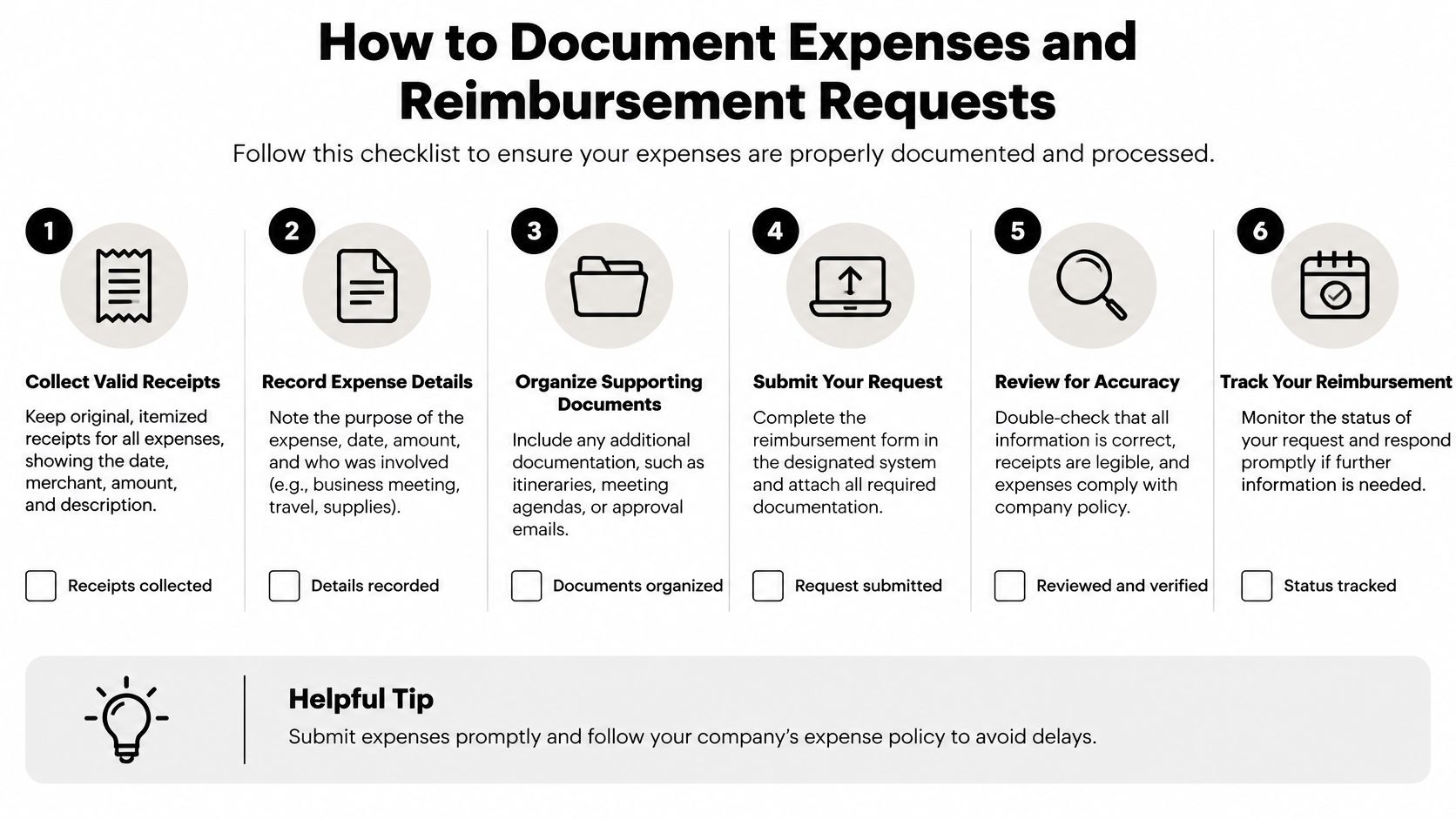
A reimbursement request is easier to assess when each cost can be traced from the child and service to the payment, applicable authority, request, repayments, and remaining balance. Keep those details together so a professional can follow the record without piecing it together from scattered screenshots.
The Colorado Child Support Services FAQ explains expense treatment and the elimination of the former $250 reimbursement threshold effective May 31, 2025, under HB 25-1159. The change removed that threshold, not the need to show that an expense qualifies for reimbursement under the order or agreement.
Create a Traceable Record
Save the receipt with identifying details. Record the service or purchase date, child's name, category, and amount. A cropped total may not show what was purchased or who provided it.
Record who paid and how. Keep a payment confirmation, bank record, or provider statement with the expense. An invoice shows a charge, but does not by itself show that it was paid.
Send a clear written repayment request. Identify the expense, requested share, and relevant order or agreement provision. Attach the receipt and retain the message you sent.
Keep the response and repayment evidence. Save approvals, questions, objections, and payment confirmations with the expense. Mark whether a request is disputed or acknowledged but unpaid.
Update the outstanding balance. Apply partial repayments to the correct expense. A request history without an updated balance can make a partly paid item look unpaid.
Maintain the parenting-time record separately. Record scheduled care, changes, overnights, and the time that occurred, including swaps and cancellations. Use factual descriptions and keep relevant exchange messages.
File the authority beside the expense. Keep the applicable order provision or written agreement with any charge that requires approval or allocation. Approval for one activity does not, by itself, authorize unrelated spending.
Export only the relevant records. Prepare a focused PDF for a lawyer or mediation, including supporting attachments. Preserve the originals and distinguish the event date from the date you entered the record.
Check the Chain Before Sending a Request
The co-parenting expense tracker guide explains how to organize costs and repayment records. Casewell's child expenses log records costs, receipts, who paid, repayment requests, amounts repaid, and what remains outstanding. Its parenting time log records scheduled care, changes, overnights, and the time that took place.
Before sending a request, check for the applicable authority, proof of payment, and a current balance. A clear record helps a professional assess the request, but does not guarantee reimbursement.
Confirm Your Order Before You Ask for a Change
Before requesting a modification or repayment, confirm that your evidence supports the particular decision you're asking someone to make. A well-organized file should answer these questions without requiring a professional to guess.
- Which order governs? Locate the signed support order, any later modifications, and the worksheet supporting the current amount. Ask whether the applicable calculation changes or emancipation provisions affect your situation.
- What inputs have changed? Compare the order's income and parenting-time assumptions with current pay records and dated overnight entries. Preserve both the original assumptions and the evidence of the change.
- Does the recalculation support modification? Have the current worksheet assessed against the substantial-and-continuing-change standard. A different estimate isn't enough by itself.
- Is the reimbursement request complete? Confirm that the expense is child-related, authorized where necessary, paid, requested, and still outstanding.
A Colorado family lawyer can assess the legal basis for modification or reimbursement. Colorado Child Support Services can address agency case questions, payment records, and available review procedures.
For US families, our private, factual records belong to the user and don't depend on the other parent's cooperation. Documentation supports professional review; it doesn't replace legal advice or determine what a court will order.
Casewell offers separated parents a private custody journal for dated overnight records, expenses, receipts, and repayment requests. Visit Casewell and start your record this week by saving your current order, recent income documents, and the evidence behind your next expense request.