
It's 7:04 p.m. and the phone still hasn't rung. Your child is at the other parent's home, you expected a goodnight call, and you're deciding whether to text, call again, or say nothing and feel worse later. By 7:20, you're not just disappointed. You're trying to decide whether this was a mistake, a busy evening, or a broken agreement.
That uncertainty is the problem to fix. A workable arrangement for child custody and phone calls isn't a vague promise to stay in touch. It's a small operating system with a schedule, an access protocol, a safety boundary, an outcome record, and a follow-up rule.
Why Phone Call Terms Create Disputes
A father calls at 7:00 p.m. on Tuesday because the plan says he may have reasonable contact on school nights. The mother says dinner runs until 7:30 and the child was in the bath. He calls again at 7:12 and 7:25. She answers the third call, annoyed, and the child hears the tension before anyone says hello. By Friday, he remembers three blocked attempts and she remembers three intrusive calls during a routine she never agreed to interrupt.
Neither memory proves what happened. The dispute starts earlier, with language that never defined reasonable hours, who initiates, how long to wait, or what counts as a missed call.
Two Different Kinds of Calls
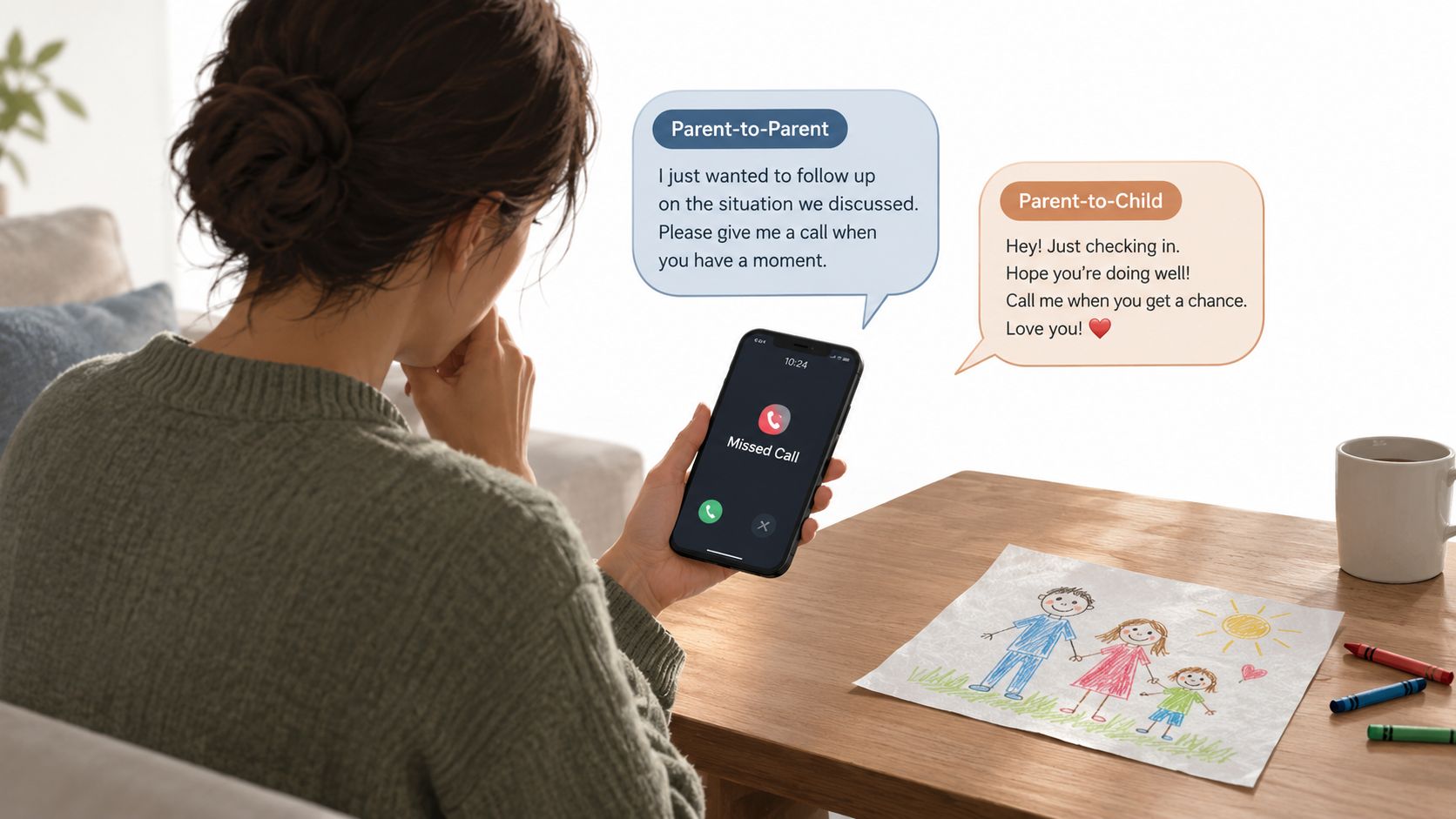
A parent-to-parent call handles logistics, school, health, and schedule changes. A parent-to-child call maintains the child's relationship with the parent who isn't present. Mixing them creates trouble fast. A child shouldn't carry messages about exchanges, hear adults argue about timing, or explain why a call didn't happen.
Frequency alone doesn't solve those questions either. A plan can promise calls three times a week and still fail on timing, supervision, holidays, time zones, homework, and bedtime. Contact also varies with how decision-making is structured. A Canadian government analysis of 2017 survey data showing 47.7% of separated parents reported daily or weekly remote communication, with 71.0% for shared or split decision-making versus 29.4% for sole decision-making gives you a benchmark, not a target for your family.
Don't draft for the evening when everyone cooperates. Draft for the tired Tuesday when dinner runs late and both parents read the same sentence differently.
When communication already triggers tension, treat these terms as decisions, not details:
- Initiator: State who places the call and on which number or device.
- Availability: Define what the receiving parent must do to make the child available.
- Failure mode: Write what happens after no answer, a technical failure, or a child who isn't home.
- Boundary: Set when calling stops for the night so retries don't become pressure.
Build a Workable Call Schedule
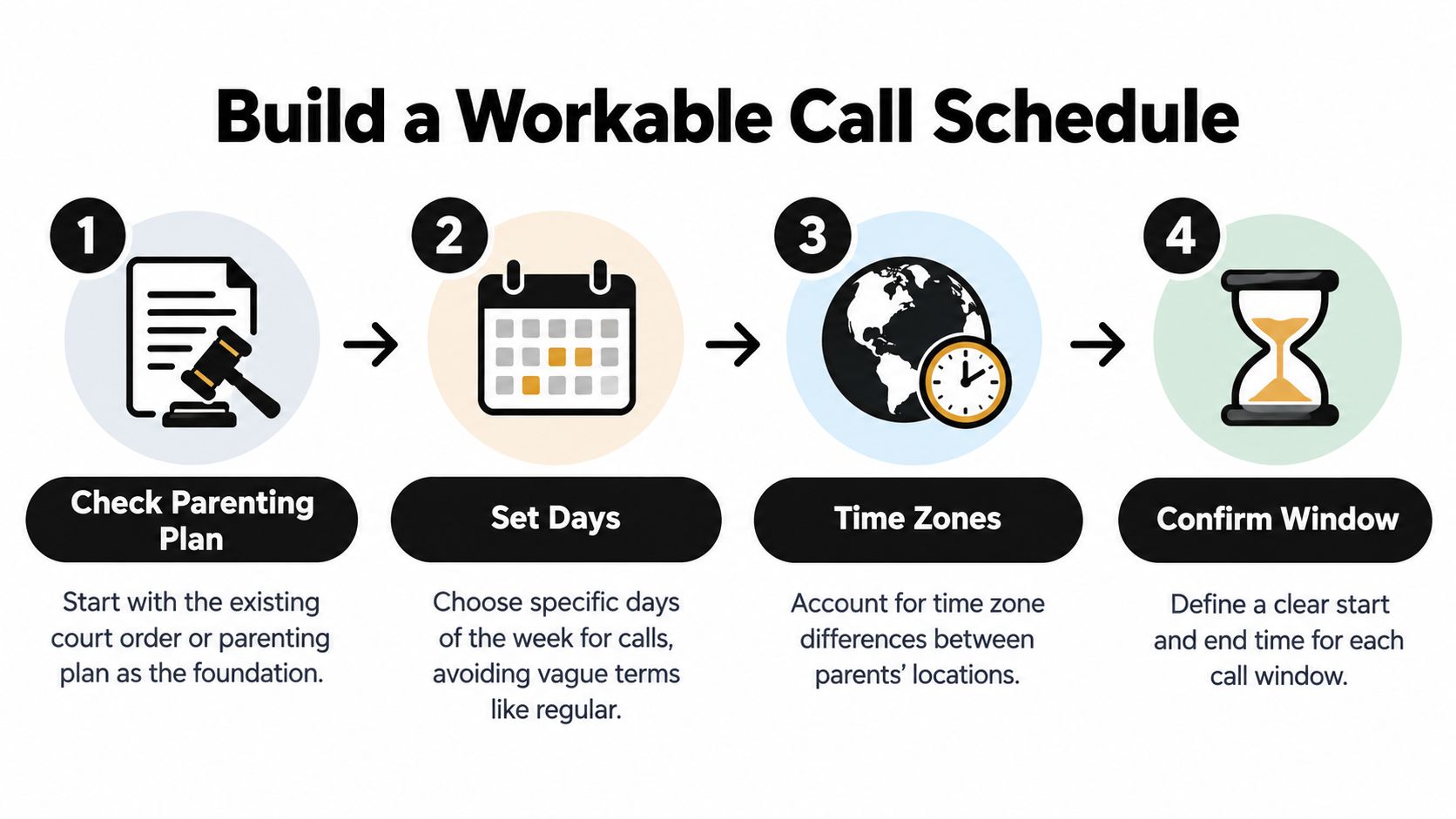
Start with the controlling order or agreement, not with what you wish it said. If a court order already sets days, a window, or a restriction, that language governs until it's formally changed. Your job is to turn it into a routine both households can run without interpreting it every night.
Lock the Core Schedule
Write the days, start window, expected duration, method, and time zone. “Regular contact” isn't a schedule. “Tuesdays and Thursdays, 6:45 to 7:00 p.m. Central, by phone to the receiving parent's listed mobile” is a schedule. If your families live apart, align this drafting work with your long-distance parenting plan so travel days and time zones don't quietly break the routine.
Choose frequency around the child's life, not around adult anxiety. A younger child may do better with shorter, predictable contact. An older child may need room for homework, activities, and friends. Don't use outside findings as a quota. For context, longitudinal European research found weekly telephone contact was 80% versus 86% for mothers and 46% versus 79% for fathers when comparing adults from separated and intact families, describing association rather than causation. That tells you patterns can persist. It doesn't tell you your child needs a call every night.
Add a Tolerance Window and a Backup
A fixed time without tolerance creates false violations. Decide whether a 7:00 p.m. call is still timely at 7:10, how many attempts fit inside the window, and when an attempt becomes a missed call. My recommendation is simple. Allow a short tolerance window, permit one calm retry inside it, then stop and use the written follow-up step.
List these operational details in the plan itself:
- Preferred number: Name the exact phone, tablet, or app account to use first.
- Backup method: State what happens if video fails, such as switching to an ordinary phone call.
- Voicemail rule: Say whether the caller leaves a message and whether the receiving parent returns it that evening.
- Conflict notice: Require advance written notice when a known activity, travel, or illness will move the call.
Handle School Nights, Holidays, and Missed Calls
Don't assume the ordinary schedule works on holidays, birthdays, or travel days. State whether holiday parenting time uses the same window, a morning alternative, or no scheduled call. Do the same for school nights so calls don't collide with homework, meals, or a bedtime routine that leaves the child overtired.
Then define the missed-call path. A workable version might say the receiving parent returns the call within the window if the child is available, or sends a brief written message offering the next agreed window. Avoid automatic make-up calls that stack up. A child doesn't benefit from owing three calls on Sunday because the week went badly.
Practical rule: One scheduled call is one event. Three retries inside ten minutes don't create three missed calls, and they don't create three make-up calls.
Test the draft against a real week. Put school, practice, dinner, baths, and bedtime on paper. If the window only works when nothing runs late, it doesn't work.
Choose the Right Access and Supervision Rules
There's no universally right structure for child custody and phone calls. Pick the least intrusive arrangement that protects the child, fits the order, and can survive an ordinary disagreement. Predictability helps most children. Flexibility helps only when both parents use it in good faith.
Choosing a Call Arrangement
| Arrangement | Best fit | Main advantage | Main trade-off | Must define |
|---|---|---|---|---|
| Flexible reasonable hours | Cooperative parents, older child | Adapts to activities and changing routines | Hardest to enforce or reconstruct later | Hours, initiator, notice, retry limit |
| Fixed window | Repeated timing disputes, younger child | Predictable for child and both households | Needs advance changes when life shifts | Days, tolerance, duration, missed-call step |
| Supervised or facilitated | Safety restrictions or serious conflict | Adds an adult boundary around contact | Depends on availability, consent, and clear roles | Supervisor, location or device, intervention rule |
A flexible arrangement sounds mature, but it fails when “reasonable” means 6:00 p.m. to one parent and any time before bed to the other. Use it only if you also define outer hours, permitted methods, and how a parent gives notice that tonight won't work. Convenience isn't a substitute for clarity.
A fixed window is the better default when timing is already disputed. The child knows when to expect the call, the receiving parent can plan dinner around it, and the calling parent doesn't have to guess. The cost is rigidity. Build in an advance-change process so a school play doesn't become a compliance fight.
Supervision is different. Don't treat it as a compromise you can invent casually. Define who supervises, whether that person stays within hearing, when they may end the call, and whether the arrangement follows a court restriction or professional recommendation. If supervision exists because of safety concerns, the controlling order and qualified advice should drive the design.
Three access questions need direct answers in every model. First, must the receiving parent make the child reasonably available, and what does that mean in practice, such as having the device charged and the child in a quiet place? Second, who initiates, the child, the calling parent, or the receiving parent placing the call at the window? Third, what privacy does the child get? An older child may reasonably speak without a parent listening to every word, while a younger child may need help holding the phone and staying engaged.
Decide voicemail and timing boundaries too. A voicemail can confirm an attempt, but it shouldn't become a recorded argument for the child to hear later. Keep messages brief and neutral. Keep calls away from school hours unless the plan says otherwise, and don't schedule them through meals or right up against bedtime unless that brief goodnight routine is the explicit purpose.
Document Missed and Problematic Calls
Document the rule first, then the event. Without the governing term, a note saying “no call Tuesday” proves almost nothing. Was Tuesday a scheduled day? What window applied? Who was supposed to initiate? A defensible record answers those questions before it describes disappointment.
Use Fixed Fields Every Time
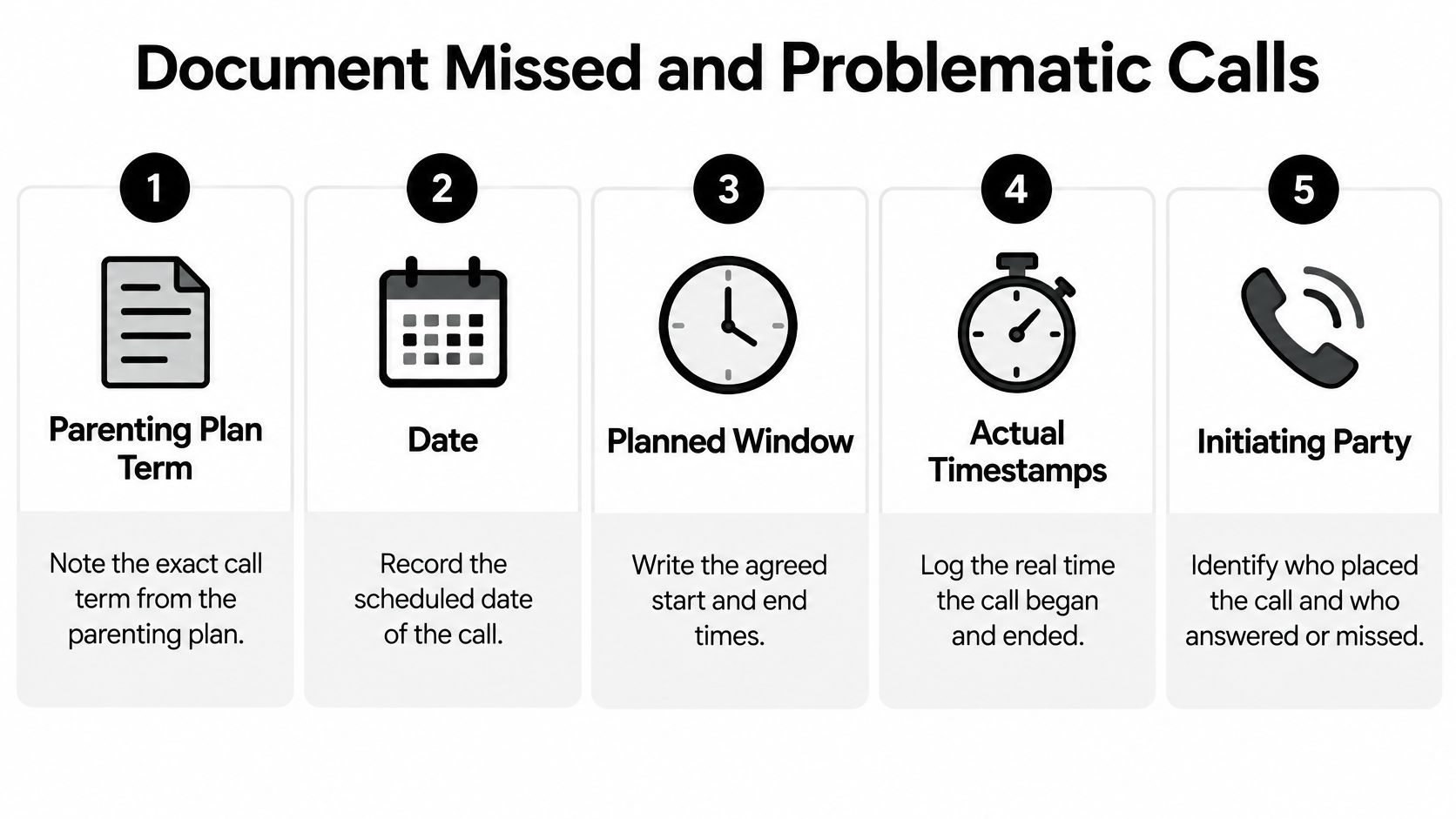
Copy the controlling terms exactly at the top of your record system. Include permitted days, the window, expected duration, method, and any safety restriction. Then log each scheduled event with the same fields, whether it went well or badly. Recording only failures makes your chronology look selective and weakens it.
Use these fields for every call event:
- Date and planned window: Write the scheduled date, start, end, and time zone before the call if possible.
- Actual timestamps: Record when attempts occurred and when a completed call started and ended.
- Parties: Name who initiated, who answered, and whether the child was available.
- Notice: Note any voicemail, text, or written notice sent about a conflict or follow-up.
- Neutral outcome: Use a consistent code such as completed, unanswered, declined, technically unavailable, or child unavailable.
- Follow-up: State what happened next, including a returned call or an agreed alternative window.
That structure follows Missouri court guidance on capturing governing terms, fixed event fields, contemporaneous proof, and neutral outcomes without treating a missed call as intentional interference. Follow that discipline. Don't estimate duration later from memory and present it as fact.
Separate Observation From Inference
Write what you saw, heard, or can verify from a timestamp. “Calls placed at 7:00, 7:04, and 7:11 p.m. No answer. Voicemail left at 7:12” is a record. “Mother blocked contact again” is a conclusion. The first version lets a mediator or attorney assess the pattern. The second version asks them to trust your interpretation and gives the other parent an easy target.
Keep that same separation when a call happens but goes badly. Note the observable fact, such as “call ended after adult voices were heard arguing about tomorrow's exchange,” without assigning motive. If the child said they didn't want to talk, record the words neutrally and who relayed them. Don't interrogate the child afterward to build a better entry.
Preserve Proof Without Overstating It
Call-log screenshots, voicemail metadata, and written notices can support timing and attempts. Save the original file without cropping away context or editing it, and keep it beside the dated entry it supports. For practical handling of those records, use the call logs and voicemail custody guide to keep metadata and notes together instead of scattered across your camera roll.
Know the limit. A call log usually can't prove what was said, why nobody answered, or how the child experienced the call. A screenshot can't prove intentional interference by itself. Patterns matter more than one dramatic evening, and proportion matters too. Preserve what's relevant, don't collect a child's private communications just because you can, and get legal advice before recording calls or accessing device data, because rules vary.
A larger evidence file isn't necessarily stronger. A short, contemporaneous chronology that a neutral reader can verify is stronger.
Protect the Child From Coercive Contact
More contact isn't automatically better contact. That's the assumption parents need to challenge when calls leave a child anxious, secretive, or responsible for an adult's emotions. A call can preserve connection, and it can also become a channel for pressure that follows the child into the other household.
The distinction matters because research on digital contact after separation identifies privacy and monitoring concerns, pressure on children, and cases where domestic violence or safeguarding risks make ordinary virtual contact inappropriate. Judge safety and quality, not volume alone. That judgment also belongs inside your wider approach to boundaries in co-parenting, not in late-night texts after a call goes wrong.
Patterns That Deserve Attention
One technical failure is not coercion. Neither is a child who's tired, distracted, or briefly unwilling to talk. Look for repeated conduct that changes the nature of contact:
- Outside-hours pressure: Repeated calls after the agreed window closes or demands for immediate answers.
- Interrogation: Pressing the child to report on the other parent's home, partner, visitors, or conversations.
- Secrecy and surveillance: Telling the child to hide contact, recording or photographing without agreement, or demanding location details.
- Messenger use: Sending adult messages, threats, guilt, or scheduling arguments through the child.
- Coaching or loyalty tests: Rewarding statements against the other parent or punishing the child for enjoying time there.
Use observable questions before you change anything on your own. How old is the child, and what have they expressed in age-appropriate ways? What's their emotional state before and after calls over several occasions, not one? Is there a safety history or restriction already in the order? Would a trusted adult's device, a scheduled video call, or professional facilitation make contact safer without cutting the child off?
Don't turn the child into your investigator while you answer those questions. Don't ask leading questions after every call, and don't make the child confirm your suspicion. Note observable behavior, timing, and exact words you personally heard, then take the pattern to an attorney, mediator, or appropriate professional. Where domestic violence, a protective restriction, or a safeguarding concern affects contact, don't improvise a new protocol. The order and safety advice control.
Sample Clauses for Your Parenting Plan
Treat sample language as drafting material for review with a qualified professional, not as legal advice you can paste into a filing. The value is operational. Each clause should prevent a specific argument you've already had or can plainly foresee.
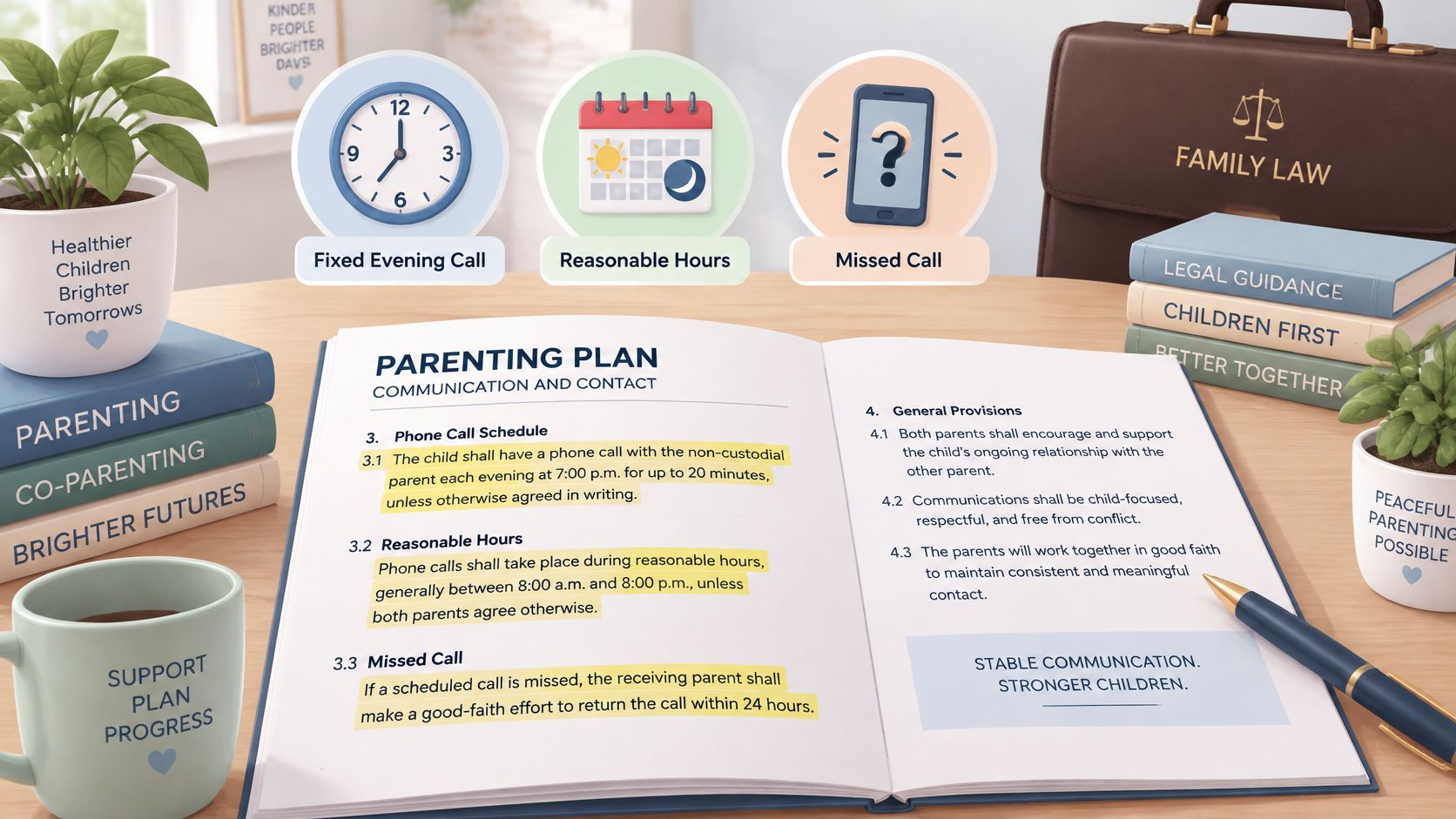
That specificity matters because San Diego court parenting-plan guidance recommends listing preferred numbers and choosing either a reasonable or specific schedule, while related material uses reasonable hours, duration, and intervals. If you're assembling the full document, fit these clauses into your parenting plan template rather than leaving phone access in scattered messages.
Fixed Evening Call
“The child may speak with the non-residential parent on Tuesdays and Thursdays between 6:45 and 7:00 p.m. Central. The calling parent will initiate to the listed mobile number. The receiving parent will make the child reasonably available in a quiet place with the device charged.” This prevents disputes about day, initiation, and facilitation. Add an expected duration if bedtime or a younger child's attention makes an open-ended call unrealistic.
Reasonable Hours Alternative
“Each parent may have phone contact with the child at reasonable hours and for reasonable duration, no later than 30 minutes before the child's usual bedtime, using the listed preferred number.” Use this only when cooperation is real. It preserves flexibility, but it doesn't define frequency or a retry limit, so add those if timing has already caused conflict.
Missed Call and Unavailability
“If the child is unavailable during the scheduled window, the receiving parent will send a brief written notice during that window when practicable and offer the next regular window or one alternative time that evening.” This prevents silent misses and endless retries. It doesn't promise a make-up call in every circumstance, which is deliberate. Illness, travel, and genuine emergencies shouldn't create a debt the child has to repay.
Supervision, Recording, and Confidential Contact
“Calls will occur on the agreed device with the named adult present as required by the order. Neither parent will record, photograph, or ask the child to keep scheduled contact secret unless a court order or written agreement expressly permits it.” This prevents surveillance and secrecy from creeping into ordinary contact. If supervision or recording is legally required or prohibited in your case, that controlling language wins over this sample.
Raising Concerns
“A parent with a concern about a call will raise it in writing to the other parent within a reasonable time, identify the date and scheduled window, and propose a specific adjustment.” This keeps complaints tied to events instead of character attacks. It also creates a record that you tried to solve an operational problem before escalating it.
Before you adopt any clause, check four things. It must match the current order, fit the child's routine and developmental needs, respect any safety restriction, and name a follow-up step that doesn't involve the child carrying the message.
Verify the Plan Before Problems Escalate
Don't sign off on call language just because it reads well. Verify it like an operating procedure. Compare every day, window, number, and restriction against the current order, then record the agreed contact details in one place both parents can reference. If the order and your informal routine differ, write down that gap and get advice before you rely on the routine.
Run a defined trial period and keep one chronology. Record scheduled calls, completed calls, returned missed calls, advance cancellations, and documented technical failures as separate outcomes. You can review simple measures for your own understanding, such as completion rate and return-call rate, but disclose the period, denominator, and exclusions. Don't present homemade percentages as court-valid success rates.
Count carefully. Don't count an attempt as a completed contact, double-count retries, combine siblings into one denominator, or treat a child's unwillingness on one evening as proof of obstruction. Note exceptions with supporting facts and keep screenshots or written notices beside the relevant entry. Consistency with the written plan is the benchmark, not maximum call volume.
For that record-keeping, Casewell is a private custody journal for structured entries, attachments, agreement records, exchange check-ins, and focused PDF exports. It isn't a messaging service and it doesn't replace legal advice. Use a tool like that, or a disciplined notebook system, to keep dated call events and proof together so a professional can review the sequence quickly.
Bring in an attorney or mediator when interpretation, enforcement, recording, or safety is disputed. Do that while the problem is still a pattern of missed windows, not after months of accusations have hardened into positions neither parent can prove.
Keep your parenting-plan terms, scheduled windows, call outcomes, screenshots, and follow-up notes in one private chronology so you can show a pattern without putting your child in the middle. Visit Casewell to organize child custody and phone calls into dated structured entries with attachments and focused PDF exports for your attorney or mediator.