

Friday's pickup was supposed to happen at 5 PM. At 5:20, there's no message. At 5:45, the other parent arrives angry, insisting that the schedule was “understood differently.” A short disagreement becomes a long exchange about past failures, the child waits, and nobody can easily separate the agreed plan from what took place.
That pattern is why boundaries in coparenting need more than good intentions. A workable boundary has three parts: a specific limit, a predictable response, and a factual record. The limit might define when messages are sent, who makes a decision, or where an exchange occurs. The response should reduce improvisation. The record should show the agreement, the outcome, and any supporting evidence without turning documentation into another argument.
Formal parenting plans already separate day-to-day caregiving from major decisions such as parenting time, schooling, medical care, communication, and dispute resolution, as outlined in Washington State's parenting-plan guide. The eight strategies below apply that same structure to ordinary situations, repeated deviations, finances, exchanges, privacy, and high conflict.
Documentation isn't a substitute for legal advice, a court order, therapy, or emergency help. If a child faces immediate danger, contact emergency services or an appropriate safeguarding professional. For ordinary record-keeping, Casewell is an optional private tool for organizing dated entries, agreements, evidence, and focused PDF exports.
1. Written Communication Documentation
Verbal agreements disappear into competing memories. Written communication gives both parents a shared reference point, especially when a schedule, school decision, medical issue, or expense may matter later.
Use one agreed channel for routine communication when possible. The channel should be practical, accessible, and consistent with any parenting plan or professional advice. Written channels such as email and texting are commonly used by separated parents, which makes concise wording and durable records operationally important, as described in research on communication patterns among separated parents.
A useful message confirms one issue at a time:
Practical rule: Write messages so a neutral reader can identify the request, the deadline, and the expected next step.
For example: “The parenting plan lists Friday pickup at 5 PM. I'll be at the agreed location at that time. Please confirm by Thursday at 6 PM if you're unable to attend.” If the other parent replies with criticism, don't answer every accusation. Respond only to the scheduling question, or record that no practical answer was provided.
Record the agreement and the outcome
Create a dated entry after significant communication. Include the channel, date, time, child involved, subject, exact agreement, and result. A useful entry might say:
- Agreement: Friday pickup scheduled for 5 PM.
- Communication: Text confirmation received on Thursday.
- Outcome: Parent arrived at 5:45 PM on Friday.
- Evidence: Relevant messages attached.
Record the agreement that pickup is at 5 PM, then record the actual arrival at 5:45 PM. If a parent verbally agrees to pay a child-related expense, document the conversation promptly and track whether payment occurs. You can also compare a message about school enrollment with the later action, rather than relying on a general statement that the decision was ignored.
Write close to the event while details are fresh. Keep the initial note factual and review it before sharing it with an attorney or mediator. A structured guide to preparing text messages as evidence can help you preserve the relevant sequence instead of forwarding scattered screenshots without context.
2. Structured Agreement Tracking With Outcome Comparison
A Wednesday arrangement can look clear until one parent cancels, changes the location, or treats a verbal exception as a permanent change. Record the agreed terms before comparing them with what happened. “The child will be at the father's home on Wednesdays from 3 PM to 7 PM, unless both parents confirm a change in writing” creates an observable standard.
The governing parenting plan or order controls the parties' responsibilities. It may address residence, parenting time, decision authority, disagreement procedures, communication, and safety conditions. Informal expectations should not be treated as changes to that document. For legal significance, ask a qualified attorney or mediator to interpret the applicable order.
Build a comparison record
Keep the signed order, written agreement, or prompt confirmation of any verbal agreement. Enter its working terms in a consistent record:
- Schedule: Day, start time, end time, location, and notice requirement.
- Decision authority: Which parent decides, which parent is consulted, and how consultation occurs.
- Expenses: What requires approval, who pays, and when reimbursement is due.
- Communication: Approved channel, urgent-contact method, and response expectations.
Then record the result beside the relevant term. If the Wednesday visit was scheduled from 3 PM to 7 PM and the father cancelled without notice, note the scheduled arrangement, the cancellation time and channel, the child-care result, and the messages supporting each entry. If the parents share medical expenses, preserve the dental charge, payment, reimbursement request, due date, and remaining balance. If one parent holds education decision authority and the other enrolls the child in an activity without consultation, retain the enrollment notice and document the sequence without speculating about intent.
Review the entries periodically to distinguish an isolated deviation from a recurring problem. Do not wait for a review when a child's immediate needs require action. Agreement records and linked deviations can be organized for professional discussion, while an attorney or mediator can explain which facts may carry legal significance. Use neutral wording, keep evidence attached to the related entry, and enforce the stated boundary through the agreed communication channel rather than escalating the exchange.
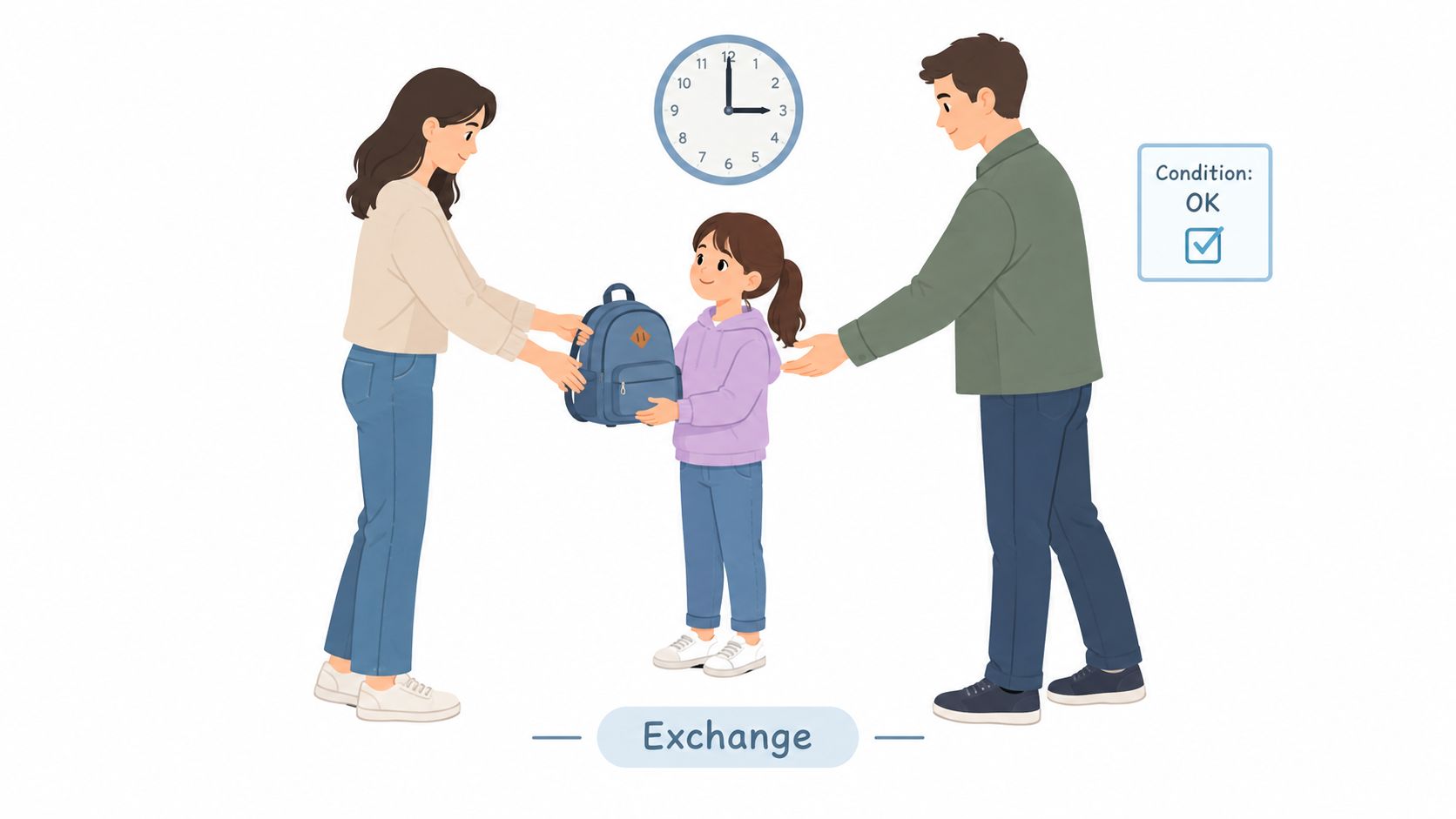
3. Exchange Check-In and Handover Documentation
At 5:12 PM, a child arrives at the library entrance with food stains on their shirt and the school backpack in hand. That entry records observable facts without turning one handover into a judgment about the other parent.
Before each exchange, confirm the agreed time and location. Afterward, record whether the handover occurred, each parent's arrival time, who was present, and any directly observable concern. A useful entry might read: “Child arrived at 5:12 PM at the library entrance. Shirt had visible food stains. Child carried the school backpack.” Record the outcome beside the relevant agreement, so the schedule and the event can be compared later.
Keep children out of evidence collection. Do not interrogate a child or ask them to prove what happened in the other home. If a child voluntarily raises a concern, write the words as accurately as possible, including the date and time, then seek professional guidance when appropriate. For example: “Child said, ‘I was scared during the argument,’ at 7:15 PM after returning home.” This preserves the statement without asserting its cause.
Use the same short check-in for every regular handover:
- Timing: Scheduled and actual arrival or departure.
- Location: Whether the agreed place was used.
- Condition: Observable clothing, belongings, or physical presentation.
- Child's words: A direct statement only if volunteered.
- Follow-up: Medical, school, safety, or professional action taken.
The exchange log template can keep entries consistent. Attach supporting messages, notices, or photographs to the relevant record, and note when an agreed boundary was enforced. If a handover is missed, record the cancellation channel, time, childcare result, and next action rather than continuing an argument in messages.
Keep the record brief. Its purpose is to preserve the schedule, handover outcome, and safety-relevant facts for later review or professional discussion.
4. Financial Boundary Documentation and Expense Tracking
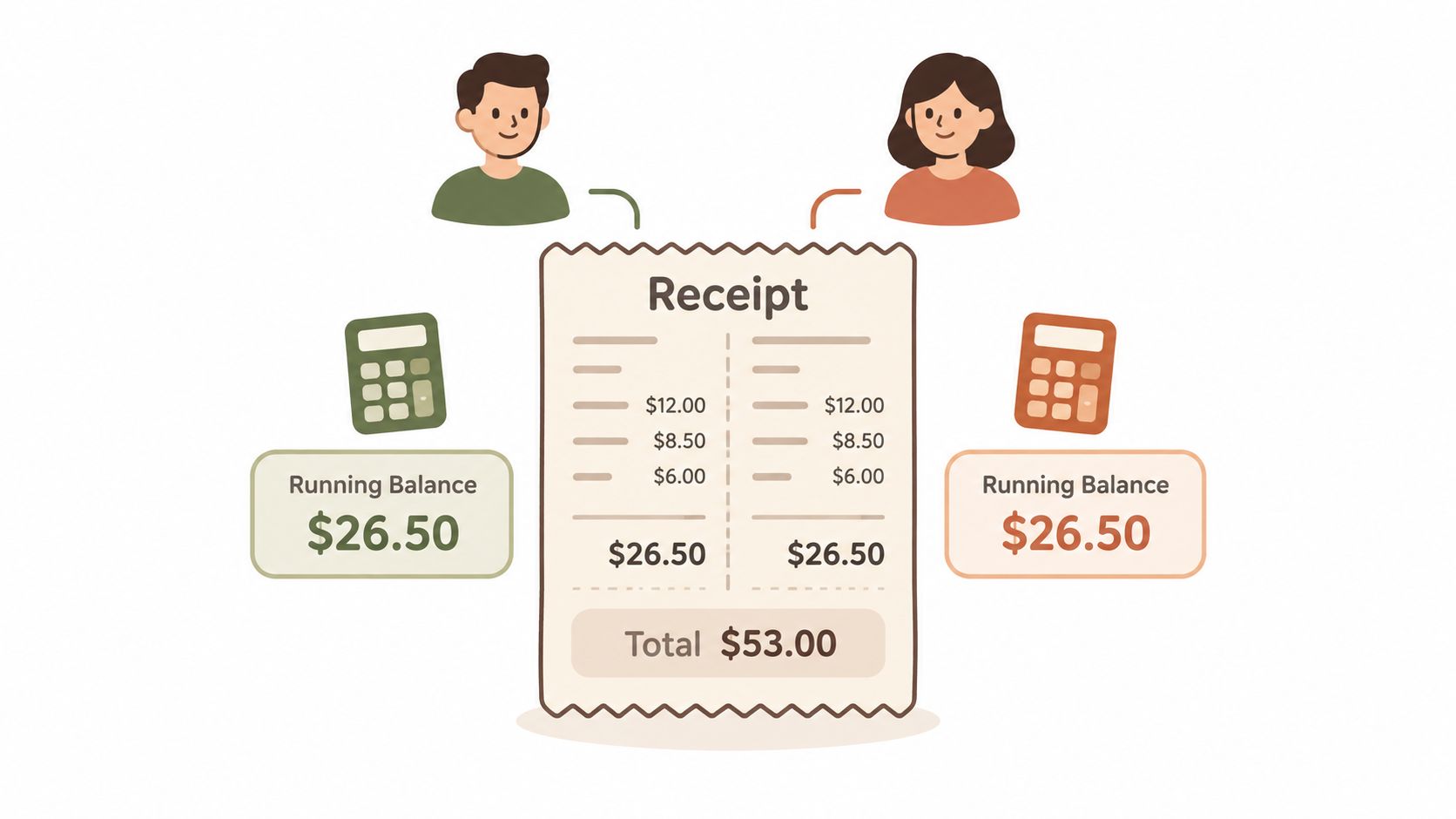
A reimbursement dispute often starts with a receipt and ends with competing accounts of what was agreed. A financial boundary keeps the discussion tied to what was spent, who paid, what was agreed, and what remains outstanding. It also gives each parent a defined response path without turning every expense into a personal argument.
Record each child-related cost as soon as the transaction occurs. Keep medical, school, activity, clothing, and other expenses in separate entries. For each entry, attach the receipt or invoice, identify whether the cost was planned or unexpected, and record when reimbursement was requested.
Use fields that show the full transaction:
- Expense: Description, provider, date, and child.
- Amount: Total cost and each parent's expected share.
- Approval: Whether the expense was agreed in advance.
- Payment: Who paid and when.
- Reimbursement: Request date, response, payment, and remaining balance.
- Proof: Receipt, invoice, message, or payment confirmation.
Record outcomes precisely. If one parent paid $1,200 for braces and requested reimbursement of 50% within 30 days, note the request and deadline. If the other parent pays $500 on day 45, enter the payment date and calculate the remaining amount. “Partially paid” alone does not show what is still owed. For an emergency-room visit costing $850, preserve the receipt, describe the relevant circumstances, and record the agreement about joint payment.
A child expense tracker can place receipts, approvals, requests, and payment updates beside the related event. Photograph or scan receipts promptly. Account portals and paper records may become difficult to access later.
Review the record for accuracy before contacting the other parent. If activity fees are repeatedly paid by one parent without reimbursement, prepare the entries for mediation or legal advice. The trade-off is simple: a focused record takes time now, but reduces repeated explanations later.
Send one neutral request with the evidence attached: “The receipt and reimbursement request are attached. Please confirm whether you dispute the expense or the amount by Friday.” Record the response, preserve the message, and enforce the agreed process without adding accusations.
5. Deviation Documentation With Evidence Attachment
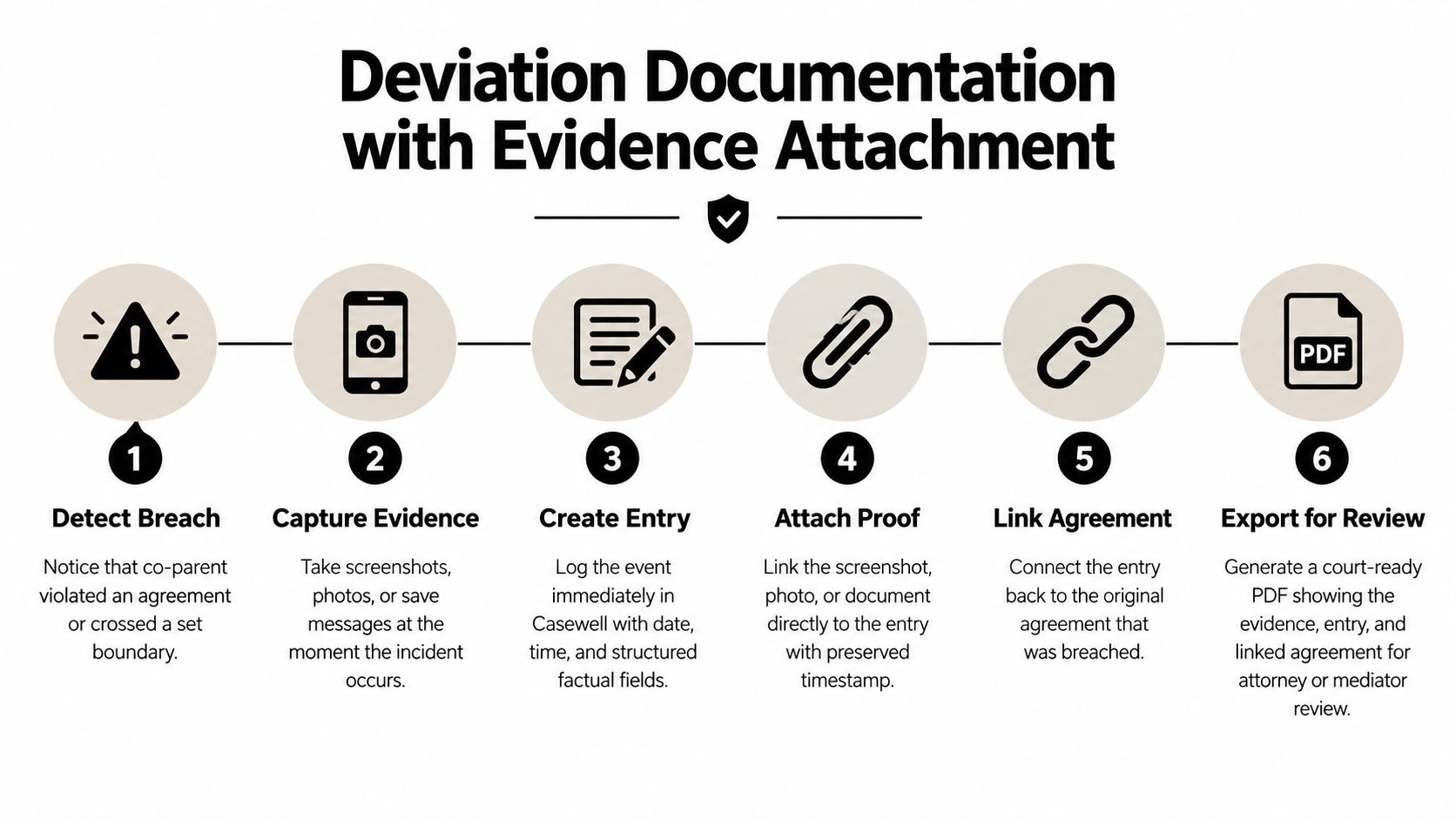
A missed pickup can create an argument in minutes. A documented deviation creates a reviewable record. Link each event to the specific expectation, capture the outcome, preserve supporting evidence, and keep any response focused on the child's needs and the agreed process.
Record four points first: the relevant term, the scheduled date and time, what occurred, and the effect on the child or schedule. Add the message, email, receipt, photograph, registration notice, or other document that supports the entry. Use a clear filename such as 2024-05-12-pickup-cancellation, so another person can locate the evidence without interpreting a phone gallery.
Match the attachment to the statement it supports. A screenshot saying, “I'm canceling pickup,” documents the cancellation. It does not establish the reason or prove a wider motive. A registration email shows that an activity was entered. It does not, by itself, establish that consultation was legally required.
Use a compact record like this:
- Schedule deviation: Preserve the cancellation message and compare the scheduled and actual arrangements.
- Medical concern: Record observable facts, obtain appropriate care, and keep relevant medical documentation.
- Unilateral decision: Attach the activity confirmation and the earlier communication showing whether consultation occurred.
- Property or belongings issue: Photograph the item or condition when safe and appropriate, then describe only what is visible.
Keep dated evidence with its related event. If the material concerns a child, protect the child's privacy and dignity. Capture only relevant information, and obtain professional guidance on photographs, recordings, and disclosure rules.
Evidence should answer three questions: What was agreed? What happened instead? What document or observation supports that account?
The workflow is repeatable: define the agreement, record the outcome, preserve the evidence, and enforce the boundary without escalating communication. A brief message may be enough: “The pickup was scheduled for 5 p.m. The cancellation message and revised arrangement are attached. Please use the agreed notice process for future changes.” Record the reply and stop there. Repeated claims about “my evidence” often invite another dispute, while consistent private documentation preserves a clearer record for later professional review.
6. Temporal Pattern Recognition and Behavioral Tracking
One late pickup may result from an isolated problem. A series of late pickups may require a schedule adjustment, a professional conversation, or a different exchange arrangement. Chronology helps separate those possibilities without relying on memory shaped by the latest conflict.
Use the same category for similar events. “Late pickup,” “missed exchange,” “school communication,” and “health concern” are more useful than free-form labels that change from entry to entry. Record the scheduled time, actual time, explanation offered, and impact on the child or household.
Review patterns without exaggerating them
If the calendar shows repeated lateness, describe the entries rather than assigning a motive. “Parent arrived more than 15 minutes after the scheduled time on nine of the last 20 exchanges” is a factual summary only when the underlying records support it. The number comes from the parent's own chronology, so preserve the individual dates and times behind the summary.
Likewise, if a child returns with soiled clothing after multiple exchanges, record each date and exactly what was observed. Don't write “this always happens” unless the record supports that statement. If a child repeatedly makes comments about substance use, capture the child's words, the date, and the response taken. Don't investigate through the child or turn the child into a witness.
A custody chronology builder can help organize categories, dates, and supporting entries. A filtered timeline may be easier for a professional to review than a large diary containing unrelated frustrations.
A pattern is not a conclusion. It is a sequence of dated observations that lets a qualified professional decide what the sequence means.
Review the chronology monthly if concerns are ongoing. Earlier documentation is usually easier to evaluate than a reconstruction written immediately before mediation or a hearing. If the pattern stops, record that too. Accurate documentation includes changes that don't support your initial concern.
7. Neutral Documentation and Emotional Boundary Separation
A factual record isn't emotionless because the situation is insignificant. It is factual because the record serves a different purpose from emotional processing. The journal should help a mediator, attorney, therapist, or safety professional understand what happened without requiring them to decode insults, diagnoses, or assumptions.
Replace conclusions with observable details. Instead of “The co-parent was drunk and negligent,” write: “At the 5 PM pickup, the co-parent's speech sounded slurred, their eyes appeared bloodshot, and they had difficulty standing steadily.” Record what happened next and contact appropriate professional support if the child may be unsafe.
Instead of “The co-parent is emotionally abusive,” identify the interaction: “During a 12-minute call about school choice, the co-parent said, ‘You're a terrible parent and you're ruining our child's life.’ The child was present and said they felt scared.” Preserve the exact wording only when you heard it accurately and can identify the context.
Separate fact, interpretation, and response
A useful entry can have three layers:
- Observed fact: What you saw, heard, received, paid, or did.
- Child impact: The child's direct statement or observable reaction, without diagnosing it.
- Response: Medical care, school contact, professional advice, or schedule adjustment.
For a missed asthma appointment, record that the appointment was scheduled for June 3, notice was sent on May 28, the other parent didn't arrive for pickup, and the appointment was missed and rescheduled for June 10. That sequence is more useful than saying the other parent doesn't care about medical needs.
Write the emotional draft somewhere private if you need to get it out. Then create the factual record separately. An optional factual-rewrite feature can help neutralize wording, but review every suggested change before saving it. A tool must not remove important facts, soften a safety concern, or change a direct quote.
The same discipline applies to messages. Don't send an accusation and then copy it into the journal as if it were evidence. Record the original communication, the observable result, and your response. Keep judgment for a setting designed to process emotion, not for a document another professional may need to assess.
8. Privacy-Protected Personal Record Maintenance and Historical Entry Preservation
Some parents need a private record because sharing every note with the other parent would create more conflict. Privacy isn't a license to weaponize documentation. It gives you room to record accurately, preserve context, and choose focused material for professional review.
Keep the broader journal separate from material you share. A mediator may need the agreement, the relevant deviations, and the attached messages. They may not need every private reflection about the relationship. A focused report is easier to review and less likely to bury the material that matters.
Preserve corrections transparently
Write entries soon after an event. If you later discover an error, don't overwrite the original without notice. Add a correction with the new timestamp and explain why the change was made.
For example, an entry written at 3:47 PM might say the child appeared tired after the exchange. Later, you may add that the child said they hadn't slept since the previous night. Keep the original entry and identify the later clarification. If you first recorded an arrival at 4:15 PM but later confirmed through a security-camera timestamp that it was 4:47 PM, preserve the correction and its basis.
This approach protects credibility because it shows how the record developed. It also acknowledges that real-time notes can contain small mistakes. A transparent correction is generally more defensible than a perfectly polished history that appears to have been reconstructed all at once.
Use an app lock or private vault when appropriate, and understand that privacy settings don't guarantee legal privilege or immunity from disclosure. Ask an attorney about what may be discoverable in your jurisdiction. Don't secretly record calls, photograph sensitive situations, or access another person's account without advice about applicable law.
Keep personal thoughts in a separate journal. The factual record should include dates, times, direct observations, agreements, evidence, and responses. If the co-parent asks about your documentation, avoid turning the question into a confrontation. Share only what is appropriate and follow professional guidance when a dispute is active.
Coparenting Boundaries: 8-Point Documentation Comparison
| Item | 🔄 Implementation Complexity | ⚡ Resource & Effort | 📊 Expected Outcomes & Impact | 💡 Ideal Use Cases | ⭐ Key Advantages |
|---|---|---|---|---|---|
| Written Communication Documentation | Low–Medium, routine logging discipline required | Moderate, timely entries, minimal tech | High, objective, court‑admissible record that reduces disputes | When verbal agreements are unreliable; mediation prep | ⭐ Clear accountability; reduces misunderstandings |
| Structured Agreement Tracking with Outcome Comparison | Medium, requires setup of formal agreement records and links | Moderate, define measurable terms and maintain links | High, exposes deviations and enforces measurable boundaries | Custody schedules, expense-sharing, formal agreements | ⭐ Makes expectations explicit; shows non‑compliance patterns |
| Exchange Check-In and Handover Documentation | Low, scheduled prompts simplify process | Low–Moderate, quick post‑exchange notes each handover | High, reveals punctuality patterns and child welfare indicators | Regular custody exchanges; welfare monitoring | ⭐ Routine cadence normalizes documentation; safety flags |
| Financial Boundary Documentation and Expense Tracking | Low–Medium, needs systematic receipt and expense entries | Moderate, collect receipts, track reimbursement status | High, objective proof of payments and balances owed | Shared expenses, reimbursement disputes, financial court review | ⭐ Prevents disputes; provides receipts and running balances |
| Deviation Documentation with Evidence Attachment | Medium, immediate capture plus secure evidence handling | Moderate–High, photo/screenshot capture, attachment management | Very High, strong, timestamped evidence of breaches | Incidents, agreement breaches, safety or legal escalation | ⭐ Visual, timestamped proof that strengthens claims in court |
| Temporal Pattern Recognition and Behavioral Tracking | Medium, tagging and long‑term data collection required | High, sustained documentation over weeks/months | High, demonstrates trends vs isolated incidents; exportable reports | Establishing chronic issues (lateness, neglect, behavior) | ⭐ Objective pattern detection; powerful timeline evidence |
| Neutral Documentation and Emotional Boundary Separation | Low, structured fields and optional AI rewrite help | Low, use prompts and review neutral rewrites | High, increases credibility with mediators and courts | High‑emotion cases where tone could undermine records | ⭐ Neutral language boosts professional credibility; reduces bias claims |
| Privacy‑Protected Personal Record Maintenance and Historical Entry Preservation | Low–Medium, configure privacy and preserve edit history | Low, single‑user vault, selective sharing; disciplined use | High, honest private records with transparent timestamps and edits | High‑conflict situations or when sharing is unsafe | ⭐ Control over sharing; preserved original entries and edit transparency |
Turn Boundaries Into a Repeatable Routine
Effective boundaries in coparenting don't depend on persuading the other parent to agree with your interpretation. They depend on making expectations specific enough to observe and responses consistent enough to repeat. A parenting plan may already define decision rights, schedules, communication, exchanges, and dispute resolution. Your daily workflow should translate those terms into actions you can carry out calmly.
Use this enforcement loop:
- State the boundary: Define the time, place, channel, decision authority, expense rule, or behavior in concrete terms.
- Communicate briefly: When appropriate, send one written message that identifies the relevant agreement and the practical next step.
- Document the event: Record the date, time, people involved, agreement, outcome, and child-related impact using observable language.
- Preserve evidence: Attach the message, receipt, photograph, school notice, medical document, or other relevant proof.
- Review deviations: Look for recurring issues and take the organized record to a qualified attorney, mediator, or other appropriate professional.
The loop works because it separates enforcement from argument. You don't need to prove a motive in the message. You don't need to answer every insult. You do need to follow the order or agreement that applies, make reasonable safety decisions, and document what occurred accurately.
Research on shared parenting has found that conflict is not automatically higher in families with shared parenting, and that many high-conflict families reduce direct contact through parallel parenting, fewer switching-hour interactions, and limited communication. The synthesis reviewed 14 studies involving 2,767 sharing couples and 13,281 non-sharing couples, with conflict levels about the same for 59% of families, lower for sharing parents in 40%, and higher for sharing parents in 1% (shared-parenting research synthesis). Those figures don't tell you what arrangement fits your family. They do reinforce a practical point: reducing unnecessary contact can be more effective than forcing open-ended cooperation.
Boundaries also need to respect the difference between your own conduct and rules enforceable against the other parent. You can control whether you answer provocative messages, whether you use the agreed channel, and whether your records remain factual. You can't unilaterally rewrite legal decision authority or impose new restrictions because the other parent ignores your preference. Family-systems research describes boundaries as rules that structure relationships and protect autonomy, while unclear boundaries are associated with poorer coparenting quality (research on boundary ambiguity and coparenting). Use professional advice when the issue involves repeated violations, safety, family violence, or a proposed change to the parenting plan.
Records should support safety and clarity, not provoke the other parent. If a child faces immediate danger, contact emergency services or an appropriate safeguarding professional rather than waiting to complete a journal entry. For ongoing disputes, choose one boundary today, write its standard in plain language, and begin recording each relevant outcome consistently.
Casewell offers a private custody journal for dated, factual records, with structured entries for agreements, exchanges, expenses, screenshots, receipts, and other evidence. Its searchable timeline and focused PDF exports can help you organize a clear record for professional review. Visit Casewell to choose one coparenting boundary and start documenting it consistently.