
There generally is no legal procedure for an adult to formally divorce or unilaterally dissolve the parent-child relationship just because the relationship has broken down. What people often mean is emotional estrangement, and that is a very different thing from legal severance.
A person may stop answering calls, move away, or set hard boundaries. Those choices can be profoundly important, but they usually do not erase parentage, inheritance rules, birth records, or earlier legal ties.
Understanding the Legal Reality of Divorcing Parents
A young adult can feel finished with a parent long before the law is finished with the family relationship. Someone might leave home, stop sharing personal updates, and decide not to attend holidays, yet still find their name tied to family records, inheritance rules, and other legal consequences. That gap between lived distance and legal status is where most confusion starts.

Legal severance is rare. A law-review analysis notes that legal systems “by and large” do not provide a mechanism to sever the parent-child bond by personal choice, which is why the phrase “can you divorce your parents” usually describes an emotional question rather than a courtroom remedy (Brooklyn Law School journal analysis).
Why people ask this question
Some readers are adults looking for a clean legal break after abuse, manipulation, or years of conflict. Others are minors who want independence from parental control and are really asking about emancipation. Those are not the same problem, even if the frustration behind them feels identical.
Practical rule: If you want distance, the law may let you create distance in daily life. It usually won't let you rewrite biology or family history on demand.
A divorce between spouses ends a marriage. It does not normally end a parent's legal relationship with a child. That distinction is central in family law, and it's why custody, support, residence, contact, and parental responsibility are treated as separate questions from the marital status of the parents (EU parental responsibility guidance).
For adults, that means the practical path is usually boundary-setting, not legal severance. For minors, the path may involve a court process, but even then the remedy is usually emancipation, not a full erasure of parentage. A useful place to start is this overview of what family court handles, because many readers first need to understand which issues a court can decide.
Emancipation, A Legal Path for Minors
A minor who wants legal independence is usually talking about emancipation, a court process that can give a young person some adult legal powers before reaching the age of majority. Cornell Legal Information Institute explains the basic rules for emancipation of minors (Cornell Legal Information Institute).
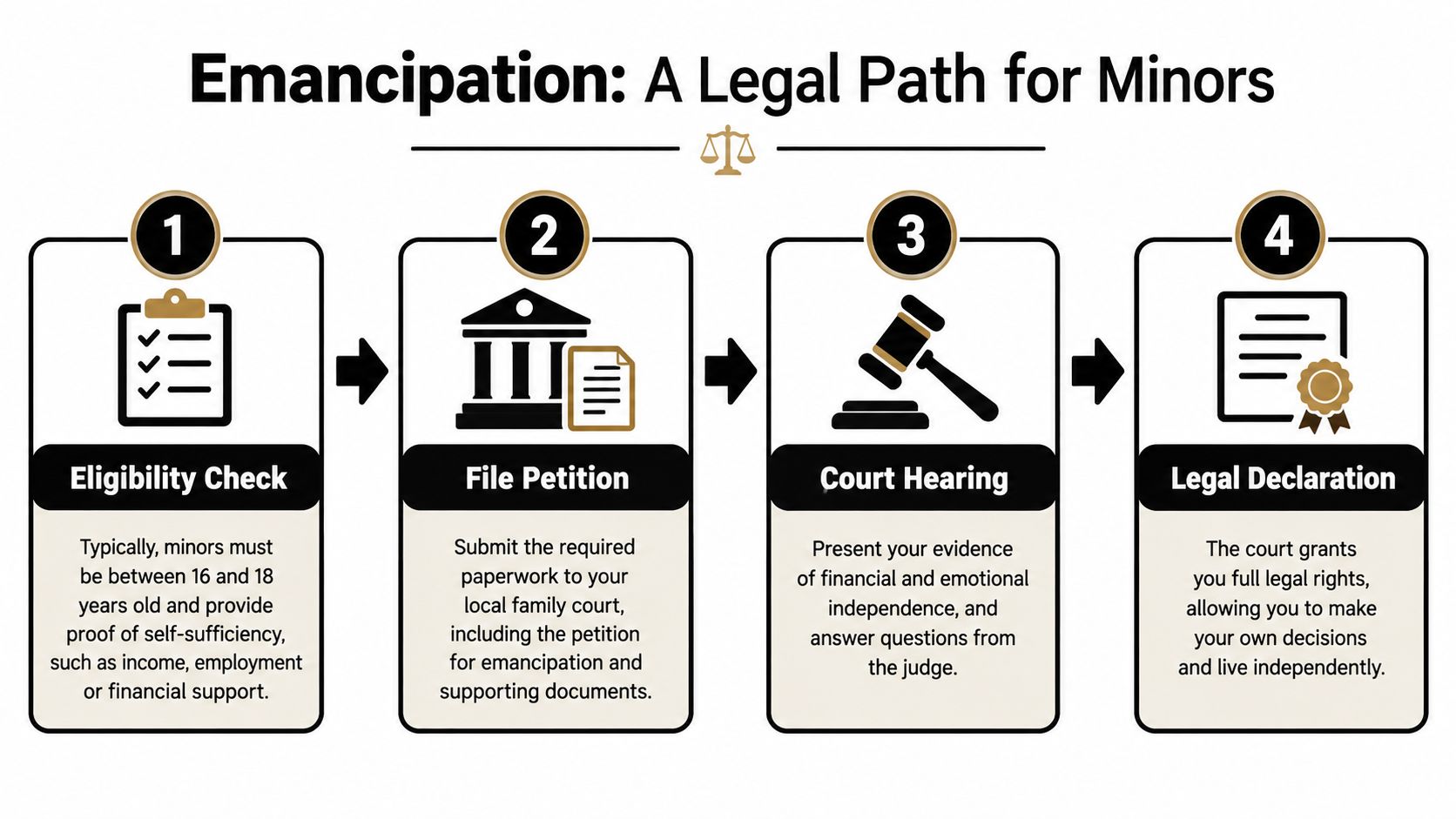
In many states, reaching adulthood ends parental legal control automatically. A minor who wants that level of independence sooner usually has to ask a court for emancipation, and the rules depend on state law (see Cornell LII).
What the process usually looks like
The process usually starts with the state's requirements. A minor may need to show they meet the age and self-support rules, file a petition, attach supporting records, notify a parent or guardian, and attend a hearing where a judge looks at maturity, stability, and best interests (see Cornell LII).
Evidence matters more than emotion. Judges want facts that show the minor can handle independent living. Housing records, income information, school records, and a written budget can all help prove that point.
What emancipation can change
Emancipation can change some parental duties and can expand a minor's legal ability to act on their own in certain areas. It does not erase biological parentage, and it is not a cure for every family conflict. Some states allow only limited emancipation, and some still require a level of parental involvement (see Cornell LII).
A teen living full-time with another relative and paying their own expenses may fit the legal standard in some places. A teen who only wants distance from a parent usually does not. Courts look for independence, not just separation in feeling.
For a minor, the strongest filing is the one that reads like a life plan, not a complaint letter. It should explain where the minor lives, how money comes in, what school plans exist, what monthly expenses look like, and why the arrangement is stable enough for a judge to trust.
Termination of Parental Rights and Adoption
Termination of parental rights is far more serious than emancipation. It usually comes into play to protect a child from abuse, neglect, or serious harm, not to let a family member step away from a painful relationship. Those cases are usually handled in dependency court proceedings, where the child's welfare sits at the center of the case.
An adult child generally cannot ask a court to end a parent's rights just because the relationship hurts. The earlier section showed the gap between personal estrangement and legal severance. This section goes one step further, because even when rights can end, the process is controlled by law, not by private preference.
Who usually starts these cases
Termination cases are commonly brought by child welfare authorities or by parties who have legal authority to act. The law treats them as protection proceedings, not as tools for family repair. If the court is involved, it is usually because the child's safety or stability is at stake.
Adoption works differently. In qualifying circumstances, adoption can replace one legal parent-child relationship with another. That is why adoption is one of the few routes that can substitute a new legal parent for an old one, but it still depends on legal eligibility and court approval.
For a closer look at the kinds of facts courts may examine in parental-fitness disputes, see how to prove a parent is unfit. That question matters in child-protection cases, not in ordinary adult estrangement.
Why the distinction matters
People often mix up three ideas, but the law keeps them separate.
- Emancipation: helps a minor gain independence before adulthood.
- Termination of parental rights: removes legal parent status in child-protection settings.
- Adoption: creates a new legal parent-child relationship.
Only one of those helps a minor move toward independence. Only one ends parental rights because of welfare concerns. Only one replaces an existing legal relationship with a new one.
Setting Boundaries as an Adult Child
For an adult child, the main issue is usually not legal divorce. It is how to live safely and peacefully while limiting contact. That can mean low-contact communication, written-only communication, or no contact at all, depending on the situation.

A 2025 YouGov survey found 38% of U.S. adults were currently estranged from at least one immediate family member, including 16% from a parent, and research summarized from the Cornell Family Estrangement and Reconciliation Project suggests many parent-adult child estrangements later end in reconciliation (YouGov).
Boundaries that are real, not symbolic
Start by deciding what contact looks like. That might include only texting, not answering unexpected calls, or using a third party for necessary logistics. If there are financial ties, housing questions, or safety concerns, those deserve special care because emotional separation doesn't automatically protect your money or address book.
A good boundary is specific. “Don't contact me” is weaker than “Email only, no calls, and no visits without notice.” Specific rules are easier to enforce and easier to explain to a lawyer if things escalate.
Keep the plan flexible
Estrangement doesn't have to be permanent. Some people need a long pause, then later decide whether limited contact is possible. That flexibility is one reason the law doesn't map neatly onto the phrase “divorce your parents.”
If family events are a trigger, decide ahead of time whether you'll attend, stay briefly, or skip them entirely. The same logic applies to gifts, shared accounts, emergency contacts, and social media. The goal is to reduce confusion before the next conflict starts.
For a practical discussion of documenting boundaries in shared-parenting settings, this guide on boundaries in co-parenting shows how written limits can reduce escalation without forcing unnecessary contact.
A short check-in can help too. If you're unsure whether a boundary is working, look at whether it lowers stress, prevents unwanted contact, and protects your daily life.
Documenting Circumstances for Legal Proceedings
If the situation might ever reach court, documentation matters more than dramatic explanations. Judges and attorneys usually need dates, messages, receipts, and a clean sequence of events. Emotional summaries can help you make sense of what happened, but records help others verify it.
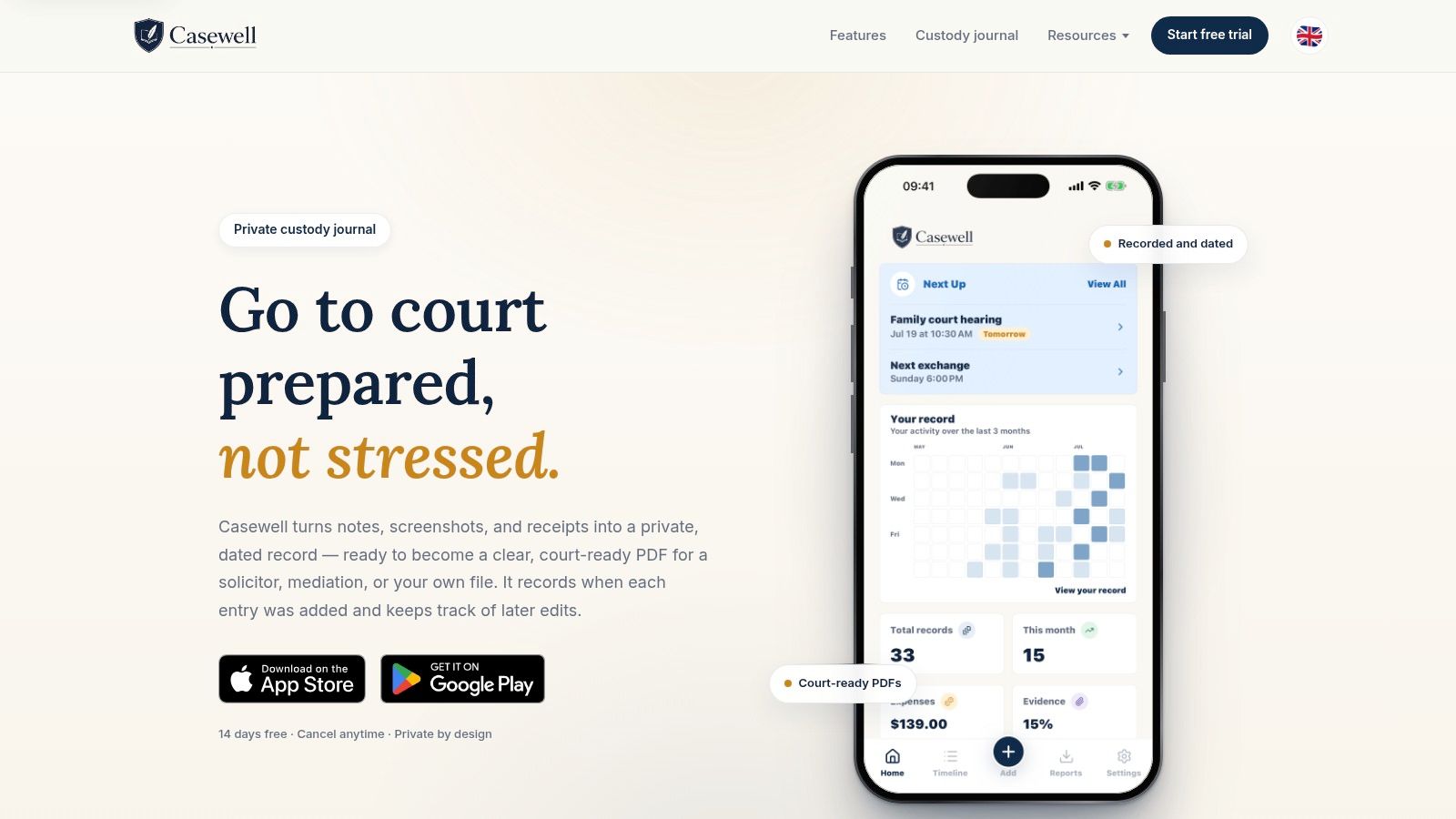
Casewell is a private custody journal application that enables separated parents to keep dated, factual records related to co-parenting. It organizes notes, screenshots, receipts, agreements, and exchange check-ins into structured entries and produces focused, court-ready PDF reports for professional review.
What to record
The safest approach is to record facts as they happen. Keep the date, time, who was involved, what was said or done, and what proof exists. If an event involved missed exchanges, broken agreements, or financial issues, store the attachment with the note so the record stays together.
A private journal can help you avoid two common mistakes. One is forgetting details because you waited too long. The other is writing entries that sound angry instead of factual.
Good documentation is boring on purpose. A judge can work with clear timestamps, screenshots, and receipts far more easily than with a paragraph full of frustration.
How structured records help
A dedicated recordkeeping tool can reduce the chance that evidence ends up scattered across text threads, email, and camera rolls. Casewell is one example of a private documentation app built for that job, with structured entries and exportable reports for review. Used well, that kind of system helps separate fact from interpretation and keeps later edits visible.
The practical point is simple. If legal advice becomes necessary, organized records shorten the time between “something happened” and “I can show what happened.” That's useful whether you're dealing with family court, mediation, or a lawyer who needs a concise timeline.
For a closer look at what belongs in a record, see what should I document. That checklist mindset is especially useful when the conflict is ongoing and details start to blur.
Comparing Legal Outcomes and Options
The best path depends on age, goals, and the kind of legal change you need. People often ask for “divorce,” but the law usually offers narrower tools with very different effects. Comparing them side by side makes the choice clearer.
| Option | Who Can Pursue | Primary Purpose | Key Outcome |
|---|---|---|---|
| Emancipation | Usually a minor, depending on state rules | Gain legal independence before adulthood | Some parental control ends, but parentage remains |
| Termination of parental rights | Usually public authorities or legally authorized parties in child-protection matters | Protect a child from abuse or neglect | Legal parent status ends in a welfare case |
| Adoption | Qualified petitioners under the adoption laws | Create a new legal parent-child relationship | Existing legal relationship can be replaced |
| Estrangement without court action | An adult child or, in some cases, a minor with support | Create distance and boundaries | Emotional contact may stop, but legal ties usually remain |
The biggest mistake is treating these as interchangeable. They are not. Emancipation is about independence, termination is about protection, adoption is about replacement, and estrangement is about personal distance.
Decision test: Ask what you want to change. If the answer is contact, boundaries, or safety, you may not need a severance remedy at all. If the answer is legal status, the options are much narrower and more jurisdiction-specific.
This is also why people get frustrated searching for a universal answer to “can you divorce your parents.” The law doesn't usually offer one. It offers separate tools for separate problems, and each one comes with different eligibility rules, proof requirements, and consequences.
Next Steps and When to Seek Legal Advice
If you're trying to separate from a parent legally or practically, start by naming your real goal. Are you trying to end contact, gain independence, protect yourself from abuse, or change a legal relationship? Once that's clear, the next step is much easier to choose.
A family law attorney can help if you're unsure whether emancipation, a protective process, adoption-related issues, or simple boundary-setting fits your situation. Bring your questions in writing, along with any records, so the consult stays focused. Ask what changes legally, what doesn't, and whether your state has special rules for age, support, housing, or consent.
If your situation involves safety concerns, don't wait for a perfect plan before getting help. Use local legal aid, a family lawyer, or a domestic violence resource if needed. If your problem is mostly emotional distance, a therapist or support group may be a better first stop than a courtroom.
The key idea is simple. You can usually stop contact. You usually can't just file to erase a parent-child relationship because it feels over. Knowing that distinction saves time, reduces confusion, and points you toward the right kind of help.
If you need a private way to keep dates, messages, receipts, and exchange notes in one place, Casewell gives you a structured record for the moments that matter. It helps you document co-parenting and family conflict in a factual format that's easier to review later with a lawyer or mediator.