
It's 11 p.m. You're at the kitchen table with a phone full of screenshots, a few missed-call alerts, and a running note in your head that says, “This can't keep happening.” You're not trying to win an argument anymore. You're trying to figure out how to prove a parent is unfit in a way a judge will care about.
That's where most parents go sideways. They collect outrage instead of evidence. They save angry texts, replay every terrible exchange, and show up believing the court will finally see what they've been living with. Sometimes the court does. But only when the record shows specific conduct, tied to actual risk or harm to the child, and backed by proof that survives scrutiny.
If that sounds cold, good. Family court usually is. The practical question isn't whether the other parent is frustrating, selfish, rude, or chaotic. The question is whether you can build a record that looks reliable, specific, and serious enough for a judge to act on it.
What It Actually Takes to Prove a Parent Is Unfit
At that late-night kitchen table, most parents think they're organizing proof. Usually, they're organizing grievances.
Courts don't remove or restrict a parent because the other parent is fed up. In U.S. family law, a common constitutional rule is that a court may not take custody from a parent in favor of a nonparent unless the challenger proves parental unfitness or actual detriment to the child, and some courts require that showing by clear and convincing evidence. Washington's high court said a nonparent must prove parental unfitness or actual detriment to the child's growth and development, and Alaska's high court similarly required clear and convincing proof that the parent is unfit or that the child's welfare requires nonparent custody. Massachusetts materials also describe unfitness as the critical inquiry and require clear and convincing evidence, as summarized in this parental-rights and custody overview.
That matters because judges aren't deciding whose story feels more upsetting. They're looking for specific facts that show serious risk, neglect, abuse, or concrete detriment to the child.
What parents usually bring versus what courts need
Parents usually bring things like:
- Moral judgments about the other parent's lifestyle
- General complaints that the child “comes back upset”
- Screenshots without context or missing dates
- Long journals full of conclusions like “he's abusive” or “she's unstable”
What courts need looks different:
- Dated incidents
- Corroborating attachments
- A clean timeline
- Records that tie conduct to child impact
Practical rule: If your evidence reads like a fight between adults instead of a record about the child's safety, health, stability, or development, it's probably too weak.
A lot of parents also waste energy trying to “sound persuasive” instead of making their records usable. That's a mistake. Judges and evaluators look for sequence, consistency, and facts that line up. If you want a better feel for how decision-makers sort signal from noise, read what judges look for in child custody cases.
Stop trying to prove everything
You do not need to prove the other parent is bad at everything. You need to prove the legally relevant thing.
That usually means narrowing your claim to conduct such as unsafe supervision, untreated substance abuse that affects parenting, failure to get needed medical care, repeated neglect, exposure to violence, or another pattern that places the child at real risk. A focused claim with support is stronger than a sprawling attack with holes in it.
Unfitness Defined in Plain Language
Parental unfitness is a legal conclusion. In plain English, it means a parent's conduct, condition, or choices make them unable to safely and adequately care for the child, or that placing the child with that parent would create a serious risk of harm.
That's a much narrower idea than most imagine.
What unfitness is not
A parent isn't legally unfit just because they're hard to deal with. Judges routinely see complaints like these and often treat them as ordinary co-parenting conflict:
- Different parenting styles
- Rude or hostile texts
- Minor schedule problems
- A messy house without a child-safety issue
- A new partner you dislike
- General claims that the other parent is “toxic”
Those things may matter in a broader custody case. By themselves, they usually don't prove unfitness.
What courts actually care about
Courts care about conduct that affects the child's safety, care, and development. The strongest categories tend to be concrete and provable:
- Chronic neglect such as repeated failure to provide basic care
- Untreated substance abuse when it interferes with supervision or decision-making
- Documented domestic violence
- Severe untreated mental illness when it impairs caregiving
- Exposure to dangerous people or conditions
- Failure to provide needed medical or educational care
- Credible risk of physical or sexual abuse
Here's the clean way to think about it. “He's selfish” is venting. “The child missed medical treatment, and the pediatric record shows the lapse” is a custody fact.
Bad co-parenting and legal unfitness are not the same thing. Courts increasingly separate ordinary conflict from conduct that is seriously detrimental to the child.
Recent guidance discussed in family-court materials also reflects that split. The person making the allegation usually has to prove both the harmful conduct and its effect on the child, and courts are being pushed to require specific evidence before giving serious weight to alienation-type claims, as discussed in Family Justice Council guidance on allegations and evidence.
The useful test
Ask yourself three blunt questions:
- What exactly happened?
- How did it affect the child?
- What independent record backs it up?
If you can't answer those with specifics, you don't have an unfitness showing yet. You have a concern. Concerns matter, but concerns still need proof.
The Clear and Convincing Evidence Standard
If you want to prove a parent is unfit, you need to understand the burden. This isn't a low-bar complaint process. In many family-law and child-welfare contexts, courts require clear and convincing evidence of current parental unfitness, and Massachusetts materials summarize that the burden does not shift back to the parent once that threshold is set. The practical point is simple. The evidence has to be highly persuasive before a court overrides parental custody, as described in this burden-of-proof summary on unfitness proceedings.
A lot of parents hear that phrase and still treat the case like a credibility contest. It's not. It's an evidence contest.
What that standard feels like in real life
A single accusation rarely gets you there. A pattern often does.
Think about the difference between these two situations:
Weak showing
You say the other parent leaves the child unsupervised. You have one text exchange and your own statement.Stronger showing
You have dated exchange notes, a school staff observation about the child arriving without an adult, a medical record from an injury during one of those incidents, and messages where the parent admits leaving the child with an inappropriate caretaker.
The second example gives a judge something to verify. It shows sequence, independent support, and child impact.
Evidence that usually helps
When courts evaluate serious fitness allegations, they tend to give more weight to records that are external, dated, and tied to child welfare. Useful examples include:
- Medical records that show missed care, injuries, or treatment concerns
- School records showing repeated attendance or behavioral issues connected to the claimed conduct
- Police reports or social-services findings
- Drug-test results
- Neutral witness observations
- Consistent communications that confirm dates, admissions, or patterns
If you're preparing materials, a solid starting point is an evidence checklist for custody preparation.
Evidence that usually hurts
Some records don't just fail to help. They can make you look unreliable.
- Edited screenshots
- Long emotional narratives with few facts
- Character attacks
- Undated notes
- Messages taken out of context
- Claims repeated by friends who didn't witness anything
The judge doesn't need to know that you think the other parent is awful. The judge needs a reason, supported by reliable records, to believe the child is at serious risk.
There's another hard truth here. Present unfitness matters in many cases. Past bad behavior can matter, but if you can't connect it to current parenting capacity or current danger to the child, it may carry less weight than you expect.
Evidence That Corroborates and Triangulates
Weak cases become stronger. Courts typically require corroborated, child-impact evidence rather than isolated accusations, and strong records often include police reports, medical or psychological records, school records, social-services findings, and drug-test results because those records connect conduct to measurable harm or risk, as explained in this overview of how courts assess parental unfitness.
The key pattern is triangulation. One incident becomes much more persuasive when it appears across independent sources.
For a quick visual, this is the framework you should be building toward:
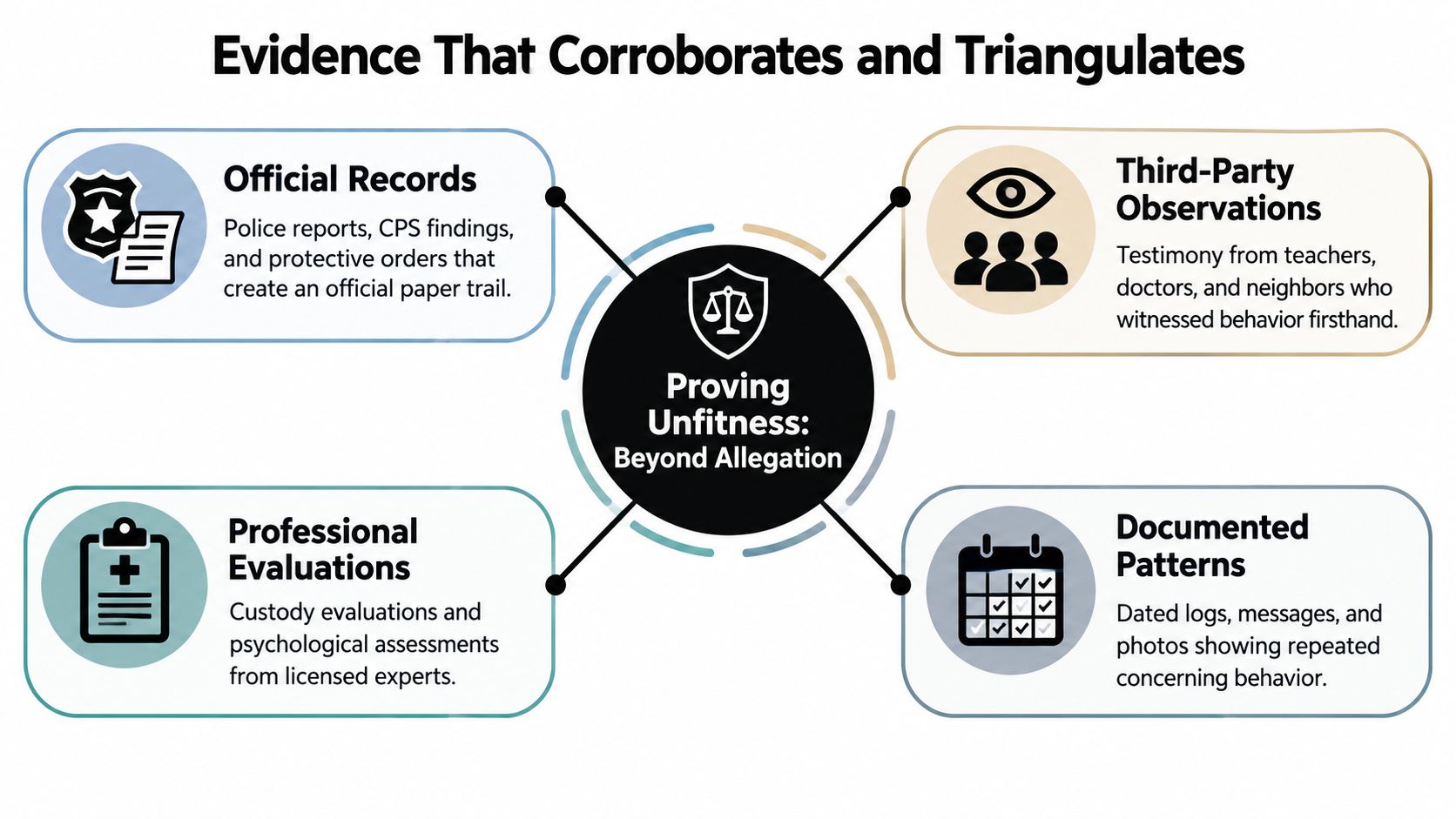
Four evidence buckets that actually matter
Official records
Police reports, child-protection records, protective orders, and agency findings create an outside paper trail. They don't guarantee a result, but they give the court a source that isn't just you.
Third-party observations
Teachers, daycare staff, pediatricians, therapists, and other adults who interact with the child can matter a lot. Their value comes from firsthand observation, not loyalty to either parent.
Medical and behavioral documentation
This includes treatment records, diagnosis notes, behavioral concerns, and records showing missed appointments or refusal of care. These records matter because they show impact on the child, not just adult conflict.
Contemporaneous communications
Texts, emails, voicemails, and check-in messages can confirm timing, admissions, refusal, intoxication, no-shows, or contradictions. They work best when they're complete, dated, and not selectively cropped.
A short explainer on this point is worth watching:
What triangulation looks like
Corroboration doesn't mean five people repeating your story. It means independent verification.
A stronger record might look like this:
- School log showing repeated tardiness or absences
- Pediatric note documenting anxiety, injury, or weight concerns
- Social-services record noting unsafe home conditions or supervision concerns
That combination is powerful because each source stands on its own. Together, they show conduct and child impact across different settings.
One report is a claim. Multiple independent records that line up in time and substance start to look like proof.
If all your evidence comes from one argument thread or one relative who already sides with you, you don't have triangulation yet. You have repetition.
Why Documentation Quality Beats Volume
Some parents think a giant file wins. It doesn't. Five strong entries can beat fifty sloppy ones because judges and evaluators look for sequence, consistency, authenticity, and relevance, not emotional output.
That's why a court-ready showing often depends more on documentation quality than sheer volume. Guidance on custody documentation emphasizes timestamped, neutral, fact-only logs with attached proof, and it also points to chain-of-custody thinking for digital evidence so screenshots, photos, and files are stronger when their source, capture time, and handling history are preserved, as discussed in this custody documentation guide.
Four traits that make records credible
Specificity
Good entries answer basic questions fast. Date, time, place, who was present, what happened, and what happened next.
“Child arrived without prescribed inhaler after weekend exchange” is specific. “Other parent was irresponsible again” is useless.
Neutrality
Write what you observed, not your diagnosis of the other parent.
Instead of “mother neglected child,” write “child arrived in the same clothes as prior day, reported not brushing teeth, and school sent hygiene note home.” That phrasing gives the court facts to evaluate.
Authenticity
Records get stronger when they look hard to fake and easy to verify. Original screenshots, attached source files, visible dates, and preserved entry history matter.
Relevance
Not every ugly interaction belongs in your file. If it doesn't connect to the child's welfare, leave it out or separate it from your core evidence set.
Documentation Quality vs Volume What Courts Weight
| Attribute | Weak Documentation | Strong Documentation |
|---|---|---|
| Specificity | Vague summary with no date or time | Exact date, time, location, people present |
| Neutrality | Labels like “abusive” or “crazy” | Observable facts only |
| Authenticity | Cropped or edited files, unclear source | Original files, timestamps, preserved source |
| Relevance | Adult conflict with no child connection | Conduct tied to care, safety, health, or schooling |
| Consistency | Gaps, contradictions, selective logging | Steady entries that form a usable timeline |
Think like someone challenging your record
Ask four blunt questions about every entry:
- Who created it
- When was it created
- Can it be altered easily
- Why does it matter to the child
That's why many parents outgrow random notes and move to a structured record system. If you want to see what that difference looks like in practice, this overview of a custody journal app for factual documentation is a useful example.
Choosing the Right Tool for Your Custody Record
The tool you use shapes the quality of the record you end up with. Most parents default to whatever is easiest in the moment. Notes app. Paper notebook. Emailing themselves screenshots. That's better than nothing, but it creates problems later.
The question is whether the tool helps you create a private, searchable, organized record that looks reliable when your lawyer reviews it.
Freeform notes
Paper journals, phone notes, and Word documents are familiar. They're also messy.
They let you write quickly, but they usually have weak structure. Entries are easy to backfill, dates may be unclear, attachments live somewhere else, and search becomes painful once the file grows. They also invite emotional writing because there's no prompt forcing you back to facts.
Shared messaging apps
Apps like TalkingParents and OurFamilyWizard can be useful for communication records because they preserve exchanges between co-parents. If the issue is what was said, when it was said, or whether someone responded, those tools can help.
Their downside is obvious. They are communication platforms first. Your evidence about the child gets mixed into conflict with the other parent, and the other party is part of the same environment. That's not ideal when you need a separate private log for incidents, attachments, receipts, agreements, and your own chronology.
Private custody journals
A private custody journal is for your record, not for talking to the other parent. That distinction matters.
Casewell is one example. It lets a parent keep dated entries, attach screenshots and files beside the event, organize records by child and category, and export selected records into a paginated PDF for professional review. That design addresses the biggest practical problem in custody prep, which is evidence scattered across too many places.
Custody Record Tools Compared
| Criterion | Freeform Notes | Shared Messaging Apps | Private Custody Journal |
|---|---|---|---|
| Neutrality support | Low. You write anything | Medium. Messages are real but often reactive | Higher. Structured entries can keep focus on facts |
| Authenticity | Mixed. Easy to edit or rewrite | Stronger for messages sent in-app | Stronger when entries preserve write date, edits, and attachments |
| Privacy from other parent | High if kept privately | Low for anything inside shared communications | High |
| Searchability | Weak once volume grows | Good for message history | Good for categories, dates, and timelines |
| Export for attorney prep | Often clumsy | Useful for communication threads | Better suited to focused incident reports |
Pick a tool that helps you document like a witness, not vent like a spouse.
If your record is hard to search, hard to sort, and hard to explain, your lawyer spends time cleaning it instead of using it.
Building Your Court-Ready Record Step by Step
Start simple. You do not need a brilliant system. You need a repeatable one.
The best workflow is boring on purpose. Boring records win because they look credible. In abuse-related cases especially, neutral chronology matters because the same behaviors can be interpreted very differently depending on context, and family-court guidance and research have emphasized evidence-first analysis, identification of the actual proof, and the need to connect conduct to harm rather than letting accusation drive the case, as discussed in this report on abuse context and evidence-first analysis in family court.
This is the process to follow:
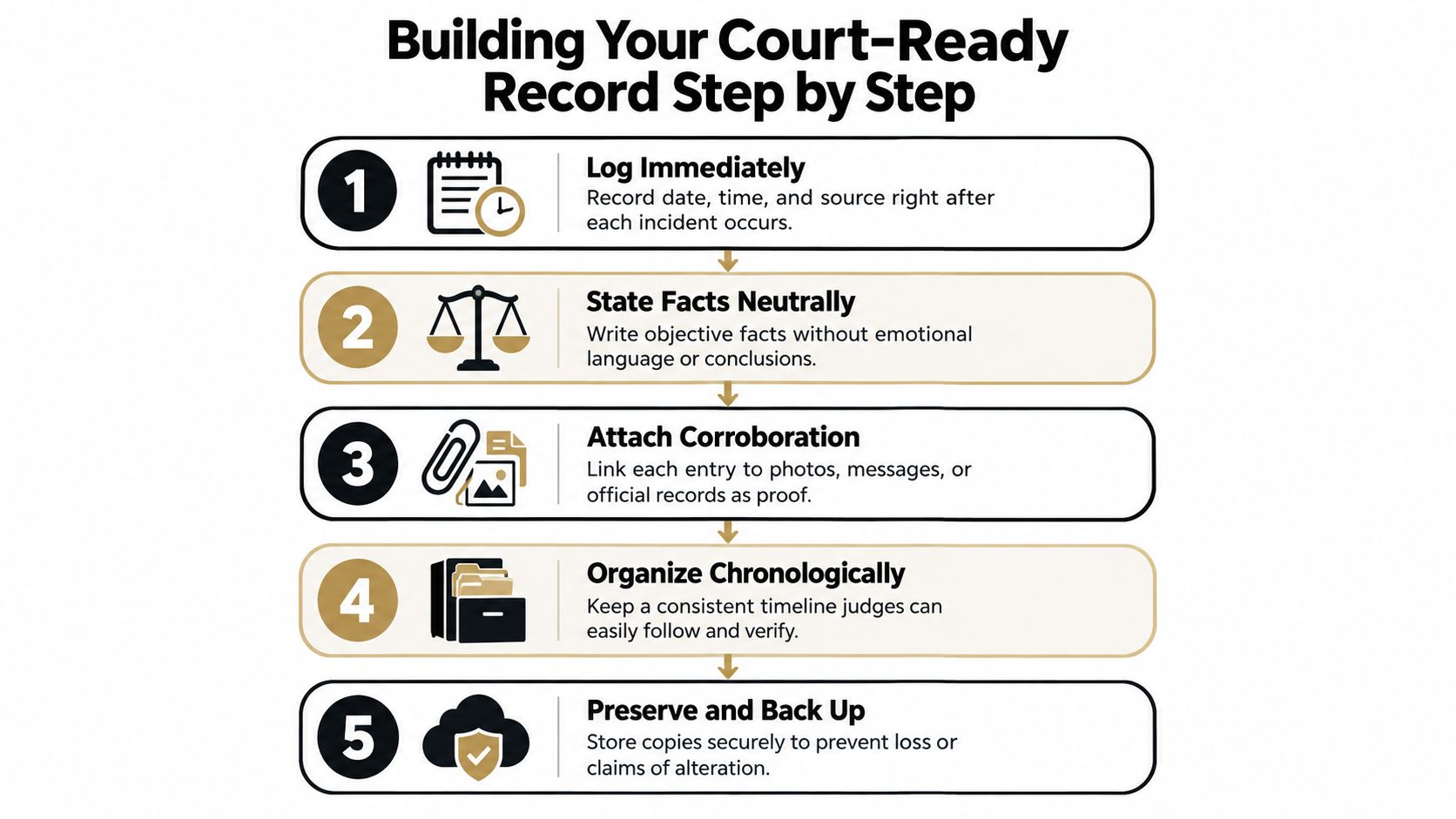
Use a repeatable entry format
For every incident, record:
- Date and time
- Source of the information
Did you observe it yourself, receive a school notice, or get a text? - Neutral fact statement
- Immediate child impact
- Attachment list
A clean entry might read like this: “March 4, 6:15 p.m. Exchange at school parking lot. Child did not have prescribed medication bag. Teacher handed me note stating medication had not been returned Friday. Child reported coughing during prior night. Attached school note and photo of exchange items.”
Attach proof to the event, not to your memory
Don't keep screenshots in one folder, receipts in another, and notes somewhere else. Link the supporting file directly to the incident it supports.
That includes:
- Messages
- School notices
- Medical paperwork
- Photos
- Receipts
- Agreement records
When attachments sit beside the entry, your timeline becomes usable.
Organize by pattern
Judges often care about patterns more than isolated noise. Group records into practical categories such as:
- Missed visits
- Medication failures
- Unsafe exchanges
- School attendance issues
- Expense disputes tied to child needs
That makes your chronology visible without forcing the court to decode a giant mixed archive.
Bring your lawyer a timeline, not a pile.
Prepare for attorney review
Before your consultation, export or print a focused record. Include the entries that matter most, with attachments and dates intact. Then ask your lawyer two blunt questions:
- What key allegation does this evidence support?
- What proof is still missing?
Sometimes the missing piece is a record you can't get alone. That's when your lawyer may discuss subpoenas or formal requests for school, medical, or agency material. If you want a checklist for that meeting, review this guide on preparing evidence for a lawyer consultation.
A court-ready record isn't dramatic. It's disciplined.
If you're trying to prove a parent is unfit, Casewell gives you a private place to keep dated, factual custody records with attachments, timelines, and focused PDF exports for attorney review. It's built for personal documentation, not co-parent messaging, which helps you keep your evidence organized and separate from conflict. If that's the kind of record you need, visit Casewell.