

You're the person packing lunches, answering school calls, and sitting beside a child who can't sleep. Then a form asks whether you're their legal parent, and you realize that doing the parenting and being recognized as a parent aren't necessarily the same thing.
The adoption of stepchildren can close that gap. But don't start by downloading a petition. Start by deciding what your child needs protected, what the other parent would lose, and whether permanent legal parenthood is the right answer. A smoother filing isn't much of a victory if the adults haven't understood the consequences.
What the Adoption of Stepchildren Actually Decides
The moment usually isn't the hearing. It's the conversation where someone says, “We should make this official,” and everyone realizes they mean something different. You may mean permission to handle medical decisions; your partner may mean security; the child may hear that they're expected to replace another parent.
Adoption is a decision about legal parenthood, not recognition for the adult who has shown up. Finalization normally creates a permanent parent-child relationship. Before proceeding, separate the practical problem you're trying to solve from the emotional meaning you attach to the word adoption.
Put the actual question on paper before the petition.

Separate the decisions before choosing the paperwork
Your preparation needs distinct tracks:
- Legal mechanics: Establish which jurisdiction controls, which adoption route fits your family, and what approvals or court findings you need.
- Family consequences: Identify the legal relationships you want to create and the relationships the proposed adoption could change.
- Child protection and recordkeeping: Understand the child's wishes and preserve useful information without turning ordinary family life into surveillance.
Don't combine those questions into “Can we get this approved?” Approval is only useful if you've chosen the right arrangement.
Parent status isn't the same as practical permission
A family might need full parenthood, authority for particular decisions, or a clearer caregiving arrangement. Those are different needs. Custody, guardianship, and adoption aren't interchangeable, and the availability and effect of each depend on local law.
Practical rule: Describe the problem without using the word “adoption.” If the answer is “I need to handle school pickups and emergencies,” investigate narrower authority before committing to permanent parenthood.
Stepparent adoption also differs from adopting an unrelated child because the proposed relationship sits within an existing family structure. Don't assume that a general adoption checklist accurately describes the paperwork, screening requirements, or timing for your situation.
Ask a local adoption lawyer to identify your legal route before you gather forms. If your relationship involves an unmarried partnership, assisted reproduction, or parenthood recognized elsewhere, explain that immediately. A familiar family label isn't a substitute for identifying who already has legal status.
Who Qualifies as a Stepparent and What the Court Looks At
Being a devoted caregiver gives you something important to describe. It doesn't, by itself, establish eligibility to adopt. Verify the legal threshold separately from the strength of your relationship with the child.
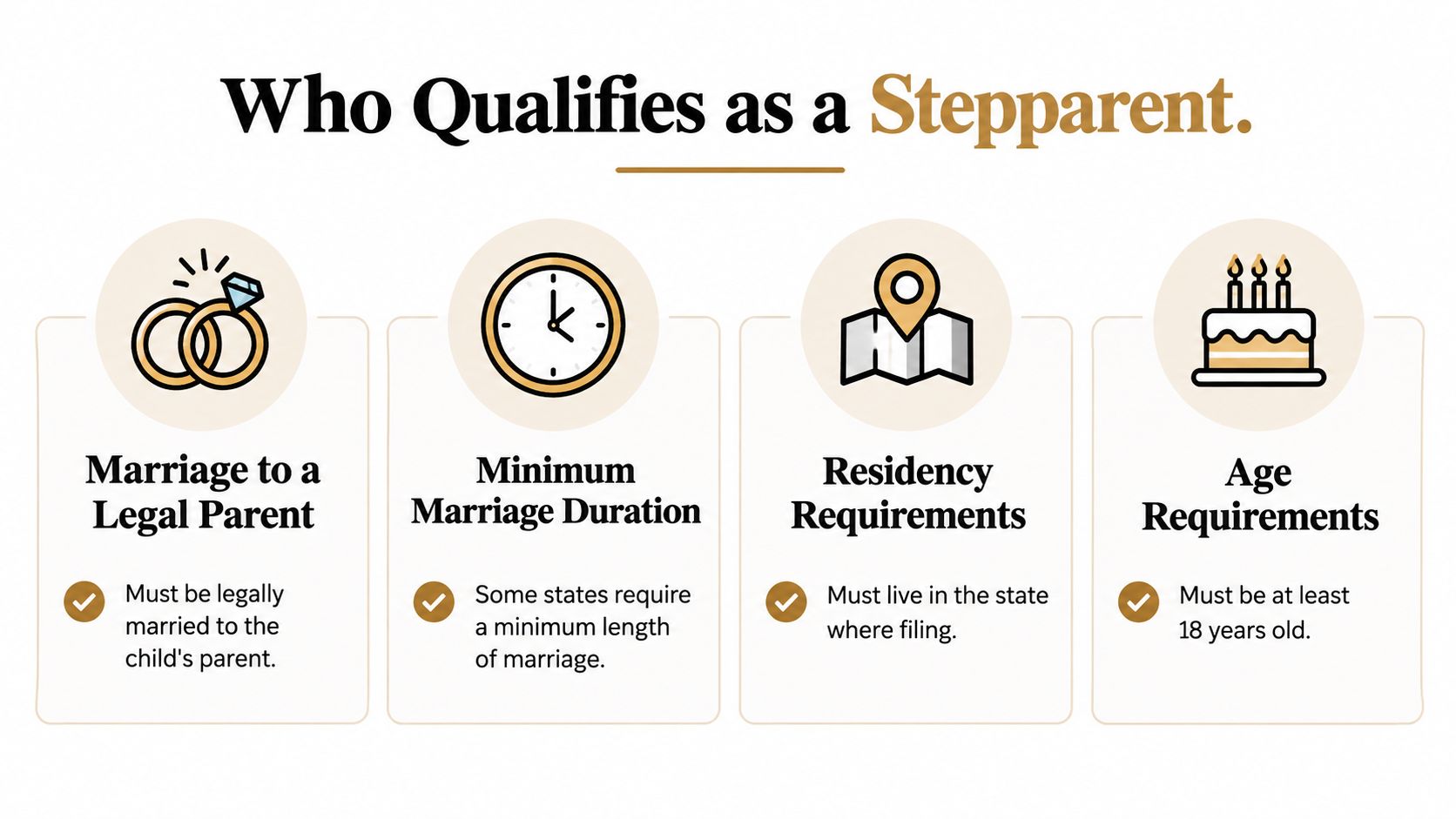
Use marriage status, marriage duration, residency, and age as questions for local review, not as a nationwide eligibility formula. The infographic identifies useful screening categories, but its statements shouldn't replace advice about your jurisdiction.
Establish the threshold with documents
Take a factual summary to your consultation rather than a narrative about why you deserve recognition.
- Relationship status: Bring marriage documentation where applicable, and identify the child's legal parent or parents.
- Dates and residence: Record when the relationship began, when your household formed, and where each relevant person lives.
- Existing orders: Collect custody and support orders rather than relying on your memory of what they say.
- Caregiving history: Describe school involvement, medical appointments, everyday routines, and responsibilities you handle.
Ask counsel whether marriage is required for your route, whether any duration or residency conditions apply, and whether your age affects eligibility. Don't borrow a neighboring state's answer because its forms look easier.
Explain stability without staging perfection
A useful household account includes ordinary responsibilities and difficult transitions. Who handles bedtime? How does the child move between homes? What happens when work schedules change? Those details give a professional something concrete to evaluate.
The distinction between stepparent and unrelated-child adoption isn't new. A historical analysis of U.S. adoption found that stepchild adoptions accounted for more than 85% of adoptions involving related children by 1975, while cautioning that definitions and reporting coverage complicate comparisons. That history explains why this category deserves separate attention, not why any particular application should be approved.
For help identifying child-centered details, the guide to what judges look for in child custody offers an adjacent perspective. Keep the distinction clear: custody preparation doesn't establish adoption eligibility or satisfy adoption requirements.
Your self-check should end with two separate conclusions: whether you appear eligible under the relevant law, and what factual information needs professional review. Neither conclusion requires pretending your household is flawless.
Consent and Termination of the Other Parent's Rights
Consent is not a courtesy signature. You're asking another parent to agree to a permanent legal change, potentially including the loss of parental rights and future support responsibilities. Treat that conversation with the seriousness it deserves.
In the United States, adoption generally requires consent from both biological parents unless a court determines that a parent has failed parental duties or cannot consent; the nonresident parent typically loses parental rights and child-support responsibilities after completion, as discussed in this analysis of stepchildren adopted by their stepparents. Ask counsel to explain the effect on existing orders, outstanding obligations, and proposed future contact rather than making assumptions about what disappears.
A willing parent still needs a valid legal process
An agreeable text message isn't enough to build your filing around. Have your lawyer identify the required consent document, execution formalities, timing rules, and any opportunity to withdraw consent under the governing law.
Keep the discussion separate from arguments about missed exchanges, unpaid expenses, or a new relationship. Don't frame adoption as the price of peace, and don't promise consequences you haven't had legally checked.
A parent should understand what they're surrendering before anyone celebrates what the stepparent will gain.
If communication is volatile, use the practical boundaries discussed in high-conflict co-parenting. An adoption conversation shouldn't become another channel for pressure or retaliation.
Refusal changes the legal question
When the other parent won't consent, ask whether the governing law provides a valid basis to proceed without that consent. Don't assume that absence, inconsistent support, a criminal conviction, or allegations of unfitness automatically establish grounds. Counsel must connect the actual facts to the applicable legal standard.
Preserve existing contact records, payment records, and relevant orders in their original context. Include attempts to participate, not just occasions when participation failed. A selective account may satisfy an angry adult, but it won't give a lawyer a reliable basis for advice.
The emphasis on parental responsibility has historical roots beyond the United States. Historical adoption figures reported by the BBC indicate that adoptions by a parent and stepparent together represented about two-thirds of all adoptions in England and Wales by 1976. That history isn't a statement of current consent law.
If consent is disputed, expect a legal assessment of grounds and evidence before assuming there's a viable filing. Wanting the child to have stability doesn't answer whether another parent's rights can lawfully end.
The Court Process From Petition to Final Decree
A domestic stepparent adoption needs a jurisdiction-specific sequence, not a collection of forms found online. Ask counsel or the appropriate court office to identify the governing law, filing location, required documents, and dependencies between consent, notice, screening, and the hearing.
Start with the records that establish identity and the current family arrangements. Check names and dates against the underlying documents. Flag discrepancies for professional review rather than changing information to make the packet look consistent.
Typical Stepparent Adoption Documents to Gather
| Category | Typical Items | Why It Matters |
|---|---|---|
| Child's identity | Birth certificate and relevant existing vital records | Establishes the child's recorded identity and parentage |
| Family relationship | Marriage documentation, where applicable | Supports the claimed stepparent relationship |
| Existing legal arrangements | Custody orders and relevant support orders | Shows what has already been decided |
| Consent and notice | Required consent documents and service records | Documents how the other parent's legal position is addressed |
| Caregiving context | Relevant school and medical records | Helps explain established involvement |
| Required review | Background-check results or home-study material, if required | Addresses the applicable screening requirements |
Gathering a record doesn't mean filing every page. Ask what the court requires, what counsel needs to inspect privately, and what sensitive information should be protected.
Keep each procedural checkpoint distinct
Determine the consent route before assuming the petition is ready. Complete legally required notice and service using the prescribed procedure; knowing that the other parent has heard about the adoption isn't a reason to improvise.
Arrange any required background checks or home-study components. Don't assume that a stepparent relationship automatically removes them. The filing sequence may depend on local procedure, so confirm whether particular reports must accompany the petition or arrive later.
After filing, prepare for the final hearing around the requested legal findings and the child's circumstances. The guide to child custody court hearings and what to expect can help with general courtroom preparation, but your adoption lawyer should explain the questions relevant to this proceeding.
The practical endpoint is the adoption decree and required amended vital records, not merely a hearing date. Confirm who handles the records request, what documentation is needed, and how you'll retain the final documents.
Don't promise the child a completion date based on an online estimate. Ask for a case-specific schedule that distinguishes court availability, unresolved consent issues, screening, and document corrections.
Immigration requires separate advice. Adoption itself doesn't automatically create immigration status, a distinction addressed in USCIS guidance on adoption, immigration, and citizenship for stepchildren. If immigration is involved, coordinate the family-law and immigration reviews before filing rather than trying to repair an assumption afterward.
Adoption or Something Less Permanent
Choose the legal tool that solves the family's actual problem. Permanence isn't automatically the best measure of protection. A child can have a strong bond with a stepparent while also wanting to preserve another important relationship.
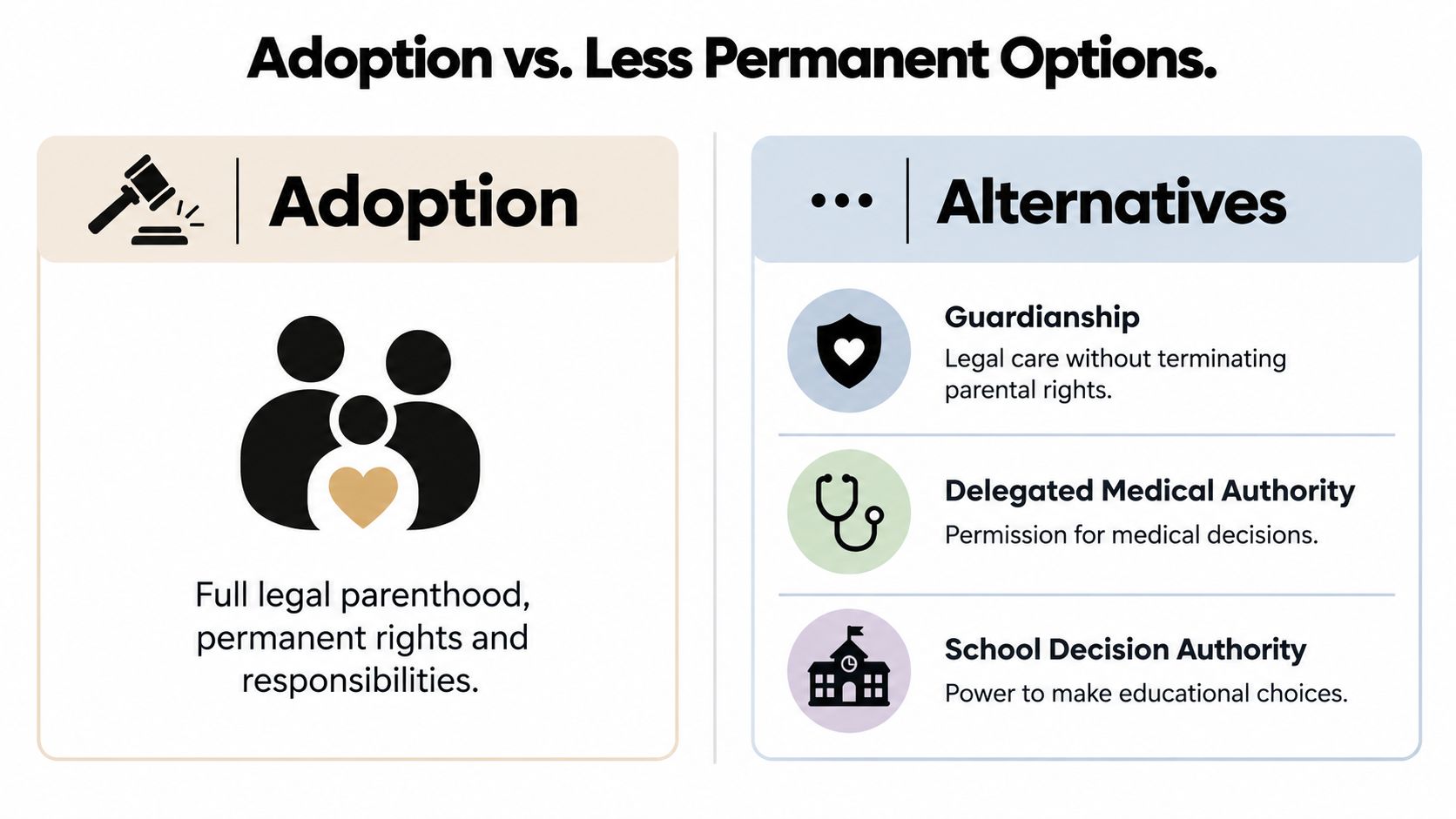
If your immediate concern is permission for medical care or school decisions, ask about targeted authority first. If your concern is enduring parenthood, ask for a full explanation of adoption's consequences. Don't let the symbolic appeal of “official” skip the comparison.
Use these categories to frame the conversation, not as guarantees that every option is available locally.
Match the arrangement to the need
| Your goal | Option to discuss | Question to resolve |
|---|---|---|
| Establish permanent parenthood | Adoption | Does the family understand the full legal consequences? |
| Formalize a caregiving role | Guardianship | What powers would it grant, and what parental rights would remain? |
| Handle particular school or medical matters | Delegated authority | Who must authorize it, and will the relevant institution accept it? |
| Prepare for urgent treatment | Emergency medical authorization | What situations does it cover? |
| Clarify cooperative caregiving | Parenting agreement | Which terms are enforceable, and which remain informal expectations? |
For a closer look at a narrower arrangement, consult the guide to legal guardianship for stepparents. Have counsel compare its local effect with adoption rather than treating guardianship as “adoption without the ceremony.”
Resolve identity and cross-border questions separately
Ask how each option would affect inheritance planning, access to family health history, and the child's sense of identity. Legal status and the child's preferred language for family relationships don't have to be identical. Don't turn a surname or a parental title into a loyalty test.
LGBTQ+ and internationally mobile families need particularly careful review. The International Bar Association's account of LGBTQI+ adoption rights describes uneven rules worldwide, including restricted adoption routes and eligibility or administrative barriers. Don't assume marriage, a foreign birth record, or recognition in another country settles domestic parenthood.
Ask a lawyer in each relevant jurisdiction what status is recognized and what supporting evidence may be needed. Preserve established caregiving records, school and medical involvement, and travel permissions for that review, without assuming every document will be admissible.
Decision test: If a narrower arrangement meets the child's practical needs without an unwanted permanent change, give it serious consideration.
Choosing less permanent authority isn't a lesser expression of love. It can be the more precise legal response.
Preparing the Child and the Household Before and After Finalization
Don't use a court decree to rush a relationship. A child needs room to understand the proposed change without managing the adults' hopes, disappointment, or conflict. Ask what adoption means to them before explaining what it means to you.
Build connection through ordinary, low-pressure time rather than adoption-themed celebrations alone.

A web-based stepfamily intervention study found that relatively brief behavioral training was associated with improvements in family adjustment, harmony, life satisfaction, parent-child conflict, and positive-parenting intentions, with effects still observed 60 days later. That supports taking preparation seriously; it doesn't establish that adoption itself produces those improvements.
Agree on roles before changing expectations
The stepparent and legal parent should discuss discipline, reassurance, routines, and difficult transitions privately. Don't make the child referee disagreements about authority.
- Define responsibilities: Agree who handles which situations instead of announcing an immediate takeover of discipline.
- Preserve the child's preferences: Record concerns and important existing relationships without translating uncertainty into rejection.
- Build predictable connection: Choose low-conflict activities the child enjoys, such as cooking, walking, or doing a puzzle.
- Review adjustment deliberately: Schedule follow-up conversations and consider qualified family support if the child is struggling.
Avoid recruiting the stepparent as a messenger in parental disputes. The child shouldn't associate their new legal relationship with an adult alliance against someone else.
A household conversation should leave space for questions, not require a performance of enthusiasm.
Record observations without building a prosecution
Useful notes describe what happened, when it happened, and what you directly observed. For example, record that the child struggled to settle after a transition and asked to call a parent. Don't convert that observation into an unsupported conclusion about who caused distress.
Track relevant school attendance, sleep, transitions, conflict incidents, and expressed concerns consistently. Include calm exchanges and successful adjustments too. Otherwise, you're preserving a dispute narrative rather than a usable account of the child's experience.
Keep adult disagreements out of child interviews. Don't repeatedly ask for statements, rehearse answers, or treat every private feeling as material for a filing.
Documentation should support care and professional understanding. Preserve original records, distinguish observation from interpretation, and share only what a qualified professional needs. The child deserves a household where adults notice their needs without making them feel monitored.
A Decision Checklist Before You File
Before filing, bring these decisions to your partner and a jurisdiction-specific legal consultation:
- Right legal tool: Does the proposed arrangement match the need you identified?
- Realistic consent path: Have you obtained advice about consent or the legal grounds for proceeding without it?
- Household readiness: Can the child express mixed feelings without pressure?
- Responsible records: Are your caregiving, agreement, expense, and contact notes factual, dated, and proportionate?
Take existing orders and a concise chronology to the consultation. Ask what remains unresolved before paying for or submitting a petition.
Jurisdiction-specific legal advice is essential. Your objective is to protect the child's relationships and legal security, not to win a paperwork race.
Casewell offers a private custody journal for dated caregiving notes, agreements, expenses, and supporting records, with focused PDF reports for professional review. Visit Casewell to organize the relevant history before your adoption consultation, while keeping documentation separate from co-parent communication and under your control.