

In most U.S. jurisdictions, marriage alone does not make a stepparent a legal guardian. A court-ordered guardianship can provide significant authority over a child's care and decisions while preserving the biological parents' legal rights.
You may already be doing the work of a parent. You take your stepchild to school, attend medical appointments, manage medication, and handle daily routines. Then a school administrator asks for proof that you can enroll the child, or a clinic receptionist says the biological parent must authorize non-emergency treatment. Your family life feels settled, but the law may still treat you as someone caring for the child without independent authority to act.
That difference between caregiving and legal decision-making power creates the central problem in legal guardianship for step parents. The answer depends on the jurisdiction, the child's circumstances, the biological parents' positions, and the exact order or document in place. The following guide focuses on the practical boundary, including what guardianship can do, what it cannot do, and how to prepare without unnecessarily escalating conflict.
Understanding the Stepparent Legal Gap
Consider a stepparent who has lived with a child for years. The child's other parent is absent or unable to participate consistently, and the stepparent handles school forms, transportation, meals, appointments, and everyday supervision. When the child needs planned medical treatment, however, the provider asks for consent from a legal parent or guardian. At school, staff may allow the stepparent to pick up the child but refuse to let that person make enrollment or records decisions.

The frustration is understandable, but the legal distinction is deliberate. Marriage to a child's biological parent doesn't automatically make the stepparent a legal parent or guardian. Marriage alone generally doesn't give the stepparent independent authority to consent to treatment, enroll the child in school, or formally act on the child's behalf. A school or healthcare provider may recognize the stepparent as a trusted caregiver for practical tasks, but that recognition isn't the same as legal authority.
In the United States, guardianship is one of two principal routes through which a stepparent can obtain formal authority, with stepparent adoption as the other route. Guardianship generally preserves the child's legal relationship with biological parents, while adoption ordinarily creates a permanent parent-child relationship and transfers parental rights and duties.
Practical rule: A close emotional bond and extensive caregiving may support a petition, but neither one substitutes for a court order or another legally effective authorization.
A guardian may receive authority over education, healthcare, and day-to-day care, depending on the order and local law. The biological parents' rights may continue, and the guardianship may end when circumstances change or when the child reaches adulthood under the governing law. The order controls. Read it carefully before assuming you can make a particular decision.
Guardianship vs Adoption vs Custody Explained
These terms are related, but they aren't interchangeable. Guardianship usually gives a nonparent specific authority to care for a child and make decisions identified by the court. It generally preserves the biological parents' legal relationship, although the parents' practical authority may be limited by the order.
Adoption ordinarily goes further. A stepparent adoption creates a permanent legal parent-child relationship and transfers parental rights and duties. It may also require addressing another parent's rights, including consent or a court determination under the applicable law. Adoption is therefore not merely a stronger version of a temporary permission form. It changes the legal family relationship.
Custody describes authority over a child's residence, care, or decision-making, but the exact meaning varies by jurisdiction. Some custody orders allocate physical care, some allocate legal decision-making, and some address both. A helpful overview of joint custody and how it differs from other arrangements can clarify why “custody” shouldn't be treated as a universal label.
| Legal Option | Preserves Biological Parent Rights | Permanence | Primary Purpose |
|---|---|---|---|
| Guardianship | Generally yes, subject to the order | Often flexible or time-limited | Provide authority for care and important decisions |
| Adoption | Usually changes or transfers parental rights | Ordinarily permanent | Establish the stepparent as a legal parent |
| Custody order | Depends on the order and jurisdiction | May continue until modified | Allocate residence, care, or decision-making authority |
The right choice depends on the family's objective. If a parent is temporarily incapacitated and the family wants the stepparent to handle healthcare and school matters, guardianship may fit better than adoption. If the family wants the stepparent to become a permanent legal parent and the legal conditions can be met, adoption may be considered. If the immediate dispute concerns where the child lives or who makes decisions, a custody or third-party custody proceeding may be more appropriate.
Don't choose based on the label alone. Ask what authority is needed, how long it must last, whether the biological parent's relationship should remain intact, and what the court can order in that jurisdiction.
Legal Requirements for Stepparent Guardianship
A guardianship petition usually asks a court to give the stepparent authority that marriage did not provide. The exact forms, filing location, notice rules, investigations, and standards differ substantially by state. A local family-law or probate attorney can identify the correct procedure before you file.
Start by defining the specific authority you need. A request for healthcare and school decisions may require different findings from a request involving residence, financial matters, or broader control. Then assemble evidence showing the child's current situation rather than relying on conclusions about the other parent.
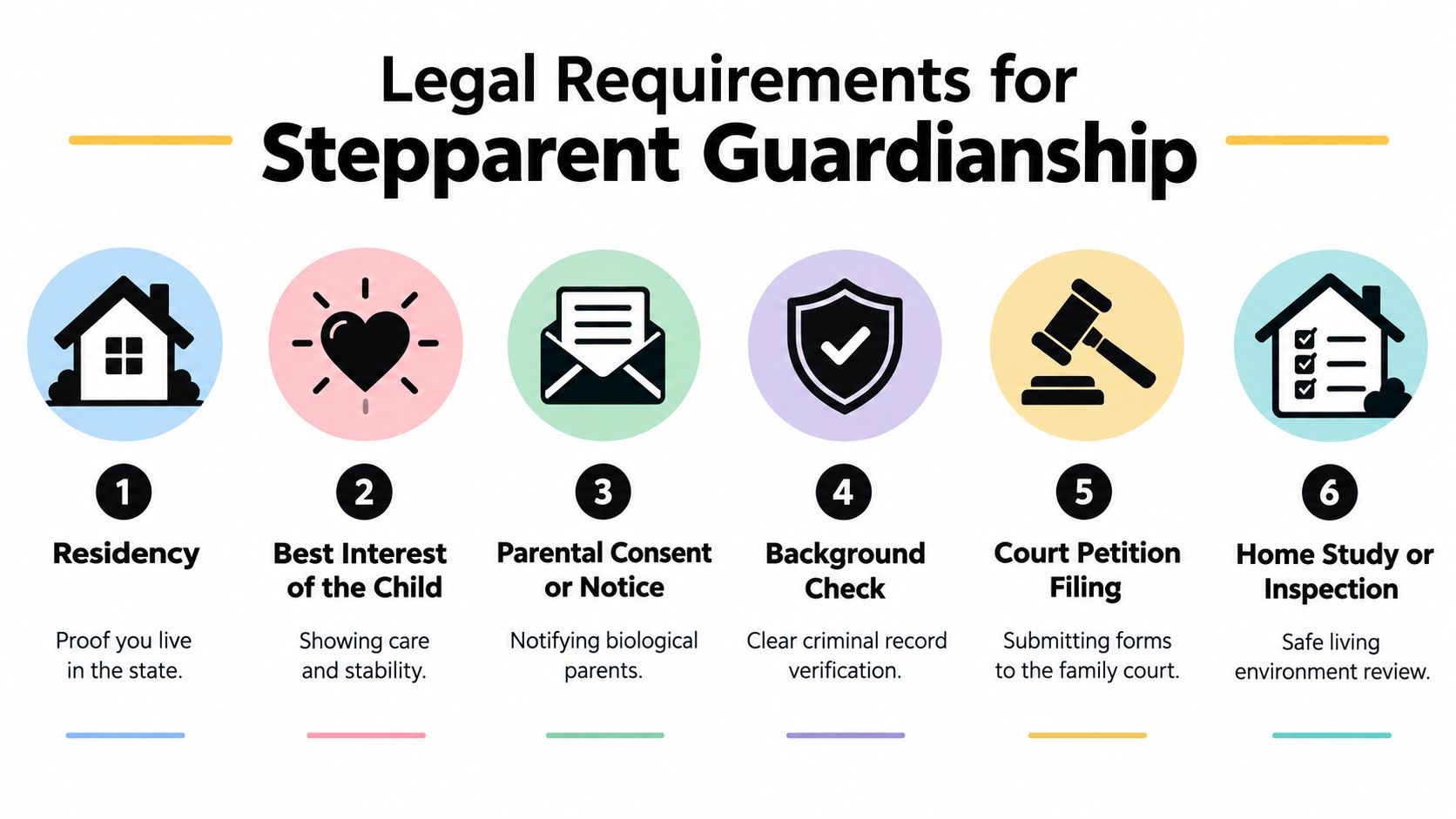
A typical preparation sequence looks like this:
- Confirm jurisdiction. Identify the court with authority over the child and check residency or venue requirements.
- Describe the child's living arrangements. Record where the child lives, who provides daily care, and how decisions are currently handled.
- Document the caregiving history. Gather school communications, medical involvement, transportation records, expense receipts, and written agreements.
- Address parental consent or notice. Determine whether consent is available and how each biological parent must be notified if consent isn't available.
- Prepare for court review. Courts may consider background checks, child-welfare information, investigations, or a guardian-ad-litem recommendation.
- Show the child's best interests. Connect the requested authority to stability, safety, continuity of care, and a concrete decision-making barrier.
The petition typically requires notice to the parents and a court review. The judge may consider parental consent, unavailability, incapacity, neglect, abuse, or other facts relevant to the child's welfare. The court's focus is not just whether the stepparent has worked hard. It is whether the requested legal authority is necessary and beneficial for the child.
Before filing: Separate observed facts from legal conclusions. “The child missed a scheduled appointment on a specific date” is evidence. “The parent is unfit” is a conclusion that requires legal support.
When Guardianship Is the Right Choice
Guardianship often fits a family that needs functional authority without permanently replacing a biological parent. For example, a biological parent may be medically incapacitated, deployed, incarcerated, absent, or temporarily unable to provide care. The stepparent may need to communicate with the school, authorize treatment, and manage daily decisions, while the family still wants the child's relationship with that parent preserved.
A flexible arrangement can also matter when circumstances may improve. Guardianship may be limited by the court or may end when the conditions that justified it change. That flexibility distinguishes it from adoption, which ordinarily creates a permanent legal parent-child relationship.
Consider three practical situations:
- The parent supports the arrangement. A consent-based guardianship or delegated authority may reduce conflict, but the court or relevant agency may still need to review the arrangement. A private conversation isn't necessarily enough.
- The parent is involved but cannot manage a specific responsibility. A narrowly drafted authorization may solve a particular school, healthcare, or travel problem without seeking broad guardianship.
- The parent objects and remains legally active. The stepparent may need to prove why the requested authority is necessary despite the parent's objection. A strong caregiving relationship helps explain the child's needs, but it doesn't automatically overcome the parent's legal position.
Adoption may be more appropriate when the family seeks a permanent parent-child relationship and the legal requirements for adoption can be satisfied. A custody or third-party custody order may be the better route when the central issue is residence or care rather than general guardianship.
The key question is not, “Which option gives me the most power?” It is, “What legal authority does this child need, and what arrangement protects the child while respecting existing family relationships?”
Documenting Your Caregiving Role Effectively
A stepparent's daily work can be extensive and still be difficult to prove in a legal proceeding. Build a record that allows another person to reconstruct what happened without relying on memory, emotion, or broad descriptions.

Use a dated structure. For each important event, note the date, the child involved, what occurred, who was present, what action you took, and what document supports the entry. Keep school messages, appointment records, receipts, exchange details, and agreements close to the related note.
A useful record distinguishes four things:
- The request: What decision or care was needed?
- The response: Who was contacted, and what did that person say or do?
- The child's experience: What practical effect followed?
- The proof: Which message, record, receipt, or document supports the entry?
Avoid labels such as “terrible parent,” “always,” or “never.” Those words communicate distress but rarely show a court what happened. Write, “The child's appointment was scheduled for Tuesday. I sent the appointment details on Monday and received no response before the visit,” if that is what the records establish.
For more guidance on organizing a factual record, review what to include in a custody journal. Preserve original material and make clear when you add or correct an entry. Don't alter a screenshot or rewrite an old note in a way that hides its original timing.
A structured record can help an attorney identify the legal issue, but it doesn't create guardianship by itself. Private notes demonstrate facts that may support a request. Only a legally effective order or authorization grants the authority you need.
A short educational video may also help families think about neutral record-keeping before meeting counsel.
Navigating Consent and Parental Involvement
Consent changes the process, but it doesn't remove the court's protective role. A biological parent may agree to a guardianship, yet the court can still assess whether the arrangement serves the child's best interests. Some jurisdictions also consider the child's preference at a specified age. Delaware, for example, requires documentation of a child's consent or an explanation of why appointment is justified when the child is at least 14, as described in this law review discussion of consent and guardianship procedure.
Consent can make the factual dispute narrower. If a parent agrees that the stepparent should handle school and healthcare matters, the parties may focus on the scope and duration of authority rather than litigating whether the parent can provide care. Even then, the document must meet local requirements, and a provider may reject an informal letter that doesn't create recognized authority.
Without consent, the stepparent generally must overcome the legal parent's preferential position. The evidence may concern the parent's unavailability, incapacity, abuse, neglect, or a demonstrable relationship between the stepparent and child that supports the requested order. The standard is jurisdiction-specific, and serious allegations should never be made without factual support.
A stepparent's involvement shows what the child's life looks like. It doesn't automatically decide who has legal authority.
Prepare for a contested case by organizing evidence chronologically and neutrally. Include attempted communication, missed appointments, deviations from agreements, care provided, and the child's practical needs. Keep the focus on the authority required and the child's welfare, not on winning an argument with the other parent.
Shared decision-making concepts can be useful background when a family is trying to define responsibilities without seeking a sweeping order. An overview of joint decision-making may help clarify how authority can be allocated, although it can't substitute for the law governing guardianship in your jurisdiction.
Common Misconceptions About Stepparent Rights
Misconception one: marriage creates legal parenthood. It doesn't. A stepparent can be highly involved and still lack independent authority for school enrollment, records, or planned medical care.
Misconception two: caregiving automatically becomes custody. Providing meals, transportation, supervision, and emotional support may be important evidence, but private caregiving doesn't itself create a court-recognized legal relationship.
Misconception three: guardianship always ends the biological parent's rights. Guardianship generally preserves the biological parents' legal relationship, while adoption ordinarily creates a permanent parent-child relationship and transfers parental rights and duties. The exact consequences depend on the order and local law.
Misconception four: guardianship is always permanent. Guardianship is commonly designed as a flexible or time-limited arrangement. It may end when the child reaches adulthood under the applicable law or when the conditions supporting the appointment change.
Misconception five: private records create legal standing. They don't. A well-kept journal can preserve useful evidence, but it cannot authorize a stepparent to consent to treatment or make education decisions without a recognized legal basis.
The most difficult misconception is that the most involved adult necessarily has the strongest legal position. A highly involved stepparent may have compelling evidence of a parental role yet weaker standing than someone who has a formal order. That result can feel unfair, but it reflects the difference between factual responsibility and legally assigned authority.
Proactive planning is therefore sensible, especially when the family anticipates travel, medical treatment, school changes, parental absence, or marital instability. Speak with counsel before an emergency forces the issue.
Next Steps and Professional Guidance
Start with the specific problem, not the legal label. Write down the decisions you can't currently make, the document a school or provider has requested, the child's living arrangements, and the biological parents' positions. This helps an attorney determine whether the appropriate path is guardianship, delegated authority, custody, adoption, or a narrower authorization.
Then create a factual file. Include dated caregiving records, school and healthcare communications, agreements, receipts, attempted contact, and documents showing the child's routine. Keep conclusions separate from observations, and preserve originals so a professional can evaluate reliability and context.
A qualified family-law attorney familiar with local statutes can explain notice requirements, consent rules, best-interests factors, possible investigations, and the scope of an order. Use a focused lawyer preparation guide to organize questions and documents before the consultation.
The legal arrangement may need to evolve as the child's circumstances change. A temporary authorization may be enough in one situation, while a court order becomes necessary when a parent is unavailable or a provider requires formal authority. Guardianship may protect stability without permanently changing parentage, while adoption may be appropriate only after the family weighs its lasting consequences.
The immediate goal is clarity. Identify the authority the child needs, document why it is necessary, respect the existing parents' legal rights, and seek advice before signing or filing anything you don't understand.
Casewell helps families keep dated, factual records of caregiving, agreements, expenses, exchanges, and supporting documents in one private custody journal. Visit Casewell to organize a clear record for review with your family-law attorney or mediator.