

The children are still sleeping in the same bedrooms, catching the same school bus, and seeing the same friends. The parents, however, are carrying bags through the front door on a rotating schedule. One sleeps in the family home while the other uses a rented studio, a relative's spare room, or another small residence, then they switch.
That arrangement is nesting in divorce, also called bird nesting or bird's nest custody. It can protect children from the disruption of moving between homes, but it also creates a demanding housing, financial, and emotional system for the adults. The children may stay settled while the parents absorb the inconvenience.
My advice is direct: treat nesting as a carefully managed temporary arrangement, not as proof that two separated adults can continue sharing a family life indefinitely. It works only when the parents can follow detailed rules, document what happens, and leave the arrangement when it stops serving the children.
What Nesting Actually Looks Like for a Family
On the first Sunday, the children remain in the family home. Mom moves into a rented studio for the nights assigned to Dad, while Dad takes responsibility for the children on his scheduled days. On Wednesday, they exchange again. The children wake up in the same rooms, use the same backpacks, and follow nearly the same morning routine.
The stability feels reassuring at first. The parent on duty restocks the fridge, handles homework, and gets the children to school. The off-duty parent leaves before bedtime or arrives only after the other parent has gone. A shared calendar records handovers, school events, medical appointments, and changes to the rotation. The arrangement may look simple from the children's perspective, but the adults are operating two connected households.
The weekly mechanics
A workable nesting schedule answers practical questions before the first handover:
- Sleeping arrangements: Each parent needs a defined sleeping space in the family home, and personal belongings must stay secured and separate.
- Food and toiletries: Parents need a clear approach to shared groceries, pantry supplies, laundry products, medicine, and children's toiletries.
- Communication: A scheduling app, written calendar, or agreed email method should record changes without turning every exchange into an argument.
- Handover routine: The parents should know exactly when one leaves, when the other arrives, and what information must be passed along.
- School logistics: Pickups, homework materials, sports equipment, and permission forms need a predictable place and owner.
A detailed custody schedule example can help parents compare rotation patterns, but no template replaces a schedule built around the children's school, sleep, activities, and each parent's actual availability.
The hidden burden
Nesting doesn't eliminate movement. It moves the movement from the children to the parents. One parent may sleep on a pullout couch in an adult residence, while the other pays for a space that's used only part of the time. Both may feel that they're carrying bags, buying duplicate essentials, and living in someone else's version of home.
The arrangement is therefore a logistics system first and a custody philosophy second. Before agreeing, calculate whether both parents can maintain the required adult housing and tolerate the emotional strain of entering and leaving the family home. If either parent expects the other to manage the house, absorb costs, or accept informal changes, nesting will become a dispute disguised as cooperation.
A Clear Definition and How Nesting Started
After separation, the children return to the same bedroom, school route, and neighborhood. The parents take turns living in the family home according to an agreed schedule. That arrangement is nesting, also called bird's-nest custody.
Nesting is a post-divorce custody arrangement in which the children remain in the family home while the parents rotate in and out during scheduled parenting periods. Cornell Law's Legal Information Institute defines bird nesting as children staying full-time in the family home while parents take turns residing there during their custody periods. The rule is straightforward: the children stay put, and the adults move. (Cornell Law School's definition of bird nesting)
Nesting differs from equal-time physical custody. In a conventional shared-care schedule, children travel between two adult residences. With nesting, the family home stays the children's base, while each parent has another place to live when not exercising parenting time. That second residence may be temporary, shared, or permanent, but the arrangement must be workable for both adults.
Where the modern model came from
The name refers to a bird's nest, where young remain in one place while adult birds come and go. Modern family-law commentary identifies a North American milestone around 2000, when a Virginia court accepted a plan that kept two young children in the family home while their parents alternated occupancy. A Canadian case in 2003 later became a notable example of a judge ordering bird's-nest custody. Courts generally do not impose this structure on unwilling parents. (A legal history of nesting in the modern era)
The model developed from child-centred concerns. Keeping the same bedroom, school access, neighborhood relationships, and daily routines can reduce the disruption caused by separation. It may also spare children repeated packing and reorientation during an early transition.
Nesting is not usually a separate statutory custody category. It is a co-parenting arrangement that a court may approve when parents agree, or when a judge considers it suitable for the children. Any order should identify parenting time and decision-making authority. A separate written agreement should address house rules, expenses, repairs, belongings, visitors, schedule deviations, dating boundaries, and the conditions for ending the arrangement. Those details protect the children and give a mediator or court a clear record if cooperation fails.
The model has appeared in the United States, Australia, the Netherlands, the United Kingdom, and Sweden. Reports describe parents rotating homes as far back as the 1970s, according to BBC Worklife's report on bird nesting. Official prevalence data remains limited because standard censuses and residency surveys generally do not identify nesting as a separate category.
Benefits and Costs to Weigh Honestly
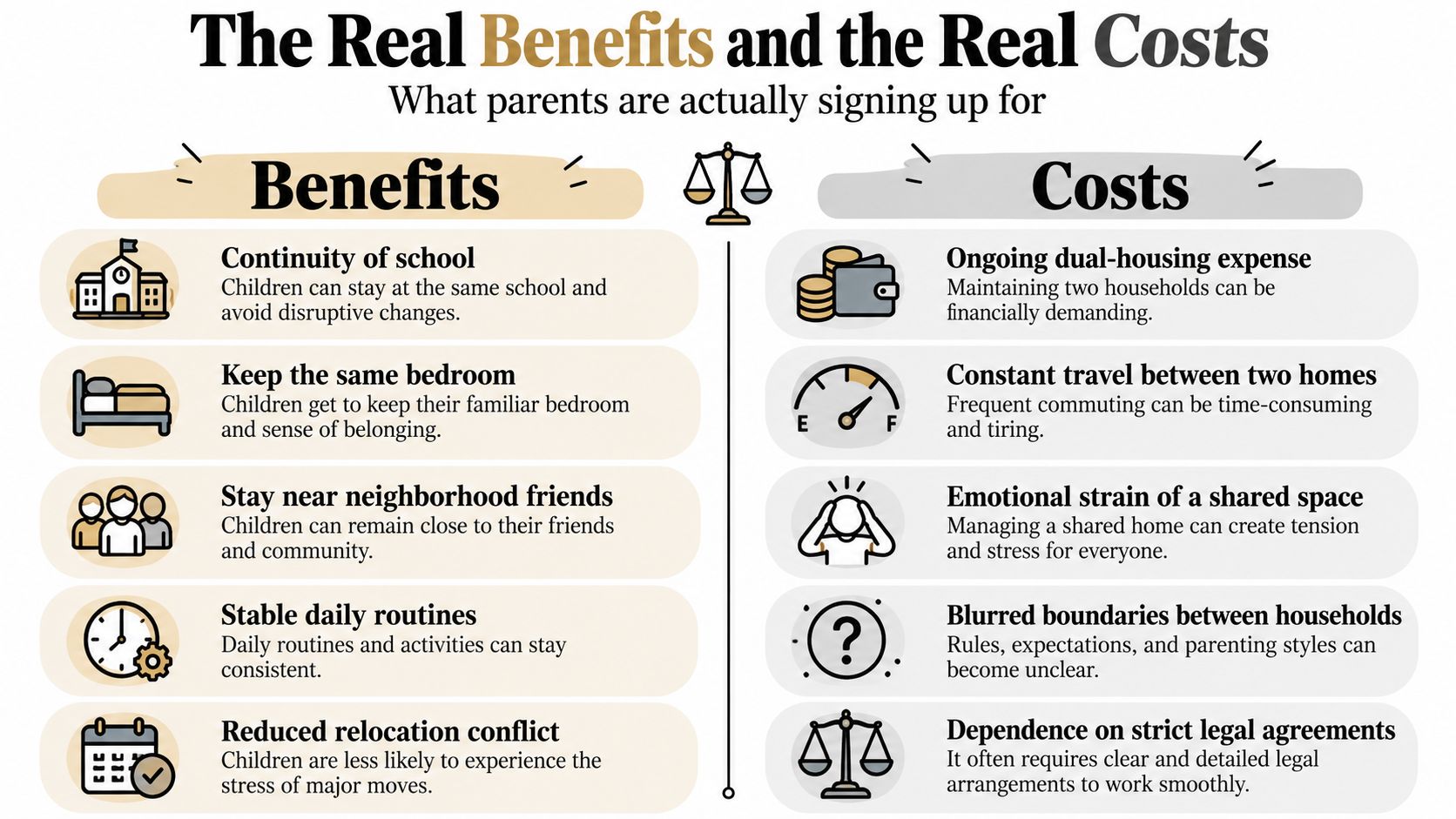
Nesting gives children physical continuity, but parents fund that stability with money, time, privacy, and constant coordination. Judge the arrangement by whether it lowers the children's overall stress, not by whether it looks orderly on paper.
What children may gain
Continuity is nesting's strongest benefit. Children keep the same bedroom, school route, neighborhood friends, pets, and household systems. They also avoid repeatedly packing and searching for a uniform, charger, book, or sports item.
Qualitative interviews with seven children from four nesting families found that physical stability eased separation by preserving familiar routines, reducing adjustment stress, and supporting emotional well-being, according to the 2024 study on children's experiences of bird's-nest parenting. That finding supports a measured conclusion. Nesting can preserve continuity at school, in the neighborhood, and in daily life. It does not remove the harm caused by parental conflict.
What parents actually pay
The financial structure can be punishing. The adults may need to fund the family home alongside separate adult housing. Mortgage payments, rent, utilities, insurance, internet, furnishings, transportation, and repairs require clear written responsibility. Without that detail, unpaid costs become disputes.
Privacy also shrinks. Parents may see each other's belongings, notice changes in the home, or feel watched even when neither person raises an issue. A new partner, altered work schedule, or disagreement about repairs can turn the shared house into a pressure point. House rules and a record of schedule deviations matter because a mediator or court may later need to assess what occurred.
| Benefit | Cost |
|---|---|
| Children keep familiar school and neighborhood routines | Parents carry the expense of separate adult housing |
| Children retain the same bedroom and household base | Parents have less privacy and personal space |
| Fewer child handoffs between homes | Parents must coordinate adult movement constantly |
| A gradual transition before a permanent schedule | Emotional separation may take longer |
| Less immediate disruption for some children | The system can fail when conflict rises |
Nesting works best as a bridge rather than a permanent answer. Coverage of bird nesting characterizes it as niche and under-measured, and professionals commonly present it as a short-term or transitional arrangement. Do not promise a fixed duration unless both parents have realistic exit criteria. Set review dates and record housing, finances, conflict, dating boundaries, schedule changes, and the children's adjustment. Documentation protects the children first, and it gives adults a usable basis for ending or revising the arrangement.
When Nesting Helps and When It Hurts
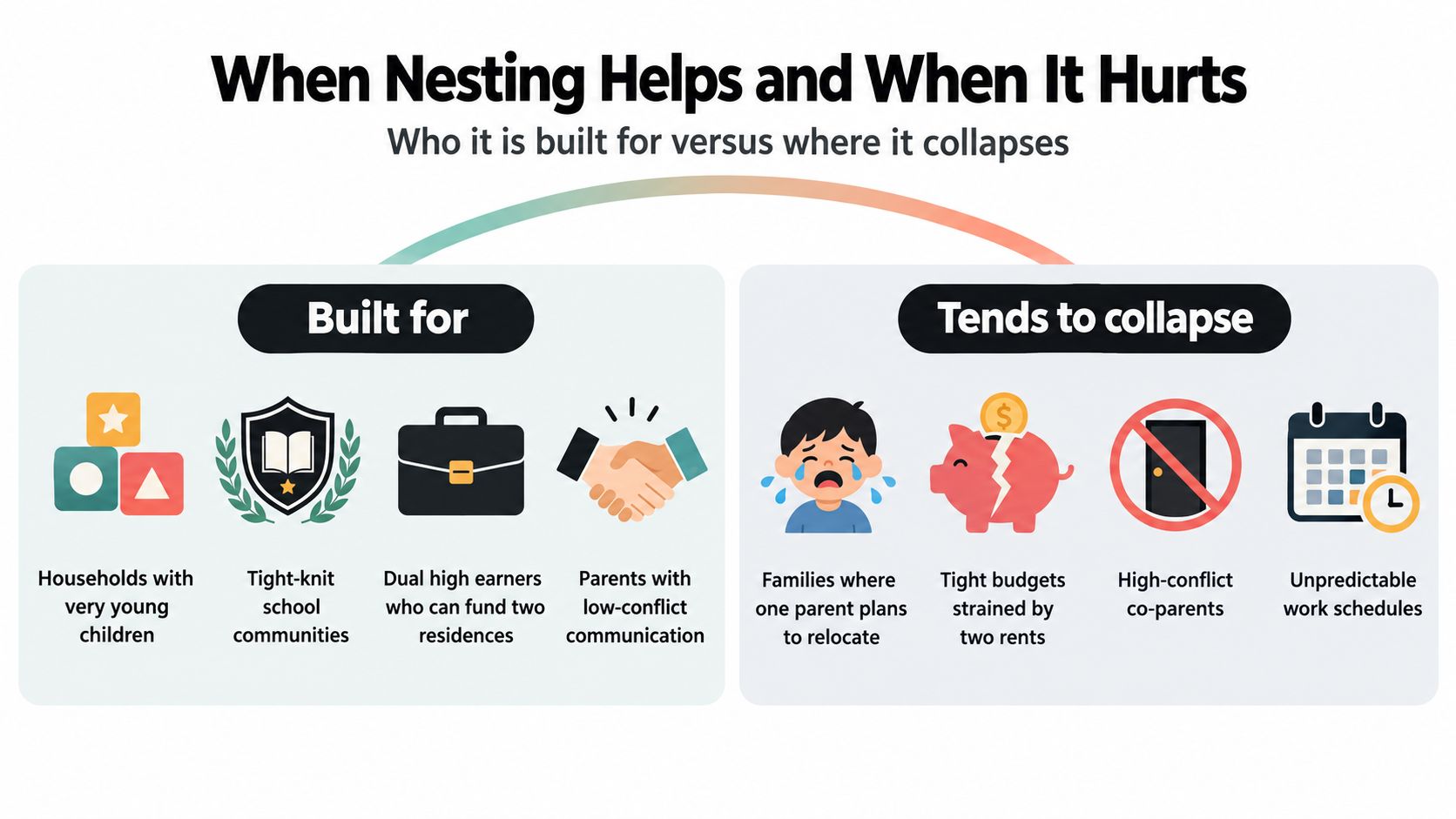
Nesting helps families that can cooperate without pretending they're still together. It tends to suit parents who communicate reliably, can fund the adult housing arrangement, and accept detailed limits on the shared home. It may also help children who are particularly attached to a school, neighborhood, bedroom, or stable daily routine.
A practical suitability test
Ask these questions before signing an agreement:
- Can both parents follow a written schedule? If one regularly changes plans without notice, the children will inherit the instability the arrangement was meant to prevent.
- Can both adults fund the structure? If one parent can comfortably maintain a second residence and the other cannot, money will quickly become a source of control or resentment.
- Can each parent leave the shared home alone? Nesting requires adults to respect private time, belongings, rooms, and boundaries.
- Can disagreements stay outside the children's hearing? A stable address doesn't protect children from arguments in the kitchen.
- Is there a credible exit plan? Nesting becomes dangerous when one parent wants a permanent solution but the other uses the arrangement to delay it.
High conflict is the clearest warning sign. Persistent parental discord can defeat the child-centred purpose of nesting, as discussed in this analysis of the advantages and risks of nesting. Parents should also take serious volatility, unsafe conduct, financial coercion, and unpredictable work schedules seriously. Nesting is not a repair tool for an unsafe relationship.
Review the arrangement before it breaks
At the 90-day review, examine missed handoffs, unplanned expenses, household damage, sleep disruption, and the children's reactions. Ask whether the parents are following the agreement without constant reminders.
At the six-month review, make a harder assessment. Is the arrangement financially sustainable? Have the parents established separate emotional lives? Are new partners, work changes, or relocation plans making the rotation unrealistic? If the answer is no, propose a conventional two-home schedule without describing the change as failure. The arrangement succeeded if it gave the children a safer transition. It doesn't need to last forever to have served its purpose.
Parents dealing with recurring hostility should also review guidance on high-conflict co-parenting before choosing a model that requires frequent contact with the other parent's living space.
Setting Nesting Up the Right Way
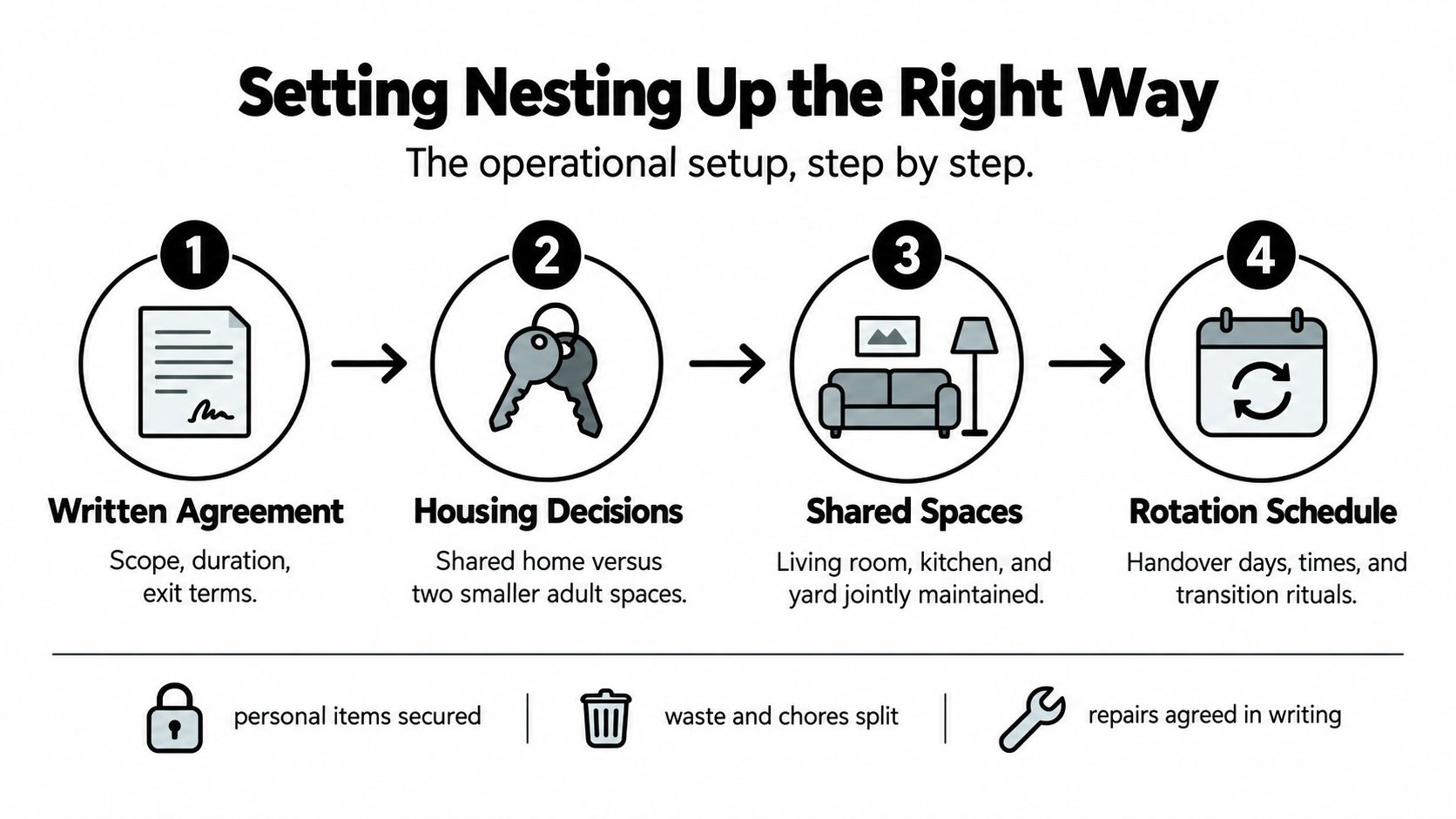
A nesting plan should begin with a written agreement, not a verbal promise made during a calm conversation. The document needs two parts: the legal parenting arrangement and the household operating rules. A custody order may establish parenting time, but it won't automatically resolve who pays for a broken appliance or whether a parent can bring an overnight guest into the family home.
Put the agreement on paper
Specify the rotation, handover time, duration, review dates, decision-making authority, and exit conditions. Identify what happens if one parent is sick, travels, loses housing, or cannot afford the arrangement. Include a dispute process, preferably mediation before either parent files an emergency motion unless safety requires immediate court action.
Then map the home itself. Decide which rooms are private, where each parent sleeps, how personal property is secured, and whether either parent can enter the home outside the assigned period. Lockable storage, separate bathroom supplies, and clearly divided closets prevent ordinary clutter from becoming a symbolic battle.
Assign every recurring cost
The agreement should address the mortgage, property taxes, insurance, utilities, internet, subscriptions, cleaning, lawn care, groceries, and children's ordinary expenses. It should also distinguish routine maintenance from capital repairs. State who can authorize work, how estimates are obtained, how reimbursement requests are submitted, and what happens when the parents disagree.
If the family home is a marital asset, discuss its treatment with a family-law attorney and financial adviser. A qualified domestic relations order, or QDRO, may matter where retirement assets are divided, but it doesn't by itself resolve the practical operation or eventual sale of the home. Parents should also review wills, beneficiary designations, insurance, and powers of attorney after separation.
Build the daily system
Use one shared calendar for school pickups, activities, medical appointments, travel, handovers, and deviations. Record key and alarm codes, pet care, rubbish collection, pantry expectations, emergency contacts, and school routes. Each parent should source adult housing that is affordable and close enough to protect the children's routine without treating the family home as a permanent hotel.
For a visual explanation of nesting's core mechanics, watch this overview before finalizing the schedule:
The agreement should also say how the children will be told about the arrangement. Keep the explanation age-appropriate, consistent, and free of adult blame. Don't ask children to carry messages, supervise handovers, or judge which parent followed the rules.
Sample Agreement Elements That Prevent Disputes
The strongest nesting agreements don't rely on goodwill alone. They convert predictable friction into written procedures. A parent should be able to answer, without calling the other parent, what happens when a flight is delayed, a pipe leaks, a friend wants to stay overnight, or a child refuses a screen-time rule.
A useful custody agreement example can help identify missing topics, but parents should have local counsel adapt the language to their court and circumstances.
Here is the level of specificity I recommend:
- Rotation: “Parent A occupies the family home during the agreed parenting period. Parent B leaves by the stated handover time. Neither parent enters the home during the other parent's period unless the agreement permits it.”
- Schedule changes: “A parent requesting a change must provide written notice as soon as reasonably possible. The request isn't effective until accepted in writing, except in an emergency.”
- Review: “The parents will review the arrangement on the agreed review date and consider whether it remains financially workable and beneficial for the children.”
- Guests: “No overnight guest may stay in the family home without the required written consent. The guest rule applies equally to both parents.”
- Repairs: “No non-emergency repair above the agreed authority limit may be ordered without written approval from both parents.”
- Expenses: “The paying parent will upload the receipt to the shared ledger and request reimbursement under the agreed process.”
- Children's care: “The parents will follow the agreed approach for school, medical and dental care, extracurricular activities, religious observances, discipline, and screen use.”
| Clause Area | What to Specify | Why It Matters |
|---|---|---|
| Rotation | Days, times, keys, late arrivals, emergency handovers | Prevents arguments about possession and missed periods |
| House rules | Guests, smoking, alcohol, firearms, cameras, renovations, pets | Defines acceptable conduct in shared space |
| Finances | Recurring bills, groceries, repairs, reimbursements, ledger access | Stops informal spending from becoming a custody dispute |
| Children's decisions | School, healthcare, activities, religion, discipline, screens | Reduces contradictory expectations |
| Privacy | Bedrooms, personal storage, devices, mail, documents | Protects separation inside the shared home |
| Review and exit | Review date, termination triggers, sale or transition process | Prevents indefinite drift |
Write holiday decorations, furniture changes, and pet care into the agreement too. These details seem minor until one parent sees a changed room or an unpaid veterinary bill as evidence that the other parent no longer respects the shared system.
Risk Management and Conflict Triggers
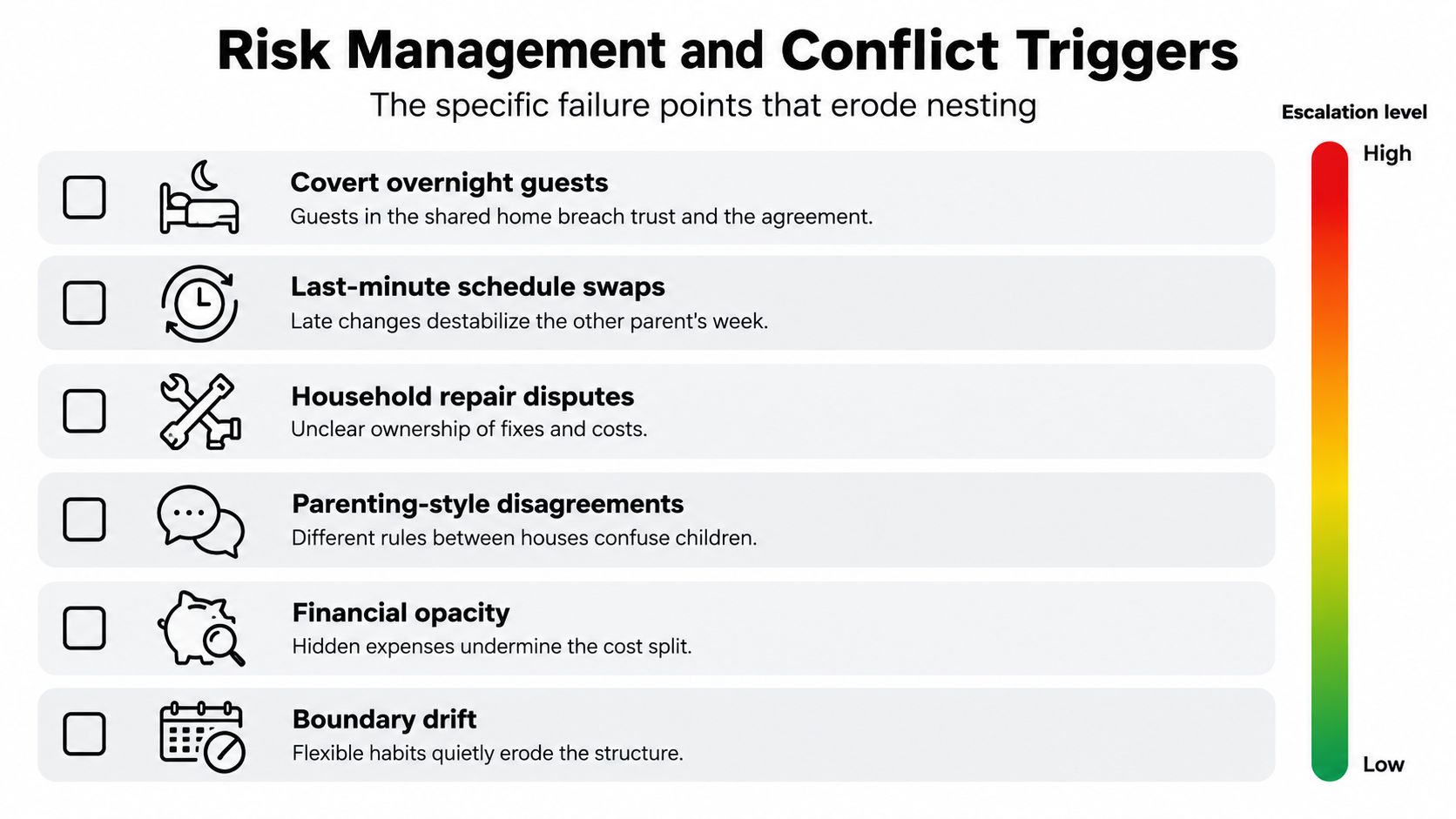
Nesting rarely collapses because parents forgot the concept. It collapses because small boundary breaches accumulate. A guest stays overnight without permission, a parent changes the schedule by text, a repair bill appears without warning, and eventually both adults keep records only to prove the other is unreasonable.
Six triggers to control early
Covert overnight guests create a direct trust problem. Define guest rules before anyone starts dating, state whether consent is required, and apply the same rule to both parents. If the parents can't agree on a standard, the shared home is not ready for this arrangement.
Last-minute schedule swaps make the calendar meaningless. Require a defined notice period for ordinary changes, identify emergencies separately, and state whether a declined request creates makeup time. Don't reward repeated noncompliance by treating every late request as a new negotiation.
Household repair disputes need authority limits and documentation. Decide who handles urgent damage, when estimates are required, and whether the parents use a reserve for agreed repairs. Take dated photographs of significant damage before work begins.
Parenting-style disagreements are manageable only when the parents distinguish safety and education from personal preference. Put core rules in writing, especially around discipline, schoolwork, medical care, devices, and bedtime. The resident parent can run the ordinary day, but shouldn't use that role to rewrite shared decisions.
Financial opacity breeds suspicion. Use a ledger, upload receipts, state reimbursement deadlines, and require written explanations for disputed charges. A parent who hides expenses is undermining more than the budget. They're making the entire arrangement harder to verify.
Boundary drift appears when exceptions become the normal schedule. Review the calendar monthly, record deviations, and use the agreed mediator when the same issue repeats. A neutral third party should be named before conflict escalates, not searched for after court papers arrive.
Practical rule: If a problem appears twice, amend the agreement or use the dispute process. Don't keep calling it a one-off.
Documentation and Using a Private Custody Journal
A nesting arrangement produces more evidence than a conventional schedule because the parents share a physical home and divide its expenses. Keep records while events are fresh, not after a dispute has become urgent. A useful journal records what happened, when it happened, who was affected, and what proof exists.
Use neutral language. Write “Parent arrived at the agreed handover time” rather than “Parent was finally on time.” Record observable facts, not diagnoses, motives, or predictions. Preserve the original message, receipt, photograph, or calendar entry beside the note when possible.
A defensible record routine
After each meaningful handover, log whether the exchange occurred as agreed and note any change. Record repairs, expenses, missing items, unauthorized guests, schedule deviations, and child-related incidents that may matter later. Keep the record private and don't threaten the other parent with it during an argument.
| Category | What to Log | Why It Matters |
|---|---|---|
| Handover | Agreed time, actual time, location, deviation | Shows whether the rotation operated as written |
| Household condition | Damage, missing items, repairs, dated photographs | Separates normal wear from disputed responsibility |
| Expenses | Item, amount, payer, receipt, reimbursement status | Creates a transparent financial trail |
| Child-related events | School, healthcare, activities, significant incidents | Connects decisions to the children's needs |
| Communication | Date, subject, request, response, outcome | Preserves the sequence without relying on memory |
| Agreement changes | Requested change, consent, implementation | Distinguishes approved flexibility from unilateral action |
A private custody journal such as Casewell's co-parenting journal can organize dated entries, exchange check-ins, agreements, expenses, receipts, screenshots, photographs, and files in a searchable timeline. It can also produce focused PDF reports showing dates, entry history, later edits, and attached proof for review by a mediator, attorney, solicitor, or court.
Don't turn documentation into surveillance. The purpose is to make the arrangement legible when memory differs, not to provoke the next conflict. If a mediator or judge later reviews the nesting plan, a factual sequence of ordinary handovers, expenses, repairs, and deviations is more useful than a folder of angry commentary.
Start recording from the first day of nesting. Agree on the schedule, preserve every approved change, and review the record at each formal check-in. That discipline protects the children's routine and gives both parents a clearer basis for deciding whether nesting should continue.
Casewell provides a private custody journal for dated co-parenting records, including exchange check-ins, expenses, receipts, agreements, screenshots, and supporting files, with focused PDF exports for professional review. If you're setting up nesting in divorce or need a factual record when the arrangement becomes difficult, visit Casewell and build the documentation routine before a dispute escalates.