
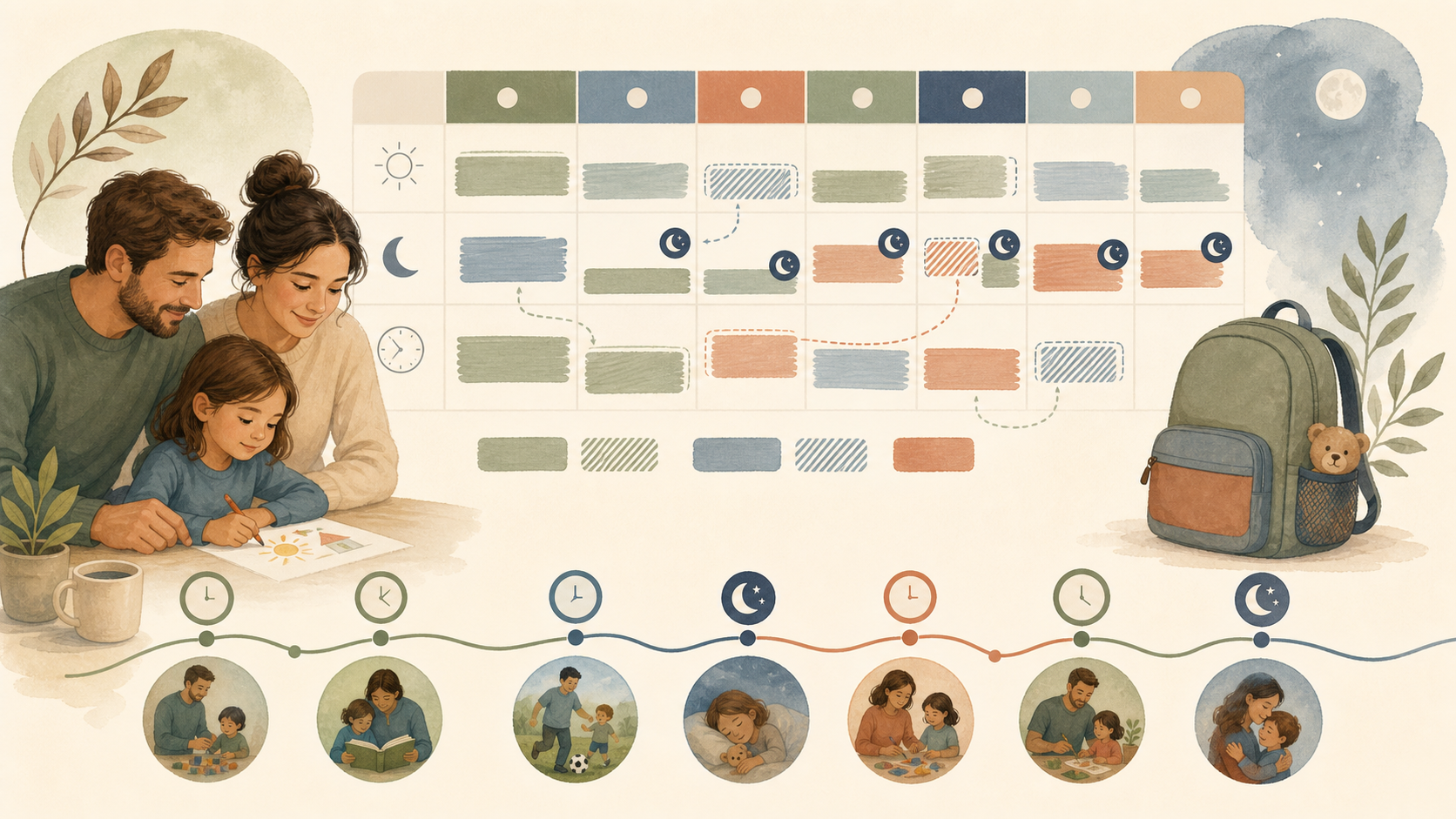
How to read this in the UK
Three things need to stay separate in a record. What the arrangement says, what actually happened, and the file that shows it. Blur them together and a reader has to take your word for it. Keep them apart and the record speaks for itself.
The UK is not one family-law system. England and Wales, Scotland and Northern Ireland each have their own rules, forms and vocabulary. Use the words that appear in your own order or agreement rather than a term borrowed from somewhere else.
Keep the complete source file, not a crop of it. Write events in the order they happened, and say plainly where something is missing or unclear. A family solicitor can work with a record like that. They cannot work with a reconstruction.
Locality checklist for a UK review
Name the UK nation and court. Copy the key words from the current order or plan. Add places only when they help explain the event. Remove home or school addresses if the reader does not need them. Check the right court rules before you use a private timeline as a formal record.
Copyable parenting-time row
PERIOD ID: PT-[YEAR]-[NUMBER]
CHILD:
PLANNED START / END:
ACTUAL START / END:
PLANNED LOCATION / EXCHANGE:
ACTUAL LOCATION / EXCHANGE:
PLANNED OVERNIGHTS:
ACTUAL OVERNIGHTS:
PLANNED HOURS:
ACTUAL HOURS:
CHANGE / CANCELLATION INITIATED BY:
NOTICE TIME / CHANNEL:
REASON STATED:
TIME MISSED:
MAKEUP OFFERED:
MAKEUP AGREED:
MAKEUP EXERCISED:
CORROBORATION / EVIDENCE IDS:
TIMELINE LINE:
Keep offered, agreed and exercised makeup time separate. An offer isn't the same fact as time that occurred.
Worked weekly reconciliation
Plan: Fri 7 Aug, 17:00 to Mon 10 Aug, 08:00 — 63 hours and three overnights. Actual: Fri 18:10 to Sun 20:00 — 49 hours 50 minutes and two overnights. Change: Sunday return requested by Parent B on Thu 6 Aug, 12:14. Parent An agreed at 13:02 in MSG-170.
Makeup: one overnight offered for 21 Aug. Not yet agreed. Row PT-2026-033 shows a 13-hour-10-minute difference and one fewer overnight. But also shows the revised return was agreed. Timeline: 6–10 Aug | Parenting time | Agreed early return. Actual 49h50 / 2 overnights. Makeup offered, pending | PT-2026-033. MSG-170.
Decision tree: what should you count?
- Does an order, agreement or official system define the measure? Use that wording and method first.
- Are you checking a residential schedule? Overnights may be useful, but keep start and end times.
- Are partial days or school periods important? Calculate actual hours as well.
- Was the schedule revised by agreement? Keep original plan, agreement reference and revised plan before comparing actual time.
- Are you preparing a legal, tax, maintenance or benefits calculation? Don't reuse a private percentage without checking that system's rules. The same calendar may be counted differently.
Jurisdiction-specific terminology
Canada's federal Divorce Act uses parenting time and defines it around the period a person is mainly responsible for the child. This can include school or daycare. England and Wales commonly describe child arrangements as whom a child lives with and spends time with or has contact with.
California self-help materials use custody and parenting time (visitation). Australia commonly uses parenting orders and language about a child spending time with a person. Use the term in the current order or plan and quote the schedule. A label alone doesn't decide how hours, overnights, support or compliance should be calculated.
Build an organized chronology from periods
Keep one row per continuous care period, then add separate event rows for a cancellation, missed exchange or later makeup period. Monthly summary: August | 12 planned periods / 16 overnights | 11 completed / 14 overnights | 1 agreed change | PT-2026-031–042. Disclose whether your total follows original or revised plans.
The timeline should point back to rows, messages and exchange records. Pair it with the exchange log template when the transition itself needs detail. Also, with how to prove parenting time for source selection.
A UK review note
Copy a planned-versus-actual parenting-time log with overnight and hour calculations, a worked reconciliation, and legal area-aware terms. Sharing any of it in the UK takes a few more steps.
Before you share any of this, work from a copy. Remove private details the reader does not need, and leave the original file untouched.
Check each key sentence. Can you link it to a date or source? If not, change the summary. Do not fill the gap with a guess.
Name the UK nation and court on the review copy. Keep the words used in the order. Ask a family solicitor about court rules and what you may need to share.
What a coherent UK record looks like
Casewell keeps the dated entry, its source file and any later addition together in one private timeline. When a review is needed, select only the records that answer the question in front of you and share those with a family solicitor.
Try for freeShould I count hours or overnights?
Keep both when feasible, then use the measure needed for your actual purpose. An overnight total can hide short or extended periods, while hours may not match a legal or administrative rule.
Does agreed makeup time erase missed time?
Keep the original variance and the later makeup period as separate facts. Your summary can show both without rewriting the earlier record.
Can I use this log to calculate child support?
It can keep dates and care periods, but official calculations and definitions vary. Use the relevant authority's method or get local advice.
Does this cover Scotland and Northern Ireland too?
No. England and Wales, Scotland and Northern Ireland have separate family-law systems, forms and terms. Use the page to organise a working record and get advice for the relevant legal system.
Sources
England and Wales, Scotland and Northern Ireland have separate family-law systems, forms and terms. The official source gives orientation only. This page is a records guide, not legal advice.