
How to read this in Australia
A record earns its weight by staying factual. Note what was planned, note what took place, and attach the file or message that supports the note.
Start from the parenting order, plan or written agreement now in force. Most family law here is federal, though Western Australia follows a different court path in some cases. Use the words that appear in your own papers.
Keep everyday days in the private record alongside the difficult ones. When a review is needed, select only the entries that answer the question in front of you. That is what lets an Australian family lawyer find the key facts quickly.
State, territory and pathway checklist
Name the state or territory and the court registry. Say if the plan is an order, parenting plan, or written deal. Use the words from that paper. Flag any Western Australian court path for legal review. Keep court papers, dispute help records, and daily notes in separate groups.
Capture context before commentary
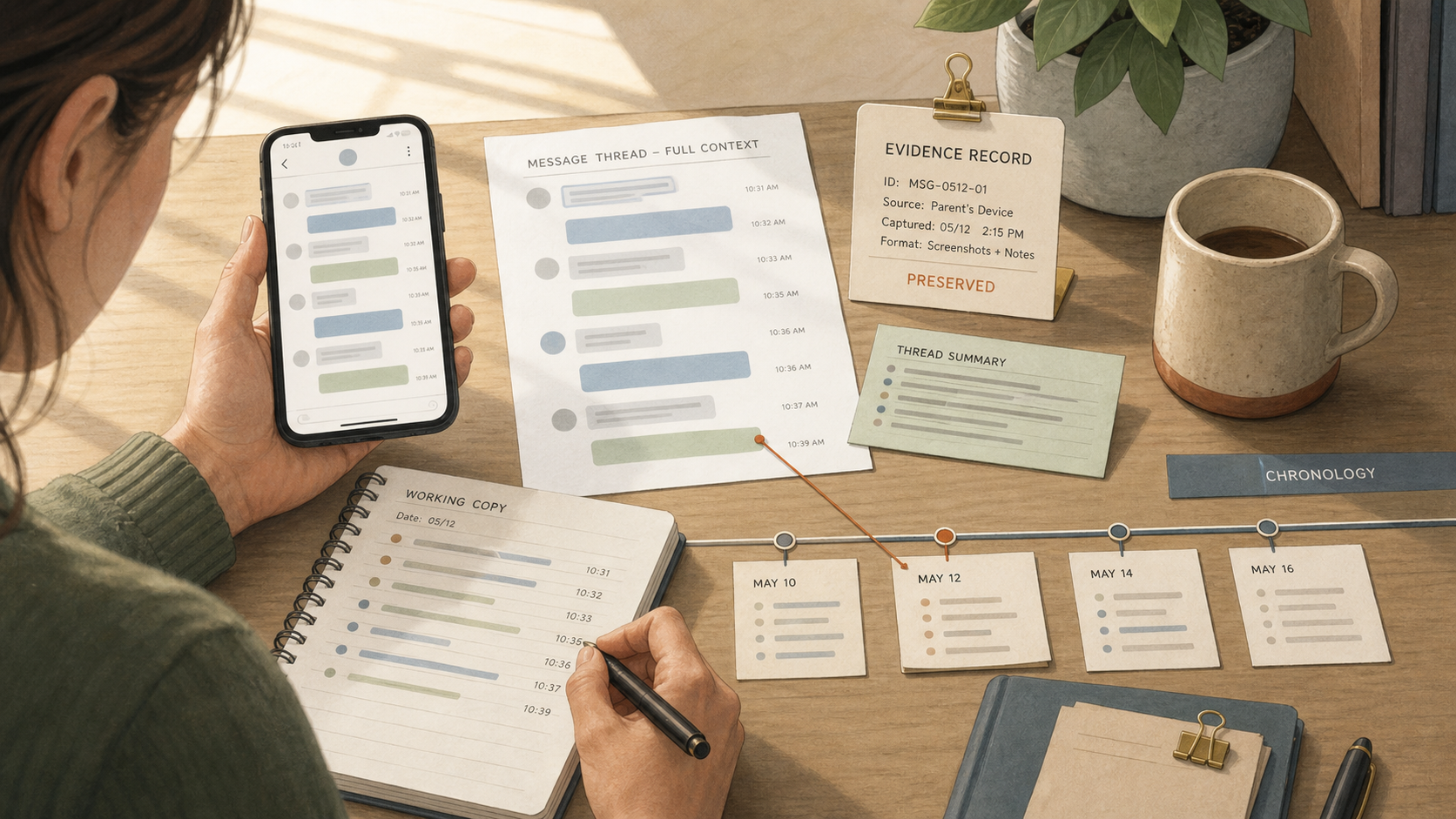
Start with the thread header or contact identity, date and time, then capture enough surrounding messages to show the subject and response. A single hostile sentence may look different after the request it answered. A cooperative answer also deserves preservation when it completes the sequence. Don't crop your own contribution out of the exchange.
If the app permits an export, keep it alongside screenshots. Record the device, account and date collected. Platform exports vary, so open the file and confirm that names, timestamps and files remain understandable.
Follow the original–working copy–excerpt rule
- Original: the device data or full export kept unchanged.
- Working copy: a duplicate given a stable evidence reference and stored with the case index.
- Excerpt: the smaller set selected for an exact review, with a pointer to the full context.
An excerpt should never become the only surviving version. Note omitted messages by reference rather than presenting the excerpt as the entire conversation. Keep media files separately if the export doesn't embed them.
Use an annotated message record
MSG-041 — 12 June 2026, 14:08–16:22
Participants: Parent An and Parent B, identified by account names in full export.
Issue: consent for school trip.
Material sequence: request sent 14:08. Clarification requested 15:02. Answer “I consent” sent 16:22.
Context kept: four messages before the request and three after the answer.
Original: iPhone export dated 13 June, pages 22–24.
Timeline: CH-026.
Limitation: voice note at 15:17 is listed but not transcribed.
The annotation states what the exchange can show and what remains missing.
Separate message event, interpretation and evidence
Event: A request for the child's passport details was sent at 09:10. A reply at 18:46 supplied the passport number.
Interpretation: The delay was intended to obstruct travel.
Evidence: Full message thread MSG-052 and travel deadline email TRV-03.
The timeline can record the request, response and practical deadline. Intent isn't established by response time alone. If the response missed a material deadline, record the actual consequence and its source.
Handle gaps and disappearing messages honestly
If messages are missing, state the gap. Don't recreate exact wording from memory. Record that a conversation occurred, identify any later message that refers to it, and label your recollection as such. For disappearing-message platforms, keep relevant material promptly and lawfully. Avoid changing contact names in a way that makes identity harder to verify.
Audio recordings, account access and data extraction raise consent, privacy and authenticity issues that vary by place. Ask a qualified local expert before covertly recording, accessing another person's account or using specialist extraction software.
Fit message references into the chronology
A timeline entry should describe the child-related event, not paste the whole conversation: 12 Jun | Education | Trip consent requested 14:08. Clarification 15:02. Consent received 16:22 | MSG-041. The master index then points to pages 22–24 of the original export.
Legal areas use different filing terms. England and Wales may place relevant correspondence in a paginated e-bundle. Australia may refer to a file as an annexure or exhibit to an affidavit. California materials may be attached to a declaration. Your private reference system can feed any of these after local review.
An Australian review note
Keep custody-related text messages with sender, date, surrounding context, originals, issue tags and timeline references instead of isolated screenshots. Sharing any of it in Australia takes a few more steps.
Work from a copy when someone needs to review the record. Include the current order or plan, a short timeline and a small set of named source files.
Check current court orders and rules before you send the pack. An Australian family lawyer can say what belongs in an affidavit, annexure, or private file.
Name the state, territory, and court path. Take extra care in Western Australia. A national guide cannot set the right court step for every case.
What a coherent Australian record looks like
Casewell keeps the dated entry, its source file and any later addition together in one private timeline. When a review is needed, select only the records that answer the question in front of you and share those with an Australian family lawyer.
Try for freeAre screenshots enough?
They may keep useful content, but a full export, original device and wider context can help with identity and completeness. Local rules decide what can be relied on.
Should I highlight words in a screenshot?
Keep an unchanged working copy. If highlighting helps a reviewer, create a clearly labelled annotated copy and keep the clean version beside it.
Can deleted messages be recovered?
Recovery options depend on the device, backups and platform. Avoid altering the device if expert preservation may be needed. Also, seek qualified technical and legal advice.
Is this a court form or affidavit?
No. It is a method for keeping a private factual record. Current court rules and expert advice decide how material is prepared or used in a proceeding.
Sources
Federal family law supplies the broad framework, while Western Australia and some related processes have distinct pathways. The official source gives orientation only. This page is a records guide, not legal advice.