 Casewell

Contemporaneous notes are records written at the time of an event or as soon as possible afterward, while memory is still fresh. That timing can help credibility, but it doesn't guarantee a court will admit the note or treat it as proof.
You just got the kids back twenty minutes late, or a text said pickup "might slip." Dinner is late, the hallway is full of backpacks, and you tell yourself you'll write it down once a hearing date exists. By then the clock time has blurred, the exact words have softened, and a September reconstruction starts to sound like a story built for a judge.
What are contemporaneous notes, in a custody file, is a habit of two clocks. One clock is when the handover, call, expense, or missed return happened. The other is when you wrote it down. A private notebook can hold both. So can a structured journal. Neither one wins a case just by existing. The useful question is whether a reviewer can see what you observed, when you observed it, and when you put it on the page.
What Is a Contemporaneous Note and What It Must Record
A contemporaneous note is a record written at the time of an event or as soon as possible afterward, while the writer's memory is still fresh. UK government notebook guidance uses those same two time frames, "at the time" or "as soon as possible after the event." The idea is older than any app or template: a page written near the event carries a different kind of weight than a page written to prepare for court.
U.S. federal evidence law treats a related idea, recorded recollection, as a reliability check rather than a rubber stamp. The record has to concern something the witness once knew, it has to have been made or adopted when the matter was fresh in memory, and it has to accurately reflect that knowledge. Courts applying this doctrine have described the traditional test as recording recollection "at or near the time of the event," while also recognizing that freshness can't always be reduced to a fixed number of hours or days. Timing is a factor. It isn't a promise of admission, and it isn't a promise that every line is true.
Say a March school handover is logged that same evening, with the planned time, the actual time, and who waited. A September write-up of that same afternoon, prepared because a hearing is coming, is a reconstruction. The March page can still be wrong. The September page has a harder time showing that the memory was still close.
One distinction does most of the work here: the event time and the writing time are two separate facts.
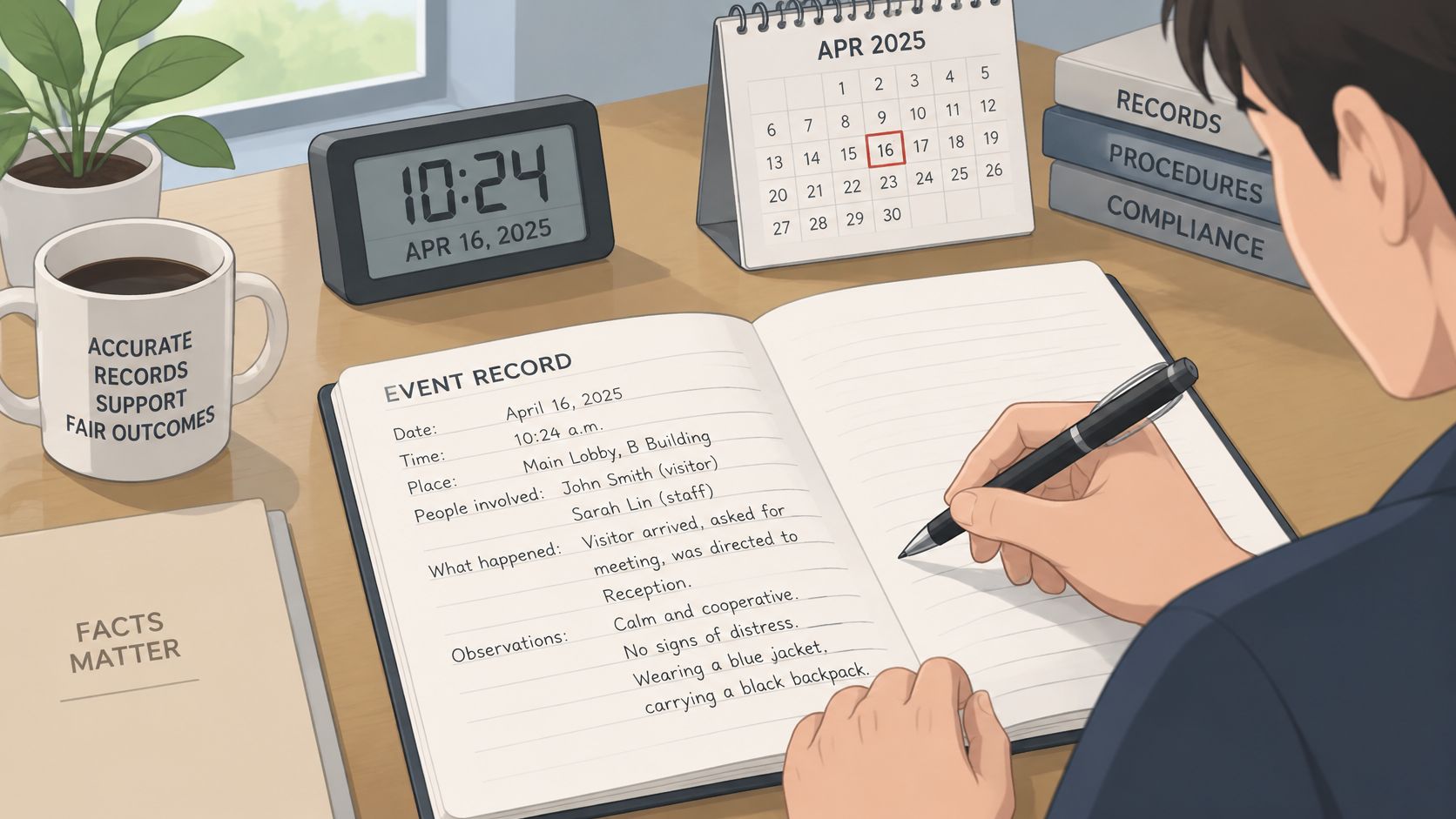
Fields that keep the two clocks apart
Work down the row, not around it. If a field is blank, a reviewer has less to test.
| Field | What to record | Why it matters |
|---|---|---|
| Event date and time | The day and approximate clock time the event happened | Shows proximity, not a later story |
| Location | Where it happened, such as school, home, or a handover spot | Anchors the account to a real setting |
| People present | Child, each adult, and anyone who saw it | Shows who had a chance to observe |
| Observable actions | What was seen or heard, not why someone acted | Keeps fact separate from motive |
| Note created | Date and time the note was written, separate from the event | Proves how fresh the memory was |
| Observation label | Direct observation, assumption, or report from someone else | Stops hearsay from looking like firsthand fact |
| Original wording | The first version, kept even if clarified later | Prevents silent rewriting |
| Attachments | Photo, screenshot, receipt, or short relevant quote | Gives context beyond the writer's memory |
Event date and time answers when it happened. Note created answers when you wrote. Those are different facts, and mixing them is the mistake that makes a tidy diary look older than it is. A page that says only "Tuesday, pickup late" forces a reviewer to guess whether Tuesday is the handover or the writing session. Write both, and the page can speak for itself.
Practical rule: If you can't point to both the event time and the writing time, treat the page as a memory aid, not as a record a professional can weigh.
Observable actions stay in the sentence. Motives stay out, or they get a label such as assumption. "He arrived at 6:40" is an observation; "he doesn't care about the schedule" is a conclusion, and it weakens the fact sitting next to it. A short quote is fine when you mark who said it. A photo, receipt, or uncropped message sits with the entry so the words aren't the only trace.
Rewriting is allowed only when the first version stays visible and the moment of the change is visible too. Silent cleanup hides when the information was first recorded, and a hidden edit can cost a page more credibility than the sloppy original ever would. Parents who later need to understand how a trial record is built can read Bryan Fagan appellate record guidance for a plain account of why what reaches a higher court depends on what was preserved below. A private note still isn't that record. It's the raw material you might be asked to explain.
How Courts Treat Fresh Records in Custody Matters
Family and custody cases run on state rules, local practice, and the judge in front of you. Federal evidence ideas are a lens for thinking about freshness. They are not a verdict on your notebook.
Read into the record is not the same as an exhibit
Under Federal Rule of Evidence 803(5), a recorded recollection may be read into evidence when the requirements are met. U.S. Code materials on the federal rules describe a memorandum, report, record, or data compilation in any form, and they tie reliability to an accurate reflection of the witness's knowledge while events are still fresh. The usual path is that the witness once knew the matter, can't now recall it fully and accurately, the record was made or adopted while the memory was fresh, and the record accurately reflected that knowledge. The record may be received as an exhibit only when an adverse party offers it.
That split matters in a parenting case. Read into the record means the court hears the note's contents while a witness testifies, and the page itself stays out of the exhibit folder unless the other side puts it there. Your note can support what you say on the stand. A lawyer still has to connect it to a witness, a foundation, and a purpose.
The regularly conducted activity rule is a different door. The federal rules of evidence put four controls on it:
- The record is made at or near the event by someone with knowledge, or from information that person supplied.
- It is kept as part of a regularly conducted activity.
- Making the record is itself a regular practice of that activity.
- A custodian, qualified witness, or permitted certification supports it, unless the source or the method of preparation indicates a lack of trustworthiness.
A parent's custody journal usually fails that test. You aren't a shop logging sales in the ordinary course. Writing only after a lawyer's letter, or only on the weeks that favor you, looks different from a steady habit. Courts can still look at personal knowledge, routine versus litigation-only writing, alteration, internal consistency, relevance, authorship, completeness, and authenticity. In practice that list becomes plain questions: who wrote each line, when did the habit start, and do the quiet weeks in the calendar match the quiet weeks in the story.
A timestamp shows that an action was recorded at a moment. It doesn't prove the sentences are true, complete, or fair.
A timestamp works like a postmark: it fixes when something was mailed and says nothing about whether the letter inside was honest.
Receipts, messages, and photographs can sit beside a handover note and give a reviewer something that didn't come only from your memory. They still don't decide admissibility by themselves.
What a reviewer can actually check
| Standard | What timing and form require | What it does not do |
|---|---|---|
| FRE 803(5) recorded recollection | Once known, made or adopted when fresh, and an accurate reflection of that knowledge | Does not make the note an exhibit unless an adverse party offers it |
| Regularly conducted activity | At or near the event, by someone with knowledge, as a regular practice, with a proper witness or certification unless untrustworthy | Does not automatically cover a personal custody journal |
| Practical custody review | Separate event time and writing time, names, observations, labeled interpretation, originals and attachments | Does not decide relevance, authenticity, or admission |
The last row is the one you control. A lawyer testing your notes tends to ask the same questions in order: when did it happen, when was it written, who else was there, and does anything attached contradict the account. Notes that answer all four without prompting read as steadier than notes that have to be explained.
Judges weigh people, not just pages. A parent's guide to courtroom credibility walks through how a Texas family court sorts consistent, specific accounts from speeches. Pair that with a clear sense of what judges look for in child custody before assuming a template is "court ready." Check the rules where your case sits, with a lawyer, because a note that meets every timing mark can still be kept out.
How to Write Custody Notes While Details Are Fresh
A recorded recollection under the U.S. Federal Rules of Evidence can matter later when the author once knew the matter but can't recall it fully and accurately, if the record was made or adopted when the matter was fresh and accurately reflected that knowledge. Timing cuts down later reconstruction. It doesn't prove the note was accurate, complete, or free of a slant. A fast note can freeze a misunderstanding.
The routine below is what you run after a handover, a call, an expense, or a broken agreement. The same shape works for factual incident reports when you want one incident, not a mood.
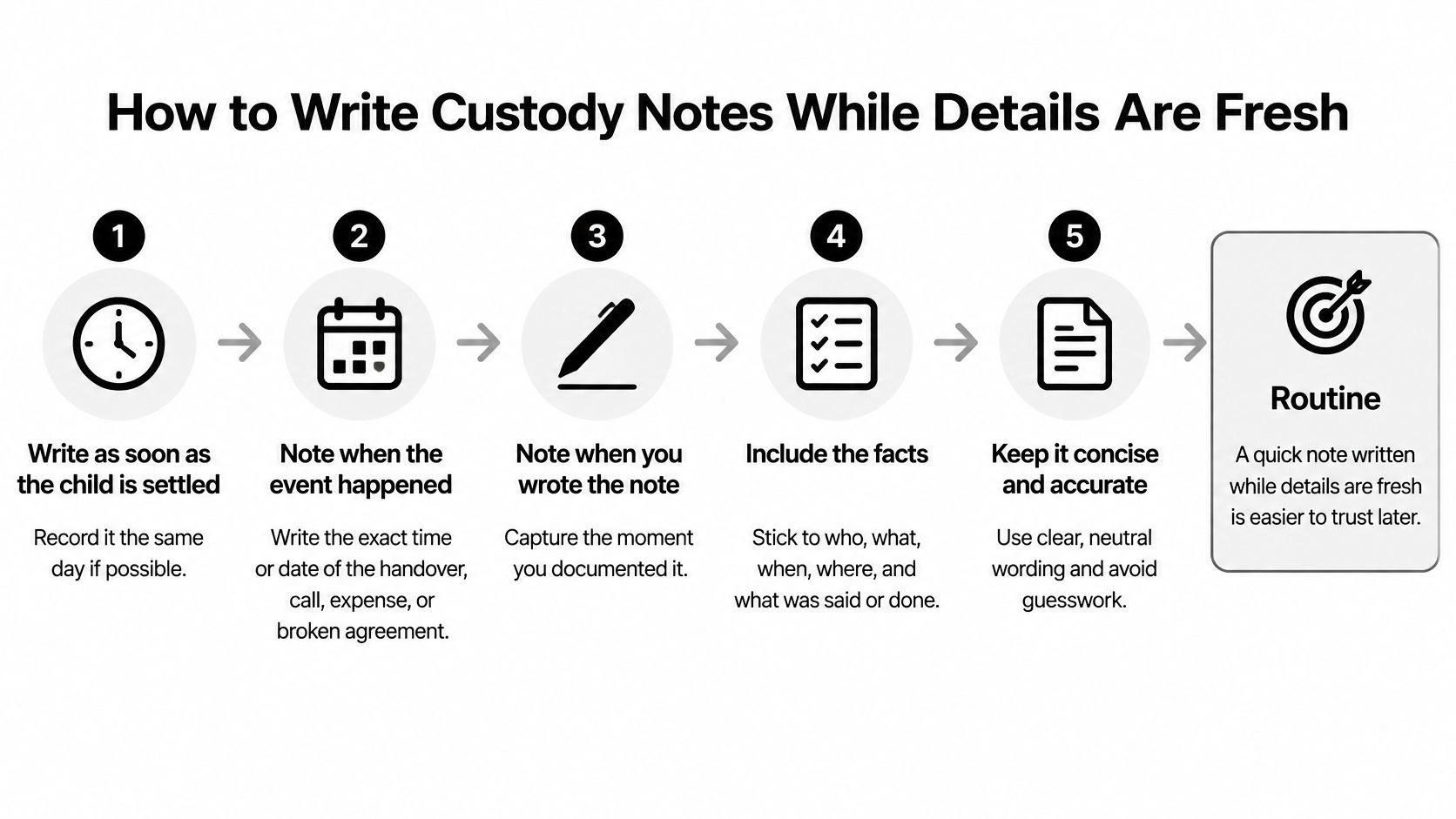
Write once the child is settled. Do it the same day if you can, and write both when the event happened and when you are writing now. Waiting until the weekend invites a blended memory. Don't leave the writing time off because the event time feels like enough.
Name the child, every adult present, and the place. A school door, a porch, a parking row. "At exchange" doesn't tell anyone who could have seen it. Skipping a bystander you noticed is a quiet omission.
State observable facts in short sentences. Planned time, actual time, the delay, what was handed over, and the immediate outcome. "He was difficult" isn't a fact. "Backpack and inhaler came across at 4:05 p.m." is.
Quote a short relevant line and say who said it. If you didn't see it, mark it as reported, not observed. Pasting a whole thread, or treating your child's retelling as your own eyes, blurs the label.
Label a guess about motive as interpretation, or leave it out. "I think she wanted to punish me" explains you, not the pickup. The slip is smuggling the guess into the fact sentence so it looks observed.
Attach the proof you already have to that entry. Screenshot, photo, receipt, voice note, or document, without cropping away the surrounding context. A tight crop that drops the date line is the common miss.
If you clarify later, keep the first version and note when it changed. A visible correction is easier to trust than a silent overwrite. Don't "clean up" the original until the old wording is gone.
Link an existing agreement only when what happened differed, and describe the difference in facts. "Sunday 6:00 p.m. return, child back Monday 8:10 a.m." beats "she violated the order." Don't attach the agreement to every calm week as if deviation were the point.
Routine beats a burst of writing once a hearing is on the calendar. Regular practice is part of why a record looks trustworthy. A stack written in one night, covering months, reads like preparation for a fight.
Neutral wording is a clarity tool you still approve. It isn't a license to invent a detail you didn't have, or to sand off a fact that cuts against you. If a sentence is hot, you can draft a plainer version beside it. The first wording stays.
A short walkthrough of the same habit, focused on writing close to the event and keeping the account factual, is worth five minutes before the next exchange.
The scenes in the next part use this shape on an ordinary pickup, a store receipt, and a late return. None of them needs legal conclusions to be useful.
Custody Moments Worth Recording the Same Day
Three notes, each written the evening they happened, show the shape without a speech. Times below are a teaching example, not a case file.
School pickup
Event: Tuesday, main door, order time 3:30 p.m. Other parent arrived 4:05 p.m. Child waited with me. No reason given in person. Note written Tuesday 7:40 p.m. at home. I saw the wait and the arrival. I didn't see the drive. A two-line text, "stuck in traffic, almost there," is attached in full, not cropped, and labeled as their message, not my observation.
The two clocks are 4:05 p.m. and 7:40 p.m. The observation is the wait. The text is not firsthand. The attachment is the full message.
Shared expense
Event: Saturday 11:20 a.m., sports store, soccer cleats, I paid $64.18 on my card. Note written Saturday 2:05 p.m. Receipt photo sits on the entry, with the store name and time still visible. I texted a repayment request at 2:10 p.m. and saved that send. I didn't write whether the split was fair.
Observation: I paid, at that register, at that time. Not firsthand: whether the other parent agrees the cleats were needed. Attachment: the receipt photo, plus the request message.
Agreement deviation
Written schedule: Sunday 6:00 p.m. return at my house. Child returned Monday 8:10 a.m. at school, with the other parent and a teacher nearby. Note written Monday 9:00 p.m. I linked the entry to the existing Sunday return term and described the gap in times. I didn't diagnose intent.
Observation: who was there at 8:10 a.m., and that the child wasn't back Sunday evening. Not firsthand: why the return moved. Attachment: the schedule page and a photo of the school drop, if you took one without cropping the time.
The sentence that adds no fact
Weak rewrite of the pickup: "She doesn't care about our son and is always late on purpose." That line names no clock, no door, and no witness. It picks a motive. A mediator can argue about character for an hour and still not know whether pickup was 4:05 or 3:35.
Write the exchange you can point at. Leave the verdict for someone whose job is to make one.
Before today ends, pick the next real exchange or the next receipt already in your bag. One note, two times, one observation, one item you didn't see yourself, and the proof you already hold. That's the habit. A speech can wait.
Mistakes That Weaken an Otherwise Timely Note
Writing something immediately doesn't make it evidence. Solicitors who organize exhibits for hearings still have to sort relevance, authorship, and whether a document was altered. Contemporaneousness is one reliability factor. Courts may still assess relevance, fairness, proportionality, authorship, completeness, authenticity, and whether the note was changed. Speed without those checks is a fast mistake.
Where fresh writing still fails
| Pitfall | Review risk | Stronger habit |
|---|---|---|
| Reconstructed weeks later | Looks dated but is not contemporaneous | Write the same day or as soon as possible |
| Backfilled after a case starts | Chronology does not prove authenticity | Label old memories and record forward from today |
| Silent overwrite | Hides the first account and the edit | Keep the original and show when it changed |
| Isolated screenshot | Name and time do not prove authorship or completeness | Keep the artifact with surrounding context |
| Motive or legal conclusions | Shifts the note from fact to argument | Record what, when, where, who, and the proof |
| Selective packet only | Can mislead by omitting context | Export a focused set without hiding contrary items |
A note rebuilt weeks later can carry precise-looking dates and still be a reconstruction. You remember "around four" and type 4:07 because it looks serious. A stack of backfilled entries after a case starts can show a chronology without showing authenticity or completeness. Label older memories as reconstructions if you must write them now. Start a genuine contemporaneous habit from the next event. Don't manufacture a past and call it fresh.
Overwriting the first wording hides when the information was first recorded. A later correction is easier to trust when the original wording and the edit history stay visible. Digital scraps are especially thin. A visible name and a clock time on one screenshot don't prove who created the image or that the thread is complete. Keep the surrounding messages, including the quiet ones.
Mixing a conclusion about motive, or a claim of a legal violation, into the facts invites a fight about character. "Contempt," "alienation," and "she never cares" are arguments. The pickup time is a check against a photo, a text, or a teacher who was standing there.
A selective packet can mislead a mediator even when each included line is accurate. Dropping the contrary texts, or the quiet months, makes a focused export look like a highlight reel. A note can also freeze an early misunderstanding, so consistency with photos, receipts, and messages still matters after the ink is dry.
The stronger habit is the one in the table's last column, applied to documentation mistakes parents repeat when they're scared and rushing. Originals, edit history, and a focused export belong in one private record you control, not in a shared chat that the other parent can edit or screenshot out of order.
Start a Private Record You Can Hand to a Professional
Three lines cover the habit. Write close to the event. Separate the time it happened from the time you wrote it. Keep the original wording, any later edit, and the proof beside the entry.
A notes app, a paper notebook, or a dedicated custody journal can all do that if you fill the fields. Paper fails when pages go missing. A shared thread fails when the other person can reply over your sentence. The tool is secondary to the two clocks and the untouched first draft.
We built Casewell as a private, single-user journal for parents who don't want a shared chat with the other parent. Each entry records when the facts happened and, separately, when the entry was added. When a record is edited, the earlier version is saved and the update time is shown. Photos, receipts, and files stay with the event they support. An optional neutral rewrite of heated wording is offered only with your approval, and the original is always kept. A PDF can be prepared for an attorney or mediator, and you choose which entries, agreements, expenses, and evidence go in. That PDF can show what happened, when it happened, when it was written, later edits, notes, agreements, evidence, expenses, and a record activity calendar.
Organized, dated, factual entries are easier for a professional to review. They don't replace jurisdiction-specific legal advice, and they don't guarantee admission. Before you hand anyone a packet, a HeyAtty guide to lawyer consultations is a useful checklist for what to bring and what to ask. Our own notes on preparing records for a lawyer sit in the same lane: selection, dates, and proof, not a script for the hearing.
After the next handover, expense, or missed exchange, capture that one event today. Attach what you already have. Leave the first wording intact.
Casewell is a private custody journal for separated parents who need dated notes, attached proof, and a record that keeps event time separate from writing time. You can organize handovers, expenses, agreements, and files in one place and export a focused PDF for an attorney or mediator. Visit Casewell and put today's exchange in writing before the details fade.