
You're sitting at the kitchen table after the children are asleep, laptop open, trying to make sense of conflicting advice. A friend says you'll automatically get custody because you're the mother. An online forum says the other parent can demand equal time. Your former partner's messages use words like “rights,” “access,” and “court,” but don't explain what any of them mean for tomorrow's school run or next weekend's handover.
That uncertainty is common because rights as a mother operate on several levels. Some come from parentage and equality principles. Others depend on a parenting agreement or court order. Your practical position also depends on whether you can show what happened, when it happened, and how it affected your child.
This guide separates those ideas. It defines the five core categories of parental rights, explains how rights arise and change, challenges the idea that custody is a simple win-or-lose contest, and shows how neutral records can support your position. If you're still gathering information before speaking with a lawyer, a divorce preparation checklist can help you organize the questions, documents, and decisions that need attention.
A Mother's Starting Point
The first useful question isn't whether you will win custody. It's which decision needs to be made, and which rule controls it.
For example, a mother might have authority to make ordinary daily choices while the child is with her, but need joint agreement for a school change or non-emergency medical treatment. She might have a right to scheduled parenting time but still need a court's help if the other parent repeatedly withholds the child. She might have serious safety concerns, yet need specific evidence and a formal request for supervised contact or another protective arrangement.
These situations look similar from a distance because people use “custody” as one broad label. In practice, the label can hide separate questions:
- Where does the child live?
- Who makes major decisions?
- When does each parent spend time with the child?
- Who contributes to the child's financial needs?
- What safeguards apply when contact may be unsafe?
A mother's legal position can also change. A written agreement may become a court order. A court order may later be reviewed after relocation, a significant change in the child's needs, or evidence of abuse or neglect. The underlying principle remains the child's welfare, not a permanent reward for either parent.
The most reliable way to prepare is to connect each right with the record that supports it. A calendar may clarify missed parenting time. School and medical correspondence may show participation in decisions. Dated incident notes may help an attorney assess a safety concern. None of these records guarantees a result, but they give a decision-maker something more useful than competing memories.
What Rights as a Mother Actually Mean
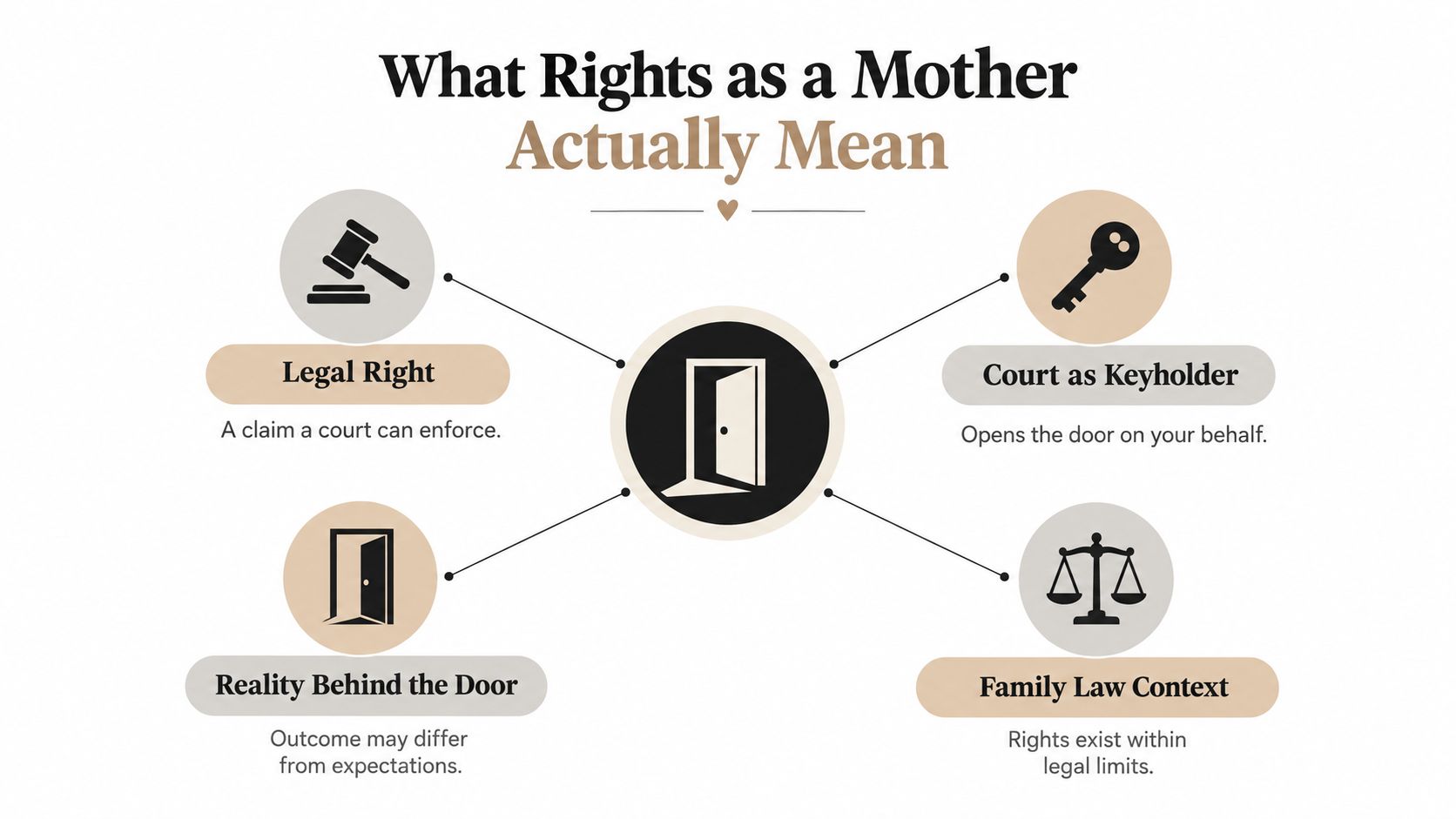
A legal right is best understood as a door a court can open on your behalf. It doesn't guarantee that the room behind the door will look exactly as you imagined. You may have the right to ask for parenting time, participate in major decisions, or challenge an unsafe arrangement, while the final schedule still depends on the child's best interests and the evidence before the court.
Three ideas that often get mixed together
Legal standing means you're recognized as someone who can bring an issue before a court. Parentage, adoption, or another legally recognized relationship may establish that position, depending on local law.
An enforceable order is more specific. It tells each parent what must happen, such as a defined exchange time, a decision-making process, or a financial obligation. Informal arrangements can be useful, but they may be harder to enforce unless they've been formalized in the way local law requires.
The best-interests standard is the decision-making test used in many custody disputes. It directs attention to the child's safety, stability, health, relationships, and developmental needs rather than treating motherhood as an automatic claim to primary custody.
Constitutional and human-rights principles generally support equal treatment and protection from discrimination. They don't usually dictate the exact school-week schedule in an individual family. That detail comes from the relevant jurisdiction's statutes, case law, procedure, and the facts presented to the decision-maker.
International law provides a useful principle rather than a ready-made custody order. The Convention on the Rights of the Child materials from the Office of the United Nations High Commissioner for Human Rights recognize the common responsibilities of both parents for a child's upbringing and development, while requiring the child's best interests to receive primary consideration in decisions about care and contact.
That means rights as a mother usually include an equal opportunity to parent, not an automatic advantage based on gender. To make those rights practical, you need to identify the specific decision, the governing document, and the facts showing why your proposed arrangement serves the child.
For a broader explanation of the financial and property issues that can arise alongside parenting questions, see this guide to what you may be entitled to in a divorce. Custody rights and financial rights can affect the same family, but they're usually analyzed under different rules.
The Five Core Rights Courts Recognize
People often say “I want custody” when they mean several different things. Separating the categories makes it easier to identify what you're asking for and what evidence matters.
| Right Category | What It Decides in Practice | Controlling Document or Order |
|---|---|---|
| Physical custody | Where the child sleeps on school nights and how the home schedule operates | Parenting plan, consent agreement, or custody order |
| Legal custody | Who has authority to participate in major choices about health, education, and upbringing | Parenting plan or court order |
| Parenting time | When each parent spends time with the child, including weekends, holidays, and exchanges | Parenting-time schedule or custody order |
| Decision-making | How parents handle issues such as school enrollment, religion, treatment, or activities | Joint or sole decision-making terms |
| Child support | How financial contributions are calculated and paid for the child's needs | Support order or approved agreement |
Physical custody
Physical custody concerns the child's living pattern. A court might decide that the child primarily lives with one parent during the school week and spends defined periods with the other parent. It could also approve a shared schedule if that arrangement fits the child's routines, safety, age, schooling, and each parent's ability to provide care.
The question isn't about which parent has the larger home or stronger preference. It's how the proposed schedule works in ordinary life. Travel time, school attendance, sleep, activities, and reliable transitions can all matter.
Legal custody
Legal custody concerns authority over significant areas of the child's life. A mother may ask who can sign a school enrollment form, consent to medical treatment, or participate in decisions about religious upbringing. A child can live primarily with one parent while both parents share legal custody.
The controlling document should tell you whether decisions require joint agreement, consultation, notice, or action by one parent alone. Read that language carefully. “Joint custody” doesn't always mean that every minor choice requires a written approval from both parents.
Parenting time
Parenting time turns a general relationship into a usable schedule. An order might define alternating weekends, holiday arrangements, school pickups, telephone contact, and what happens when a parent is late or unavailable.
A missed visit isn't automatically a custody violation in every jurisdiction. The significance depends on the wording of the order, the reason for the missed time, the pattern, and the effect on the child. Keep the original schedule beside any record of what happened.
Decision-making
Decision-making provisions address disagreements before they become emergencies. A plan might require parents to consult about a school change, share medical information, or use a dispute-resolution process before asking a court to intervene.
Suppose a mother receives a notice about a proposed school transfer and replies with questions, while the other parent refuses to share the underlying information. The issue isn't merely that the parents disagree. It may concern whether the required process was followed and whether the child's needs were considered.
Child support
Child support is separate from physical custody. A parent may owe support even when that parent has regular parenting time, and a parent's financial contribution doesn't by itself determine where the child lives.
The amount and payment process are governed by local law, financial information, and the applicable order or agreement. Keep records of payments, receipts, reimbursement requests, and child-related expenses. Those records can clarify what was paid, what remains disputed, and which obligation the payment relates to.
How Rights Originate and How They Change
Rights often begin with the legal recognition of parentage and the responsibilities that follow it. The details vary by jurisdiction, especially for unmarried parents, but the practical path commonly moves from a starting legal status to an agreement, mediation outcome, or court order.
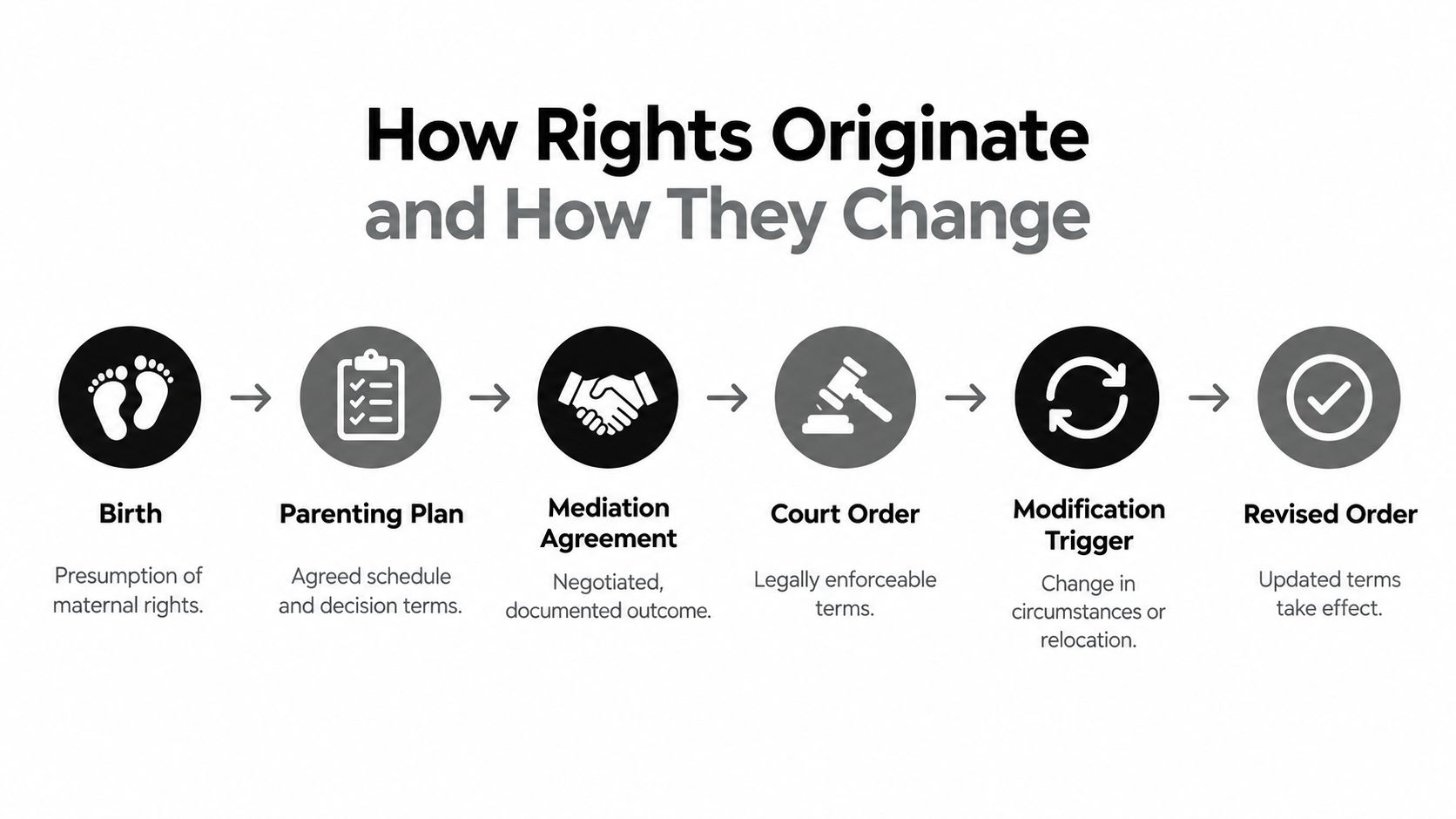
An informal arrangement may describe where the child stays and how parents communicate. A written parenting plan can make those expectations clearer. Mediation may produce negotiated terms, while a court order creates enforceable instructions through the legal process available in that jurisdiction.
The document matters
A parent's understanding of an arrangement can differ from the wording that controls it. “We usually switch on Sundays” is not the same as an order that states a specific Sunday time, location, and procedure for changes.
Keep the current version of every agreement or order. If the parents later sign a new plan, confirm whether it replaces the earlier document, requires court approval, or operates only as a temporary arrangement. An attorney can explain the effect of the document in your jurisdiction.
Circumstances can prompt review
A court may reconsider parenting terms when a qualifying change affects the child or the operation of the existing order. Examples can include:
- Relocation: A proposed move may affect school, travel, exchanges, and the feasibility of the current schedule.
- Safety evidence: Substantiated abuse, neglect, coercive control, or another serious risk may require protective terms.
- Family changes: Remarriage or a new household may matter when it affects the child's care, stability, or safety.
- Child development: A child's expressed preference may receive consideration when the child reaches an age or level of maturity recognized by local law.
A change doesn't automatically erase existing rights. Usually, a parent must use the appropriate legal process and show why a revised arrangement is justified. The decision-maker then compares the current circumstances with the child's welfare and the terms already in place.
That is why records should show both the original arrangement and the event that allegedly changed it. A clear timeline can identify whether a problem was isolated, repeated, resolved, or still affecting the child.
Beyond Win and Lose
Custody is often described as a contest in which one parent wins and the other loses. That framing hides the way courts analyze many disputes. A decision may give one parent more overnights, another parent greater decision-making authority, and both parents defined responsibilities. The result is often a collection of separate findings rather than a single verdict about who is the better parent.
Evidence can also redirect the analysis away from gender. A court may consider whether a parent supports a child's safe relationship with the other parent, but that principle doesn't require unsupervised contact when credible evidence points to danger. A mother's right to participate in decisions doesn't automatically mean equal physical time is safe or legally required.
The distinction matters especially in cases involving parental alienation, coercive control, or domestic abuse. A 2025 peer-reviewed analysis found that when a court found parental alienation, the odds of a mother losing custody to the father were nearly four times higher. In the same analysis, when the father's abuse was substantiated, the odds of the mother losing custody were substantially lower, with an odds ratio of 0.12. The findings don't prove that every alienation allegation is tactical or that every abuse allegation is accepted. They show why the competing narratives and evidentiary findings matter. Read the peer-reviewed analysis on parental alienation, abuse, and custody outcomes.
What the decision-maker may need to distinguish
A child's resistance to contact can arise from fear, ordinary loyalty conflict, developmental factors, or influence by a parent. A mother should record what the child said and what she observed without turning an uncertain explanation into a conclusion.
The concern is not limited to physical incidents. Research involving private family-law cases in England and Wales reported domestic-abuse evidence in 87% of reviewed files, while more than half of the cases resulted in unsupervised overnight contact with the allegedly abusive parent. The same review described coercive and controlling behavior as often misunderstood or reframed as ordinary parental conflict. Review the reporting on domestic abuse in family-court cases.
| Factor Considered | What a Court Examines | Documentation That Helps |
|---|---|---|
| Child's attachment and routine | Who provides regular care and how the child responds to transitions | School notices, appointment records, activity calendars |
| Contact resistance | What the child said or did, when it happened, and possible explanations | Exact words, date, setting, witnesses, follow-up observations |
| Alleged alienation | Whether a parent interfered with contact or whether the child had an independent concern | Messages, schedule records, offers of appropriate contact, professional records |
| Abuse or coercive control | Threats, intimidation, retaliation, monitoring, violence, and impact on safety | Dated incident records, reports, messages, medical or support-service records |
| Cooperation and compliance | Whether each parent follows agreements and supports required decisions | Original orders, correspondence, change requests, and outcome records |
Organized evidence doesn't guarantee a preferred result. It gives the court a way to test each parent's account against dates, documents, witnesses, and the child's actual circumstances.
Documentation That Strengthens Your Position
Good documentation reads like a reliable timeline, not a closing argument. The purpose is to preserve what happened so a lawyer, mediator, or court can assess it later without having to reconstruct the event from emotion and memory.
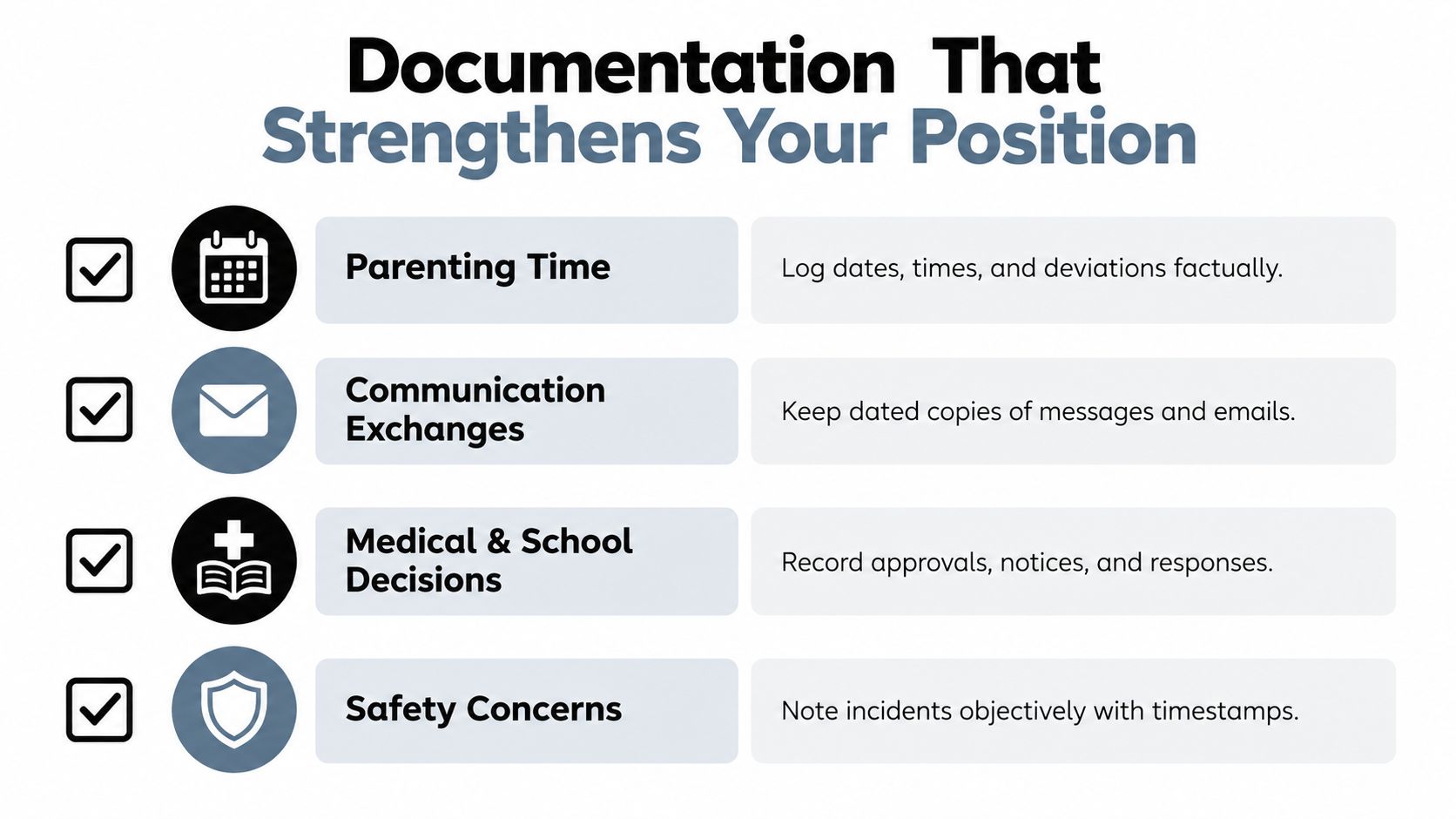
Begin with four categories: parenting time, communication, medical and school decisions, and safety concerns. For each entry, record the date, time, people involved, child-related impact, relevant agreement or order, and supporting material.
Write facts before conclusions
Compare these two entries:
“The other parent deliberately sabotaged the handover and doesn't care about the child.”
“The exchange was scheduled for 5:00 p.m. at the agreed location. At 5:18 p.m., the other parent sent a message saying they wouldn't attend. The child remained with me. I sent a message at 5:22 p.m. asking whether a replacement time was proposed. No response arrived by 7:00 p.m.”
The second entry gives a decision-maker something to evaluate. It identifies the schedule, the event, the response, and the result without assuming motive.
Use direct quotes only when the exact wording matters, and identify who said the words. If your child makes a concerning statement, record the words as accurately as possible, the date and setting, and what you did next. Don't repeatedly question the child to fill gaps, suggest answers, or ask the child to choose between parents.
Preserve the original record
Keep original messages, emails, photographs, files, and receipts alongside any summary. Cropped screenshots can remove dates, earlier messages, or the surrounding exchange. Social media posts may also be incomplete or taken out of context.
A practical record system should make it possible to:
- Trace the source: Keep the original file or complete conversation where possible.
- Follow the sequence: Arrange events chronologically rather than by emotional importance.
- Separate fact from interpretation: Use a distinct field for your concern or question.
- Connect proof to events: Attach the relevant receipt, message, notice, or photograph to the entry it supports.
- Protect sensitive information: Redact unrelated private details before sharing records with a professional.
Before mediation or a hearing, prepare a short, focused packet. Start with the current order or agreement, then include a timeline of the issues that matter, followed by the supporting records in the same order. Avoid sending every difficult interaction when only a defined period or issue is relevant.
A private custody journal such as Casewell's custody evidence checklist can help a parent think through the categories, dates, and supporting material that belong in a structured record. The legal significance of any entry still depends on the jurisdiction and the professional reviewing it.
Jurisdictional Variation and Safety Planning
Rights as a mother aren't identical across countries, states, or even neighboring counties. Local law may define parentage, filing requirements, relocation rules, mediation procedures, evidence standards, and emergency applications differently. A general explanation can help you identify the issue, but it can't tell you which form to file or predict how a particular court will weigh the facts.
Routine disagreement and urgent danger also require different responses. A disagreement about holiday timing may call for negotiation or mediation. Threats, stalking, violence, coercive control, or a credible risk to a child may require immediate advice about emergency custody, protective orders, supervised contact, separate handovers, or confidential addresses.
| Factor | Routine Jurisdictional Variation | Safety-Specific Legal Tool |
|---|---|---|
| Parenting schedule | Local rules may differ on forms, holidays, and exchange procedures | Supervised parenting time or structured exchanges |
| Relocation | Notice requirements and best-interest tests can vary | Temporary order addressing travel, residence, or contact |
| Decision-making | Courts may use different terms for joint consultation and sole authority | Emergency decision-making provisions where permitted |
| Alleged abuse | Definitions and evidentiary procedures differ | Protective order, emergency application, or safety-focused custody request |
| Professional support | Mediation and child-representation roles vary by court | Attorney, guardian ad litem, specialist advocate, or protective service |
A safety plan should record the incident, the immediate risk, the child's location, any threats or injuries, witnesses, reports, and the protection requested. Don't confront a potentially dangerous person to create evidence, and don't delay emergency help while building a perfect file. Contact emergency services or a specialist domestic-abuse service when there's an immediate danger.
Technology can create additional risks. Review whether shared accounts, location services, devices, or communication channels expose your address or movements. Legal advice is particularly important if the other parent uses repeated litigation, threats, financial control, monitoring, or child exchanges to maintain coercive control.
For jurisdiction-specific recording questions, consult local guidance such as this resource on recording a co-parent in California. Recording laws and privacy rules can differ, so don't assume that a recording allowed in one place is lawful or useful in another.
Bringing It All Together
A practical review links each claimed right to a defined question and a reliable record:
- Custody and parenting time: Compare the order or agreement with a dated schedule log showing exchanges, missed time, and changes.
- Decision-making: Keep dated school, medical, and activity correspondence, including requests for information and responses.
- Safety and protection: Record incidents with times, direct observations, witnesses, reports, and the safeguards requested.
- Modification requests: Preserve evidence showing the changed circumstance, its effect on the child, and why the current terms no longer work.
- Child support: Keep payment records, receipts, reimbursement requests, and the order or agreement that creates the obligation.
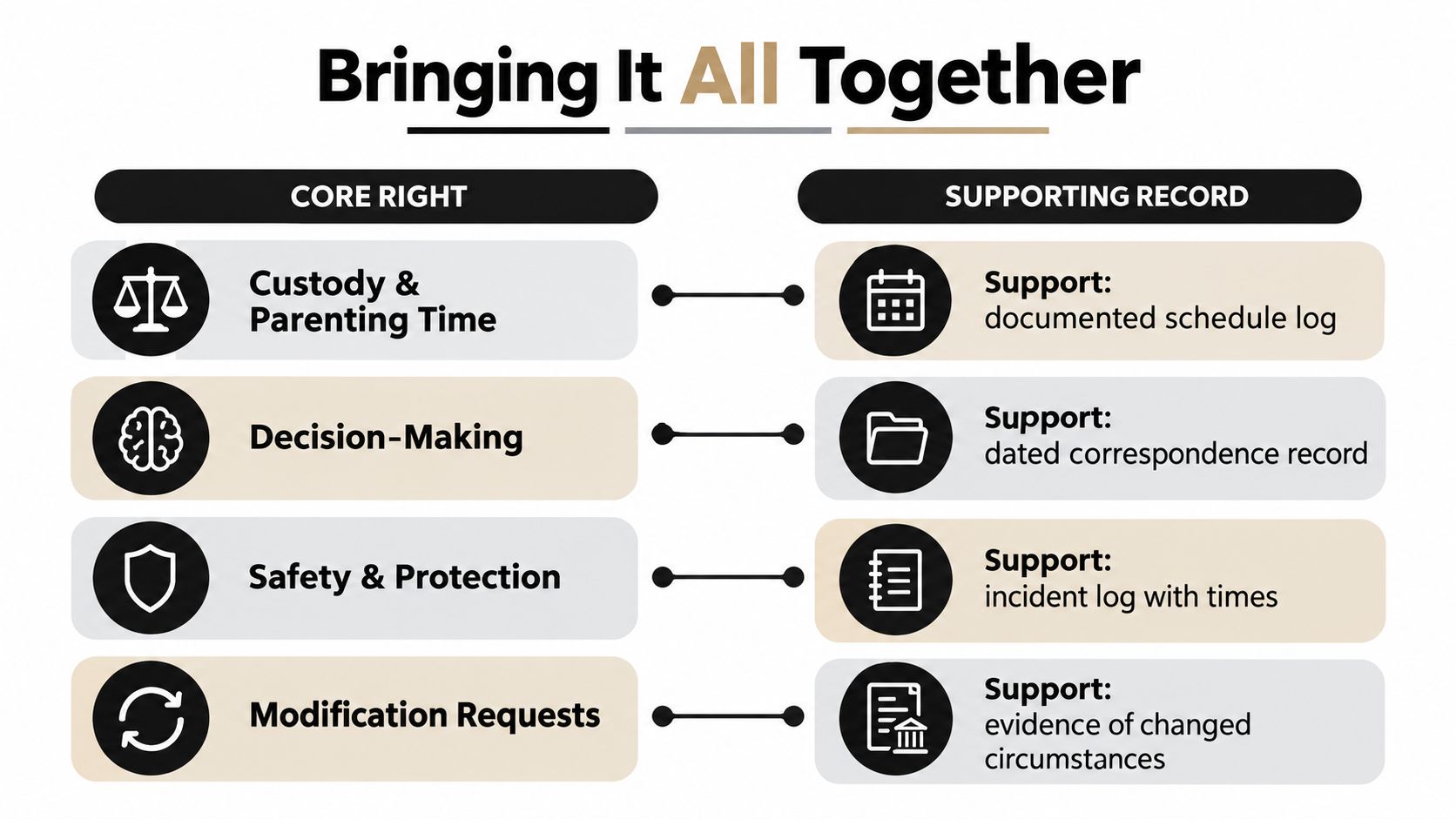
Documentation can strengthen your position, but it doesn't create a right by itself. Your legal standing comes from parentage, an enforceable agreement or order, or another relationship recognized by local law. A record becomes useful when it accurately connects the facts to the child's needs and the legal question before the decision-maker.
A qualified family-law attorney can explain the rules that apply where you live, assess urgent safety concerns, and help you present records without exaggeration or omission. Pairing early legal advice with organized, neutral documentation is more dependable than relying on either one alone.
Casewell provides a private custody journal for dated records about parenting time, handovers, communication issues, expenses, incidents, and agreements, with selected records available for PDF export to a lawyer or mediator. Visit Casewell to organize your timeline while keeping your original notes and supporting files under your control.