

Joint custody usually means both parents share parenting after separation, but it has two separate parts: decision-making and parenting time. In practice, the time-sharing part doesn't always mean a perfect 50/50 split, because research and legal systems often count joint physical custody anywhere from about 25% to 30% with each parent, and some use a broader 30% to 70% range.
If you're newly separated, this is often the first point of confusion. You hear "joint custody" in a mediator's office, from a lawyer, or in a text from your co-parent, and your brain jumps straight to the calendar. Where will your child sleep? Who picks up from school? Do you need permission for a dentist appointment? Are you about to lose half your week, or half your authority?
The hard part is that people use one phrase to describe two different things. One part is about who makes the big decisions. The other is about where the child lives day to day. Once you separate those two layers, the rest gets much easier to understand, and much easier to document.
What Joint Custody Actually Means
On week one after a separation, "joint custody" can sound clearer than it really is. One parent hears, "We both stay fully involved." The other hears, "We split the week in half." A judge, lawyer, or mediator may use the same phrase while meaning something more technical.
In plain English, joint custody means both parents continue sharing parenting authority after separation instead of one parent holding all of it. That shared role usually has two parts. One part covers major choices about the child. The other covers the child's day-to-day living arrangement. Cornell Law School describes joint custody in those terms in Cornell's overview of joint custody.
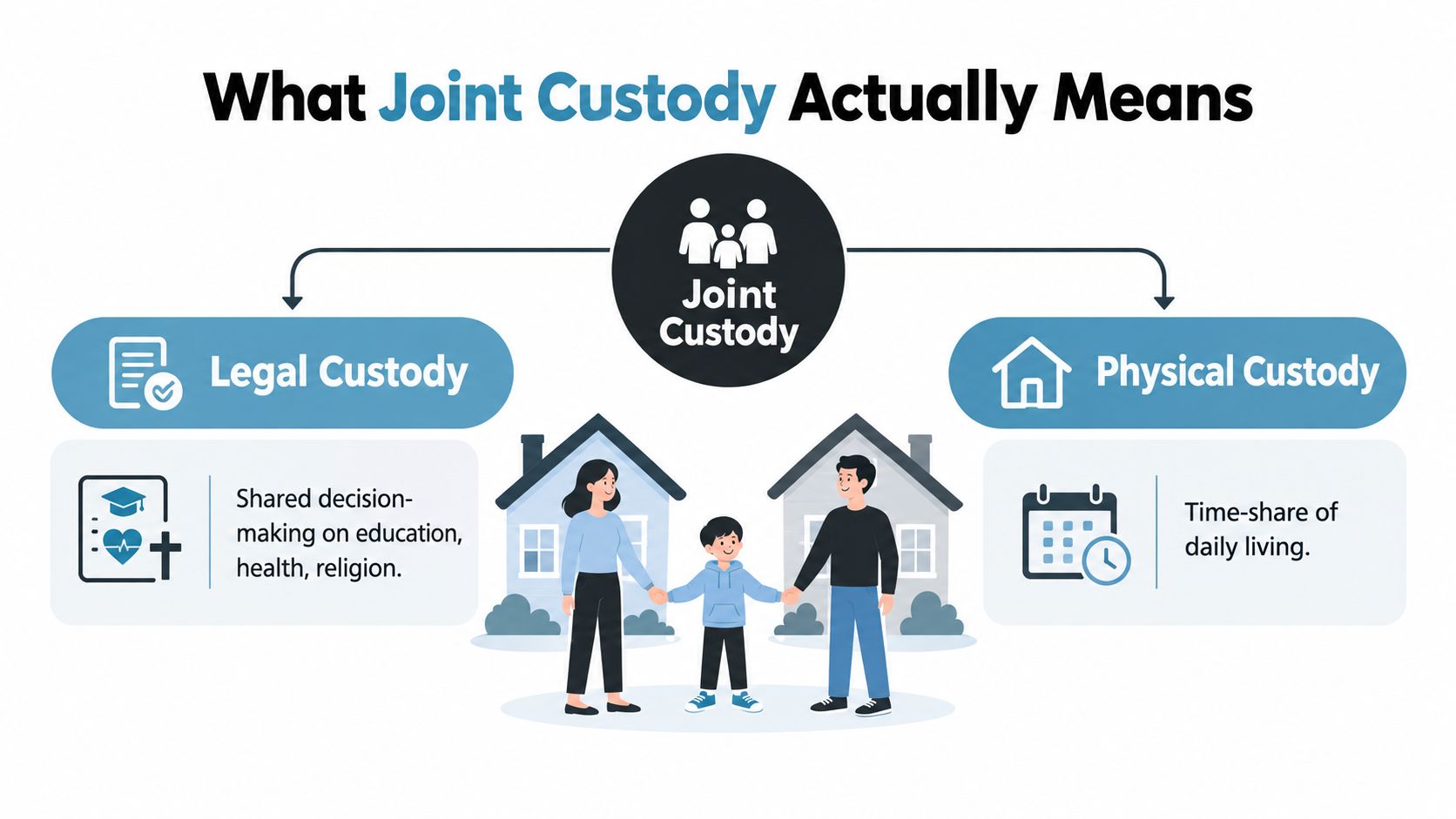
One phrase, two moving parts
Joint custody works like sharing a household binder with two sections.
- One section is authority. Who gets a say in major decisions that shape the child's life.
- One section is time and care. Where the child is on school nights, weekends, holidays, and ordinary Tuesdays.
That split matters because separated parents often argue about one part while using the label for the other part. A text saying "You can't do that, we have joint custody" might be about a haircut, a therapy appointment, a school form, or a weekend swap. Those are not all the same kind of custody issue.
Why parents get confused so fast
Everyday conversation blurs legal terms. Friends ask whether you "have joint custody" as if there is a single yes-or-no answer. Court orders are usually more specific than that.
That is why a simple documentation habit helps early. Each time a disagreement comes up, label it in your private custody journal before you react. Write "decision issue" if it involves a major choice. Write "schedule issue" if it involves handoffs, overnights, lateness, or missed time. That small habit does two things. It reduces panicked back-and-forth in the moment, and it starts turning messy daily friction into organized, court-ready facts.
The exact label can vary by state and by study
The phrase also shifts depending on who is using it. Courts, statutes, and researchers do not always draw the line in exactly the same place, especially for parenting time. As one review of joint physical custody definitions and development explains, researchers have used different thresholds for what counts as joint physical custody, and the concept developed over time in U.S. family law.
So if someone says "joint custody," do not assume you already know what they mean.
Ask two separate questions right away: Are we talking about shared decision-making, shared parenting time, or both?
Then write down the answer, along with the date, the context, and any document or message that goes with it. That is how you move from a vague label to a usable record.
Legal Custody vs Physical Custody Explained
On Monday, one parent texts about switching Wednesday overnight. On Tuesday, the school sends a form that needs a signature for a tutoring evaluation. Those two moments can feel equally urgent after a split, but they are usually different kinds of custody questions. One is about time. The other is about decision-making.
That is the split to learn first. Custody works like a two-column chart, not a single meter that slides from "full" to "shared." One column covers who gets to make major choices. The other covers where the child lives and how parenting time is divided. Each column can be joint or sole.
Legal custody is about major decisions
Legal custody means authority to make bigger, longer-term choices for a child. In plain English, it answers questions like: Who can agree to a school change? Who can consent to non-routine medical care? Who has a say in religious upbringing or other major life planning?
Courts and legal references, including Cornell's plain-language definition discussed earlier, generally treat legal custody as decision-making authority rather than day-to-day caretaking.
A helpful record-keeping habit goes with this category. If a disagreement involves school, medical treatment, counseling, religion, or another major choice, mark it in your private custody journal as a decision issue. Then note the date, what decision was proposed, what each parent said, and any deadline. That turns a vague argument into a usable timeline.
If you want a clearer explanation of the residential side, this guide on what physical custody means gives a plain-language overview.
Physical custody is about where the child lives and who handles the day
Physical custody deals with the child's living arrangements and routine care. It answers the practical questions that fill a calendar:
- Where does the child sleep tonight?
- Who handles pickup or drop-off?
- Which parent covers the after-school stretch?
- Which home is the base for this part of the week?
This category causes confusion because physical custody is not only about overnights on paper. It often shows up in real life as lateness, missed exchanges, last-minute switches, or arguments about who was supposed to cover a school closure.
That is why the matching journal label matters here too. If the conflict is about handoffs, overnights, transportation, cancellations, or missed parenting time, mark it as a schedule issue. Save the message, write down what happened, and record the effect on the child or the schedule. Over time, that private log can show a pattern much more clearly than memory can.
The Four Custody Combinations at a Glance
| Legal Custody | Physical Custody | Typical Situation |
|---|---|---|
| Joint | Joint | Both parents share major decisions and the child lives with each parent on a structured schedule. |
| Joint | Sole | Both parents still share major decision-making, but the child primarily lives with one parent and spends limited scheduled time with the other. |
| Sole | Joint | The child spends substantial time with both parents, but one parent has final authority over major decisions because cooperation has broken down or another concern exists. |
| Sole | Sole | One parent handles both major decisions and primary residence, often where serious conflict, instability, or safety concerns make shared authority unworkable. |
A lot of confusion starts because people shorten all four boxes into one phrase: "joint custody."
Why the distinction matters in real life
Schools, doctors' offices, coaches, and even parents often use custody words loosely. A school office may ask who "has custody" when the question is who can sign an enrollment form. A parent may say "we have joint custody" when the order gives shared decision-making but only limited parenting time.
The fix is simple. Ask two separate questions every time: Who decides? and Whose parenting time is it?
That habit does more than improve communication. It also helps you document problems accurately. If you label each conflict by category before responding, you are less likely to argue in circles, and more likely to build a clear, court-ready record if the pattern keeps repeating.
Parents' Rights and Responsibilities
Once you split custody into authority and time, the next question is simpler. What exactly does each parent get to do without checking first, and what requires consultation?
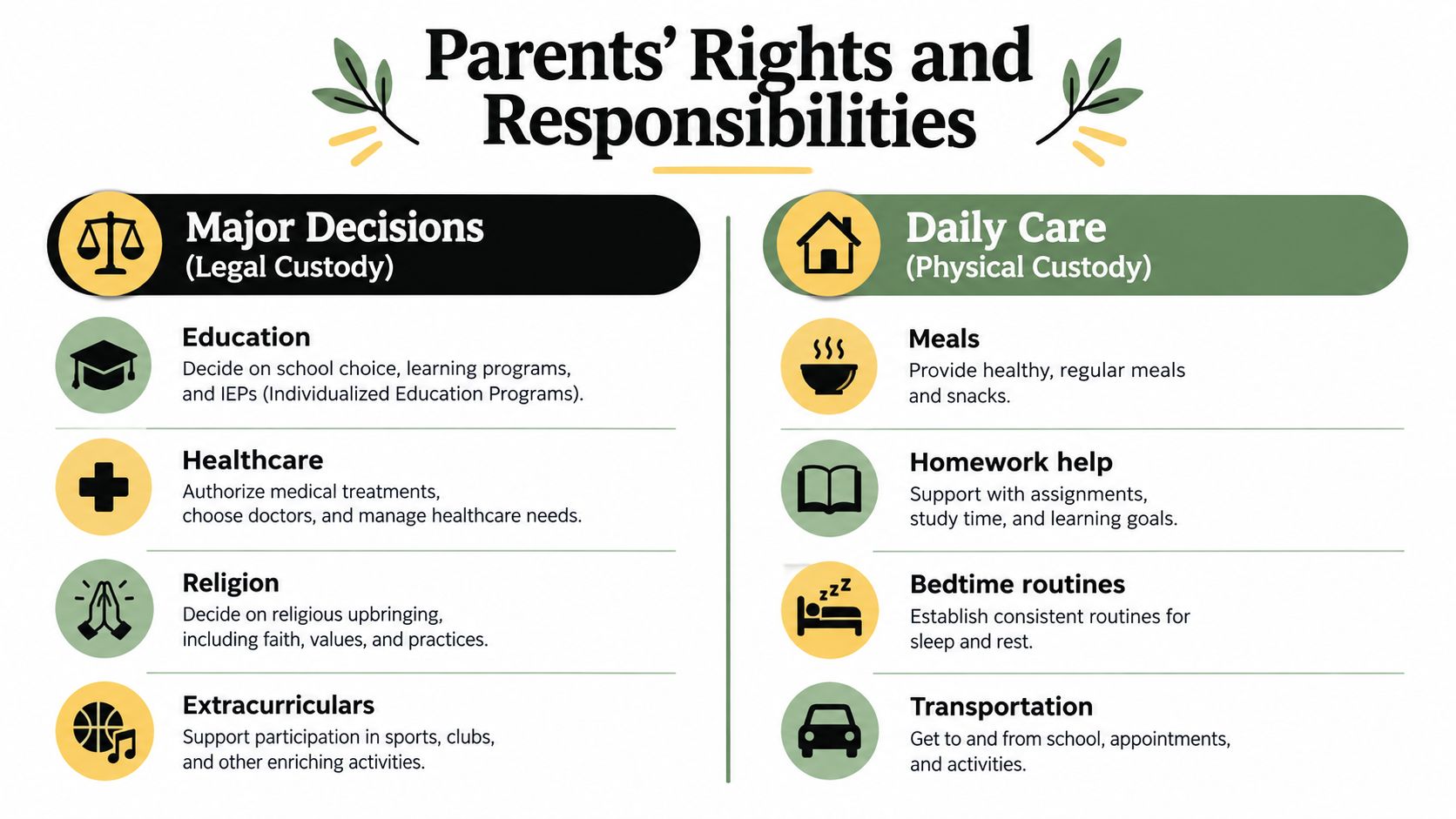
What usually falls under shared decision-making
When parents share legal custody, they usually need to consult each other on major issues such as:
- School choices: enrolling in a different school, addressing major education planning, or agreeing to significant school-related decisions
- Medical treatment: non-routine care, procedures, selecting providers, and larger treatment decisions
- Religious upbringing: whether the child will participate in formal instruction or observance
- Big extracurricular commitments: activities that affect schedule, cost, or travel in a serious way
These are the decisions that shape the child's longer-term life. They aren't the same as ordinary parenting judgment.
What belongs to the parent who has the child that day
The parent exercising parenting time typically handles daily care without turning every small choice into a negotiation.
- Meals and routines: dinner, breakfast, bedtime, bathing
- Homework support: checking assignments, signing routine forms, helping study
- House rules: screen time, chores, ordinary social plans
- Transportation: getting the child to school, practice, or a friend's house during that parent's time
Joint custody doesn't mean every sandwich, bedtime, or playdate needs a committee vote.
A simple rule for week-one confusion
If the choice affects the child's long-term health, education, religion, or major commitments, treat it like a shared legal-custody issue. If it's about getting through today responsibly, it's usually a physical-custody parenting call.
That rule won't solve every disagreement, but it gives you a starting point. It also gives you a documentation habit: when conflict starts, write down whether the issue was a major shared decision or a same-day parenting choice. That small label can matter later when someone claims the other parent "never consulted" or "micromanages everything."
Common Joint Custody Schedules
A schedule looks neat on paper until Tuesday arrives with soccer cleats, a math worksheet, and a forgotten lunchbox. That's why examples help more than abstract definitions.
The Parkers have two school-age children. Both parents live close enough to the school that weekday exchanges are possible. They need a plan that gives both parents meaningful time without constant renegotiation.
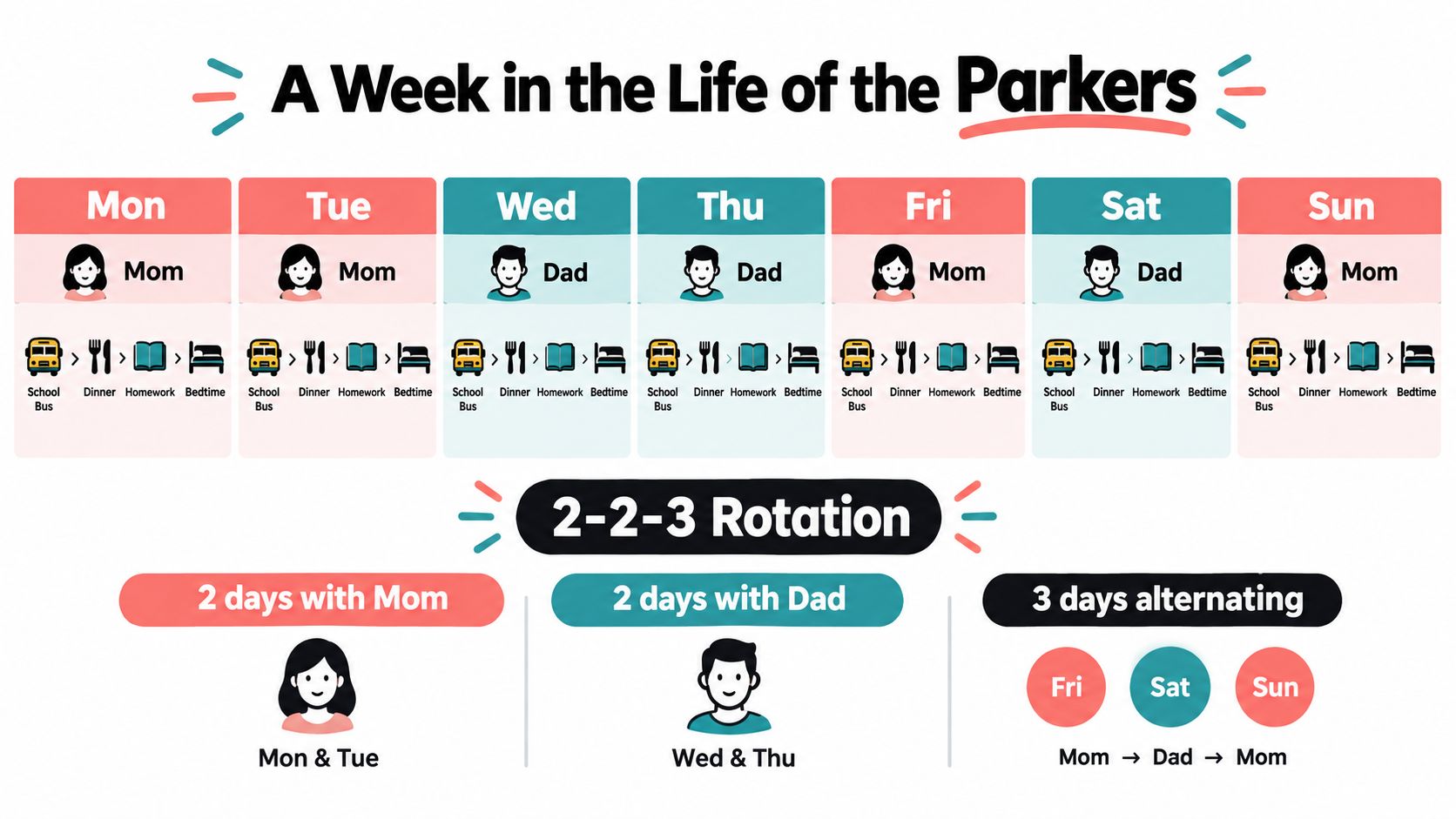
The 2-2-3 pattern
In a 2-2-3 schedule, one week might look like this:
- Monday and Tuesday: Mom
- Wednesday and Thursday: Dad
- Friday through Sunday: Mom
The next week flips the long weekend block to Dad. This gives frequent contact with both households, which can work well for younger children who struggle with long separations.
The friction points are predictable. Homework has to travel well. School clothes and medications need duplicate systems or careful packing. If parents live far apart, the exchanges can wear everyone out.
Later, if you want to compare this with other layouts, these examples of custody schedules show how the patterns differ in practice.
A short visual can help if you're trying to picture the handoffs:
Alternating weeks and 2-2-5-5
Alternating weeks are simpler. The child stays a full week with one parent, then a full week with the other. Fewer exchanges can mean less midweek disruption, but longer stretches away from each parent can be hard for some children.
A 2-2-5-5 schedule keeps the same weekdays with each parent and alternates the longer blocks. For example, Mom always has Monday and Tuesday, Dad always has Wednesday and Thursday, and the long weekends rotate. That predictability helps with school and activities because each parent knows their standing days.
Holidays sit on top of the base schedule
Most parenting plans layer holidays over the regular week-to-week schedule. Thanksgiving may alternate by year. A child's birthday might be shared by agreement, split by hours, or alternated. School breaks often have separate rules too.
The calendar in your head isn't enough. If a schedule matters, write it into the parenting plan with exchange times, holiday overrides, and pickup responsibility.
The right schedule depends on the child's age, school needs, travel distance, and each parent's real work life. The best-looking plan is useless if nobody can live it.
Modification and Enforcement Basics
A custody order isn't meant to shift every time life gets annoying. Courts usually treat the final order as the baseline because children need stability, routines, and predictability.
Still, life changes. Work hours move. Kids get older. One parent relocates. A pattern that worked at age five may stop working at age twelve.
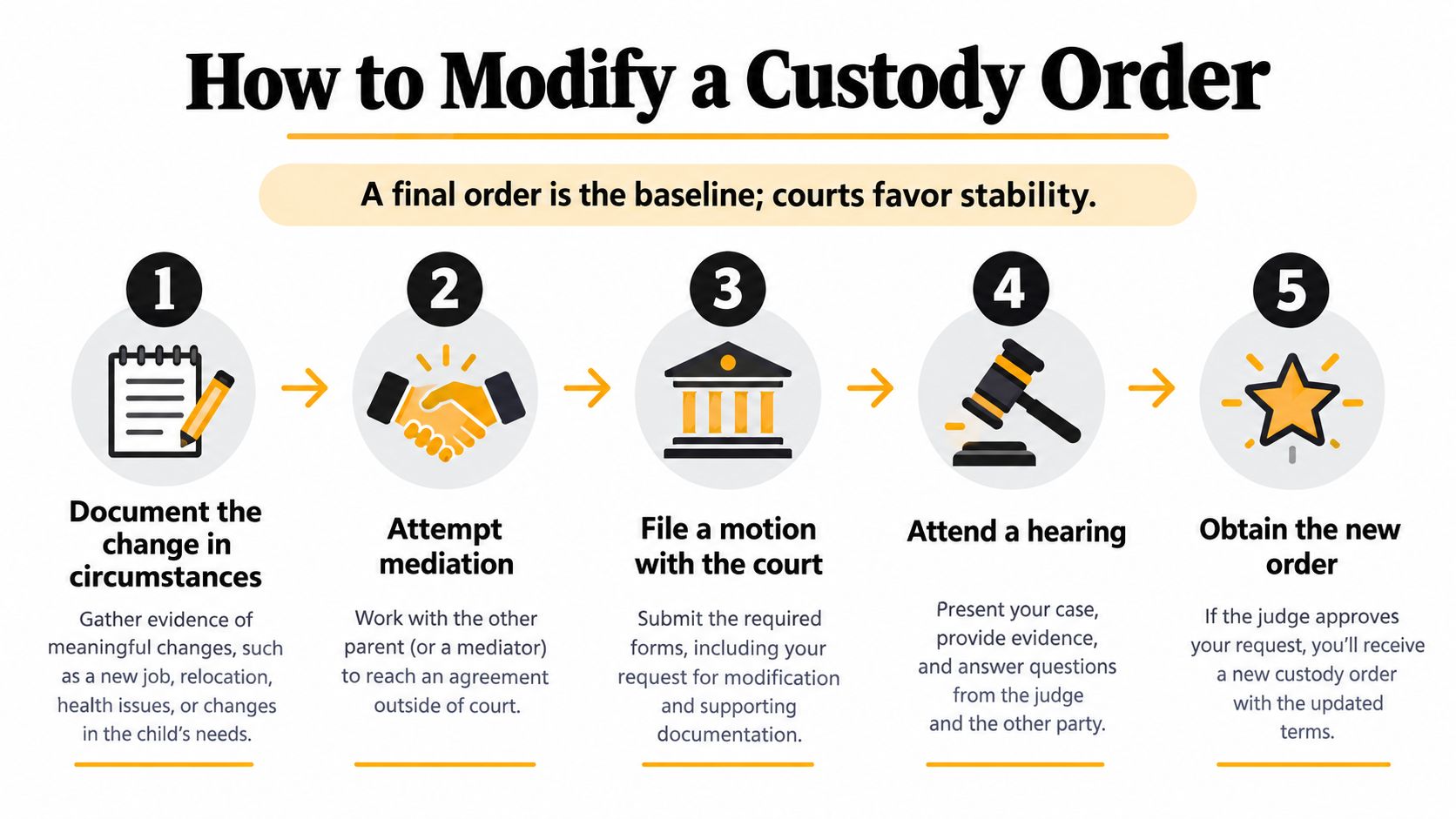
Common reasons parents ask to modify custody
Some requests come up again and again.
Work schedule changes
A parent who used to work daytime shifts now works nights or weekends. Save the updated work notice, schedule email, or payroll calendar showing the new pattern.The child's needs have changed
A teenager's school load, therapy schedule, or activity demands may make the old exchange plan unrealistic. Keep school communications, appointment summaries, and your own dated notes about how the schedule affects the child.Relocation or school-district issues
If one parent moves farther away, transportation and school attendance can become much harder. Keep address-change records, commute notes, and examples of missed or strained exchanges tied to the distance.Sustained interference
One missed handoff usually isn't a court event. A repeated pattern might be. Log denied calls, refused exchanges, or repeated last-minute cancellations with dates, times, and what happened.
If you're trying to understand the order you're already living under, this explanation of a parenting time order helps translate legal language into day-to-day terms.
What enforcement looks like in real life
Enforcement terms can sound dramatic, but they usually point to practical court responses.
- Contempt often means a parent is asking the court to address noncompliance with an order.
- Make-up time means restoring parenting time that was wrongly denied.
- Family court services may include mediation or related court-connected help, depending on the local system.
Small frustrations usually aren't enough by themselves. The court will care more about patterns than isolated irritation.
Save records before you feel desperate. Parents often wait until a hearing is close, then realize they have memories, not evidence.
The records worth keeping now
Before filing anything, try to gather:
- Order documents: the current custody order and parenting plan
- Exchange logs: dates, times, locations, late arrivals, no-shows
- Communication records: texts, emails, and call logs tied to the dispute
- School and medical records: notices that relate to the scheduling or decision-making problem
- Expense proof: receipts, reimbursement requests, and responses
- Neutral notes: same-day summaries written in factual language
Those records don't make a case by themselves, but they make your account testable and clear.
How Courts Weigh Joint Custody Decisions
It is common in the first weeks after a separation to ask, "What is fair to me?" Courtrooms usually ask a different question first. "What arrangement is most workable and healthiest for this child?"
That shift matters.
A judge is usually less interested in which parent feels more wronged and more interested in what daily life will look like on a school morning, during a doctor visit, or when a child needs both parents to follow the same plan. Joint custody works a lot like a shared group project. The court is not grading who gives the most emotional speech. It is looking at whether both people can reliably do their part.
Research often gets cited here, but it helps to read it carefully. A broad review of child outcomes in joint physical custody found that joint physical custody was associated with better outcomes than sole physical custody in many cases. The authors also said those associations often remained even after accounting for factors such as income, conflict, and parent-child relationship quality, as noted in that same research review.
What judges usually look for
Courts often weigh a cluster of practical questions instead of chasing one perfect answer.
| Common Parental Assumption | What Courts Actually Weigh |
|---|---|
| "The judge will pick the better parent." | The court often looks for stability, follow-through, and a plan that works in real life. |
| "If I love my child more, that should decide it." | Courts usually look at caregiving history, availability, and who handles the child's daily needs. |
| "Mothers automatically get custody." | Courts are supposed to look at case-specific facts, not parent gender. |
| "If my co-parent annoys me, joint custody cannot work." | Courts often separate ordinary co-parent tension from a true inability to make major decisions together. |
| "I can win by listing every flaw." | Judges often notice which parent supports the child's relationship with the other parent and which parent follows orders consistently. |
A useful way to understand this is to picture the judge testing a bridge before letting traffic cross it. The question is not whether the bridge looks good from far away. The question is whether it holds weight day after day. In custody cases, "holds weight" often means dependable exchanges, child-focused communication, school involvement, medical follow-through, and fewer avoidable disruptions.
Why records matter here
Many parents get blindsided. They walk in with strong memories and a clear sense that the other parent has been difficult. The court still needs something more concrete.
If you say, "I always handle school issues," the judge may wonder, "How often? Which issues? Over what period?" If you say, "We cannot communicate," the next question may be, "About routine friction, or about major decisions that affect the child?"
A private custody journal helps answer those questions with specifics. It turns vague claims into checkable examples. A short same-day note about a missed call with the pediatrician, a refusal to share school information, or a calm proposal you sent and the response you received can show the difference between ordinary conflict and a real co-parenting problem.
When courts move away from joint arrangements
Joint custody is not automatic. Safety can change the analysis quickly.
If there are credible concerns about domestic violence, substance abuse, severe neglect, coercive control, or another serious risk to the child, courts may move toward limited, structured, or supervised arrangements. In those cases, the key question is no longer just whether parents can share responsibilities. It is whether shared access would put the child or a parent at risk.
That is also why neutral documentation matters so much. A journal entry is not magic, and it does not replace police reports, medical records, or court filings. But it can help show frequency, timing, impact on the child, and whether a problem was isolated or part of a pattern.
In close cases, the parent with the calmer, better-organized record often appears more credible than the parent with the strongest anger.
Building Court-Ready Records Without Sharing Them
Most custody problems don't begin as legal arguments. They begin as small, messy moments. A late exchange. A changed pickup. A reimbursement request ignored for weeks. A school decision discussed by text and then denied later.
Those moments only become useful later if you capture them in a way another person can follow.
The four categories worth logging
A private system works best when you record the same kinds of events consistently.
Custody exchanges
Write the date, time, location, who arrived, whether anyone was late, and how the exchange happened.Informal agreements
If you agreed by text or in person to swap a weekend, cover camp pickup, or split a holiday differently, note the date, the terms, and whether both sides followed through.Shared expenses
Track what was paid, what it was for, the receipt, whether reimbursement was requested, and what response came back.Possible order violations
Use neutral language. Write what happened, who was present, what part of the order seems relevant, and how it affected the child or schedule.
If you want a focused recordkeeping model, this guide to a co-parenting journal shows how many parents structure these notes.
How to make the notes usable later
Good records aren't dramatic. They're boring in the best way.
- Write the same day: details fade fast
- Stick to facts: "Arrived at 6:42 p.m." is stronger than "He was disrespectful again"
- Keep attachments together: screenshots, receipts, photos, and notices should stay linked to the event they support
- Use categories or tags: exchanges, expenses, school, medical, missed calls, schedule changes
- Export clean summaries: lawyers, mediators, and judges need a readable timeline, not a chaotic phone gallery
A judge can work with facts, dates, and sequence. A judge can't do much with a month of angry notes that don't show what actually happened.
One private container is better than five scattered ones
Some parents use a paper notebook. Others use folders, notes apps, or spreadsheets. The method matters less than the consistency. What usually fails is fragmentation. Photos in one app, texts in another, receipts in email, and memory filling the gaps.
Casewell is one private option built for that job. It lets a parent keep dated custody notes, receipts, screenshots, agreements, and exchange check-ins in one place, organize them by category and child, and export focused PDF records for a lawyer, mediator, or personal review.
The key habit is privacy. This isn't about drafting messages for the other parent. It's about building a factual record you control, without tipping off the co-parent or turning documentation into another argument.
If you're trying to understand joint custody meaning while also living it day by day, Casewell offers a private place to document exchanges, agreements, expenses, and order issues in clear dated records. That can make the difference between saying "this keeps happening" and showing exactly what happened, when, and with what proof. You can learn more at Casewell.