
A criminal record can affect child custody, but it generally isn't an automatic bar to custody. Courts usually look beyond the existence of a record to assess whether the documented conduct creates a present risk to the child or affects the parent's ability to provide safe, stable care under local law.
If one conviction appears in a custody file, has the judge already decided what parenting time should look like? No. The missing step is the court's assessment of how the offense, its legal status, the parent's circumstances today, and any evidence of change relate to this child's safety and welfare. That assessment can lead to different arrangements, and a parent's record alone doesn't tell you which one.
How a Criminal Record Can Affect Custody
A parent may assume that a conviction has already decided the custody case. That assumption treats every offense as interchangeable. Courts generally don't: a record can affect the safety analysis, but it usually isn't an automatic bar to custody.
The key distinction is between having a record, whether the conduct matters to the child's welfare, and what risk, if any, it suggests today. A court may consider the offense's nature and seriousness, how recent or repeated the conduct was, whether it involved violence or a child, and what has changed since. It may also look at living arrangements, compliance with court orders, rehabilitation, and the parent's current ability to care for the child.
Pennsylvania law offers a clear example of this approach. Under Pennsylvania's custody statute on criminal convictions, courts must consider specified convictions or pleas involving a parent or household member, including substantially equivalent offenses from another jurisdiction. Before granting custody, the court must determine that the person doesn't pose a threat of harm to the child. Yet the statute also says a listed conviction “shall not by itself be determinative.” The judge must consider the circumstances as a whole and the child's best interests.
That doesn't mean a serious record is brushed aside. Violence, child abuse, sexual offenses, domestic abuse, or conduct indicating continuing danger may carry substantial weight. An older, unrelated, nonviolent offense may have less bearing on parenting, depending on the evidence and local law.
Practical rule: Don't argue only that a record exists, or only that it's old. Show what the record establishes and how the parent's circumstances relate to the child's safety now.
The specific rules vary by jurisdiction. A local family-law professional can help determine which facts matter, what records the court may consider, and how to present them without overstating or minimizing the history.
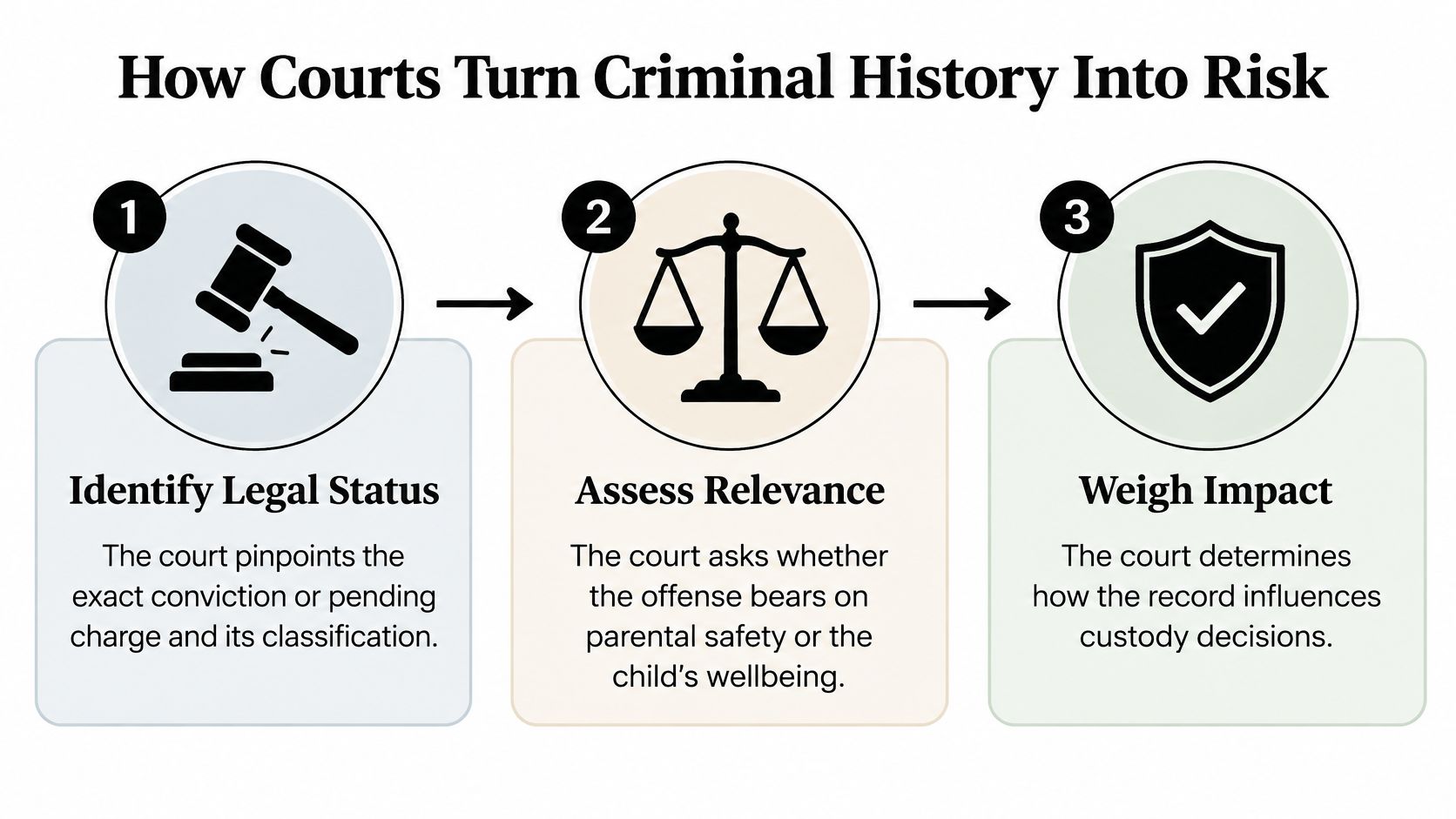
How Courts Turn Criminal History Into Risk
A court does not read a criminal-history entry and select a custody outcome. It evaluates the information in context, much like a courtroom notebook: the entry is one item, and its meaning depends on the documents and circumstances around it. The same offense can matter differently in different files because the evidence about timing, relevance, and present conditions can differ.
The decision usually follows a sequence:
- Identify the legal status and conduct. Was there a conviction, a pending charge, a dismissed case, an arrest, or an order? What conduct does the underlying record establish?
- Assess relevance to the child. Does the conduct bear on safety, caregiving, or the parent's ability to exercise custody and control? Is the connection direct, or does it depend on disputed claims?
- Weigh present circumstances. The court may consider protective measures, household arrangements, compliance, rehabilitation, and evidence of current parenting capacity.
- Choose a parenting arrangement. Depending on local law and the evidence, the result could be ordinary parenting time, supervision, restricted exchanges, limited contact, or denied contact. None is guaranteed by the mere existence of a record.
The process matters because a legal status and a safety conclusion aren't the same thing. A conviction establishes a legal outcome, but the court still has to consider its relevance to the child and the current circumstances. A pending matter or allegation may raise concerns, but it shouldn't be described as a proven fact.
Parents can prepare by learning what judges look for in child custody decisions and organizing the underlying documents rather than relying on a label such as “criminal record.” A professional can then assess what each item supports, what remains disputed, and what safeguards may be appropriate.
Convictions Charges and Orders Are Different
A conviction, a pending charge, a dismissed case, an arrest, an allegation, and a protective order aren't interchangeable. Each has a different legal status, and each may have a different evidentiary significance in a custody case. Treating them as identical can overstate the evidence. Treating them all as irrelevant can overlook information that a court may need to assess safety.
| Record or status | Key distinction | Questions a professional may examine |
|---|---|---|
| Conviction or guilty plea | A criminal case reached a legal outcome | What conduct was established? Is the offense relevant to child safety or parenting? |
| Pending charge | The criminal case hasn't reached a final outcome | What is alleged, what documentation exists, and are temporary safety measures in place? |
| Dismissed charge | The case ended without a conviction | Why was it dismissed, what evidence remains, and what can the family court properly consider? |
| Arrest | An arrest records an enforcement event, not a finding of guilt | What followed the arrest? Is there a charging document or other reliable evidence? |
| Protective order | An order may impose specific restrictions, regardless of the criminal case's status | What are its exact terms, whether it remains active, and how it affects contact or exchanges? |
| Allegation | A claim that may be disputed or unverified | Who made it, what supports or contradicts it, and has a court made a finding? |
A parent shouldn't claim that an allegation proves misconduct. Equally, a parent shouldn't assume that a dismissal, an old record, or a record thought to be expunged is automatically irrelevant. The treatment of those materials depends on local rules, the court's authority, the facts, and any applicable disclosure requirements.
Start with the documents. Identify what happened, when it happened, the status of each proceeding, and whether any order remains in effect. Keep the original record separate from your interpretation of it. If dates or accounts conflict, flag the disagreement rather than resolving it in your notes.
This comparison is groundwork, not a legal ruling. A local professional can advise what may be disclosed or admitted and how to describe the status accurately.
Offenses That Carry the Greatest Weight
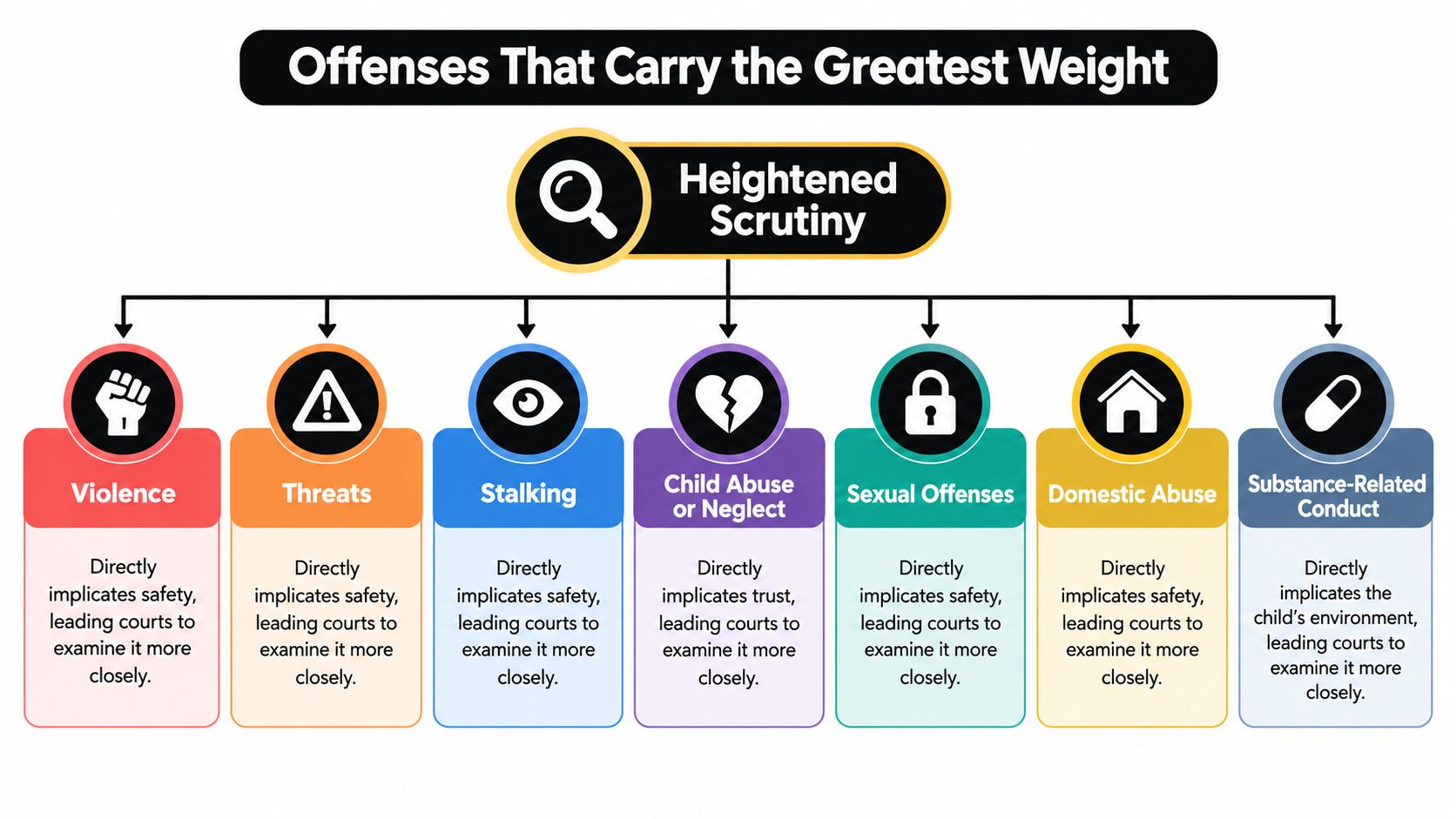
Some histories raise more direct child-safety concerns than others. Violence, threats, stalking, child abuse or neglect, sexual offenses, domestic abuse, and substance-related conduct can draw heightened scrutiny because a court may need to assess how the conduct affected the child, the other parent, or the household. No universal ranking applies across jurisdictions, and the offense label alone doesn't answer the custody question.
Look for the connection to present safety
A direct threat to the child, abuse of a household member, or conduct that limits a parent's ability to supervise safely may have a clear connection to custody. A court may also consider whether the record points to repeated behavior, whether the conduct is recent, and whether circumstances have changed. An old offense with no evident connection to parenting may present a different question from recent conduct that indicates continuing danger.
For substance-related offending, the relevant question isn't whether an offense occurred. A professional may examine the underlying conduct, whether the parent has completed treatment, evidence of sustained sobriety, compliance with sentencing or probation, and the current caregiving arrangement. Those details can help assess present risk, but they don't erase a conviction or guarantee unsupervised parenting time.
Domestic-abuse histories deserve careful review because abuse can affect both a child's safety and the parents' ability to co-parent. In a 2025 government review of selected family-court files in England and Wales, about two-thirds of the files in the sample contained evidence of a previous or concurrent criminal investigation or criminal-court proceedings involving the family. That figure describes the review's sample, not all custody cases. In a separate population-level measure, the government review of domestic abuse in the family court reports that about 3.8 million people aged 16 or over, or 7.8%, experienced domestic abuse in the year ending March 2025. It also reports 816,493 domestic-abuse-related crimes recorded by police, 54,987 related prosecutions, and 41,070 convictions, a 74.7% conviction rate among those prosecutions. These figures don't establish that a conviction automatically removes parenting time. They help explain why courts may scrutinize records, proceedings, orders, and patterns when deciding what contact arrangements are safe.
A California judicial-system review of domestic violence and custody describes research in which documented violence affected judicial decisions about custody and visitation. The practical point is not that one type of case always produces one result. It's that evidence of violence can shape the safety measures a judge considers.
Parents assessing what documentation may matter can review types of evidence that may be used in a custody battle. Keep the focus on verified events and their connection to the child, not broad claims about another parent's character.
Why Jurisdictions Handle Records Differently
The governing law determines what a court must consider and how it applies the child's best interests. The safety analysis may involve similar questions across cases, but legal terms, evidentiary rules, disclosure duties, and custody standards can differ. A result from one state or country can't be assumed to govern another.
Pennsylvania provides a specific statutory example. Its law requires courts to consider certain convictions and pleas involving a parent or household member, including offenses from another jurisdiction that are substantially equivalent. The court must determine that the person doesn't pose a threat of harm to the child before granting custody, but the statute says a listed conviction isn't by itself determinative. That framework calls for consideration of the record alongside the wider circumstances and the child's best interests.
Delaware also identifies criminal history as a best-interests factor. Its approach includes the history of each party and household resident, including guilty pleas, no-contest pleas, and convictions. The details of how that factor operates must be understood under Delaware law rather than inferred from another jurisdiction.
The practical lesson is to check the rules that apply to the actual case. Terms like “custody,” “parenting time,” and “contact” may not operate the same way everywhere. Local rules may also address whether a court can consider an arrest or dismissed case, what must be disclosed, how protective orders affect exchanges, and whether particular records can be sealed or expunged without affecting family-court access.
Pennsylvania's procedural changes also illustrate why careful disclosure and record handling matter. Its 2025 procedures call for confidential criminal-record and abuse-history information, disclosure of household members, and updates when charges or household circumstances change. The procedures provide ways to obtain child-protection reports while addressing confidentiality and evidentiary disputes. That kind of structured review doesn't itself mean a parent automatically loses custody. It can help the court assess a broader safety picture with relevant records in view.
Get advice based on the case's actual jurisdiction before relying on an online example. A professional can identify which statute and procedure apply and explain what information to disclose.
How Different Custody Scenarios May Turn Out
These composite scenarios are examples, not real cases or predictions. Each shows why the court needs more than an offense label before assessing parenting arrangements.
An older nonviolent conviction
A parent has an old nonviolent conviction and now describes stable housing, consistent parenting, and compliance with court requirements. Those facts may help explain present circumstances, but they don't decide the case. A professional would need to examine the offense, the child's relationship to it, the parent's history since then, and what the local court can consider.
Missing information matters: the record's legal status, the underlying conduct, any later incidents, and the quality of evidence supporting current stability. “It happened years ago” isn't a substitute for showing what has changed.
Recent violence involving the other parent
A parent has a recent violence-related record involving the other parent and a documented protective order. The order's precise terms matter, as do the circumstances surrounding it, whether it remains in force, and whether there have been later violations or other safety concerns. A court may need to consider how contact and exchanges can occur without breaching the order or exposing the child to risk.
In a Norwegian study of 12 custody cases involving police-reported domestic abuse, courts relied most heavily on police documentation when an investigation was ongoing, a prior violence conviction existed, or child-welfare proceedings were underway. When police investigations had been discontinued, police information was used less often. The study shows how the evidentiary pathway can matter, not that one outcome follows from an allegation. The Norwegian study of police information in custody cases also reinforces the need to distinguish a finding from an unresolved or discontinued investigation.
A pending substance-related case with treatment
A parent faces a pending substance-related charge and has completed treatment with records of attendance and recovery. The charge isn't a conviction, and treatment evidence doesn't resolve the criminal matter. A professional would need to review the alleged conduct, treatment documentation, current safety arrangements, and any court restrictions before assessing what parenting time is appropriate.
In every scenario, identify what is known, what is disputed, and what evidence is missing. Don't present a hypothetical as proof that a judge will reach a particular result.
Build a Clear Record for Court Review
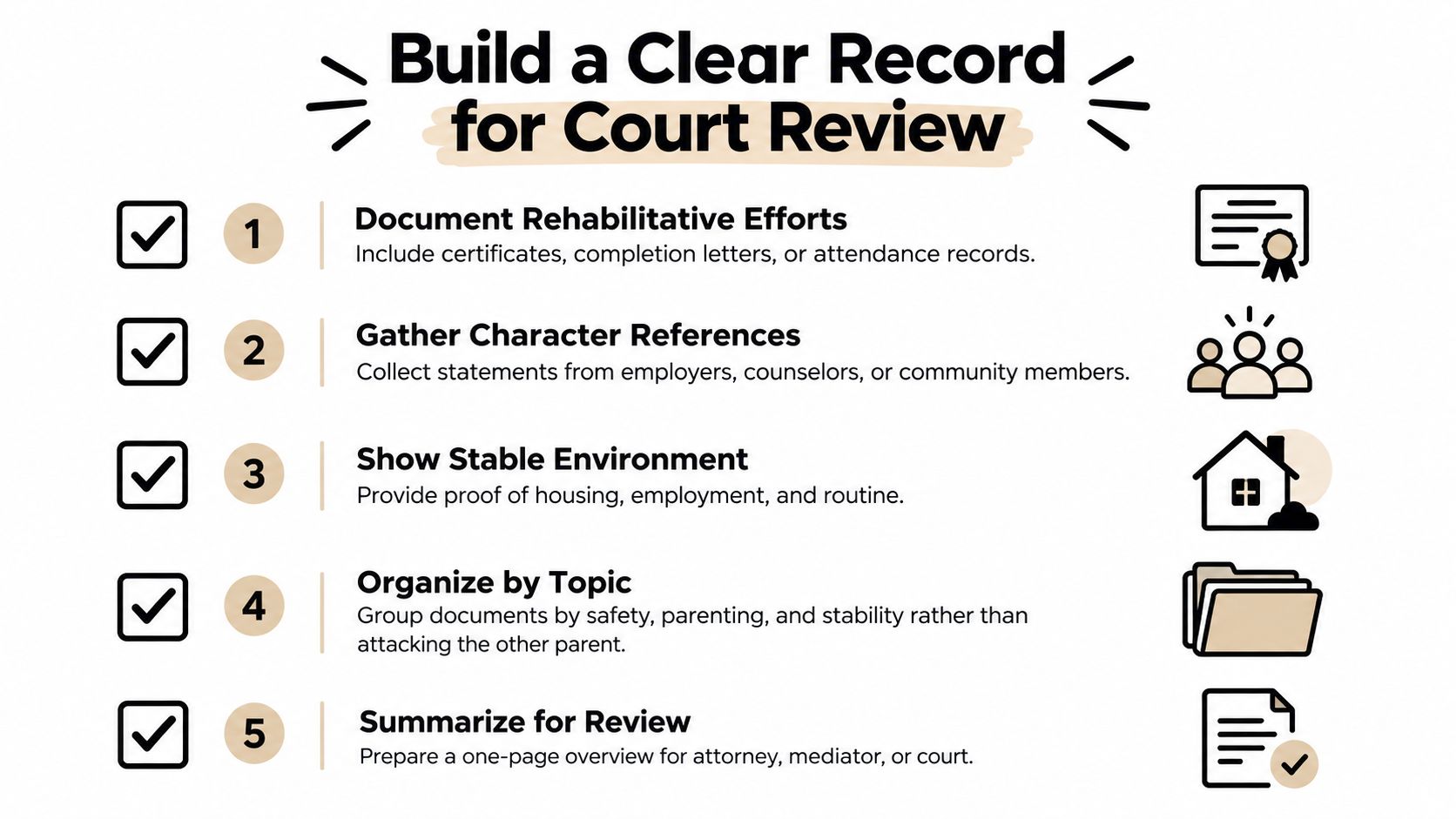
A useful custody file documents events without turning them into a character attack. Record what happened, when it happened, how you know, and why it may matter to the child. Separate direct observation from interpretation, and label disputed claims clearly.
Use a consistent entry format
For each relevant event, note its date and time, the source of the information, who was present, and any practical effect on the child or parenting schedule. Record exact order terms rather than paraphrasing them. Attach the relevant document, message, receipt, or photograph beside the entry, and distinguish what you saw yourself from what someone else told you.
Preserve earlier versions of notes and identify later edits. If a date is uncertain or a fact is disputed, say so. Neutral wording helps a professional assess the evidence without having to separate verifiable events from conclusions.
Collect records tied to the risk question
A focused file may include:
- Court documents: Orders, judgments, agreements, and the terms of any protective order.
- Police and case records: Documents that clarify whether a matter involved an arrest, charge, conviction, dismissal, or pending proceedings.
- Parenting-time records: Scheduled and actual exchange times, missed exchanges, and any changes agreed by the parents.
- Relevant communications: Messages or emails that document a specific threat, agreement, or safety concern.
- Rehabilitation and compliance records: Treatment completion, attendance, sobriety-related documentation, probation compliance, or other relevant progress.
- Child-related observations: Specific, dated behavior or impacts, without diagnosing the child or asserting a cause that hasn't been established.
Organize information around safety, parenting, and stability. Don't bury a court order in a folder of unrelated screenshots, and don't submit sensitive material without confirming what the court requires and permits.
A structured journal, calendar, or spreadsheet can help keep dates and attachments together. Casewell is one private custody-journal option; it organizes dated entries and supporting files and can export selected records for professional review. Whatever method you use, ask a lawyer or mediator to check what may be admissible, what must be disclosed, and how to protect confidential information. A custody evidence checklist can help you prepare materials for that review.
Prepare With a Local Legal Review
Before mediation or a hearing, prepare a concise package that lets a professional trace the record from its legal status to the current safety question. The aim isn't to argue that a label proves everything. It's to show what is documented, what remains disputed, and what facts bear on the child's present circumstances.
Bring the governing jurisdiction's rules and identify each relevant item: conviction, plea, pending charge, dismissed case, arrest, allegation, or protective order. For each, note the source, date, procedural status, whether an order remains active, and any connection to the child or caregiving. Mark gaps and disputed statements rather than presenting them as settled.
Then assemble dated documents that speak to current conditions, including compliance with court orders, treatment or rehabilitation progress, housing arrangements, parenting-time records, and relevant safety measures. Keep sensitive information separate until a professional advises whether it should be disclosed or filed.
Ask for specific guidance on admissibility, confidentiality, disclosure duties, expunged or sealed records, and safety protections. Don't assume that every screenshot or record belongs in a court filing. A lawyer-preparation guide can help you organize questions and materials for a legal meeting, but it can't replace advice about local law.
A criminal record can affect custody, but the court's response depends on the conduct established, its connection to the child, current circumstances, and the rules that govern the case.
Prepare a short chronology and a list of questions for a local family-law professional. Ask what the court may consider, which evidence supports a present safety concern, and what parenting arrangements or protections are legally available. That review is essential because the force of a record depends on the offense, the evidence, the parent's circumstances, and the applicable law.
If you're managing a custody dispute, Casewell offers a private journal for organizing dated co-parenting records, attachments, and exchange notes into focused reports for professional review. Visit Casewell to see whether its documentation tools fit the way you're preparing for a lawyer, mediator, or court.