

You send a routine message about Tuesday's soccer practice. It stays unanswered. Then your texts stop showing the usual delivery behavior, your calls end after a single ring, and the contact photo disappears. The thought arrives quickly: “My coparent blocked me.”
First comes anger. Then comes the quieter fear: Will I miss parenting time? Will the children hear from me? What happens at the next exchange?
The most effective response isn't a flood of messages or an immediate accusation. Treat the block as a documentation and communication problem first, and a legal problem second. Check the order, move to the required channel, preserve the original evidence, and build a dated record that another person can understand without hearing the entire history of your relationship.
What It Feels Like When Your Coparent Blocked Me
A blocked number creates uncertainty because you usually can't tell what happened from one failed call or message. The phone may be off, the child may be unavailable, the number may have changed, or the other parent may have restricted contact. From your side, those events can feel identical.
That uncertainty doesn't make your concern unreasonable. Canadian family-law research found that access denial was reported by 38.5% of custodial parents at least once, while the same research noted that many custodial parents said denial seldom occurred. That combination matters. Blocked contact may be intermittent rather than constant, but occasional interference can still disrupt parenting time and create a recurring record of missed contact. Canadian family-law research on access denial and contact disputes
Separate the event from the conclusion
Write what you know before you decide what it means:
- Known event: You called at the scheduled time and the call didn't connect.
- Known event: Your message shows an error or failed delivery.
- Known event: An email sent through the permitted channel received no response.
- Unproven conclusion: The other parent intentionally prevented contact.
- Unproven conclusion: The child was told not to speak with you.
That distinction protects you. A judge, mediator, or lawyer can evaluate observable conduct. They can't do much with a record built mostly from assumptions about motive.
Practical rule: Record the failed contact precisely, then let the pattern and the order determine what it means.
Your children shouldn't become investigators, messengers, or evidence collectors. Keep the adult dispute in adult channels. Your immediate job is to preserve access, follow the order, and avoid giving the conflict a new argument about harassment, pressure, or inappropriate contact.
Why a Coparent Blocking Contact Is Rarely Just One Moment
A single unanswered message usually doesn't explain a custody dispute. It may be a technical problem, a scheduling mistake, or an isolated lapse. Repeated blocking matters because it can show a pattern that affects parenting time, exchanges, and child-related decisions.
Orders and parenting agreements commonly address communication in practical terms. They may require parents to use a named email address or co-parenting application, provide schedule information, avoid unreasonable interference with the other parent's contact, or follow a specific exchange procedure. Your order controls. Don't assume that a rule from another family's order applies to yours.
What makes a pattern meaningful
A stronger record connects the communication failure to a parenting obligation. For example, the relevant issue may not be that a text went unanswered. It may be that the unanswered text prevented confirmation of an exchange, left a child without a scheduled pickup, or concealed a material schedule change.
Research on parental-alienation cases illustrates why outcomes can vary widely. A 2020 study of 967 cases found that 69% involved some physical custody alteration at the trial level, while 20.3% ended with one parent losing all custody or being limited to highly supervised visitation. About 40% resulted in the alienating parent losing 20% or more of parenting time after appeals. A later summary of the same dataset reported that 41.2% had no change in physical custody, and 18.3% of parents who alleged alienation lost 20% or more of their parenting time. These findings don't prove that any particular blocked message will change custody. They do show that courts can reach very different conclusions, which makes accurate documentation more useful than dramatic labels. The 2020 family-court outcomes study
Look for recurrence across different dates, channels, and parenting tasks. Ignored medical notices, refused handoffs, unanswered schedule questions, and blocked child calls tell a more complete story when you preserve each event and link it to the exact order language.
First Steps Within the First 48 Hours
Your first response should make your position easier to verify, not harder to defend. Follow this sequence.
- Stop retaliation. Don't use a new number, recruit mutual friends, contact relatives repeatedly, or send angry accusations. One attempt through an unauthorized route can become counter-evidence.
- Read the order word for word. Find the communication method, response expectations, exchange terms, phone or video provisions, and any restrictions. Note whether the order names OurFamilyWizard, TalkingParents, email, or another channel.
- Use the required channel. If text is blocked but the order requires email or an approved app, move there. Don't treat the blocked phone as permission to abandon the communication process.
- Send one factual message. State the date, time, attempted channel, observable result, and the child-related issue that needs an answer.
- Save the evidence immediately. Keep screenshots with timestamps, the complete message thread, call records, error notices, and any follow-up response.
- Create a same-day log entry. Memory becomes less reliable when anger and anxiety take over. Record the event while the sequence is clear.
Use a structured guide to preserving text-message evidence to keep the original message, surrounding context, and identifying details together.
A suitable message might say:
“I attempted to contact you by text at [time] on [date] regarding [child's name] and [specific issue]. The message did not appear to deliver. I'm sending this through [required channel] to confirm [question or exchange]. Please respond through this channel.”
If the block repeats, don't keep escalating your own outreach. Give your lawyer or mediator the order, the communications, and the timeline.
Building a Strong Record of Blocked Attempts
A strong log answers the same questions every time: When did you try? How did you try? What did you send? What happened? What did you do next? A contemporaneous record is strongest when the entry matches screenshots, call logs, voicemails, phone records, and the relevant order provision. Guidance on documenting blocked telephone communication
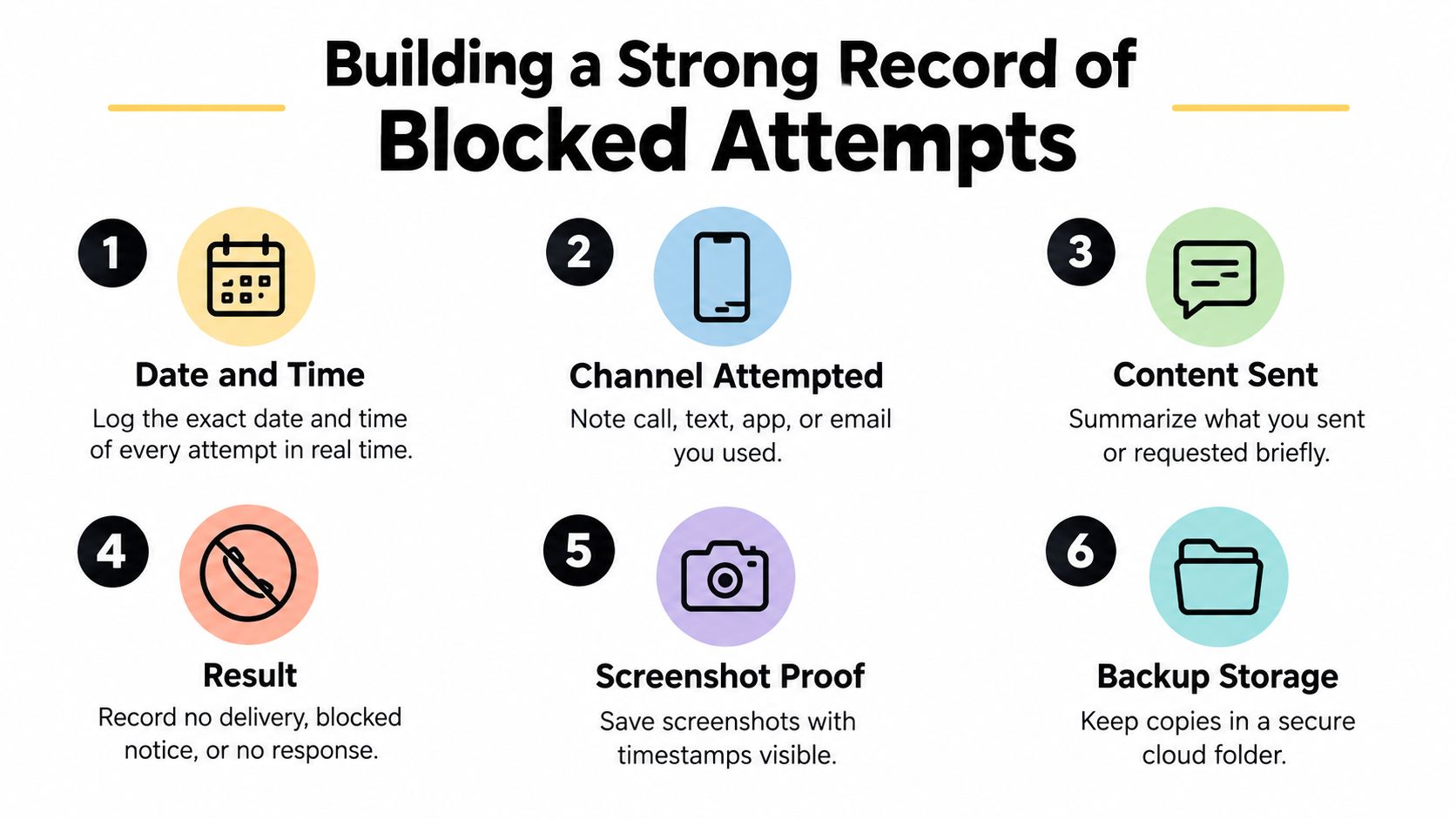
Use one consistent entry format
Include these fields:
- Date and time: Record the exact time, including the time zone when it could matter.
- Channel attempted: Identify the phone number, email address, app, or platform.
- Content or request: Summarize the child-related question without editorializing.
- Result: Use observable language such as unanswered, declined, blocked notice, delivery error, or no response.
- Order connection: Identify the section that governs the call, exchange, notice, or response.
- Follow-up: State whether you sent one permitted follow-up, proposed an alternative, or received a response.
- Attachments: Save the screenshot, call record, voicemail, receipt, or complete thread.
Example:
Date and time: Tuesday, 8:10 a.m.
Channel: Text to number ending in [last digits]
Request: Confirm Tuesday soccer pickup and return time
Result: Message failed to deliver; call at 8:14 a.m. ended after one ring
Order connection: Exchange provision, section [reference]
Follow-up: Email sent at 8:25 a.m. asking for confirmation
Evidence: Screenshot, call log, sent email, complete email thread
Keep the language neutral. “No response received by 9:00 a.m.” is useful. “They're deliberately trying to destroy my relationship with the child” is an interpretation that may distract from the actual evidence.
Save the original files in a secure folder organized by child, date, and incident type. Don't crop away timestamps, edit screenshots, or replace the original file with a rewritten version. Preserve the complete thread because context can matter, including messages that make your own conduct look less favorable.
A co-parenting communication-log guide can help you create repeatable fields instead of relying on scattered notes. The two habits that matter most are simple: write the entry the same day, and never edit the original file.
Communication Channels That Still Hold Up
When a direct number is blocked, choose the channel based on the order, not convenience. Courts generally have an easier time evaluating records from a designated channel than a new method one parent selected during a dispute.
| Channel | Speed | Verifiability | Court Reception | Main Tradeoff |
|---|---|---|---|---|
| Fast | Strong when threads and headers are preserved | Usually practical if permitted by the order | Less immediate than a call | |
| Court-approved coparenting app | Fast | Strong archives, timestamps, and message history | Stronger when named or ordered | Requires both parents to use it |
| Documented hand-delivered letter | Slow | Strong if delivery is provable | Formal, but may be excessive for routine matters | Delay and possible delivery disputes |
| Third-party witnessed contact | Variable | Can provide independent confirmation | Useful when safety or credibility is contested | Adds another person and may increase conflict |
| Trusted family-friend courier | Variable | Depends on written proof and neutrality | Uncertain if the order doesn't authorize it | The intermediary can become a new issue |
Email often provides the cleanest fallback when the order permits it. Use a clear subject line, keep each issue in its own thread, and avoid sending multiple emotional follow-ups.
OurFamilyWizard and TalkingParents can be useful when the order requires or authorizes a parenting app. Their value is the organized record, not the app's ability to settle the dispute. Research on post-separation parenting tools notes that message archives, shared calendars, expense tracking, and exportable records are commonly valued, while the evidence base for their effectiveness remains limited and needs rigorous evaluation. Research on post-separation parenting tools and their evidence base
A letter or witnessed delivery may make sense where safety, repeated nonresponse, or formal notice is involved. A family friend should never become a negotiator. If you use an intermediary without order language supporting it, the other parent may challenge the method itself.
Choose in this order: the channel required by the order, the option that protects safety, then the most convenient method.
Turning Scattered Incidents Into a Clear Pattern
One blocked text feels urgent to you, but it may look inconclusive to a professional reviewing the file. A consolidated timeline turns isolated frustration into conduct that can be assessed.
Start by sorting entries into categories:
- Missed handoffs: The other parent didn't confirm, appeared late, or failed to provide required information.
- Ignored child-related notices: Medical, school, activity, or illness information received no response.
- Blocked direct contact: Calls, texts, or video attempts failed while another permitted channel remained available.
- Unagreed schedule changes: Parenting time or exchanges changed without the notice required by the order.
Next, rank each category by recurrence and child impact. Don't bury the reader in every unpleasant exchange. Pull the strongest incidents into a one-page summary and attach the underlying records separately.
Build the summary around the order
For each cluster, place the governing order clause beside the event. A reviewer should be able to see:
- The required duty, such as notice, access, exchange, or communication.
- The attempted compliance, including date, time, and channel.
- The result, stated without motive claims.
- The effect, such as a missed handoff or inability to confirm a child's schedule.
- The supporting file, linked by a clear name.
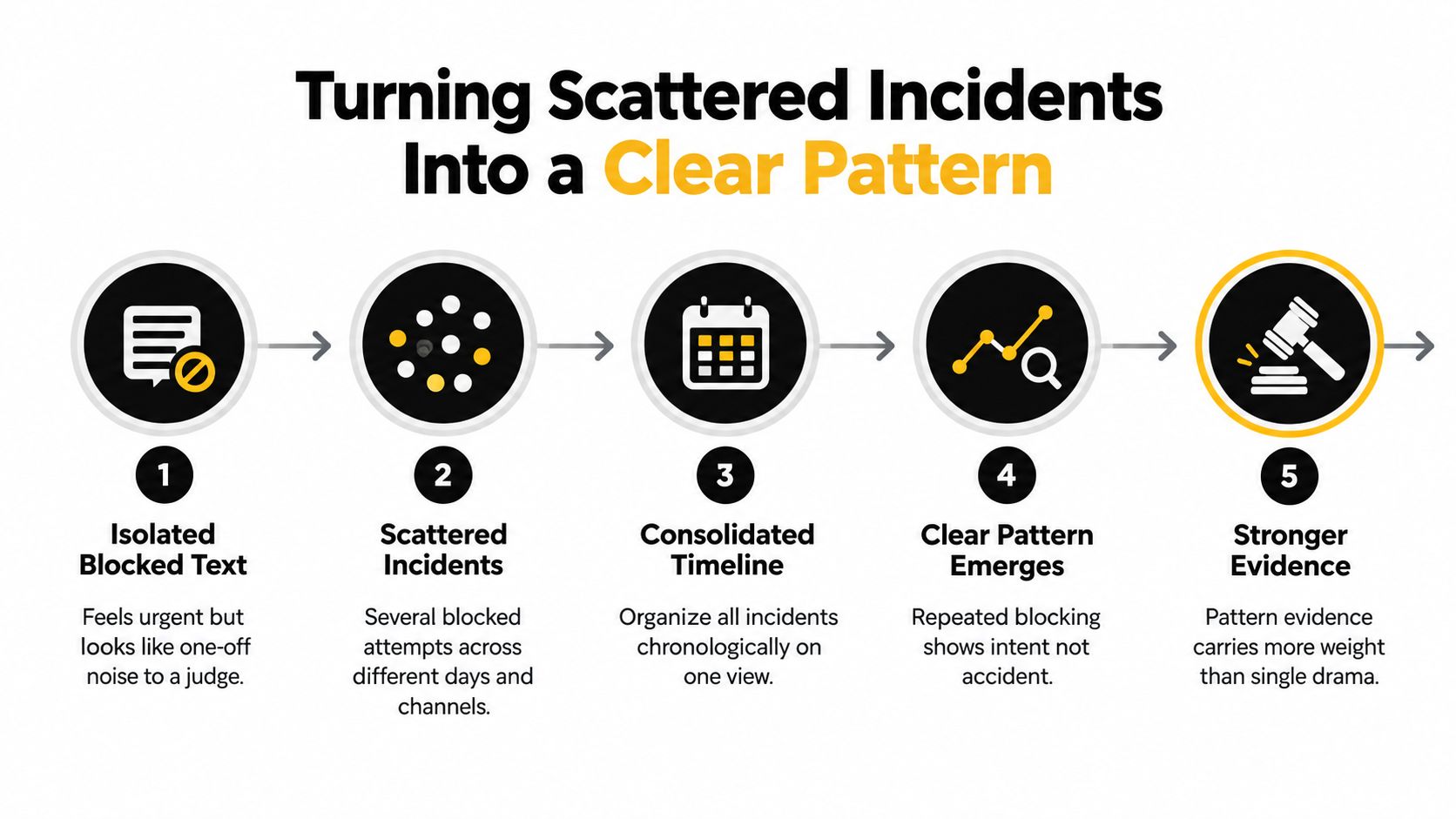
The point isn't to prove intent through volume. It's to show whether the conduct is systematic and whether it changes expected access or handoff performance, an approach emphasized in guidance on safeguarding custody rights after violations.
If the record includes hostile or repeated unwanted messages from either side, separate those communications from ordinary access attempts. A focused record of coparent harassment keeps categories clear and prevents a professional from confusing child-focused coordination with personal conflict.
Ready-to-Use Message Templates
Keep every message brief, factual, child-focused, and tied to the order. Edit the brackets before sending. Use the court-required channel whenever one exists.
Requesting access
“I'm requesting [call/video contact/parenting time] with [child's name] on [date] at [time], consistent with section [reference] of the order. Please confirm whether this time works or propose a specific alternative.”
This asks for the contact without accusing the other parent of blocking it.
Confirming an exchange
“Please confirm the [date] exchange at [time] at [location], as provided in section [reference]. I'll arrive as scheduled unless you identify a specific issue requiring clarification.”
This creates a clean record of your readiness and keeps the discussion limited to logistics.
Recording a missed handoff
“I arrived at [location] at [time] on [date] for the exchange required by section [reference]. The exchange did not occur. I'm preserving this message and the related records. Please confirm whether a makeup exchange is available on [proposed date and time].”
Avoid adding predictions, insults, or threats. The event and the requested remedy are enough.
Proposing a channel switch
“My text and call attempts on [date] did not connect. To keep child-related communication organized, I propose using [email, OurFamilyWizard, or TalkingParents] for future notices and schedule questions. Please confirm whether you'll use that channel, or identify the channel required by the order.”
The request doesn't concede that the block was lawful. It shows you're trying to maintain communication without repeated dialing.
Use co-parenting templates as starting points, then adapt them to your order and facts. Don't send the same template repeatedly when the other parent doesn't respond. One clear message, one documented follow-up, and a professional review is usually stronger than a long sequence of increasingly angry drafts.
Your Next Steps and When to Bring in a Professional
For the first week, follow a disciplined checklist:
- Pause retaliation. Don't contact through unauthorized numbers, relatives, or repeated alternate accounts.
- Review the order. Identify the required channel, exchange terms, contact provisions, and any safety restrictions.
- Switch channels. Use the designated email or parenting app if direct contact is unavailable.
- Log consistently. Record each attempt, response, missed exchange, and child-related notice while details are fresh.
- Seek a review. Bring the organized record to a mediator, parenting coordinator, or family-law attorney if the conduct continues.
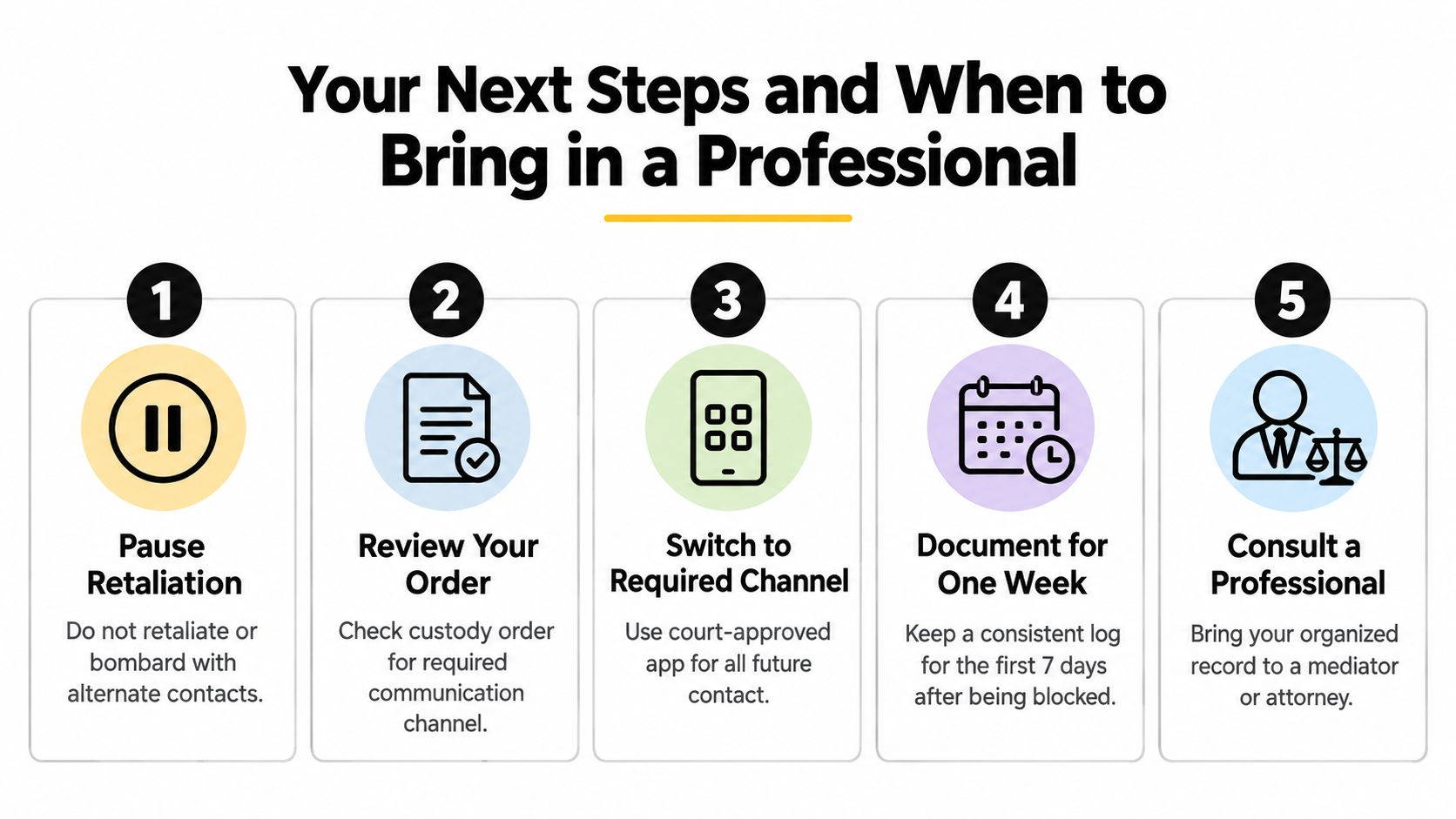
Bring in a professional when ignored messages become repeated, exchanges fail, contact with the child is consistently interrupted, or you suspect a continuing interference with parenting time. A mediator can help structure a workable channel and schedule when both parents can participate. A parenting coordinator may help manage recurring logistics where that role is available and appropriate. A family-law attorney can assess enforcement, modification, safety concerns, and the remedies available under your jurisdiction.
Don't wait until the record is chaotic. A professional can move faster when you provide the order, a concise timeline, original communications, screenshots, call records, and a short explanation of the child-related impact. Keep your documentation factual, preserve the originals, and let the professional decide which incidents matter legally.
If you're documenting repeated blocked contact, missed exchanges, or ignored child-related notices, Casewell lets you keep dated custody records, attach screenshots and files, link events to agreements, and export focused PDF reports for review. Start by organizing your existing evidence, then use the resulting timeline when you speak with a mediator or family-law attorney.