
You're standing in a school parking lot five minutes before pickup, rereading a text thread that started with a simple question about a permission slip and ended in a fight about last month. Your child is about to get in the car and ask what is wrong. That moment, repeated week after week, is where the choice between different parenting structures stops being theoretical and becomes practical.
Why Co Parenting and Parallel Parenting Need Separate Answers
Many parents first hear the term parallel parenting from a mediator, attorney, or therapist after they have already tried to cooperate and found that ordinary conversations keep escalating. The suggestion can sound like a verdict. It can feel as if someone is saying you failed at co-parenting, or that your child will now live in two disconnected worlds because the adults could not get along.
That reading is understandable, but it's not accurate. A parenting model describes how two households coordinate care, not how much either parent loves a child or how hard either parent has tried. Some families can discuss a fever, a homework problem, and a schedule swap in one calm call. Others can't get through the first topic without both people feeling attacked, even when both care greatly about the outcome.
The Question That Actually Matters
The useful question in co parenting vs parallel parenting isn't which label sounds better. It's whether disagreements between adults regularly reach the child.
Consider two families with the same custody schedule. In the first, parents argue often, but they keep those arguments in writing, away from exchanges, and never ask the child to carry messages. In the second, parents speak less often, yet every handover includes a tense doorstep exchange the child watches from the hallway. The second family has less contact on paper and more exposure in real life.
A model works for a child when it lowers what the child has to witness, carry, or fix, not when it merely lowers how often adults talk.
That's why a single rule for every separated family doesn't work. A cooperative structure that requires constant joint decisions will strain a family where every decision becomes a contest. A low-contact structure will frustrate a family that could solve small problems quickly with a brief, respectful call. Both arrangements keep both parents involved. They differ in how much coordination they demand between households.
It also helps to separate the structure from the season you're in. Conflict right after separation doesn't always predict conflict two years later, and a calm start doesn't guarantee things stay calm when schedules, partners, or schooling change. You're choosing a structure for the conditions you have now, with a way to review it later. Treating the choice as conditional and revisable, rather than permanent and personal, makes it easier to judge objectively and to explain calmly to a mediator or attorney.
Defining Co Parenting and Parallel Parenting
Parents use these terms loosely, which creates confusion in mediation and in court paperwork. One parent says co-parenting and means sharing a calendar. The other hears it and thinks it means agreeing on every house rule. Precise definitions prevent that kind of mismatch before you compare options.
What Cooperative Co-Parenting Means in Practice
Cooperative co-parenting means parents communicate regularly about the child, coordinate schedules and activities, and make many decisions together. You'll typically see shared information about school and health, some flexibility when plans change, and an effort to keep major expectations reasonably consistent across homes. A parent might call to say bedtime has been difficult this week, and both parents agree to try the same wind-down routine.
This model asks a lot of the adult relationship. It requires frequent communication, coordination, and shared decision-making, so it's most realistic when parents can exchange information without disputes escalating. Disagreement doesn't disqualify you. Co-parents argue sometimes. The test is whether you can usually return to the child's need, settle the point, and move on without the child becoming an audience or a messenger.
What Parallel Parenting Means in Practice
Parallel parenting means each parent manages the child independently during their own parenting time, while contact between households stays limited and structured. Communication tends to be written, brief, and focused on essentials such as health, school dates, and exchange logistics. Day-to-day choices about meals, homework order, or weekend plans belong to the parent whose time it is.
- Independent daily care: Each household runs its own routines during its own time.
- Limited direct contact: Messages cover necessary information, not open-ended discussion.
- Pre-set structure: Schedules, responsibilities, and exchange details are written down in advance so fewer issues need live negotiation.
The core distinction is the level of interparental contact and joint decision-making, as described in a review distinguishing parallel parenting from cooperative co-parenting by contact and joint decision-making. It isn't whether both parents remain involved. In both models, both parents parent. One model coordinates that involvement collaboratively. The other manages it side by side, with less interaction.
This isn't a rare fallback. Prolonged conflict affects a meaningful share of families, with estimates that 10% to 15% of separated parents remain in sustained conflict two years after separation and 9% to 18% remain in moderate-to-high conflict six years after divorce, figures reported in that same review discussion summarized above. A separate estimate in the research places parallel parenting at a minimum of 40% of post-divorce arrangements. If you're considering it, you're not describing an unusual family. You're describing a common pattern that needs clear rules to work well.
Comparing Communication, Decisions, and Exchanges
Labels become useful only when you can picture a Tuesday. Who texts whom about a late pickup? Who chooses a weekend activity? What happens when a plan falls through? The table below compares daily mechanics, not intentions, because mechanics are what your child actually experiences.
Co Parenting and Parallel Parenting Compared
| Criterion | Co Parenting | Parallel Parenting |
|---|---|---|
| Communication | Regular, often conversational, by phone or message | Limited, structured, usually written and brief |
| Routine decisions | Often discussed and aligned across homes | Made independently during each parent's time |
| Major decisions | Made jointly through discussion | Follow a written process or assigned areas of responsibility |
| Exchanges | Flexible timing and location, parents may speak briefly | Fixed time and place, minimal or no direct interaction |
| Information shared | Broad updates about mood, school, health, and routines | Essential facts about health, school, and logistics |
| When disputes arise | Parents talk through the issue directly | Parents follow the written plan or involve a neutral professional |
Communication is the most visible difference. A co-parenting exchange might include how your child slept and a worry about a friendship. A parallel message stays narrower, such as confirming a dentist appointment or noting that medication is in the backpack. Neither style is automatically warmer for the child. What matters is whether the channel stays child-focused and calm.
Decision-making is where families feel the deepest difference. Cooperative parents often decide together in real time. Parallel parents rely on the written plan so they don't have to. If you're weighing how authority should be divided, it helps to understand how joint decision-making works when parents share major choices, because a parallel plan still needs a clear method for education and healthcare even when daily choices stay separate.
Exchanges show the same logic in miniature. Flexible handovers work when a five-minute delay and a brief chat cause no tension. Fixed handovers, sometimes at school so parents don't meet at all, work when doorstep contact reliably turns difficult.
Practical test: If a routine change requires a live negotiation and live negotiations reliably go badly, your plan needs fewer live negotiations, regardless of what you call it.
As you read each row, mark which criteria are essential for your family. Medical communication may be essential even if social updates stop. A fixed exchange point may matter more than identical rules. Most real plans borrow from both columns. Naming where you need cooperation and where you need distance gives a mediator something concrete to draft, instead of a general wish that things feel less tense.
When Each Model Fits in High-Conflict Cases
Parents often ask which model research proves is better for children. The honest answer is conditional. Children can do well in a low-contact arrangement when both homes provide adequate care, parents shield them from disputes, and the agreement clearly defines schedules, responsibilities, and when joint decisions are required. Reduced contact by itself doesn't guarantee that result.
The checklist below frames fit around exposure and workability, rather than around which parent is more cooperative in principle.
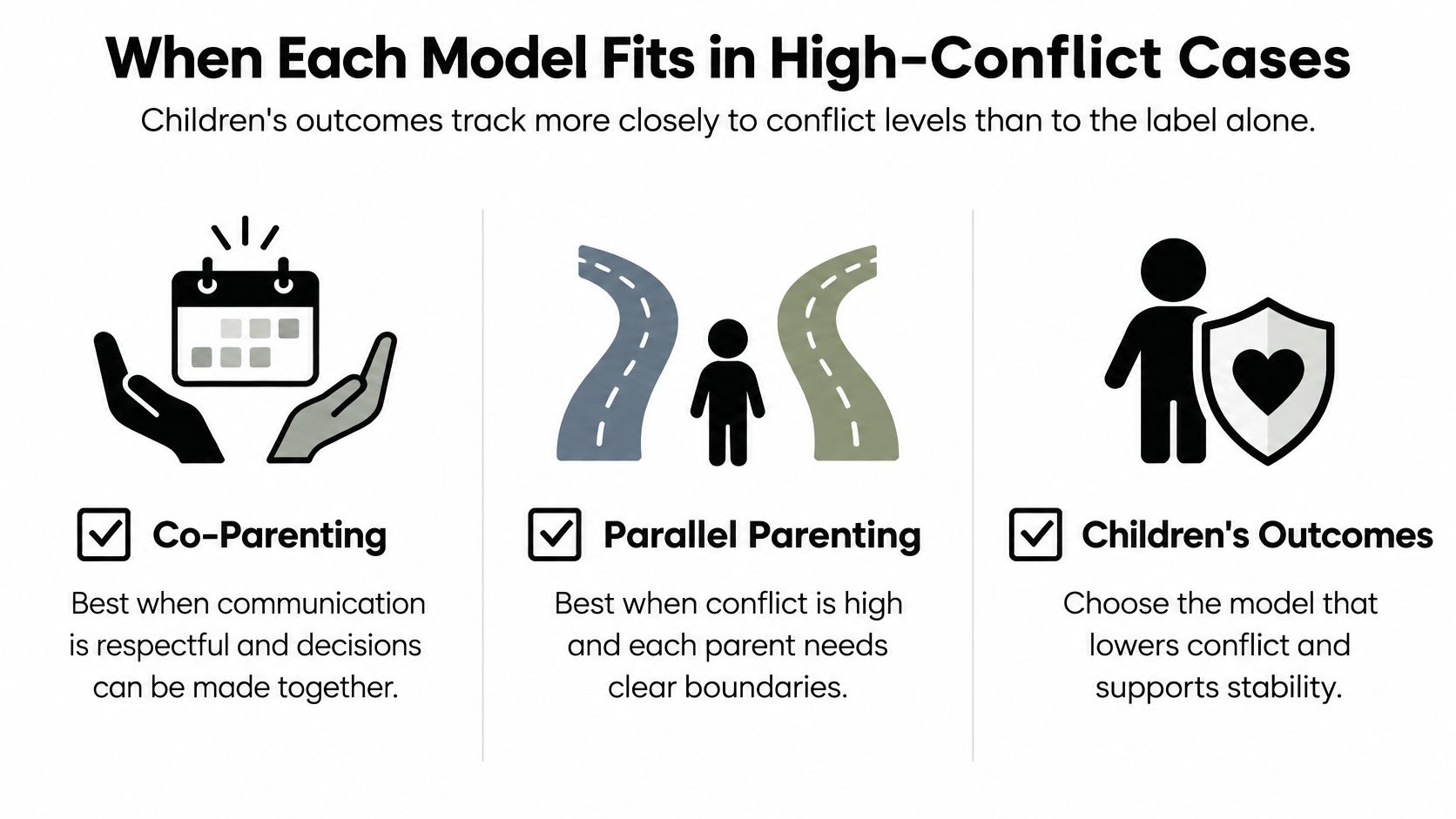
Start With Exposure, Not With the Label
Earlier longitudinal research linked children's outcomes more closely to frequent exposure to conflict than to conflict level in the abstract, a distinction discussed in a scholarly review of co-parenting after separation and children's exposure to disputes. In plain terms, what reaches your child matters more than how frustrated you feel privately. Heated messages your child never sees are still stressful for you, but they're a different problem from arguments at exchanges, criticism relayed through the child, or questions that put the child in the middle.
That distinction gives you a practical threshold. Sort your disagreements before you choose a structure.
- Logistics: Pickup times, homework folders, and activity fees. If you can settle these in writing without escalation, cooperative or limited cooperation often works.
- Values and routines: Bedtimes, screen limits, and diet. These can differ between homes in a parallel structure, provided each home is safe and adequate.
- Safety, coercive control, or abuse: These aren't communication problems. They call for low-contact boundaries, professional guidance, and legal advice, not more joint discussion.
If your situation involves persistent escalation, strategies for managing high-conflict co-parenting while keeping contact structured can help you separate ordinary friction from patterns that need enforceable limits.
The short video below offers another plain-language walkthrough you can pause and compare against your own recent exchanges.
A carefully defined parallel plan can protect children while preserving meaningful relationships with both parents, but only if the definition is real. Vague distance isn't a plan. Schedules, decision areas, communication channels, and exchange points need to be specific enough that neither parent has to improvise contact to get through the week.
Transitioning From Conflict to a Workable Parenting Plan
Families rarely stay in one pattern forever. A longitudinal study of 944 families tracked how arrangements shifted over time, in a longitudinal analysis of post-divorce parenting patterns and child outcomes. About six months after divorce, 34% of families were high-conflict and 29% were parallel parenting. About 3.5 years later, high-conflict parenting had fallen to 26% while parallel parenting had risen to 41%. Conflict eased for many families, yet direct cooperation stayed limited, so parallel structure became the durable pattern rather than a brief phase.
That same study found cooperative co-parenting was associated with the fewest child behavior problems and the closest relationships between children and fathers, while children in that group didn't score significantly better on 10 additional outcomes. Children in the parallel group had school-grade scores averaging 0.29 standard deviations below the single-parenting group. Read together, the findings argue against slogans. Cooperation can help when parents can sustain it. Parallel structure can be workable when they can't, and it still deserves monitoring, especially around school.
The timeline below shows a cautious order for change, starting from stability rather than from hoped-for goodwill.
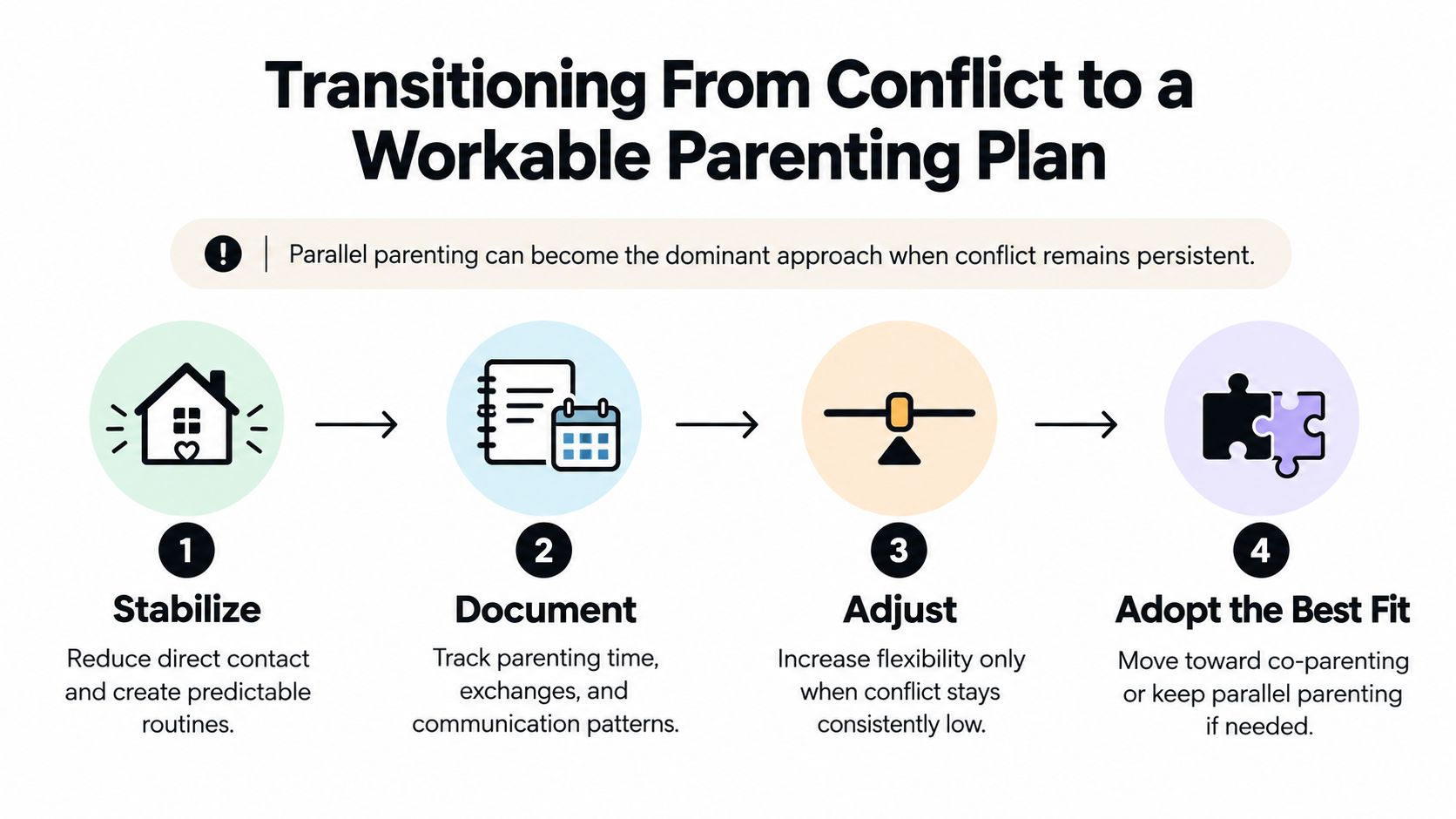
A Sequence That Protects Stability First
- Set a parallel baseline: Fix the schedule, exchange point, and written channel. Remove decisions that require live agreement.
- Run it without exceptions for a defined period: Predictability lets you see whether tension drops when contact drops.
- Add one narrow area of cooperation: Try shared input on a single topic, such as a school meeting, while everything else stays parallel.
- Review before expanding: Keep the change only if it worked without exposing your child to disputes.
Readiness signs are specific. Messages stay on topic. Exchanges happen on time without commentary. A schedule problem gets solved in writing and doesn't reopen old grievances. Pause signs are just as specific. Small requests become audits of the other home, the child starts reporting tension again, or flexibility gets used to create last-minute pressure.
Build review points into the agreement itself, with dates when you'll revisit the structure with a mediator or attorney. If you're drafting or revising the document, guidance on what belongs in a parenting plan during divorce can help you turn these steps into enforceable language. A review clause also lowers the stakes today. Neither parent has to treat the starting structure as a lifetime ruling on trust.
Documentation Options That Protect Parental Rights
Whatever structure you choose, memory will not carry it. Six months from now, neither parent will reliably recall which pickup ran late, which expense was repaid, or what was agreed about a holiday swap. Records turn those disputes into checkable facts, and they help a mediator or attorney see patterns instead of competing recollections.
The photo below reflects the unglamorous core of that work, gathering dates, receipts, and schedules into one reviewable history.
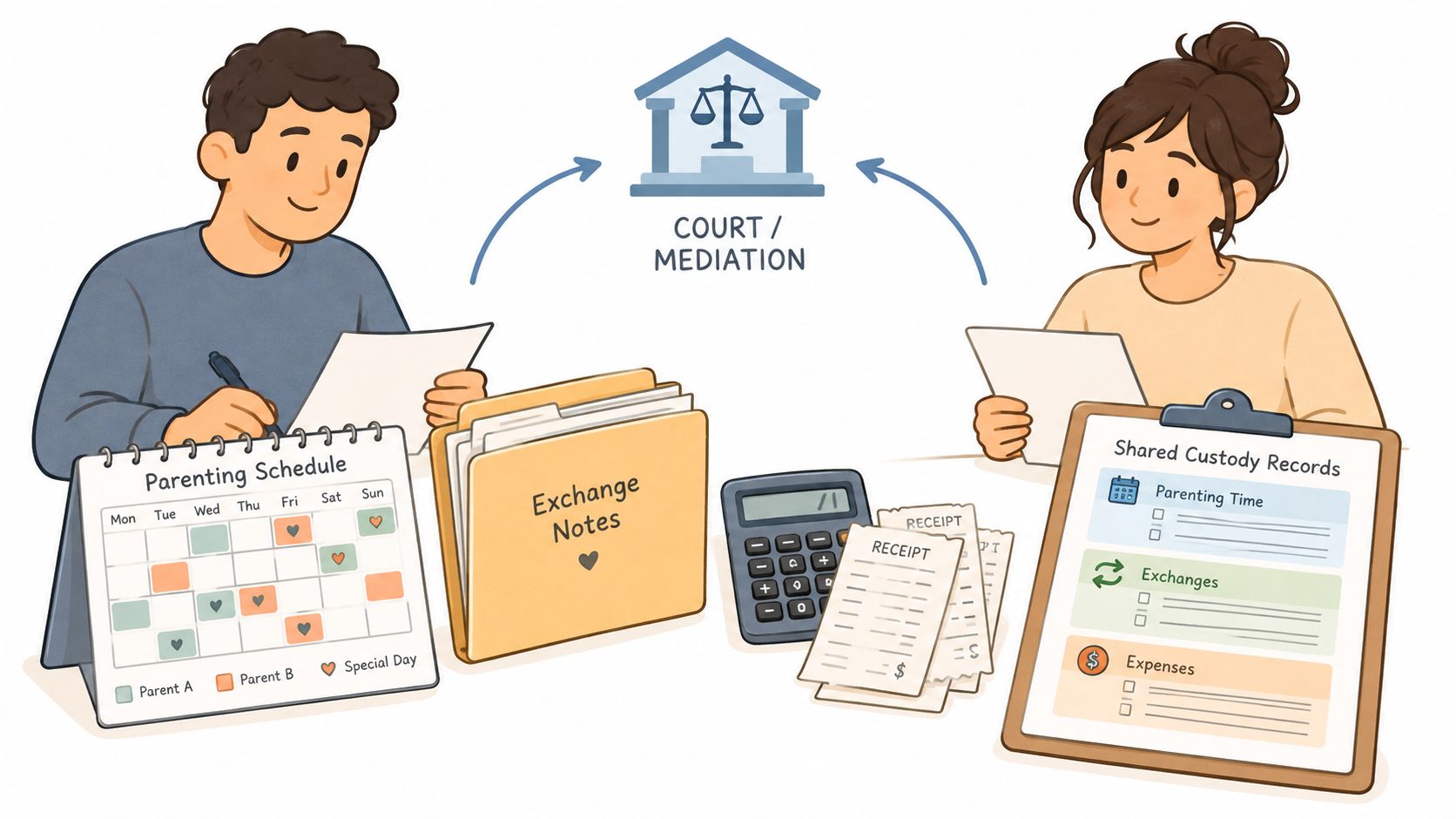
What Each Option Captures
Informal notes in a notebook or phone app are better than nothing and easy to start. Their weakness is inconsistency. Dates get skipped, wording gets emotional, and photos of receipts end up separated from the events they prove.
Saved messages and emails preserve exact wording and timestamps, which can be valuable. They don't, by themselves, summarize parenting time, link a missed exchange to the agreement it departed from, or total shared expenses. You end up scrolling through threads to reconstruct a sequence a professional needs in minutes.
Purpose-built custody journals add structure. A strong record contains the date and time, the child involved, a neutral description of what happened, and attached proof. Casewell, a private custody journal app, organizes entries by child and category, prompts exchange check-ins after usual handover days, links deviations to the original agreement, and tracks expenses with receipts and repayment balances. It exports focused PDF reports showing event dates, when entries were written, and later edits, which helps a reviewer judge sequence and reliability.
- Dates and edits: Can a reader tell when something happened, when you recorded it, and whether you changed it later?
- Attachments in place: Do receipts, screenshots, and agreements sit beside the relevant entry instead of in a separate folder?
- Professional readability: Could a mediator follow the timeline without you narrating every item?
Approaches to documenting high-conflict co-parenting with clear, dated records matter because tone affects credibility. Write what happened, not what you think it proves about the other parent. A private record kept for your own documentation, rather than a shared messaging channel, also keeps the act of recording from becoming another source of contact and conflict.
Choosing Your Model and Taking the Next Step
You don't need to declare a winner between these models for all families. You need a structure that fits your conflict level, your child's exposure, and the kinds of decisions your family has to make. That's a narrower question, and you can answer it with evidence from your own recent weeks.
A Decision You Can Test Against Your Own History
Choose cooperative co-parenting as your working model if you can exchange information, solve routine problems, and disagree without escalation reaching your child. You'll gain flexibility and consistency, and your child will see two parents who can coordinate care. Keep written summaries anyway, because goodwill doesn't preserve dates.
Choose parallel parenting if minimizing direct interaction is necessary to keep disputes away from your child, or if safety and coercive dynamics make open communication unwise. You'll trade flexibility for predictability. That trade only pays off when the plan is detailed, each home provides adequate care, and major decisions still have a defined path.
Don't ask which model good parents choose. Ask which structure keeps adult conflict out of your child's daily life this month, and how you'll know if that changes.
Many families land between the columns. They keep parallel exchanges and independent routines, then add limited cooperation on school or medical matters once written communication stays calm. Others start cooperative, hit a hard season, and tighten contact until things stabilize. Movement in either direction isn't failure. It's the plan responding to conditions, which is what a review process is for.
Before you change arrangements, do three things in order. First, reread your current agreement and mark where it forces live negotiation. Second, list recent disagreements and note which ones your child witnessed, heard about, or was asked to relay. Third, take that list, with dated records, to a mediator or attorney and ask for structure matched to those specific pressure points rather than a generic label.
Your concrete step this week is small. Create a private record for the next three exchanges. Note the scheduled time, actual time, location, anything your child witnessed, and any expense or agreement connected to the handover, all in neutral language on the same day. Three entries won't settle your case, but they'll show you, clearly and calmly, whether your current level of contact is protecting your child or exposing them. That clarity is where a workable choice begins.
If you're sorting out co parenting vs parallel parenting, a private, dated record helps you show what contact and exchanges look like instead of relying on memory. Casewell lets you log exchanges, agreements, and expenses by child and export focused PDF reports for a mediator or attorney. Start with your next three handovers and build a history you can review with confidence.