

You're trying to settle a parenting schedule, and the conversation keeps circling back to one number: 60/40. But that number doesn't tell you who handles school mornings, how often your child changes homes, or what happens when a pickup is missed. A workable plan needs more than a percentage. It needs clear expectations and records of what happens.
Treat the calendar as the starting point, not the whole agreement. The schedule describes the intended routine; consistent, factual documentation helps you and your co-parent see whether that routine works for your child and where it needs attention.
Why the Headline Percentage Is Never the Whole Story
A father signs a 60/40 agreement in March. By June, he and his ex are arguing about Sunday nights, about whether the 60 percent covers summer holidays, about whose problem it is when school closes early. The percentage answered none of that. Two parents can put the same ratio on paper and still walk out of mediation carrying two different plans in their heads.

The same split produces very different weeks for a child. A routine built on fewer handoffs tends to suit a child who struggles with transitions. A schedule with more exchanges can work well when parents live near the school and hand off reliably. The question that matters is whether the arrangement gives the child a predictable week and lets each parent deliver the responsibilities they signed up for.
Canadian federal guidance reaches a similar conclusion: research has not established a fixed number of hours or visits that guarantees good outcomes for children, and what counts is the quality of parenting and the child's involvement in everyday life, not time alone. Treat that as permission to stop arguing about the ratio and start fixing the schedule. (Canadian Department of Justice guidance on parenting arrangements)
Start with what needs to be written down
A workable plan names the regular schedule, exchange times and locations, holiday arrangements, and the fallback when a parent cannot make a scheduled handoff. It also states how changes get agreed, so a one-time swap does not harden into a routine nobody consented to.
Practical rule: If two reasonable people could read the plan differently, write down the detail they'd disagree about.
That is why I treat a 60/40 split as a documentation problem first and a calendar problem second. The calendar records what should happen. Dated notes record what did. Keep a private custody journal and log every exchange the same way: date, time, place, who was present, anything late or altered. Three lines per handoff. When a disagreement surfaces six months later, you will have a record instead of a memory contest, and your child will never have to carry messages between homes.
What a 60 40 Split Actually Means
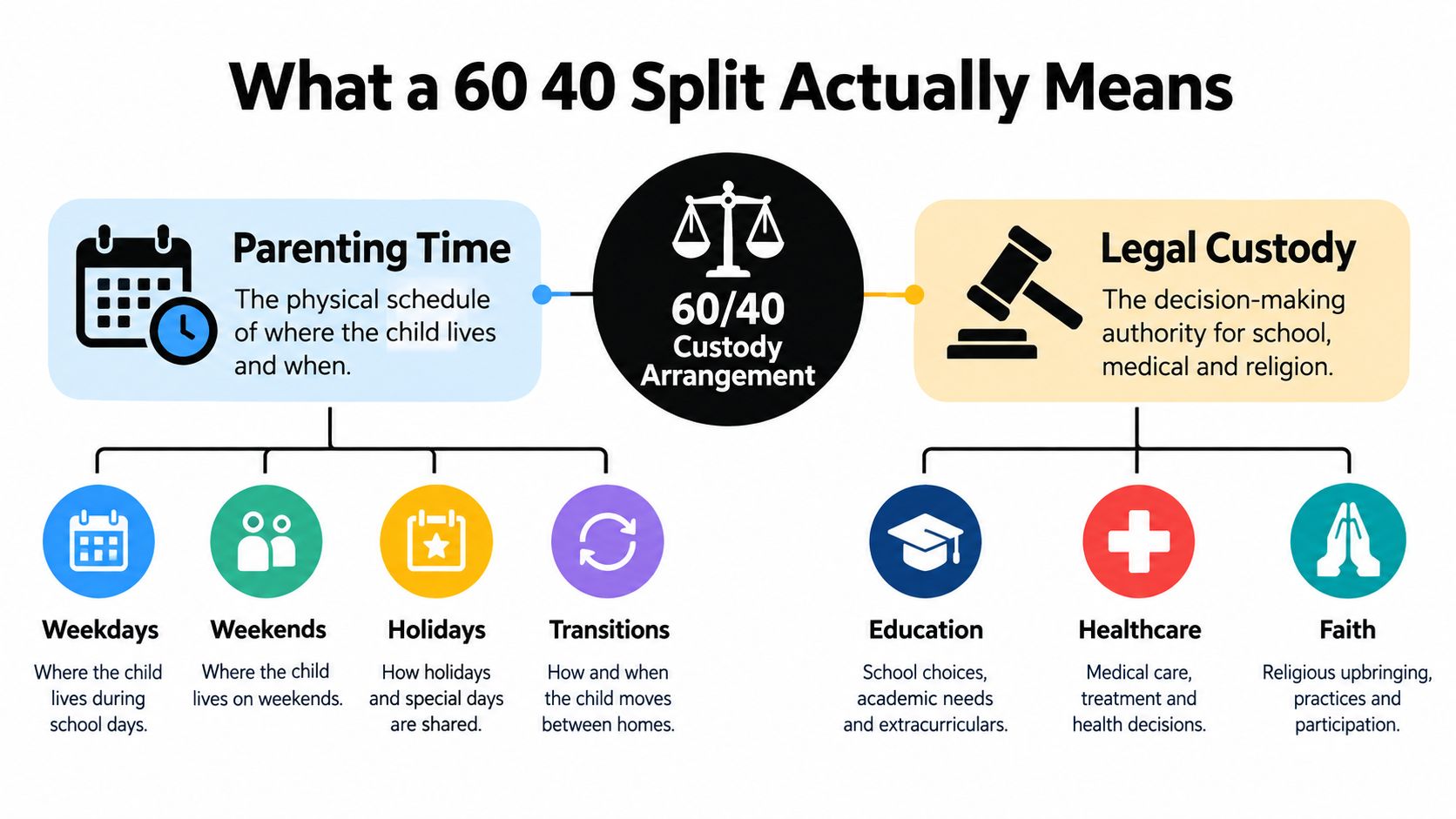
In a parenting plan, a 60/40 split describes an uneven division of parenting time: one parent has more scheduled time with the child, and the other has less. The label doesn't, on its own, establish which parent makes major decisions. It also doesn't tell you what the weekly routine looks like.
Separate parenting time from decision-making
Parenting time is the schedule: where the child stays and when. It includes overnights, exchanges, weekdays, weekends, holidays, and the practical caregiving that goes with each period.
Legal decision-making concerns authority over important matters, such as education, healthcare, or religion. A 60/40 physical schedule doesn't automatically determine whether parents make those decisions jointly or whether one parent has authority over particular decisions. Put both questions in the written plan and get local legal advice about how the terms apply where you live.
Count the routine, not the label
Parents often discuss a split as a percentage, but the schedule is lived in overnights, school mornings, and handoffs. If a plan uses overnights to describe the division, make sure you know exactly which nights belong to each parent and how holidays or school breaks affect the routine. Don't assume a short label answers those questions.
Compared with a 50/50 arrangement, an uneven split generally means one parent has more scheduled overnights and the other has fewer. Depending on the template, it may also mean one parent handles more school-night care, or that the child travels between homes less often. Those are separate operational choices. A schedule can have one parent holding more time without making exchanges unusually frequent, and another can create a heavy handoff burden despite a clear majority of time with one parent.
Before negotiating, make a list of the terms you need to agree on:
- Overnights: Which parent is responsible for each night, including holidays and school breaks?
- Exchanges: When and where does the child move between homes, and who handles transportation?
- Decision-making: How will parents handle major education, medical, or other decisions?
- Changes: How will you record a swap, cancellation, or make-up period?
A percentage is a summary. The written schedule is the instruction manual. If the instructions don't say who picks up the child after school or what happens when school is closed, parents are still negotiating the arrangement.
Common Schedule Templates That Add Up to 60 40
The same 60/40 label can produce different routines. Compare templates by looking at transitions, school nights, and travel, not just by asking whether the time adds up. For more examples of how different calendars can be laid out, see these custody schedule examples.
Four schedule patterns to consider
A 4-3 weekly rotation gives one parent four overnights and the other three in a repeating weekly arrangement. It can be predictable and keep the child's week organized, but the exact handoff pattern matters. If the exchange lands on a school morning, parents need to decide who gets the child to school and how belongings move between homes.
Alternating long weekends can reduce handoffs when the parents live farther apart or have work schedules that make frequent exchanges difficult. The trade-off is that one parent may go longer between visits, and school-night responsibilities need careful attention. Spell out when the long weekend begins and ends; an informal understanding can turn every holiday into a dispute.
A 5-2 weekly rotation keeps most weekdays with one parent and a shorter block with the other. This may suit a child who benefits from a stable school-week base, but it can leave one parent with fewer ordinary school routines. If the child has activities or appointments during that parent's block, agree in advance how transportation and participation will work.
A school-year and summer arrangement gives one parent more school-term responsibility while shifting time during school breaks. It can fit families whose work, travel, or distance makes a consistent weekly pattern impractical. But it requires explicit terms for school holidays, summer start and end dates, and transportation. Without those details, the annual calendar becomes a repeated negotiation.
| Template | Weekly Overnights (Parent A / Parent B) | Weekly Transitions | Best Fit |
|---|---|---|---|
| 4-3 rotation | Four / three in the recurring pattern | Depends on exchange days | Parents seeking a regular weekly routine |
| Alternating long weekends | Varies with the defined weekend and school-night arrangement | Often fewer, depending on the plan | Parents managing distance or difficult work schedules |
| 5-2 rotation | Five / two in the recurring pattern | Depends on how the shorter block starts and ends | A child who benefits from a steady school-week base |
| School year versus summer | Varies by season and written calendar | May cluster around seasonal changes | Families needing different school-term and break routines |
The table isn't a ranking. A plan with fewer exchanges may still be a poor fit if it creates long gaps between parent-child time or conflicts with school and activities. Choose a short list of realistic options, draw each one on a calendar, and test the logistics before treating any template as final.
How Courts and Mediators View Uneven Splits
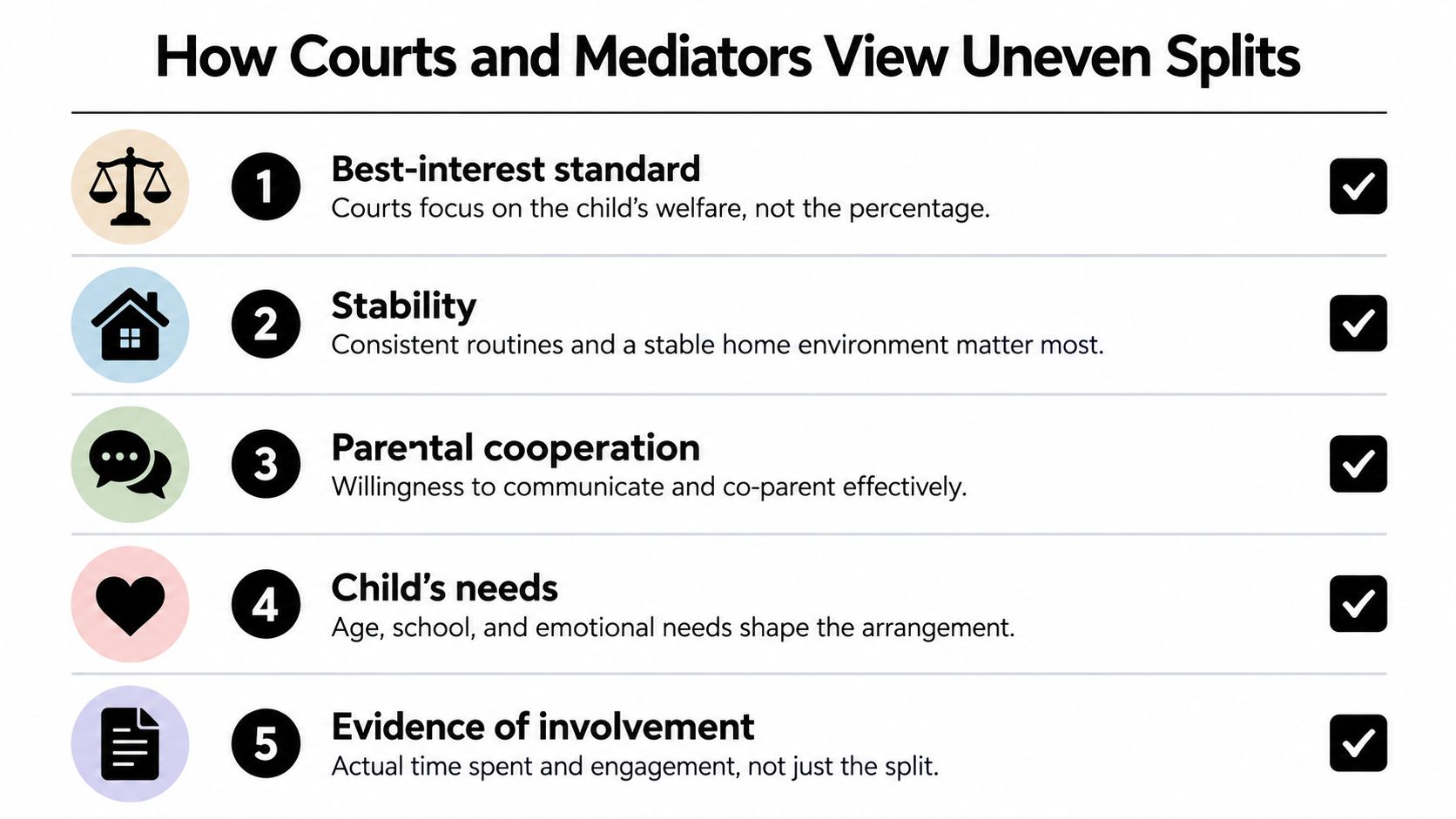
Mediators and judges rarely ask about the percentage first. They ask about Tuesday morning. Who wakes the child, who drives to school, where homework gets done, which parent sits in the dentist's waiting room. If your 60 40 plan survives that level of questioning, it deserves to be proposed. If it doesn't, no ratio will save it.
Explain the child's routine and relationships
As noted earlier, Canadian federal guidance discusses parenting arrangements in terms of the child's best interests, including the child's relationships, needs, and circumstances. That guidance also warns against treating any amount of time as a preset formula for good outcomes. My advice after watching these conversations play out: stop defending the ratio and start defending the routine.
Expect questions along these lines:
- Continuity: How does the schedule support school attendance, activities, and familiar routines?
- Caregiving: Who handles ordinary tasks such as meals, transportation, appointments, and school preparation?
- Cooperation: Can the parents communicate about routine changes and the child's needs?
- Adjustment: How does the child respond to the current arrangement and transitions?
- Practical fit: Do work schedules and distance make exchanges manageable?
Bring documentation, not impressions
A calendar shows planned time. It does not show who picked the child up, which school nights ran late, or how many exchanges happened on schedule. Professionals know this, which is why a dated custody journal carries real weight. Record each handoff, the planned and actual times, and the effect on the child. If you're preparing for one of these conversations, a guide to what judges may consider in custody matters can help you organize your questions, though local law and your family's facts control the outcome.
A clear record doesn't make an arrangement automatically right. It helps professionals understand what parents agreed to and what the child has actually experienced.
For mediation, bring a proposed calendar and a short written explanation of its practical logic: how many transitions the child makes each week, how many school nights sit in each home, and how you'll record changes when life interferes. If the arrangement already runs, describe the pattern with dates and what you observed, kept separate from what you think it means. Facts move these conversations. Ratios don't.
Reading the Warning Signs Six Months In
A signed schedule can look workable on paper and still create strain in daily life. Pay attention when exchanges are repeatedly missed, pickups run late, school mornings become difficult, or activities keep colliding with one parent's scheduled time. One difficult week may call for a conversation. A recurring pattern needs a closer look.

Record the event, not the accusation
Write down what happened while the details are fresh. Include the date, the planned exchange time, what happened, relevant messages, and the practical effect on the child. Don't use the entry to diagnose the other parent's motives. A neutral note is easier to review and less likely to bury the useful facts under frustration.
Keep an eye on these patterns:
- Missed or late exchanges: Record the scheduled and actual handoff details, plus any message explaining a change.
- School-night fatigue: Note the specific concern, such as difficulty getting ready or a reported missed routine, and who observed it.
- Activity conflicts: Save the schedule notice and record whether transportation or participation was affected.
- Requests to change the routine: Note what the child said in neutral terms, who was present, and whether the child appeared distressed. Don't coach the child to repeat a preference.
- Caregiving beyond the plan: Record a parent's additional pickup, appointment, or overnight when it differs from the written arrangement, and link it to any agreement about the change.
A journal helps distinguish a one-off adjustment from a pattern. Informal texts may show that parents discussed a handoff, but they don't always make it easy to connect the message to the original plan, the actual exchange, and any follow-up. A dated entry with the relevant message attached creates a clearer timeline.
If the routine is no longer working, don't wait for a heated dispute to reconstruct months of events from memory. Gather the relevant entries, speak with your lawyer or mediator, and ask what options are appropriate in your jurisdiction. This guide to records for a possible custody modification can help you think through what to organize. Keep records for clarity, not as a way to manufacture conflict.
Documenting the Plan So It Holds Up Later
A useful record connects the written agreement to what happened. You don't need an elaborate system. You do need a consistent one that captures the schedule, exchanges, and changes without turning each handoff into an argument.
A simple recordkeeping routine
Save the agreed plan. Keep the current schedule, exchange details, holiday terms, and any written changes together. If parents later agree to a one-time swap, record that as a change rather than replacing the original arrangement.
Log the exchange. Make a dated entry with the planned and actual handoff details. Note cancellations, late arrivals, missed time, or an agreed make-up period. Keep the wording plain: what was scheduled, what occurred, and any relevant communication.
Attach the evidence to the event. Save the message, receipt, school notice, or other relevant item beside the entry it supports. A screenshot without a date or context can be hard to interpret later. A short factual note explains why it matters.
Prepare a focused report. Before a mediator or attorney meeting, select only the relevant child, period, and category of records. A concise timeline is easier to review than a large folder of unrelated messages. Ask your professional what format and material will be useful.
Keep the record boring. Dates, times, changes, and supporting documents are more useful than conclusions about intent.
A private custody journal can make that habit easier to maintain. Casewell organizes dated notes, screenshots, receipts, agreements, and exchange check-ins into structured entries, and can produce focused PDF reports for professional review, with data kept on-device by default. Its parenting plan template can also help you think through which details to include in a written schedule.
Whether you use an app, a secure folder, or another consistent system, keep the same standard: record facts promptly, preserve the original agreement, and make it easy to see what changed. A record should clarify the child's routine, not encourage parents to score points against each other.
Choosing the Right 60 40 Setup for Your Family
Before settling on a percentage, answer practical questions that reveal whether the schedule can work in your family's actual week. Don't choose a template because it looks balanced on a sample calendar. Choose one you can explain, follow, and review using clear records.
Three questions to answer first
How far apart do you live? A plan that requires frequent handoffs can become burdensome when parents live far from school or from each other. Revisit the transition and travel trade-offs described in the schedule comparisons, and be specific about who handles transportation.
What are your real work and school routines? Use actual start times, pickup responsibilities, and recurring activities. A schedule that depends on a parent being available at a time they regularly work is a predictable source of conflict, not a minor detail to sort out later.
How does your child handle transitions? Consider the child's age, routines, and observed response when moving between homes. The headline split won't answer that. Use the practical questions and child-focused considerations discussed above, and seek local professional advice when you need help evaluating the arrangement.
Common questions parents ask
Does a 60/40 split affect child support? It may be relevant, but child support rules depend on local law and the facts of your situation. Don't assume the parenting-time label alone determines the amount. Ask a family-law professional or consult the official guidance for your jurisdiction.
Can the schedule be changed later? Parents may be able to agree to a change, and a formal order may require a legal process to vary it. The right steps depend on where you live and whether the arrangement is part of a court order or another agreement. Get legal advice before treating an informal change as permanent.
How should I present the plan to a mediator? Bring a proposed calendar, explain how school and exchanges will work, and identify the questions that still need agreement. If the schedule is already in use, bring concise, relevant records rather than a disorganized message archive.
What if my co-parent won't log exchanges? You can keep your own factual record. Note the planned and actual handoff, preserve relevant messages, and avoid pressuring your child to document events. One parent's refusal to keep a journal doesn't prevent you from maintaining a clear account of your own observations.
The percentage sets the outline. The details and recordkeeping show whether the arrangement works in practice. Choose a schedule your child can live with and both parents can follow, then document changes calmly and consistently.
Casewell is a private custody journal for organizing dated notes, agreements, exchange check-ins, receipts, and supporting screenshots into focused records for professional review. If you're working out a 60/40 schedule, visit Casewell to see how its recordkeeping tools can help you keep the written plan and day-to-day events together.