

You may already be doing nearly everything a parent does. You take the child to school, schedule appointments, help with homework, attend activities, and provide a steady home. Then a school administrator asks for a legal signature, or a doctor asks who can consent to treatment, and your everyday role suddenly feels less certain.
That gap between caregiving and legal authority is the central issue in step parent guardianship. A warm, established relationship matters, but marriage, co-residence, and regular care don't automatically give a stepparent the power to make every medical, educational, or legal decision. Courts generally need specific evidence and a formal order.
The right path may be guardianship, adoption, a narrower contact or parenting-time order, or no court application at all. The answer depends on what authority the child needs, what each legal parent retains, and what arrangement serves the child's best interests.
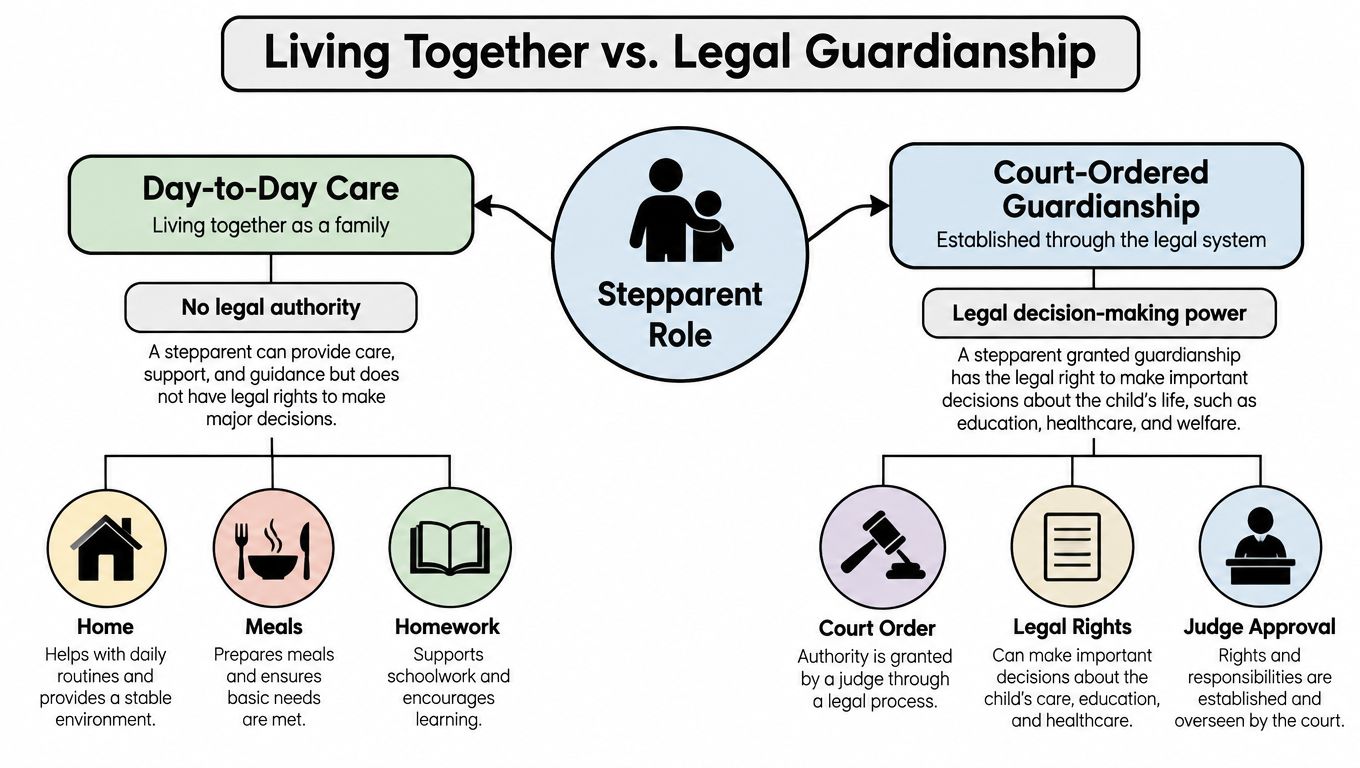
Why Living Together Does Not Create Legal Authority
Consider a common morning. A child has a school trip, but the school asks for a permission form signed by a legal parent. Later, the child needs a non-emergency medical appointment, and the clinic wants consent from someone with recognized authority. The stepparent may have been the adult handling these responsibilities for years, but the institution still has to verify who can legally decide.
Being the trusted adult in a child's life and being a court-appointed guardian are different roles. A stepparent may provide meals, transportation, supervision, homework help, and emotional support. Those actions show a meaningful relationship and can become important evidence, but they don't by themselves create court-ordered decision-making power.
The available population figures also need careful interpretation. The U.S. Census Bureau estimated that approximately 4.6 million children under age 18 lived with at least one stepparent in 2010, while a separate Census analysis classified 2.8 million children as the householder's stepchildren. The difference reflects how household surveys define relationships and why co-residence statistics cannot be treated as a count of legal guardianships. See the Census discussion of stepchildren and household relationships.
What guardianship changes
A guardianship order may give a stepparent defined authority to act for the child. The precise powers depend on the jurisdiction and the wording of the order. It may address care, decision-making, or other responsibilities, while the biological or legal parent may continue to hold legal status and obligations.
Guardianship isn't a declaration that the stepparent is “more of a parent” emotionally. It's a legal arrangement designed to give the right adult enough authority to meet the child's needs while respecting the rights of existing legal parents.
Key takeaway: Living together can prove the depth of a caregiving relationship, but only the applicable law and a formal order determine whether that relationship includes legal authority.
Before discussing forms, identify the actual problem. Is the issue a school pickup, access to records, a recurring medical-consent barrier, participation in a parenting schedule, or a need for broader decision-making? A plain-language custody terms glossary can help separate terms that are often used interchangeably but have different legal effects.
Choosing Between Guardianship Adoption and Contact Orders
The biggest early mistake is choosing an order because it sounds broad rather than because it solves the family's actual problem. Guardianship, adoption, and contact or parenting-time orders can all involve a stepparent, but they don't do the same work.
Guardianship generally gives a stepparent caregiving or decision-making authority while preserving the biological parent's legal status. In British Columbia, for example, a stepparent doesn't become a guardian automatically. The applicant must seek a court order and show that the arrangement serves the child's best interests, as explained in this British Columbia guidance on stepparent rights and responsibilities.
Adoption is more permanent. It typically requires the termination of another parent's legal rights, subject to the jurisdiction's consent rules and exceptions. Adoption may be the objective when the stepparent wants a permanent parent-child legal relationship, not merely authority to handle care and decisions.
A contact or parenting-time order is narrower. It may fit when the stepparent's main concern is preserving a relationship or setting predictable time with the child. Seeking full guardianship for a problem that can be solved with defined contact may create unnecessary conflict and invite questions about why such broad authority is needed.
| Option | Effect on Parental Rights | When It Fits |
|---|---|---|
| Guardianship | Usually gives defined caregiving or decision-making authority without automatically replacing the legal parent | The stepparent provides substantial care and needs formal authority for the child's welfare |
| Adoption | Usually creates a permanent legal parent-child relationship and may require consent or termination of another parent's rights | The family seeks permanence and understands the consequences for existing parental rights |
| Contact order | Creates a narrower framework for time or contact with the child | The main need is preserving a meaningful relationship rather than making broad decisions |
Questions to answer before filing
Start with the practical barrier. Write down what happened, who refused or requested authorization, what decision was needed, and whether a narrower document or order could address it. Then ask whether the requested authority would affect the other parent's decision-making, contact, or legal status.
A court may be less persuaded by a general statement such as “I do everything for this child” than by a specific explanation: the child lives with the stepparent, the stepparent manages recurring appointments, and existing arrangements leave no reliable way to obtain consent for necessary decisions.
Adoption shouldn't be treated as a stronger version of guardianship. It is a different legal choice with more lasting consequences. If the family wants to understand how court proceedings are structured before selecting a remedy, review this overview of what happens in family court.
How to Prepare and File Your Guardianship Request
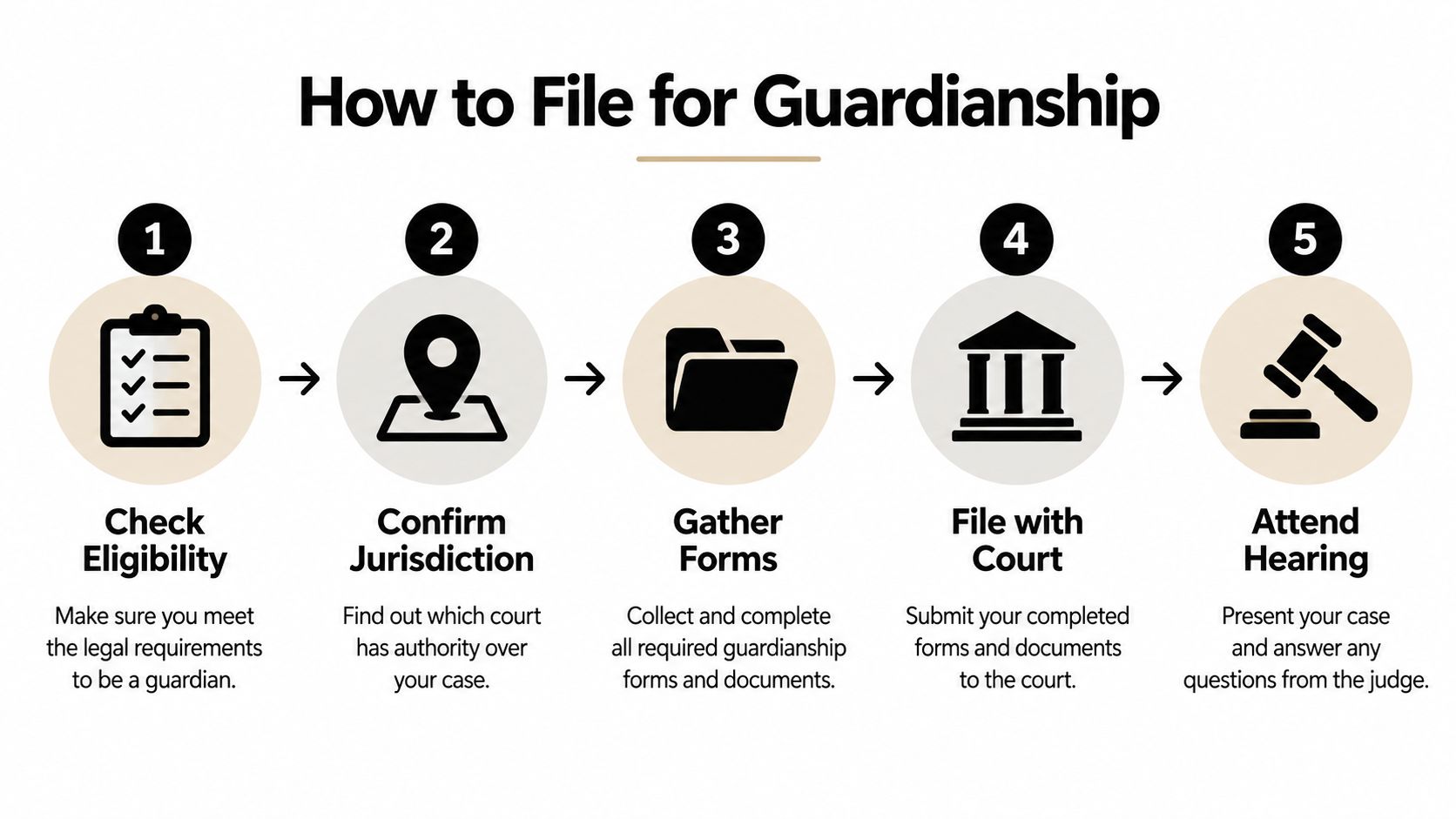
Once the family identifies guardianship as the appropriate remedy, preparation should proceed in a deliberate order. Court requirements vary by jurisdiction, so use the forms, filing instructions, and service rules for the court with authority over the child.
Start with eligibility and jurisdiction
First, confirm who may apply, what type of guardianship is available, and which court handles the matter. A court may need authority over the child, the people involved, or the subject of the application. Don't assume that the court closest to your home is automatically the correct venue.
Next, gather the child's identifying information, current living arrangements, existing parenting or custody orders, and the legal names and addresses of every person who may need notice. In British Columbia, the practical guidance identifies parents and each adult with whom the child usually resides as people who must be served with notice. Other jurisdictions may use different rules, so verify the local requirement.
Build the application around facts
The petition or application should explain the relationship, the child's living arrangements, the care the stepparent provides, the authority requested, and why that authority serves the child's best interests. Attach dated records where the rules permit attachments, and keep conclusions separate from observable facts.
If a parent can't be located, document search efforts carefully. Keep copies of returned mail, address checks, messages, and other permitted efforts. A claim that the parent is “absent” is not the same as proof that the court's notice requirements have been satisfied.
File and serve correctly
After filing, follow the court's instructions for service, response deadlines, declarations, and hearing materials. Defective service can delay a matter or force the court to reschedule it. Confirm whether service must be completed by a sheriff, process server, another adult, or a method approved by the court.
Don't confuse guardianship paperwork with adoption paperwork. California Courts explain that stepparent adoption ordinarily requires the other parent's written consent unless an exception applies, including death, waiver, inability to locate the parent after documented search efforts, or a court order ending parental rights. The California Courts stepparent adoption guidance is specific to that process and shouldn't be used as a substitute for local guardianship instructions.
Before submitting anything, use a filing checklist similar to the one described in this guide to filing custody papers. Check names, addresses, case numbers, attachments, service documents, and requested relief. If the situation involves contested parental rights, relocation, safety allegations, or an existing order, jurisdiction-specific legal advice is especially important.
What Courts Evaluate and How to Prove It
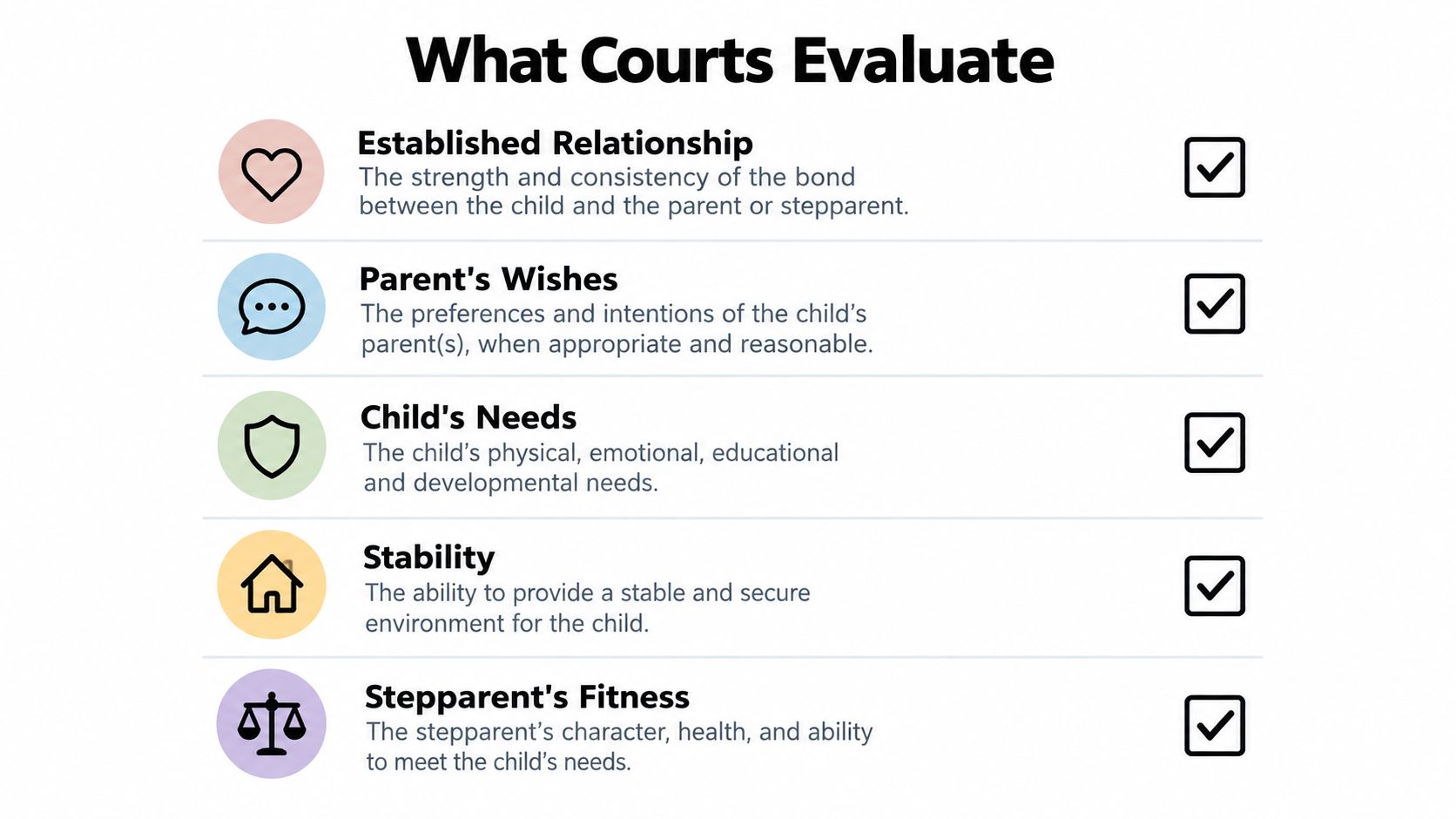
A judge usually needs more than a description of a loving relationship. The court must connect the requested order to the child's welfare, the legal parents' rights, and the practical realities of daily life.
The established relationship
Show how the relationship operates in ordinary life. School attendance records, appointment confirmations, activity schedules, teacher communications, and dated caregiving notes can demonstrate involvement without relying on emotional labels.
A useful record identifies the date, the child's need, what the stepparent did, and the result. “Took child to appointment” is clearer than “I am the only responsible adult.”
Stability and living arrangements
The court may need to understand where the child lives, who provides routine care, and whether the proposed arrangement is workable. Records can include school enrollment information, calendars, childcare arrangements, and evidence of consistent routines. Avoid turning this into a character attack on another adult. Explain the child's circumstances instead.
Family structures differ. Research using Current Population Survey data found that nearly 1 in 10 U.S. children lived with a stepparent in both 2010 and 2016. In 2016, 55% of children in stepfamilies lived with a biological parent and that parent's spouse, while 45% lived with a biological parent and a cohabiting partner. These figures show that courts and families encounter multiple household arrangements, not one standard model. The National Center for Family and Marriage Research family profile provides the underlying demographic context.
Decision-making and relationships with legal parents
State precisely what authority you need. If the issue is education, identify the decisions that cannot currently be made. If it's healthcare, describe the consent barrier. If it concerns daily care, explain why existing arrangements don't provide reliable authority.
The court may also consider the effect of the request on the child's relationship with each legal parent. A strong application doesn't ask the judge to accept broad conclusions about an absent or nonpaying parent. It presents dated facts, explains the practical consequences, and addresses whether narrower orders could protect the child's interests.
Evidence is strongest when another person could verify it without needing to adopt your interpretation.
Keep the child's needs at the center. School reports, medical records, activity schedules, and neutral statements from professionals may help, subject to local rules on admissibility and privacy. A guide to what judges look for in child custody matters can help you organize questions for a lawyer, but it can't replace the legal test used by the court in your jurisdiction.
Organizing Records Proof and Daily Caregiving Notes
Good records don't need dramatic language. They need dates, times, specific events, and supporting documents. Start a separate entry for each meaningful event rather than keeping one long narrative that mixes school, medical care, exchanges, expenses, and disagreements.

Use neutral wording. “At 8:10 a.m., I took Sam to the dental appointment listed in the calendar” is more useful than “I had to rescue the situation again.” Record what you saw, what you did, what was agreed, and what happened next. Save the original message, receipt, photograph, or appointment confirmation beside the entry.
A simple record structure
Create categories that match the issues a court may need to understand:
- Caregiving: School drop-offs, pickups, meals, homework, appointments, and activities.
- Health and education: Appointment dates, school communications, consent requests, and attendance.
- Agreements and exchanges: The agreed plan, the actual handover, delays, cancellations, and any practical effect on the child.
- Expenses: What was purchased, who paid, whether repayment was requested, and what remains unresolved.
- Relationship evidence: Routine activities and consistent involvement, recorded without exaggeration.
Preserve edit history. If you correct an entry, keep the earlier version and note the correction. Don't delete an inconvenient fact because it complicates your preferred argument. A complete record is more credible than a polished record that appears selective.
Casewell is one private record-keeping option. It organizes entries by child and category, stores attachments beside events, tracks exchanges and expenses, preserves entry history, and exports focused PDF reports for professional review. It is designed as a private journal rather than a shared messaging platform, so review its privacy and storage choices before deciding whether it fits your needs.
A focused export should answer a lawyer's question without forcing them to sort through every family message. Select the relevant date range, include the supporting documents, and keep a copy of what you provided.
For a practical demonstration of structured documentation, review the following video after setting up your own categories and timeline.
Don't record secretly where local law prohibits it, and don't pressure the child to create evidence. The safest approach is to document your own observations and preserve ordinary records created by schools, healthcare providers, and service providers.
Timelines Pitfalls and Your Next Move Forward
Guardianship matters rarely move according to the family's preferred schedule. Timing can depend on the court's calendar, whether every person was served correctly, whether someone files an objection, whether the court requests more information, and whether an existing order affects the application.
The absence of a parent or missed financial support doesn't automatically decide the case. Courts generally need jurisdiction-specific findings tied to the child's best interests, parental responsibility, and procedural fairness. A strong application therefore avoids treating nonpayment or limited contact as a shortcut to guardianship.
Common reasons an application loses momentum
- Overbroad relief: Asking for every possible power without explaining the specific need can make a narrower order appear more appropriate.
- Weak chronology: General statements about years of care are harder to evaluate than dated examples tied to the child's needs.
- Defective service: Missing a required parent or resident adult, using the wrong method, or failing to file proof can delay the hearing.
- Unproven search efforts: Saying that someone cannot be found isn't enough where the law requires documented attempts to locate and notify them.
- Confused objectives: Guardianship may not be the right route if the family seeks permanent adoption or continued contact after separation.
No reliable government or court-validated global success rate exists for stepparent guardianship or adoption applications. Don't rely on a privately advertised percentage as a neutral prediction of your own outcome.
Before meeting a lawyer, prepare a concise packet:
- The child's current living arrangement and caregiving schedule.
- Existing orders, agreements, and relevant court documents.
- A dated timeline of care, decision-making barriers, and important events.
- The specific authority you need and why narrower options don't solve the problem.
- The names and addresses needed for notice and service.
- Questions about consent, objection, search efforts, and the evidence allowed in your court.
If your records show a stable relationship but the requested powers are too broad, narrow the application. If the facts are important but scattered, organize them before filing. If a parent's rights may be permanently affected, pause and obtain jurisdiction-specific advice rather than treating a standard form as enough.
The work you've already done as a caregiver matters. The next step is to translate that work into a lawful request supported by dated, factual records.
Casewell helps stepparents keep private, dated records of caregiving, exchanges, agreements, expenses, screenshots, receipts, and supporting files, then export focused PDF reports for a lawyer or mediator. Visit Casewell to organize the facts behind your step parent guardianship decision before you speak with counsel.