 Casewell
If your child missed a dose, give it as soon as you remember, unless the next dose is nearly due. Never give two doses at once to catch up, and call the prescriber or pharmacist if you are unsure. Then write down what happened, because with two homes the record answers the question that comes next: who gave what, and when. A dated, factual log is also what keeps a missed dose a medical question instead of an argument. We built Casewell for that second part, so the entry takes a minute and reads as neutral later.
TL;DR
- Give a forgotten dose as soon as you remember. If the next dose is almost due, skip the missed one. Never double up.
- Timing rules differ by medicine and dosing schedule. If you are unsure whether to give or skip, call the child’s doctor or pharmacist.
- Call 911 for a child who is hard to wake, struggling to breathe or having a seizure. Poison Control is 1-800-222-1222, free, 24 hours a day.
- When a dose is missed in the other parent’s care, stick to facts: date, time, medicine, what you were told, what you did.
- A same-day log with a handover note makes the pattern, or the lack of one, easy to see.
Table of Contents
- What to do right away when a dose is missed
- How the safe answer changes with the medicine and the delay
- When to call, and whom
- When the dose was missed in the other parent’s care
- Why a log matters between two homes
- What to put in the entry
- Where Casewell fits
- Our perspective
- FAQ
- Sources
What to do right away when a dose is missed
The general rule from pediatric sources is consistent. HealthyChildren.org, the American Academy of Pediatrics’ parent site, says to give a forgotten dose as soon as possible, give the next dose at the correct time, and never give two doses at once or extra doses without speaking with the doctor. If you are unsure, check with the doctor or pharmacist.
Children’s Healthcare of Atlanta’s medicine safety sheet puts it in the same two steps: give the dose when you remember, but if it is almost time for the next one, skip the missed dose. It also says never to give two doses at the same time. Nemours KidsHealth repeats the point that a double dose is never the way to catch up.
In practice, that gives you a short sequence:
- Find out what was last given. Check the bottle, the written schedule, or ask the other parent. Do not guess.
- Look at the clock. How late is the dose, and when is the next one due?
- Decide give or skip. If it is only a little late, give it. If the next dose is close, skip it and return to the normal schedule.
- Call if unsure. The pharmacist who filled the prescription can usually answer within minutes, and the prescriber’s after-hours line can too.
- Write it down. Do this while the details are fresh.
How the safe answer changes with the medicine and the delay
There is no single number of hours that fits every drug. The label or the pharmacist’s instructions for that prescription come first. To show how much the answer depends on the schedule, here are the rules in Children’s Wisconsin’s teaching sheet on missed doses of cancer medicine:
| Dosing schedule | Give the missed dose if | Skip it if |
|---|---|---|
| Once a day | Less than 12 hours late | More than 12 hours late |
| Twice a day | Less than 6 hours late | More than 6 hours late |
| Three times a day | Less than 3 hours late | More than 3 hours late |
| Four times a day | Less than 2 hours late | More than 2 hours late |
| Every 2 to 4 hours | Not applicable | More than 2 hours late |
Those figures come from an oncology sheet, so treat them as an illustration of the logic: the more often a medicine is given, the shorter the window. Your child’s own prescription may follow a different rule. The same sheet says to return to the usual schedule and never double up. For cancer or pain-management medicine, it says to call the oncology provider, who may change how or how long the medicine is taken.
Two habits help whatever the medicine:
- Keep the pharmacist’s missed-dose instruction for each prescription where both homes can see it. Take a photo of the leaflet.
- Ask the prescriber at the next visit which of your child’s medicines are the ones that should never be skipped, and write the answer into the shared schedule.
When to call, and whom
Match the call to the situation.
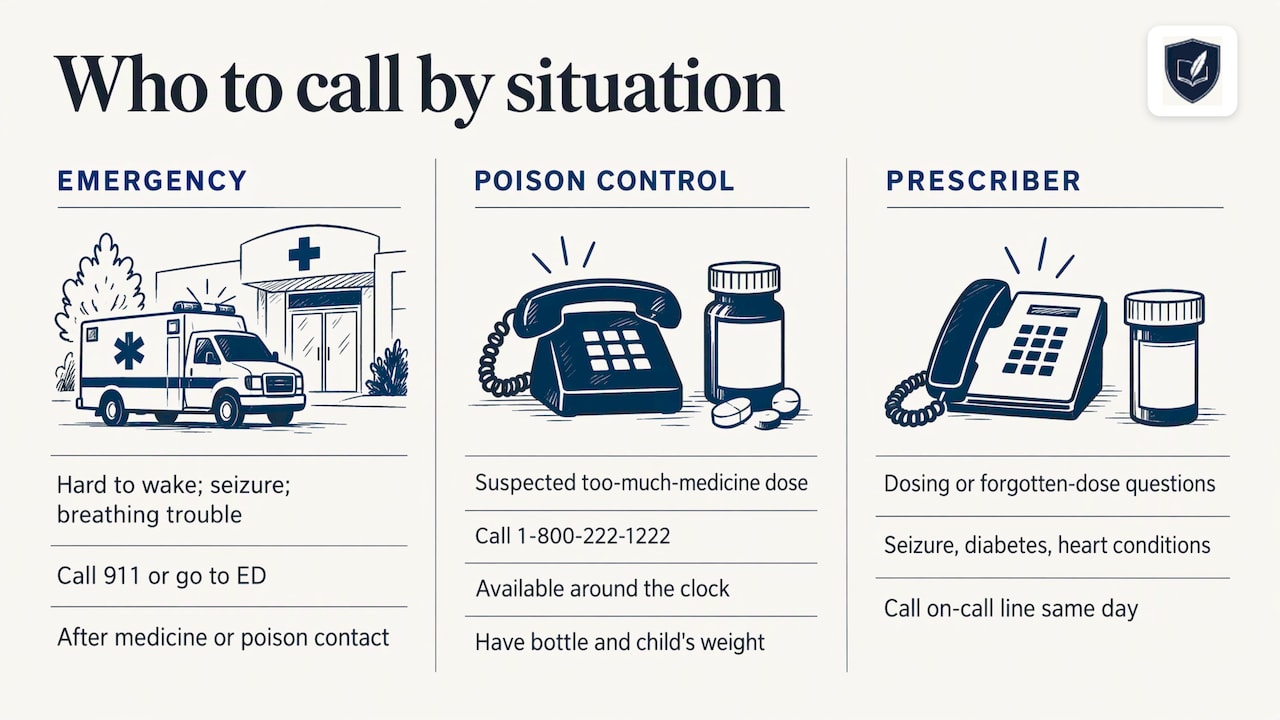
Call 911 or go to the emergency department if your child is hard to wake, not breathing normally, having a seizure, or showing other worrisome symptoms after medicine or possible poison contact. HealthyChildren.org lists unconsciousness, not breathing and seizures as reasons to call 911.
Call Poison Control at 1-800-222-1222 if you think your child got too much medicine, for example two doses in a short time because both parents gave one. The line is staffed around the clock, and CHOA’s sheet directs parents there if a child takes too much. Have the bottle and your child’s weight ready. When two doses may have been given, do not spend the time arguing over who did it. Call first and sort out the record afterward.
Call the prescriber or pharmacist for dosing questions, or when you are unsure whether to give or skip a forgotten dose. If the medicine was prescribed for seizures, diabetes, a heart condition or another condition where the doctor has said not to miss doses, call the prescriber’s on-call line that same day instead of waiting.
This article is general information, not medical advice for your child’s particular drug. Your child’s doctor or pharmacist has the final word on any specific medicine.
When the dose was missed in the other parent’s care
This is the situation that makes a medication slip harder than it should be. You do not know exactly what happened. The other parent may not respond, or may respond defensively. Your job at the handover is to protect your child’s health first and the record second.
At the handover
Ask a plain, closed question: “When was the last dose given, and what time is the next one due?” Compare the answer with the bottle and the schedule. If the child came back without medicine that was supposed to travel with them, say so in writing and describe what you did about the next dose.
A good handover message is short. A sample co-parenting plan from Luce Family Law shows the kind of language parents agree to: each parent cooperates in exchanging prescription medication and prescribed medical devices, and notifies the other immediately of any serious medical condition or emergency that arises during their time. If your own parenting plan has similar language, quote its section number in your message instead of characterizing the other parent’s behavior.
Messages that stay neutral
Compare two versions of the same message.
- Heated: “You obviously didn’t give her medicine again. You never take this seriously.”
- Neutral: “Sam’s 8 a.m. dose was not given today. When was the last dose given? I gave the dose at 6 p.m. per the pharmacist’s instructions and will give the usual dose tomorrow at 8.”
The second version states what happened, what you did and what you need. It will read the same way to a mediator or a judge a year from now. If your first draft sounds like the first version, that is normal when you are worried. In Casewell, the optional AI rewrite can turn a draft into neutral language, and you approve every word before it is saved.
What not to do
Do not withhold the child’s next dose or the medicine itself as leverage. Do not give an extra dose to make up for a gap. Do not diagnose motive in writing. If a pattern worries you, record the facts and raise it with the child’s doctor and, if needed, with your attorney.
Why a log matters between two homes
Courts look at patterns, not single incidents. One missed dose is a medical question. Several, documented over weeks with dates and times, can become a legal one. A Texas family law firm’s explanation says that skipping prescribed medication becomes a legal issue once there is a pattern, and that a dated log and written communications can support a request to modify medical decision-making rights under Texas law. It advises keeping a same-day log of dates, times, what happened, and what the child, a teacher or the pediatrician said. Laws differ by state, so ask a family law attorney in your state what applies to you.
Medication is also a recognized point of friction. Nebraska’s court system lists administration of medications among the issues addressed through parenting coordination in high-conflict custody cases, in its Judicial District 2 procedures manual. Whether or not your case ever gets that far, the practical benefit is the same: when you can show when each dose was given, the discussion stays about your child.
What to put in the entry
Keep every entry factual and the same shape each time:
- Date and time of the missed or late dose, and when you wrote the entry.
- Medicine, strength and scheduled time, copied from the label.
- What you know and how you know it: “Child told me,” “bottle was full,” “other parent texted at 7:42 p.m.”
- What you did: whom you called, what the pharmacist or doctor said, whether you gave or skipped the dose.
- Child’s condition: acting normally, symptoms, anything you watched for.
- Communication: what you asked the other parent and when, with the reply or the absence of one.
Leave out opinions, sarcasm and guesses about intent. If something is unknown, write “unknown.” Screenshots of messages and a photo of the bottle with the pharmacy label belong with the entry.
The same habit works with babies and toddlers. Parents who track feeds and other routines can borrow the approach from this three-day feeding log, where short, timed entries make patterns visible.
A shared schedule and a handover note
Prevention is easier than documentation. Agree on one written schedule that both homes follow: each medicine, strength and dose, times, food instructions, the missed-dose rule from the pharmacist and who to call. Add a two-line handover note whenever the child moves: the time of the last dose, whether the next one is due before or after the next handover, and how much is left. A missed or vomited dose goes in that note too. Vomited doses deserve a call before any re-dosing, since extra doses of fever medicine can be harmful. The pharmacist or Poison Control can say whether and when it is safe to give more.
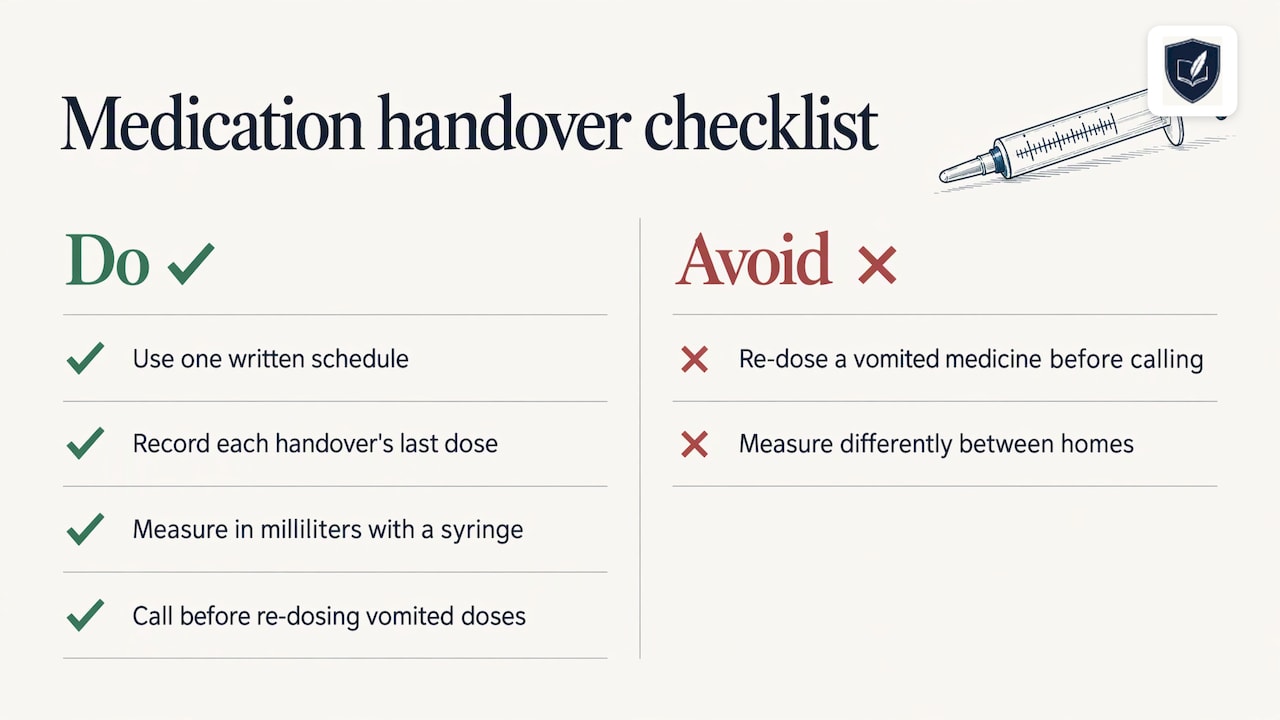
About the child’s own part: the AAP says a metric-dosing policy was reaffirmed in May 2025, and it reports that more than 70,000 children visit U.S. emergency departments every year because of unintentional medication overdoses. It recommends dosing in milliliters with an oral syringe. Writing the dose in milliliters in the shared schedule keeps both homes measuring the same way.
Where Casewell fits
A missed dose is exactly the kind of event that gets lost in text threads. Our app is a digital custody journal where you log exchanges, messages, expenses and parenting time in one place, and it prompts you after each exchange or handover so you can note medication while you remember it. The timeline updates as you add entries. The AI-assisted rewrite, which is optional and approved by you, helps turn a frustrated draft into neutral wording. Records are stored encrypted on your device, and we do not keep copies on company servers.
When you need to share the history, Casewell creates filterable, indexed, court-ready PDFs you can export for legal review. For a single dated event, such as a missed handover, our guide to documenting missed handovers shows the same fact-first approach. If you want a wider view, read our piece on documenting a high-conflict co-parent without becoming one and the parenting time log page.
Casewell Premium costs $2.99 per week or $49.99 per year, and it starts with a free trial. If you need a finished chronology of events for a hearing, our Court timeline service starts from £29 one-off. You can start on the Casewell home page.

Our perspective
Most parents we talk to about medication in two homes are not trying to build a case. They are trying to answer one question at 8 p.m.: did she get it or not?
We think the answer should live in a record that both reads calmly and cannot be rewritten later. A dated entry made the same day, with the facts and nothing else, protects your child first, because the next adult to give a dose knows what came before. It protects you second, because a pattern, or the absence of one, is visible without a single accusation.
That is why Casewell is private by design: your records are encrypted on your own device, not copied to our servers. It is why the AI rewrite is optional and always yours to approve. And it is why the prompts come right after the handover, when the details are still fresh. The goal is a journal that helps you stay the calm parent in every message you send.
Mielad
FAQ
Should I give a double dose if my child missed one?
No. HealthyChildren.org, CHOA and Nemours all say never to give two doses at once to catch up. Give the missed dose when you remember if the next one is not almost due, or skip it and return to the usual schedule. If you are unsure which applies, call the doctor or pharmacist.
What if I cannot tell whether my child already took the dose?
Do not give another dose on a guess, especially for fever medicine such as acetaminophen or ibuprofen. Call the pharmacist, or Poison Control at 1-800-222-1222 if two doses may have been given. For medicines the prescriber said never to miss, such as seizure medicine, call the prescriber that same day.
What should I write down about a missed dose?
Write the date, time, medicine, what the label says, what you were told and by whom, what you did and how your child was afterward. Keep opinions out. Add screenshots of any messages and a photo of the label.
How do I raise it with the other parent without a fight?
Ask for the facts in a short written message: when the last dose was given and what is due next. Say what you did and what you will do next. If your parenting plan covers medication, refer to that section rather than to the other parent’s character.
Can a log help in court?
A consistent, dated log can show a pattern over time, which is what courts weigh. Rules differ by state, so ask a family law attorney in your state how the records would be used in your case.
Sources
- Medication Safety Tips for Families, HealthyChildren.org
- Safety with medicines, Children’s Healthcare of Atlanta
- Medicines: Using Them Safely, Nemours KidsHealth
- What To Do If My Child Misses a Dose of Cancer Medicine, Children’s Wisconsin
- Co-Parenting Disputes in Texas: What Matters in Court, Ashmore Law Firm
- Sample Co-Parenting Plan, Luce Family Law
- Judicial District 2 Parenting Coordination Recommended Procedures Manual, Nebraska Judicial Branch
- 3 Day Feeding Log for New Parents