
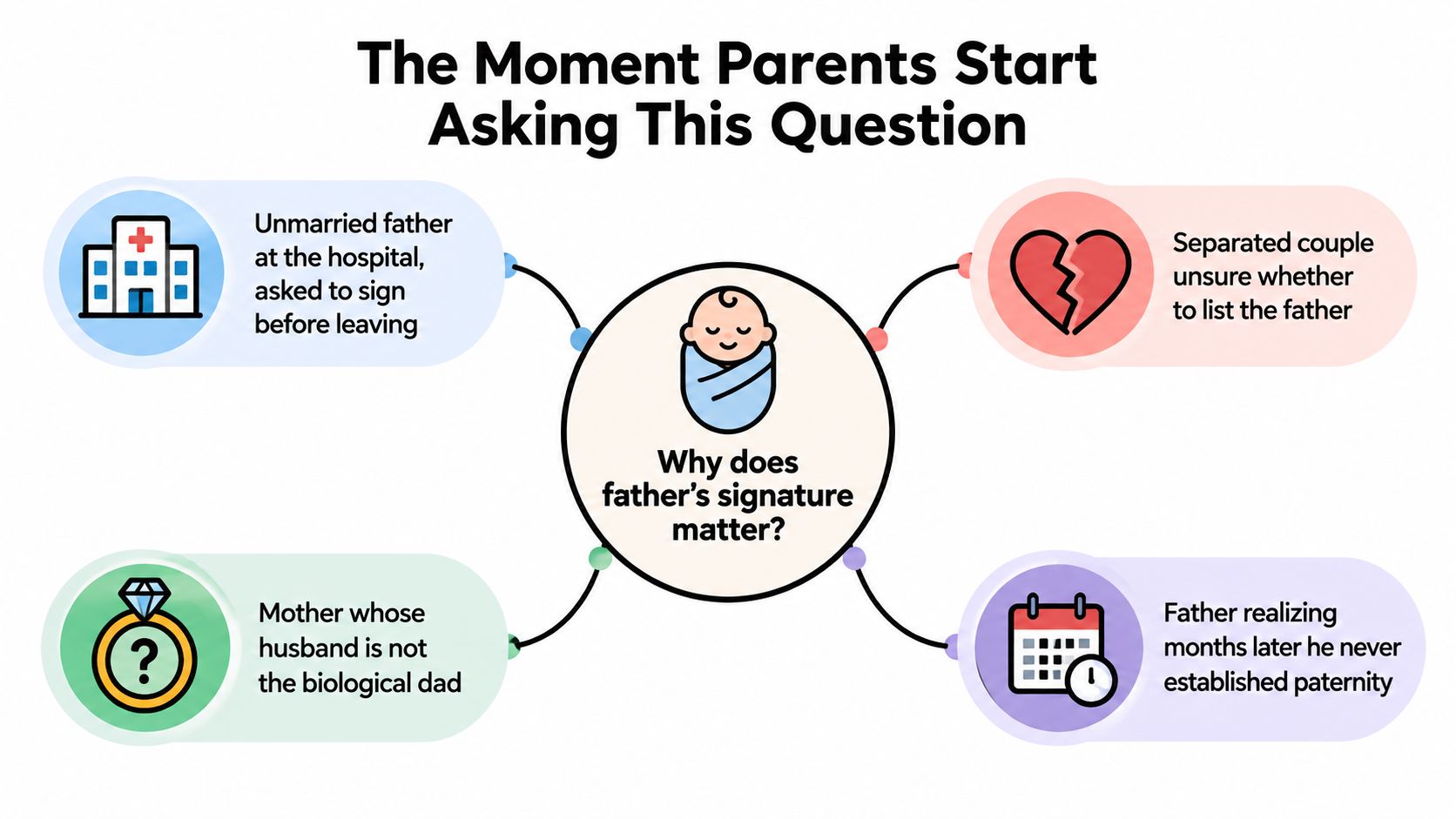
You're at the hospital with a newborn, and someone has placed a form in front of you. Perhaps you're an unmarried father deciding whether to sign, a separated couple unsure whether the father should be listed, or a mother whose husband isn't the biological father. You may also be a father hesitating because you're worried that a signature will create long-term support or custody obligations.
The question “does father have to sign birth certificate” hides three different legal questions:
- Does he need to sign the birth certificate itself?
- Does he need to sign a separate voluntary acknowledgment of paternity?
- Has he been legally recognized as the father through an acknowledgment, marriage-based presumption, or court order?
Those actions can involve different forms, legal effects, and deadlines. A hospital may present the signature as routine paperwork, but its meaning depends heavily on the parents' marital status and the law of the place where the child was born.
The Moment Parents Start Asking This Question
The immediate answer is often simpler than the legal answer. In many jurisdictions, an unmarried father's name won't be added to the birth certificate unless both parents complete a voluntary paternity acknowledgment or another required legal process. Signing the birth certificate and establishing legal paternity may be related, but they aren't always the same act.
Three acts that are easy to confuse
Signing the birth certificate places information in the official birth record. It may help identify the father, but the legal effect varies by jurisdiction and marital status.
Signing a separate voluntary acknowledgment of paternity is a formal legal declaration. In many systems, this is the document that establishes the father-child relationship for legal purposes, rather than the birth certificate signature alone.
Being legally recognized as the father by court order happens when a court determines parentage, often after a petition, genetic testing, or a dispute. A court order may be necessary when the parents don't cooperate or when another person is presumed to be the legal father.
Practical rule: Before signing, ask the hospital staff whether the document is the birth certificate, a voluntary acknowledgment of paternity, or both.
The distinction matters because legal fatherhood can affect custody, child support, inheritance, and medical decision-making. In Massachusetts, for example, both parents can sign a parentage form at the hospital, and the other parent's name is added to the birth certificate once the required signatures are notarized. Florida likewise explains that the legal father's name appears when the acknowledgment is completed and recorded. The Massachusetts parentage guidance illustrates why a signature may be treated as a formal legal step rather than simple hospital administration.
What Signing the Birth Certificate Actually Means
A birth certificate is a vital record. It documents the child's birth and records parentage information, but the hospital usually isn't deciding disputed legal parentage. That decision may come from a marital presumption, a properly filed acknowledgment, or a court order.
The same signature can therefore have different consequences for married and unmarried parents.
Married parents and unmarried parents
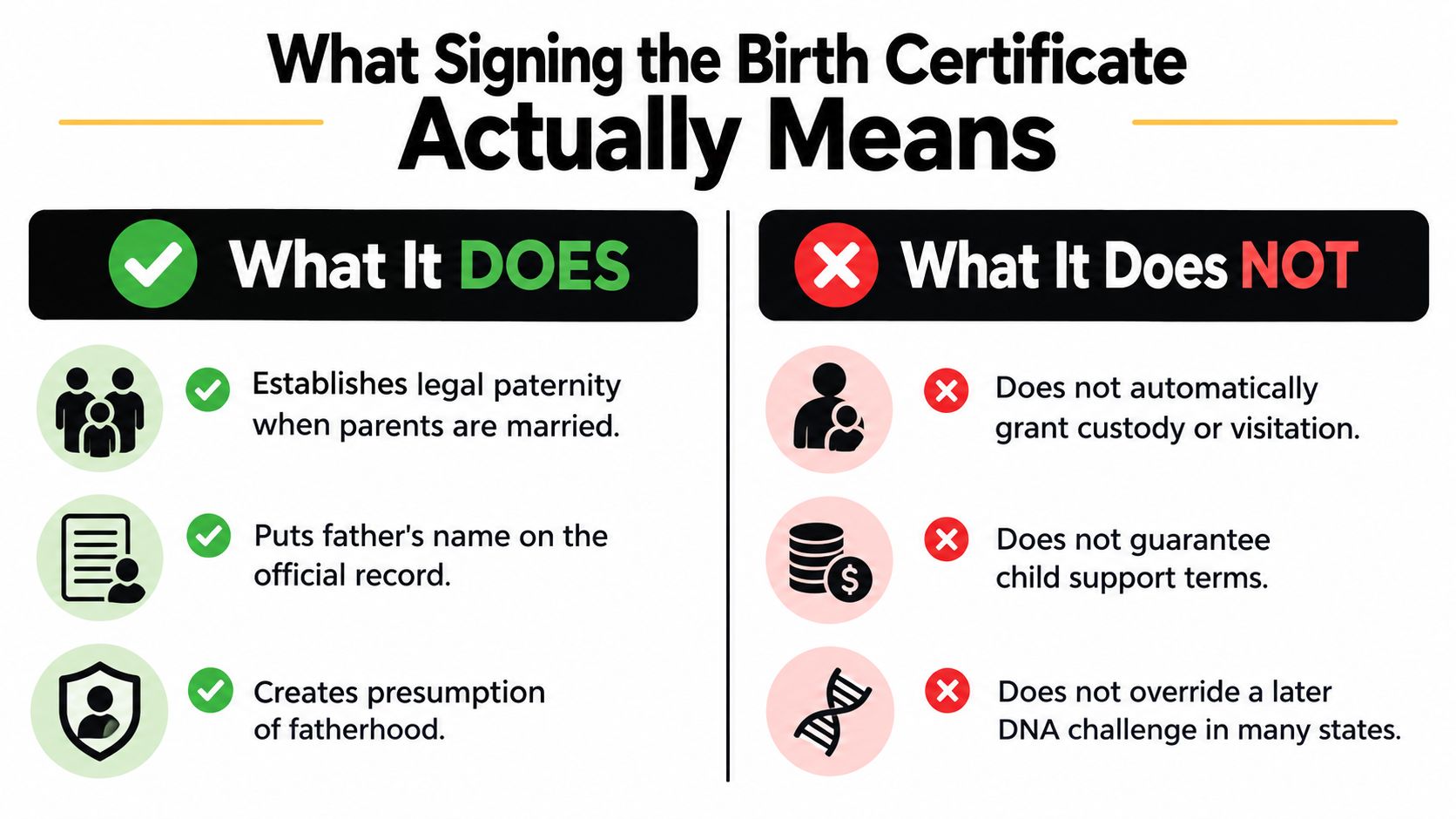
When the mother and father are married, the law in many jurisdictions presumes that the husband is the legal father. The father's name may be recorded through the ordinary birth-registration process, and his signature can operate within that existing legal presumption.
For unmarried parents, the father's signature on the birth certificate may not be enough. Some jurisdictions require both parents to sign a separate acknowledgment of paternity or affidavit. Arkansas guidance expressly warns that signing only the birth certificate, without the separate paternity affidavit, doesn't establish paternity. That separation is also reflected in the Arkansas paternity information.
What the certificate does and doesn't prove
Being named on the certificate can be important, but it isn't a universal substitute for establishing paternity. In some places, the certificate is evidence of parentage. In others, the separate acknowledgment is what creates the enforceable legal relationship.
That's why an unmarried father shouldn't assume that signing at the hospital automatically gives him custody or visitation rights. Legal fatherhood may provide standing to ask a court for parenting orders, but a parenting schedule usually requires a separate agreement or court decision.
The safest question isn't only, “Can I sign?” Ask instead: “What legal document am I signing, and does it establish paternity where this child was born?”
The Legal Effects of Establishing Paternity
A properly signed paternity acknowledgment can have the force of a court determination. New York guidance states that a voluntary acknowledgment has the same force and effect as a court order determining legal fatherhood and creates child-support duties. That means the acknowledgment can open legal rights while also creating enforceable responsibilities.
Pennsylvania guidance describes a 60-day rescission window for undoing the acknowledgment. After that period, removing the father's name generally requires a court order based on grounds such as fraud or duress. The exact procedure varies, so parents should treat the deadline as urgent rather than assume a later correction will be simple. The New York acknowledgment guidance explains the court-order effect and support consequences.
| Area | Effect of Established Paternity |
|---|---|
| Child support | The father may become legally responsible for financial support, subject to the applicable support process. |
| Custody and parenting time | The father may gain standing to seek custody or visitation, but establishment alone doesn't guarantee a particular schedule. |
| Inheritance | The legal relationship can support inheritance rights between the child and father. |
| Medical information | Legal parentage can help establish access to relevant medical history and decision-making rights, subject to local rules. |
| Birth record | The father may qualify to be recorded on the birth certificate through the required filing process. |
| Challenges | A short rescission period may apply, followed by a more difficult court-based challenge process. |
The effects work in both directions. A father may gain the ability to request parenting time and participate in important decisions, while the child gains a legally recognized parent and potential support rights. At the same time, the father may acquire support obligations that exist even if the parents don't live together.
For a practical discussion of the separate issues involved in parenting rights, review this guide to fathers' parenting rights. It's important to separate legal paternity from the final custody arrangement. The first establishes the relationship. The second addresses what parenting time and decision-making will look like.
Alternative Paths to Legal Fatherhood
The hospital isn't the only place where a father can establish legal parentage. The appropriate route depends on cooperation, timing, and whether someone disputes biological or legal fatherhood.
Voluntary acknowledgment
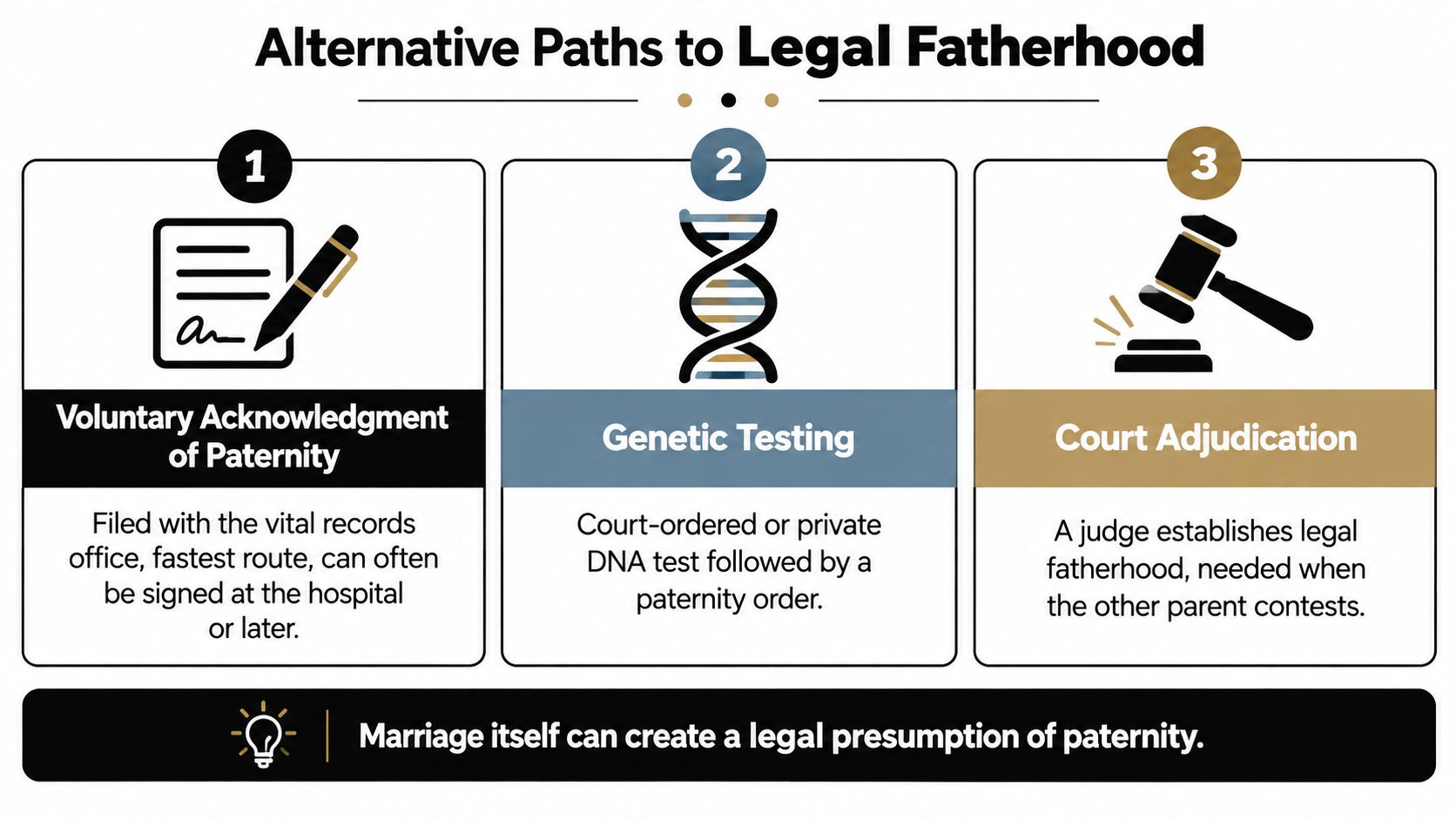
A voluntary acknowledgment is usually the most direct option when both parents agree. It may be signed at the hospital or later through the state's vital records or child-support agency. The document generally requires correct signatures, formal witnessing or notarization, and filing with the appropriate registry.
A parent may be able to complete the acknowledgment after leaving the hospital and, in some jurisdictions, even years after the birth while the child is still a minor. The legal deadline, filing method, and rescission rules are state-specific.
Court determination
A court case becomes more likely when the mother won't sign, another man is presumed to be the father, or the father needs an enforceable determination. A judge may require service of legal papers, a hearing, and genetic evidence before entering a paternity order.
This route is heavier and less predictable than a cooperative acknowledgment, but it may be necessary when the family can't complete the form voluntarily.
Genetic testing
Genetic testing can provide evidence for either a voluntary resolution or a court case. A private test may help parents decide what to do, but a court may require a properly administered test before relying on the result. Testing doesn't itself replace the legal filing that establishes fatherhood.
A father who lives separately from the mother may complete paperwork through a vital records office or another authorized agency, but the parents should confirm whether separate notarization or coordinated filing is required. Keep copies of every signed form, confirmation, and amended certificate request. If parenting disputes later arise, dated records can help organize the facts for a lawyer or mediator. A private record such as Casewell's co-parenting documentation guide can help parents understand what information to preserve, although it doesn't establish paternity or replace legal advice.
How Jurisdictions Treat the Signature Differently
There isn't one universal answer to whether a father must sign the birth certificate. In many U.S. jurisdictions, an unmarried father's name is added only after both parents complete a voluntary acknowledgment or another accepted process. Massachusetts and Florida provide examples of systems that connect the father's listing with completion and filing of a parentage acknowledgment.
England and Wales use a different framework. An unmarried father historically hasn't had a general right to enter his name on the register alone. He's typically included when both parents jointly sign or when accepted documentary proof of paternity is produced. Being named on the birth certificate is prima facie evidence, meaning it can support a conclusion of paternity without necessarily being conclusive proof.
That distinction explains why two systems may both require a father's involvement but attach different legal weight to the record. A U.S. acknowledgment may become equivalent to a court determination after the applicable challenge period. In England and Wales, the birth register may be important evidence while parental responsibility and other rights can depend on additional legal steps. These principles are discussed in the legal history of parentage registration in England and Wales.
| Jurisdiction | Effect of Father Signing at Birth | Treats Acknowledgment As | Rescission / Challenge Window |
|---|---|---|---|
| Many U.S. jurisdictions | May add the father to the record when the required parentage form is completed and filed | Often equivalent to a court determination after the applicable period | State-specific, with an early rescission period and later court challenge |
| Massachusetts | Parentage form can be signed at the hospital, with notarized signatures required for the other parent's name to be added | Formal establishment of parentage through the filed form | Governed by Massachusetts procedure |
| Florida | The legal father's name appears when the acknowledgment is completed and recorded | Formal acknowledgment of legal fatherhood | Governed by Florida procedure |
| England and Wales | Joint signature or documentary evidence may be required for an unmarried father's entry | Birth registration is prima facie evidence rather than automatically binding proof | Governed by the applicable family and registration rules |
Canada, Australia, Scotland, and Ireland also have their own rules concerning registration, presumed parentage, parental responsibility, and court orders. Families who move across borders shouldn't rely on an online post from another country. Confirm the rule where the child was born and where the record was filed, not only where either parent lives now. A jurisdiction-specific resource, such as this California co-parenting recording guide, may help with local documentation questions, but it isn't a substitute for confirming the parentage rule with the relevant authority.
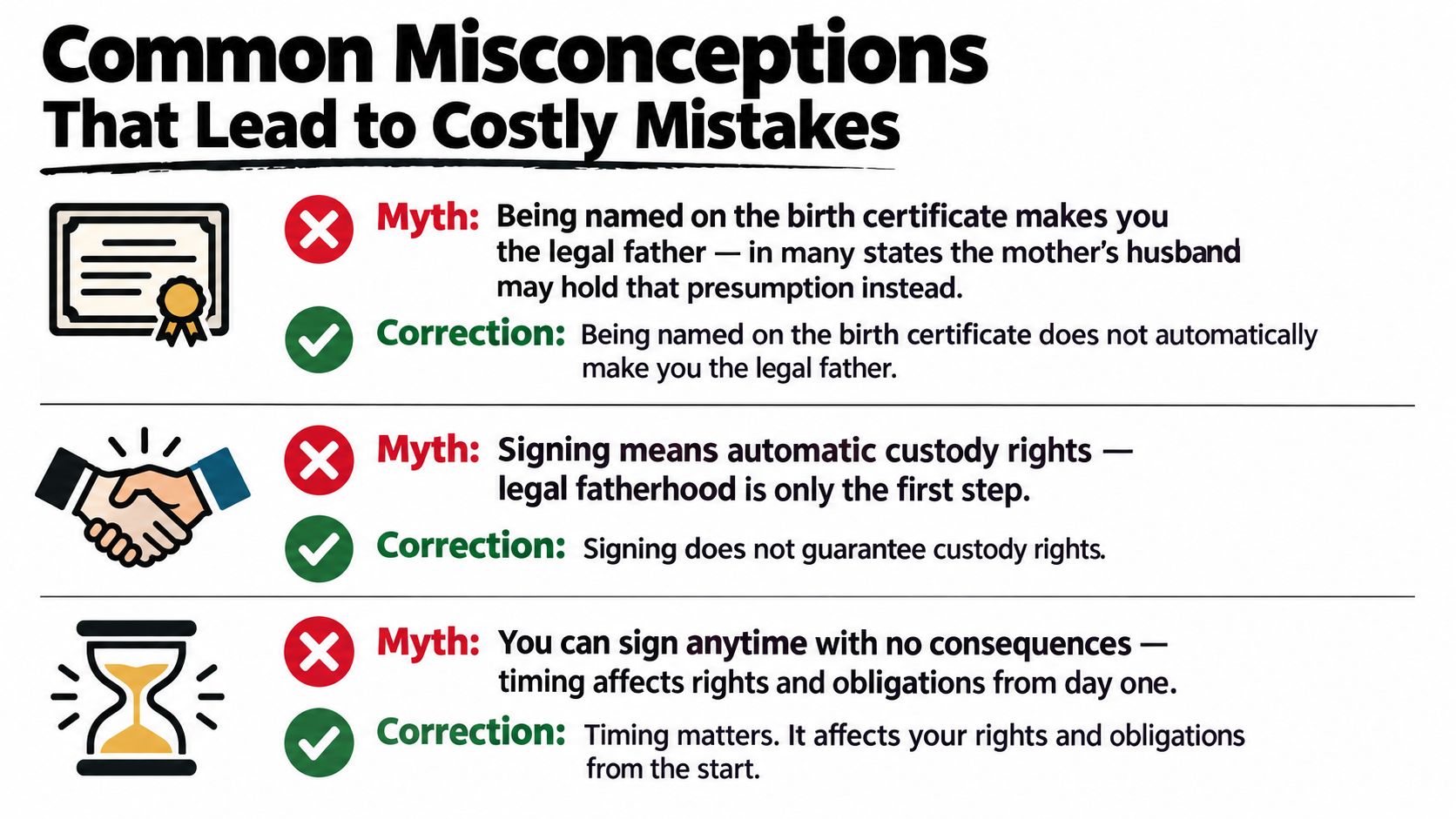
Common Misconceptions That Lead to Costly Mistakes
The most damaging errors usually happen when parents treat the birth certificate as the entire legal system. It's a record, but the legal relationship behind that record may depend on a separate acknowledgment, a marital presumption, or a court judgment.
Being named always equals legal fatherhood
A father may appear on a certificate without having every parental right available to him. In an unmarried-parent situation, the name may be recorded only after a particular form is filed, and some systems distinguish between the record and the underlying legal determination.
The reverse can also happen. A biological father may not be listed, yet he may still have a route to legal recognition through an acknowledgment or court proceeding.
Signing is only administrative
A signature can create immediate legal consequences. A valid acknowledgment may establish support duties and give the acknowledgment the effect of a court determination, while the opportunity to rescind may be limited.
A father who has doubts about biology shouldn't sign casually because the form is presented in a hospital setting. He should ask what the document does and obtain legal advice before signing if the answer isn't clear.
The mother's husband is irrelevant
A husband or former husband may matter even when everyone believes another man is the biological father. Some jurisdictions apply a marital presumption, and Connecticut materials describe situations in which a husband or ex-husband may need to participate through a notarized signature. The issue can become especially complicated when a child is born within the statutory period after a marriage ends.
The Connecticut child-support parentage booklet shows why parents should disclose marital history when completing parentage paperwork. Don't assume that the biological father, mother, and hospital can resolve the issue without addressing a presumed father's legal status.
Next Steps Based on Your Situation
Start with the facts that change the legal analysis. Don't decide based only on whether the father's name appears on the hospital form.
If the parents are married
Ask whether the husband is presumed to be the legal father and whether the birth record correctly identifies both parents. Review the certificate for spelling, dates, and parent information before requesting a correction. If another man may be the biological father, speak with a family-law attorney before anyone signs an acknowledgment.
If the parents aren't married and agree
Ask the hospital or the state vital records office for the voluntary acknowledgment of paternity, not just the birth certificate paperwork. Confirm whether signatures must be notarized, where the form is filed, and how the father's name will be added to the record.
Keep the filed copy and any receipt. A completed form that never reaches the registry may not produce the result the parents expected.
If the father has doubts
Pause before signing. Genetic testing may answer the biological question, but the legal question still requires the correct acknowledgment or court process. Since rescission can be time-limited and later challenges may require proof of fraud, duress, or another legally recognized ground, get advice before making a formal declaration.
If the parents live apart or disagree
The father may need to file a paternity petition, respond to an existing case, or address a presumed father's status. Gather identification, hospital paperwork, existing birth records, prior court orders, child-support notices, and relevant correspondence.
Establishing paternity doesn't guarantee custody or a particular parenting schedule. It can, however, create the legal basis to seek orders about parenting time and decision-making. For preparation, this guide to what judges look for in child custody cases can help explain why organized, factual records matter.
If you've already signed and want to reverse the acknowledgment, act quickly. Identify the date of signing, the agency that filed it, and the deadline for rescission in the child's place of birth. If that period has passed, consult a family-law attorney about the available court process rather than trying to correct the birth certificate informally.
Casewell offers a private custody journal for dated co-parenting notes, agreements, expenses, exchange check-ins, and attached proof, with focused PDF exports for professional review. If establishing paternity leads to parenting-time or documentation disputes, visit Casewell to keep the relevant records organized and under your control.